Lessons · Lesson 3 of 3
Cuttable width, splices, and the metres the store actually issued
Reconcile a marker efficiency against the cloth the store really issued, price a mill's width tolerance, and see why one line in a buyer's fabric manual can be worth more than every point of efficiency in the marker room.
Lesson 3 of 3 · 30 min
Two complaints, one cause
The width on a mill's invoice is not the width a cutting room can use. The woven edges have to come off. The cloth wanders slightly as it is spread. And the sales contract usually lets the mill deliver narrower than the quoted figure. So a plan can be built for cloth that never arrives. This lesson follows the gap between the cloth a plan promises and the cloth a store hands out.
It is 4 August, and two people are unhappy about the stripe colourway of MP-4417.
The fabric store reports that the stripe is running 18.6% over its booking, with 1,100 pieces still to cut. The store thinks the marker room over-promised.
The cutting master has been asked to raise his efficiency. He says he cannot, because the largest loss on his floor is not inside the marker at all. He is right. And he cannot prove it, because nobody measures the thing he is pointing at.
Both complaints have the same cause. It is one sentence in Marlow and Pike's fabric manual, signed off by a merchandiser in February with no number beside it.
Cuttable width is a measured quantity, not a quotation
Behera Mills sells this twill as 150 cm. Amreya makes its markers at 146.
nominal width                              150.0 cm
selvedge, 1.5 cm each side                  -3.0
edge waviness and spreader tracking         -1.0
cuttable width                             146.0 cm
The selvedge is the woven edge that held the cloth on the loom. On this fabric it carries a denser weave, and a line of pin holes from the finishing machine. It is not garment cloth. The extra centimetre covers the fact that a spread ply never lies perfectly straight. The cloth wanders a few millimetres across a 10 m lay. A marker planned to the last millimetre of usable width will put an edge piece off the cloth somewhere in the lay.
That is only the first half. The second half is on the sales contract, and it is where the money is:
Width: 150 cm, tolerance plus or minus 2%.
Plus or minus 2% means 147.0 to 153.0 cm. The mill is entitled to ship anywhere in that band. At the bottom of the band, cuttable width is 143.0 cm — not 146. A marker made for 146 cm is physically too wide for that cloth. The outermost pieces run into the selvedge, and the cutting master finds out on ply 30.
Mark to the minimum, or band the rolls
There are two honest answers to a width tolerance, and one dishonest one. The dishonest one is to mark at 146 and hope.
Answer one: mark everything at the contractual minimum. At 143.0 cm cuttable, the 6-garment marker stretches from 10.68 m to 10.90 m. That is 1.817 m a garment instead of 1.780. On the 16,800 solid pieces it is 621.6 m of marker, and 652.7 m of purchased cloth once the 5.0% cutting allowance goes on top. At USD 3.85 a metre, that is USD 2,513 of extra cloth. It is an insurance premium, paid on every metre, whether the cloth is narrow or not.
Answer two: band the rolls by width, the way you already band them by shade. Amreya measured all 300 ecru rolls at goods-in:
| Cuttable width | Rolls | Share |
|---|---|---|
| 146.0 cm and over | 231 | 77.0% |
| 144.0 to 145.9 cm | 51 | 17.0% |
| 143.0 to 143.9 cm | 18 | 6.0% |
| Total | 300 | 100.0% |
Band them, and the penalty applies to 23.0% of the cloth instead of all of it. That is roughly USD 578 rather than USD 2,513, against the cost of one more marker file and two more sets of lays. Banding wins here, and it will usually win. But notice that it is not free either. Every extra band is another sub-lot, and lesson 2 already showed what an extra set of lays costs in ends.
The splice, and the sentence in the fabric manual
A splice is what a spreader does when a roll runs out in the middle of a ply. Instead of throwing the part-laid ply away, he stops at a splice line — a line drawn on the marker where no major piece crosses. He overlaps the new roll by enough to cover the join, and carries on. The overlap on this style is about 0.70 m of cloth per roll change.
The alternative is to end the ply where the roll ends, and throw away what has been laid. Rolls arrive at about 60 m, and a roll ends at a random point in a ply. So the average discard is half a ply.
That is the whole difference, and it is enormous.
stripe marker 11.90 m, plus 0.04 m of ends = 11.94 m a ply
roll changes across the stripe colourway  = 9,552 ÷ 60 = 159
spliced:      159 × 0.70 =   111 m
not spliced:  159 × 5.97 =   950 m
839 m. USD 3,608. Nobody costed it, because it sits in nobody's territory: not in the marker, not in the cost sheet, not in anybody's job description. It sits in the buyer's fabric manual, clause 6.4: no splices are permitted within a garment panel on yarn-dyed, matched or directional fabrics. On a matched stripe that is a reasonable rule — a splice inside a front panel can shift the repeat. It was signed off in February, in a batch of twenty other clauses.
It became negotiable the moment somebody put 839 m beside it. On 14 August, Marlow and Pike agreed to splices placed on a repeat boundary and outside the fronts. That is exactly what a competent marker room would have proposed in February.
Where the metres actually went
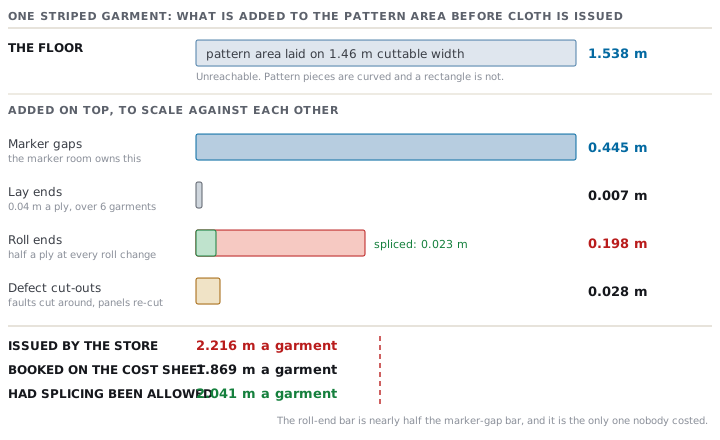
| Step | Metres a garment | What it is |
|---|---|---|
| Pattern area on this width | 1.538 | The floor. Only reachable if pattern pieces were rectangles |
| Marker at 77.5% | 1.983 | The gaps between pieces |
| Lay ends, 0.04 m a ply | 1.990 | What the spreader clamps and cuts against |
| Roll ends, not spliced | 2.188 | Half a ply discarded at every roll change |
| Defect cut-outs, 1.4% | 2.216 | Faults cut around, panels re-cut |
| Booked on the cost sheet | 1.869 |
The number the marker room is judged on is 77.5%. The number the cloth actually achieved is:
true utilisation = pattern area ÷ cloth issued
(4,800 × 2.245) ÷ (10,636 × 1.46) = 69.4%
The ecru colourway was cut on the small markers of lesson 2 and spliced normally. It ran at 80.2% against a marker figure of 82.7%. The stripe ran at 69.4% against 77.5%. The gap between the CAD screen and the cloth is 2.5 points on the ecru, and 8.1 points on the stripe. The difference between those two gaps is entirely clause 6.4.
The finding worth taking to the next order
Put the splice policy and the marker choice into the same table, and something changes shape.
| Splicing allowed | No splicing | |
|---|---|---|
| 6 garments in the marker, 77.5% | 2.041 | 2.216 |
| 3 garments in the marker, 74.0% | 2.144 | 2.229 |
| Gained by the longer marker | 0.103 | 0.013 |
With splicing, moving from a 3-garment marker to a 6-garment marker saves 0.103 m a garment. Without splicing it saves 0.013 m — one eighth as much.
Here is the reason. The discard at a roll change is half a ply, and a ply is as long as the marker. Make the marker longer and two things grow at almost exactly the same rate: the marker's efficiency, and the roll-end discard. Under a no-splice rule the two effects very nearly cancel out. Every point the marker room fights for is handed back at the roll change.
So the order of operations is fixed, and it is the opposite of the order most factories work in: settle the splice rule first, then argue about points. A merchandiser who spends a week negotiating three points of efficiency, on a fabric that may not be spliced, has negotiated almost nothing.
The order, reconciled
| Colourway | Pieces | Booked | Issued | Difference |
|---|---|---|---|---|
| Ecru | 9,600 | 17,942 m | 18,417 m | 475 m over |
| Olive | 7,200 | 13,457 m | 13,188 m | 269 m under |
| Stripe | 4,800 | 8,971 m | 10,636 m | 1,665 m over |
| Total | 21,600 | 40,370 m | 42,241 m | 1,871 m over |
At USD 3.85 for the solids and USD 4.30 for the stripe, the overrun is USD 7,953. That is 28.8% of the order's whole margin of USD 27,648. Not one dollar of it appears on a cost sheet, a purchase order or an invoice. It becomes visible only when somebody divides the metres the store issued by the garments the cutting room produced.
Olive is the control. Olive was cut to the plan, on 6-garment markers, spliced normally. It came in 269 m under its booking. That tells you the 5.0% allowance was never the problem.
Check yourselfA buyer forbids splices on a directional print. Your marker is 9.60 m for 6 garments, rolls average 55 m, and you are cutting 7,000 pieces. What is the roll-end loss, and what would you ask the buyer for?Show the answer
Cloth on the table is 7,000 ÷ 6 = 1,167 plies at 9.60 + 0.04 = 9.64 m, which is 11,250 m. So there are about 11,250 ÷ 55 = 205 roll changes. Without splicing, each one discards half a ply, 9.64 ÷ 2 = 4.82 m. That is 988 m — 8.8% of the cloth, and 0.141 m a garment. Ask for splices permitted on a print repeat boundary and outside the front panels. That is the version a buyer can say yes to, and it takes the loss down to 205 × 0.70 = 144 m. Ask before the cost sheet is signed. If the answer is no, put the 988 m into the cost sheet — instead of into the argument you will have in August.
Prompt · Price a width tolerance and a splice rule before you sign them
The week a fabric contract or a buyer's fabric manual is in front of you, and every clause in it looks like somebody else's problem.
Act as a fabric technologist and a cutting-room manager at the same time, and disagree with yourself where the two roles would. I am about to sign a fabric contract and a buyer's fabric manual, and I want the clauses in them converted into money before I do. Fabric facts: [CONSTRUCTION], [WEIGHT], nominal width [CM], declared tolerance [GIVE THE CLAUSE VERBATIM], selvedge [CM EACH SIDE] if known, average roll length [METRES], price [AMOUNT] a metre, mill [NAME OR NOT KNOWN]. Order facts: [QTY] pieces, marker length [METRES] for [NUMBER] garments, end allowance per ply [METRES], working ply height [NUMBER], expected defect rate [PERCENT] or the four-point score if I have it, shade groups expected [NUMBER]. Manual clauses to price: [PASTE THE SPLICE CLAUSE, THE SHADE-BANDING CLAUSE, ANY MATCHING REQUIREMENT, AND ANYTHING ABOUT ROLL ALLOCATION]. Do the following. First, turn the width tolerance into a minimum cuttable width and tell me what marking at that width costs against marking at nominal, on this order, in dollars. Second, compare it with width-banding the rolls: what share of the cloth would carry the penalty, and what does banding cost me in extra sub-lots, lays and ends. Third, price the splice clause: roll changes across the order, the loss per change if I may splice against half a ply if I may not, in metres and dollars. Fourth, tell me whether a longer marker is still worth pursuing under that splice clause, and show the gain with and without splicing side by side. Fifth, build me a per-garment reconciliation from pattern area to metres issued, naming every step, and give me the true utilisation as a percentage beside the marker efficiency. Sixth, write the three lines I should add to the fabric purchase order and the cutting order so this is measurable next season, and draft the one paragraph I would send the buyer asking for a splice rule they can actually say yes to.
AI can make mistakes — check anything you act on.