Lessons · Lesson 3 of 3
Turning it into a costable brief
Assemble the minimum set of facts a price needs, record every assumption honestly, and hand the cost sheet a brief instead of a guess.
Lesson 3 of 3 · 28 min
Wednesday, 16:00 — what you actually have
Between the brand's specification and the price sits a document most factories never produce. It is one page. It lists every fact the price depends on. Each fact is either sourced from somebody who knows, or marked openly as an assumption. Writing it takes very little time, and it changes what a quotation is. What quietly eats a margin is never the assumption you declared. It is the three you made without noticing.
The buyer answered six of the nine questions. Industrial engineering has a predicted bulletin from the proto. The mill quoted fleece at USD 7.20 a kilo landed, dyed, on a 320 gsm finished specification. The wash unit ran three garments and gave you a rate and a shrinkage figure. Tomorrow you build the price.
So there is one more document between the pack and the cost sheet, and most factories do not produce it. Call it the costable brief: every fact a price needs, each one either sourced or marked as an assumption. It takes twenty minutes to write. It is the difference between a quotation you can defend line by line and a number you will spend the season explaining.
The minimum set of facts
A price cannot be built from fewer than these. If a row is empty, you are not costing — you are estimating, which is a different activity with a different name on the email.
| What the price needs | NK-2214 | Where it came from |
|---|---|---|
| Garment, construction, closure | Men's pullover hooded sweatshirt, set-in sleeve, two-panel hood | Pack, confirmed question 5 |
| Fabric specification | 100% cotton brushed-back fleece, 320 gsm finished pre-wash, 20s face and 10s ply back, open width 180 cm usable | Pack plus buyer answer 1 and 2 |
| Fabric rate and basis | USD 7.20 a kg, landed, dyed, nominal weight invoicing | Mill quotation, valid 30 days |
| Rib specification | 2x1 rib, 97/3 cotton and elastane, tubular, cuff 8 cm and hem 6 cm | Pack plus buyer answer 4 |
| Consumption basis | Marker from the proto pattern, size ratio 1:2:3:2:1 across S to XXL | Sample room, laid Tuesday |
| Shrinkage allowance | 6.2 percent length, 4.1 percent width after wash | Wash unit trial on three garments |
| Operation bulletin and SAM | Predicted bulletin, 24 operations | Industrial engineering, from the proto |
| Machines required | One coverstitch tipping operation the factory does not own | Line supervisor |
| Decoration | Chest print, 240 mm, 3 colours plus white underbase on two grounds, printed before wash | ASSUMPTION — question 6 unanswered |
| Wet processing | Single enzyme wash with silicone softener, 40 minutes, 40 pieces a load | Wash unit trial and quotation |
| Trims list | 11 lines, each with a placement, a consumption and a colour | Pack BOM, plus labelling manual v9 received Wednesday |
| Nominations and testing | No nominated trim supplier; EN 1811 nickel test on aglets and eyelets at our cost | Buyer answer 8 |
| Quality standard | AQL 2.5 major, 4.0 minor, buyer-appointed third party, our cost | Buyer answer 9 |
| Tolerances | Our proposed table, six points, sent with the quotation | ASSUMPTION — buyer did not object |
| Quantity and split | 18,000 pieces, three colours at 6,000, five sizes | Pack cover |
| Packing | Solid colour, solid size, 20 pieces a carton, recycled LDPE polybag | ASSUMPTION — question 9 partly answered |
| Commercial terms | FOB Alexandria, on board 2 October, no agent commission | Enquiry email |
Three rows in that table say ASSUMPTION. That is a good outcome — not because assumptions are good, but because three named assumptions are manageable and eleven silent ones are not.
Recording an assumption honestly
An assumption is not a guess. A guess is a number you cannot explain. An assumption is a number you can explain, with the cost of being wrong written next to it. Four columns turn one into the other.
| Line | What we assumed | Basis | If wrong, per piece | If wrong, on 18,000 |
|---|---|---|---|---|
| 3 colours plus underbase, before wash, 5 screens | Our own two dark grounds; standard practice on fleece | plus USD 0.13 if a discharge print or a sixth screen is required | USD 2,340 | |
| Tolerances | Our table, six points at plus or minus 1.0 to 1.5 cm | Achievable on washed fleece in this factory | Not a cost — a rejection risk on the whole lot | Held shipment |
| Packing | 20 pieces a carton, solid colour solid size | Buyer's previous season | plus 8 percent on every per-carton logistics figure at 18 pieces | Roughly USD 900 |
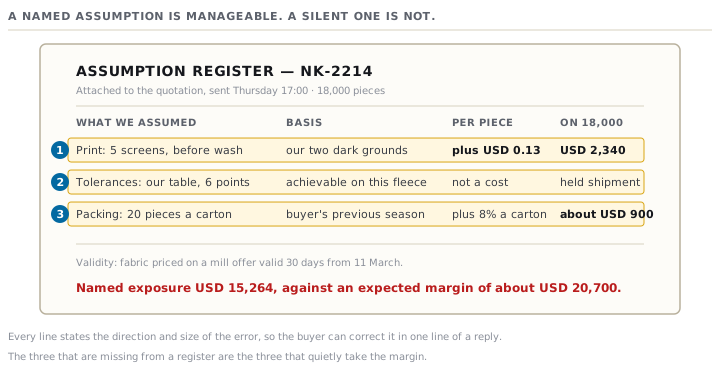
Three rules make an assumption register worth writing.
- It goes on the face of the quotation, numbered, not in a file on your desk. An assumption the buyer never saw is not an assumption, it is your problem.
- It states the direction and size of the error. "Print assumed at 5 screens" tells a buyer nothing. "Print assumed at 5 screens; a discharge print adds USD 0.13 a piece" tells them exactly what to correct if they care. They usually do.
- It carries a validity. Fabric quoted on a mill offer valid 30 days is not a price you can hold until December. Saying so on Thursday is a normal commercial statement. Saying so in November is a renegotiation.
The four days, spent properly
- Monday. Read the pack twice, build the gap list, send the nine questions with a Wednesday midday deadline. Release the flats to the pattern room and IE the same afternoon.
- Tuesday. Marker laid from the proto pattern. Fabric enquiry to two mills with a full specification, not a fabrication summary. Three garments to the wash unit. Trim enquiries out with placements and colours attached.
- Wednesday. Answers land. Bulletin back from IE. Wash rate and shrinkage back. Close the costable brief and mark every remaining hole as an assumption with a number beside it.
- Thursday. Build the cost sheet, review it against the brief, attach the assumption register and the tolerance table, and send by 17:00.
Notice what is not in that list: waiting. The factory does not sit still until the buyer replies. The fabric enquiry, the marker and the wash trial do not depend on the answers. The questions and the work run side by side, and that is the only reason four days is enough.
Check yourselfYour manager says: 'Stop asking questions, just quote it, we will sort out the details after we win it.' How do you answer?Show the answer
Quote it — and quote it with the register attached, because the two are not in conflict. What he is objecting to is the delay, not the discipline. So price every open point at the assumption you can defend, put the assumptions on the face of the quotation with their per-piece impact, and send on time. What that buys you is the ability to re-open exactly three lines later, as variations, instead of discovering in production that the whole price was built on a wash recipe nobody had seen. A quotation with three numbered assumptions is not slower than one without. It is the same quotation, with the losses named while they can still be recovered.
What happens on Thursday
You now have a brief. It has a fabric with a rate and a basis, a consumption basis, a bulletin, and a wash rate and a load size. It has a trim list with consumptions, a quality standard, packing, and an incoterm with a named port and a date. Every hole in it has a name and a number.
Turning that into a fabric line, a making cost, an overhead charge and an FOB price is a separate craft with its own arithmetic. That arithmetic is the marker and the wastage policy. It is SAM, the minute rate and efficiency. It is trims by consumption and rate. It is overhead charged against a capacity you have actually sold, and commission grossed up rather than added on. That is course 8.1, Garment Costing. Take this brief with you into it. The sheet is only ever as honest as the brief behind it.
Prompt · Attack my assumption register
The hour before a quotation goes out, when everything looks complete.
You are a costing auditor who has seen factories lose a season's profit on an assumption nobody wrote down. Below is the brief behind a quotation I am about to send.

Facts I have sourced: [list each fact and where it came from - mill quotation, wash trial, IE bulletin, buyer reply, pack page]
Assumptions I am carrying: [list each one, its basis, and the per-piece impact if it is wrong]
Order: [pieces, colours, incoterm, named port, ship date]
Quotation validity I intend to state: [days]

Do four things. One: find the assumptions I am making that are NOT on my list - the ones I have not noticed I am making, especially around fabric weight basis, shrinkage, pieces per load in wet processing, screens and underbase, pieces per carton, and who pays for testing and inspection. Two: for every assumption, sourced or not, tell me whether the error runs in my favour or against me, because the ones that only run against me are the ones that get chosen. Three: total the downside if every assumption on this sheet turns out to be the expensive version, and express it as a percentage of the margin I expect on this order. Four: rewrite my assumptions as numbered lines fit to print on the face of a quotation - each one stating what was assumed, what it costs if corrected, and how long the price is valid. Be specific and use my numbers.
AI can make mistakes — check anything you act on.