Lessons · Lesson 2 of 3
What is always missing, and the questions that get answered
Find the five gaps every tech pack has, price the exposure of each, and write the one message that gets them answered before the deadline.
Lesson 2 of 3 · 32 min
Tuesday, 08:00 — the gap list
A specification can be entirely competent and still be impossible to price. A few things are missing from almost every one ever written. They are missing for an honest reason: a pack describes a garment, and a price describes a job. The gaps are the same handful every time. All of them move the price against the person quoting. This lesson names them, and gets them answered in one message.
You read NK-2214 yesterday. Nothing in it is wrong. It is a competent pack from a competent buyer, and it still cannot be priced as it stands, because five things are missing that are missing from almost every pack that has ever landed on a merchandiser's desk.
They are missing for an honest reason. A tech pack is written by a designer and a technologist describing a garment. A price describes a job: a specific fabric on a specific machine, a specific recipe in a specific wash unit, a specific number of screens. The pack was never meant to carry those, and waiting for a pack that does is waiting for something that will not arrive.
The five gaps, and what each one costs
| Gap | What the pack says | What it does not say | If you guess wrong |
|---|---|---|---|
| Fabric named but not specced | "100% cotton brushed-back fleece, 320 gsm" | Yarn count and ply, knit construction, open width or tubular, finish, whether 320 gsm is pre-wash or post-wash | 0.040 kg a piece between 300 and 320 gsm — USD 0.29 a piece, USD 5,184 on this order |
| A trim with no supplier | "Drawcord, 8 mm flat cotton, 130 cm, metal aglets, antique brass" | Nominated supplier or free source, trim card reference, nickel release requirement | Antique brass aglets run 0.018 to 0.041 a set, and EN 1811 nickel testing is USD 180 a submission |
| Measurements with no tolerance | 18 points, base size L, grade rules stated | Tolerance on 6 of the 18 points, and whether the spec is measured before or after garment wash | Not a cost line — a rejection line. An 18,000-piece lot held at final inspection |
| Artwork with no placement | "Chest print, 3 colours, 240 mm wide" | Placement measured from HPS, ink system, underbase on dark grounds, printed before or after wash | 3 screens against 5 — USD 0.13 a piece, USD 2,340 on this order |
| A wash with no standard | "Garment wash, soft hand feel" | Recipe, reference garment, shrinkage limits, hand-feel standard, load size | Enzyme softener at USD 0.35 against a stone and enzyme vintage wash at USD 0.78 — USD 7,740 on this order |
Add the last column and it is USD 15,264 of exposure on a quotation you have not written yet. On an order of this size that is most of the margin. And every one of those numbers moves in the same direction: against you. Nobody guesses the expensive option when they are trying to win an order.
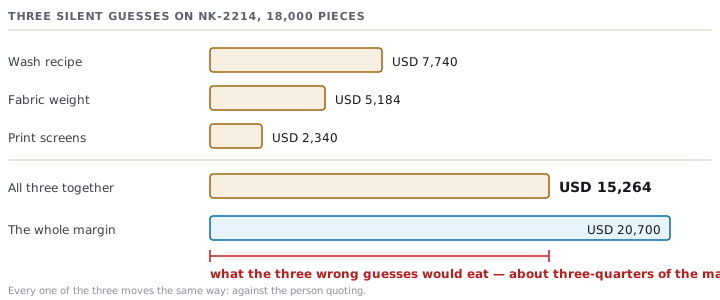
The tolerance question is different from the other four
Four of the five gaps are money. The tolerance gap is a dispute waiting to happen, and it is the one merchandisers skip because it has no line on the cost sheet.
| Point of measure | Base size L | Buyer's tolerance | What we proposed | Why |
|---|---|---|---|---|
| Chest, 2.5 cm below armhole, half | 60.0 cm | not stated | plus or minus 1.5 cm | Washed fleece relaxes unevenly across a lot; 1.0 cm is not achievable after a tumble |
| Body length from HPS | 71.0 cm | not stated | plus or minus 1.5 cm | Length is where a garment wash moves most |
| Sleeve length from centre back | 88.5 cm | plus or minus 1.0 cm | plus or minus 1.5 cm | Raglan-free set-in sleeve on washed fleece; 1.0 cm forces a re-measure of every carton |
| Across shoulder | 50.0 cm | plus or minus 0.5 cm | plus or minus 1.0 cm | 0.5 cm on a shoulder seam in fleece is a sampling tolerance, not a bulk one |
| Hood height | 36.0 cm | not stated | plus or minus 1.0 cm | Two-panel and three-panel hoods behave differently here |
| Cuff opening relaxed, half | 11.0 cm | plus or minus 0.5 cm | plus or minus 0.5 cm | Rib holds it. Accepted as written |
| Hem opening relaxed, half | 43.0 cm | not stated | plus or minus 1.0 cm | Rib plus a washed body; the two do not shrink together |
Send that table with the quotation. A tolerance you proposed and the buyer did not object to is a very different conversation at final inspection from a tolerance nobody ever wrote down.
The message that gets answered
Nine questions, one message, one deadline. Not nine messages over three days, and not a phone call that leaves no record.
Subject: NK-2214 hooded sweatshirt — nine points to confirm before we price, answers needed Wednesday 12:00 Cairo time.
Opening paragraph: "Thank you for NK-2214. We are building the price for Thursday 17:00 as requested. Below are the points the pack does not settle. Where we do not hear back by Wednesday midday we will price the assumption shown, and it will appear on the face of our quotation so there is no confusion later."
- Fabric weight. The cover and the BOM say 320 gsm; the fabric page says 300 gsm and its footer reads REV B, 26 February. Please confirm which is current, and whether the figure is measured on finished fabric before garment wash or on the washed garment. Assumption if unanswered: 320 gsm on finished fabric, before wash.
- Fabric construction. Please confirm yarn count and ply, and whether a bio-polish is required. Assumption: 20s single on the face and 10s ply on the brushed back, open width at 180 cm usable, no bio-polish.
- Shrinkage after wash. Please state the maximum permitted shrinkage in length and width after the garment wash, and confirm whether the graded spec is a pre-wash or post-wash measurement. Assumption: spec is post-wash, maximum 5 percent length and 4 percent width.
- Rib. 2x1 rib, 97/3 cotton and elastane, cuff 8 cm and hem 6 cm finished. Please confirm tubular or open width, and whether the rib is washed with the body or attached after. Assumption: tubular, washed with the body.
- Hood construction. The flat sketch on page 3 shows a three-panel hood with a centre gusset; the construction callout on page 9 says two panels with a centre back seam. Please confirm which is correct. This changes the pattern and the sewing time, so we cannot assume it — this one we need answered.
- Print. Please confirm the ink system, whether a white underbase is required on Charcoal Melange and Faded Olive, and whether the print is applied before or after the garment wash. Please also send the artwork file with a placement measured from HPS at centre front. Assumption: plastisol with an underbase on the two dark grounds, printed before wash, top of print 80 mm below HPS, 240 mm wide.
- Wash. "Garment wash, soft hand feel" can be four different recipes at four different prices. Please send an approved wash standard, a reference garment, or the recipe you accepted on a previous season. Assumption: single enzyme wash with silicone softener, 40 minutes, 40 pieces a load.
- Trims and nominations. Are the drawcord, aglets and eyelets nominated, and is there a trim card we should be working to? On nickel release we will test the metal components to EN 1811 and price the testing unless your own supplier certificate covers this style.
- Labelling, tolerances and packing. The labelling page refers to your manual version 9, which is not in the pack — please send it. Six of the eighteen measurement points carry no tolerance; our proposal is attached and we will price against it unless you send yours. Packing assumption: solid colour, solid size, 20 pieces per carton, recycled LDPE polybag with the suffocation warning in German, French and English.
Four things make that message work, and none of them is the wording.
- It is one message. A buyer's merchandiser handles thirty styles. Nine questions in one email get answered in one sitting; nine emails get answered never.
- Every question carries the assumption you will use if it is not answered. This is the whole technique. Silence stops being a blocker and becomes an answer, and the risk moves from you to the person who did not reply.
- It has a deadline that is earlier than yours. Wednesday midday, not Thursday, because you still have to build the sheet.
- The questions are numbered. The reply comes back as "1 yes, 2 confirm, 3 see attached", and you can file it against the quotation.
And one thing that keeps it credible: never ask a question the pack answers. A buyer who has to point you back to page 9 stops reading your list, and question 6 is where the money was.
Check yourselfThe buyer replies to three of your nine questions and writes: 'the rest as per our standard, please proceed'. What do you do?Show the answer
You proceed, and you write down what "standard" meant. Take the six unanswered questions, restate the assumption for each in one line, and send a short confirmation: "Noted, we are pricing on the following basis" followed by the six assumptions, then price. That message is not bureaucracy — it is the only record that exists of a decision the buyer delegated to you. When the reference wash garment arrives in three weeks and it is not what you assumed, the conversation is a variation with a documented starting point rather than an argument about what "standard" meant. What you must not do is treat "as per our standard" as an answer to question 5, the hood panels. That one is not an assumption you can carry; it changes the pattern.
Prompt · Build my question list, with assumptions
Once you know what is missing and you have to get it answered before the price is due.
Act as the merchandising manager reviewing the question list I am about to send a buyer. Your job is to make it shorter, sharper and answerable in one sitting.

Style and quantity: [style, pieces, colours, ship date]
Price deadline: [date and time]
What the pack does not settle: [list every gap you have found]
What my factory can absorb without asking: [anything you are happy to decide yourself]

Produce the message I should send, in this shape. A subject line that names the style, the number of points and a reply deadline earlier than my costing deadline. One short opening paragraph stating that unanswered points will be priced at the assumption shown and that the assumption will appear on the quotation. Then a numbered list where each item is one question, in plain English, followed by the exact assumption I will use if nobody replies.

Then tell me three things separately. First, which of my questions the pack already answers, so I can delete them - a buyer who has to point me back to a page stops reading the list. Second, which questions are NOT safe to carry as an assumption because they change the pattern, the machine or the lead time, and must be answered. Third, estimate the per-piece and total cost exposure of each assumption on my order quantity, so I know which single question matters most.
AI can make mistakes — check anything you act on.