Lessons · Lesson 1 of 3
What a tech pack actually contains
Read a 22-page pack you did not write: what each section is for, who in the factory uses it, and which line of your price it decides.
Lesson 1 of 3 · 30 min

Monday, 09:20 — twenty-two pages and four days
The document a brand sends when it wants a garment priced is not one document. It is a bundle of pages written by different people at different times. They do not always agree with one another. The most useful page is the one recording what has changed and when, and it is the one everybody skips. This lesson is what each section is for, and the order in which to read them.
Nordkraft, a German high-street retailer, sends a tech pack through their Istanbul liaison office. Men's hooded sweatshirt, pullover, garment washed, 100% cotton brushed-back fleece. Three colours — Charcoal Melange, Ecru, Faded Olive — 6,000 pieces each, sizes S to XXL on a ratio of 1:2:3:2:1, FOB Alexandria, on board 2 October. Style NK-2214. The file is marked REV C, dated 11 March. Price wanted Thursday at 17:00.
Four days sounds like plenty until you count who else has to work inside them. The mill needs a day to price fleece. The wash unit will not commit a rate without seeing the fabric. Industrial engineering cannot time a bulletin from a sketch. Two of your four days belong to other people. So the first hour of the first day is the one that matters. What can you read off this pack, what must you ask for, and what will you still be assuming on Thursday at 16:55?
A tech pack is not one document. It is roughly thirteen documents bound into one file. Different people wrote them, for different readers, at different times. They do not always agree with each other.
The section map
| Section | What it is for | Who in the factory uses it | What it decides in your price |
|---|---|---|---|
| Cover and header | Identity: style number, season, buyer, garment type, fabrication summary, revision | Merchandising | Nothing directly, but it tells you which revision you are pricing |
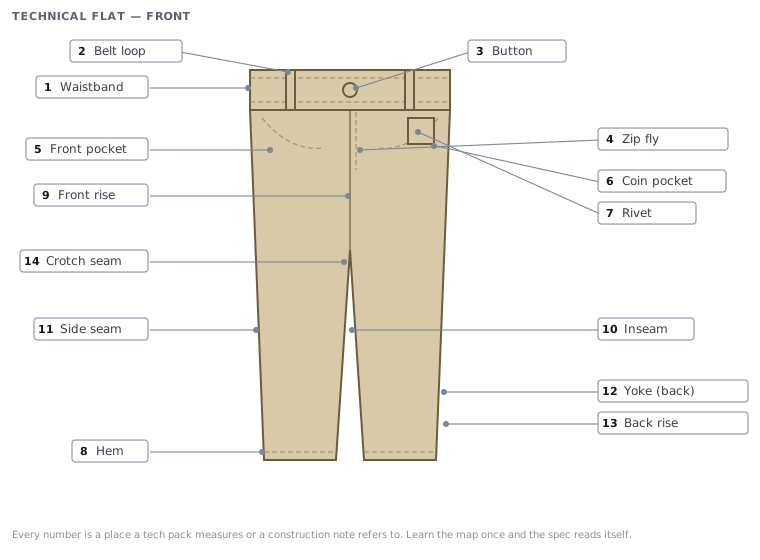
| Technical flat sketches | Front, back and side line drawings showing every seam and closure | Pattern room, industrial engineering | The operation list, and therefore the SAM |
| Construction callouts | Stitch type, SPI, seam allowance, seam finish, special operations, per area | Sewing floor, IE | Machine types you own or must subcontract |
| Colourways | Every colour with Pantone or TCX code, contrast trims, dye or print method | Dyeing, sourcing | Lab dips, minimum dye lots, dye-lot surcharges |
| How to measure | A flat with POM codes and a plain-language definition of each tape placement | Quality, pattern room | Nothing directly; it settles arguments at inspection |
| Graded spec sheet | Every point across the full size range, base size, grade rule, tolerance | Pattern room, quality | Rejection risk, and the fit sample count |
| Bill of materials | Main fabric, rib, interlining and every trim with placement, consumption, supplier, colour | Sourcing, costing | Material cost, which is most of the price |
| Artwork and graphics | Print or embroidery: file reference, version, placement, scale, colour count | Printing subcontractor | Screens, underbase, ink system, colour count |
| Labels and packaging | Main, size, care and origin labels with placement; folding, polybag, carton marking | Finishing, packing | Trim lines and the pieces-per-carton figure your logistics depend on |
| Approvals plan | Lab dips, strike-offs, trim cards, PP and TOP samples with status and date | Merchandising, sampling | Development cost and, more importantly, the calendar |
| Revision history | What changed, when, and by whom | Everyone | Whether the page you just costed from is still live |
Two of those sections are the ones people skip. Revision history is skipped because it looks like paperwork, and it is the only page that tells you whether the fabric spec you costed from was superseded three weeks ago. How to measure is skipped because the numbers are on a different page, and it is the page that decides whether the buyer's 60.0 cm chest is a half measure or a full one.
Read it in the order the work happens, not in page order
Page order is the designer's order. Your order is set by lead time and by who you have to wait for.
- Fabric first. Longest lead, biggest number, and the mill wants a full specification, not a fabrication summary. Everything else can wait a day; this cannot.
- Decoration and wash second. They are subcontracted, they have their own capacity calendar, and their price swings more than any other line on the sheet.
- Construction third. Flats plus callouts go to IE for a predicted bulletin. Without a bulletin you have no making cost, only a memory of the last hoodie.
- Trims fourth. Long list, small money, but every nominated or tested trim has a lead time that can be longer than the fabric.
- Packing and labelling last. They cost little and they change the container arithmetic completely.
Reading a spec sheet you did not write
The graded spec on page 12 lists 18 points across five sizes, base size L, with a grade rule of 2 cm on the chest and 1.5 cm on the body length. Three conventions decide whether you read it correctly. Here is the page itself, drawn as it arrives. The three badges are the three questions below — and nothing on the page answers them.
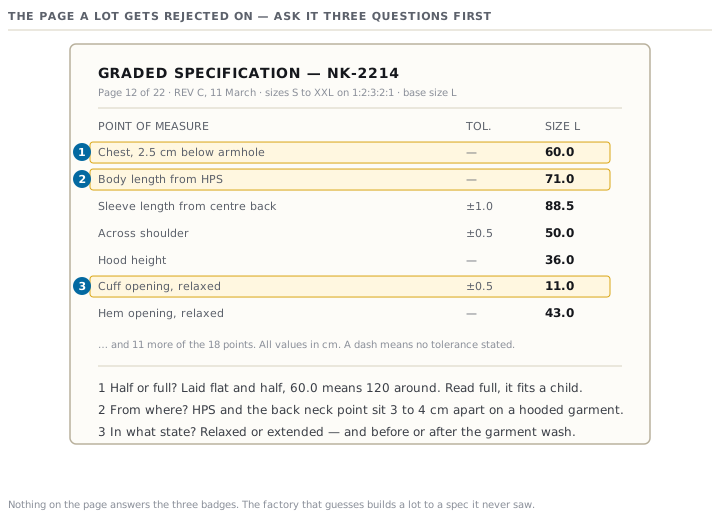
Half or full. Chest is quoted at 60.0 cm. On a men's size L that can only be a half measure, laid flat, giving 120 cm around — a relaxed modern fit. If you read it as a full circumference you have a garment for a nine-year-old. Most European packs measure knitwear flat and half; most do not say so on the page.
From where. Body length is 71.0 cm "from HPS" — the high point of the shoulder, not the centre back neck point. On a hooded garment those two are 3 to 4 cm apart, and a factory that measures from the wrong one makes an entire lot 4 cm short against a spec it believed it had met.
In what state. Cuff opening 11.0 cm relaxed, half. Rib is measured relaxed and extended, and the pack quotes one of them. A rib that meets 11.0 cm relaxed can still be rejected for recovery if extended is not specified — and on a garment-washed product, nothing on the spec sheet tells you whether the numbers are before or after the wash.
What the pack is not going to tell you
The pack tells you what the garment is. It does not tell you what it costs to make in your factory, and it is not trying to. It will not name your marker efficiency, your minute rate, your wash unit's recipe, your carton dimensions or your port. Half the work of the next two days is turning a description of a garment into a description of a job on your floor.
Check yourselfThe pack has a full graded spec with 18 points across five sizes, but no 'how to measure' page. The buyer's merchandiser says the points are standard. Can you price it?Show the answer
You can price it, because measurement definitions do not change the cost of the garment. What you cannot do is accept it silently. A missing how-to-measure page is a rejection risk parked in the buyer's favour. At final inspection their third-party inspector measures the chest their way and you measured it yours, and the difference between two tape placements on a washed fleece hoodie is easily 1 cm. Ask for the page, and if it does not exist, send your own measured photographs of the proto with each point marked and ask them to confirm in writing. That exchange costs one email now and saves a held shipment later.
Prompt · First read of a tech pack
In the first hour after a pack lands, before you send anything to anybody.
You are a senior technical merchandiser in an export garment factory. I am going to describe a tech pack that has just arrived and I have four working days to quote it. Do not reassure me and do not summarise the pack back to me.

Style: [garment type, silhouette, closure]
Fabrication as stated: [fabric, weight, composition, any finish or wash named]
Quantity and split: [pieces, colours, size range, ratio]
Terms: [incoterm, named port, ship date, price deadline]
What the pack contains: [list the sections and page numbers you actually have]
Everything the pack states about construction, trims, artwork, labelling and packing: [paste or summarise page by page]

Do five things. One: tell me which of the standard tech-pack sections are absent from this pack entirely, and for each one say what the factory cannot do without it. Two: list every place where two pages of this pack contradict each other, including revision markings and weights, and tell me which version I should treat as live and why. Three: for the graded spec, tell me which measurement conventions are unstated - half or full, from HPS or centre back, relaxed or extended, pre-wash or post-wash - and what each ambiguity would cost me if I read it the wrong way. Four: name the operations in this construction that need a machine a general knit factory may not own. Five: rank everything above by how much money it puts at risk on this order quantity, highest first. Use my numbers, and where you need an assumption, label it as one.
AI can make mistakes — check anything you act on.