Lessons · Lesson 1 of 3
Six rooms, and the joins nobody owns
Walk one order through a factory's six rooms, name the document that crosses each join, and see why an order can be on time in every room and late in the building.
Lesson 1 of 3 · 40 min
Two complaints, one morning, both true
Work is hardly ever lost inside a room. Each room can tell you exactly what it did. An order can still be late while every one of those answers is true. This lesson is about the joins: what leaves a room, what paper travels with it, who signs for it. The rooms on either side count in different units, and nobody owns the conversion.
21 May, 09:10. Sabbour Garment Works, Bilbeis. Five sewing lines, 268 machines, 640 people, and a wall of windows down one side that everybody complains about in August.
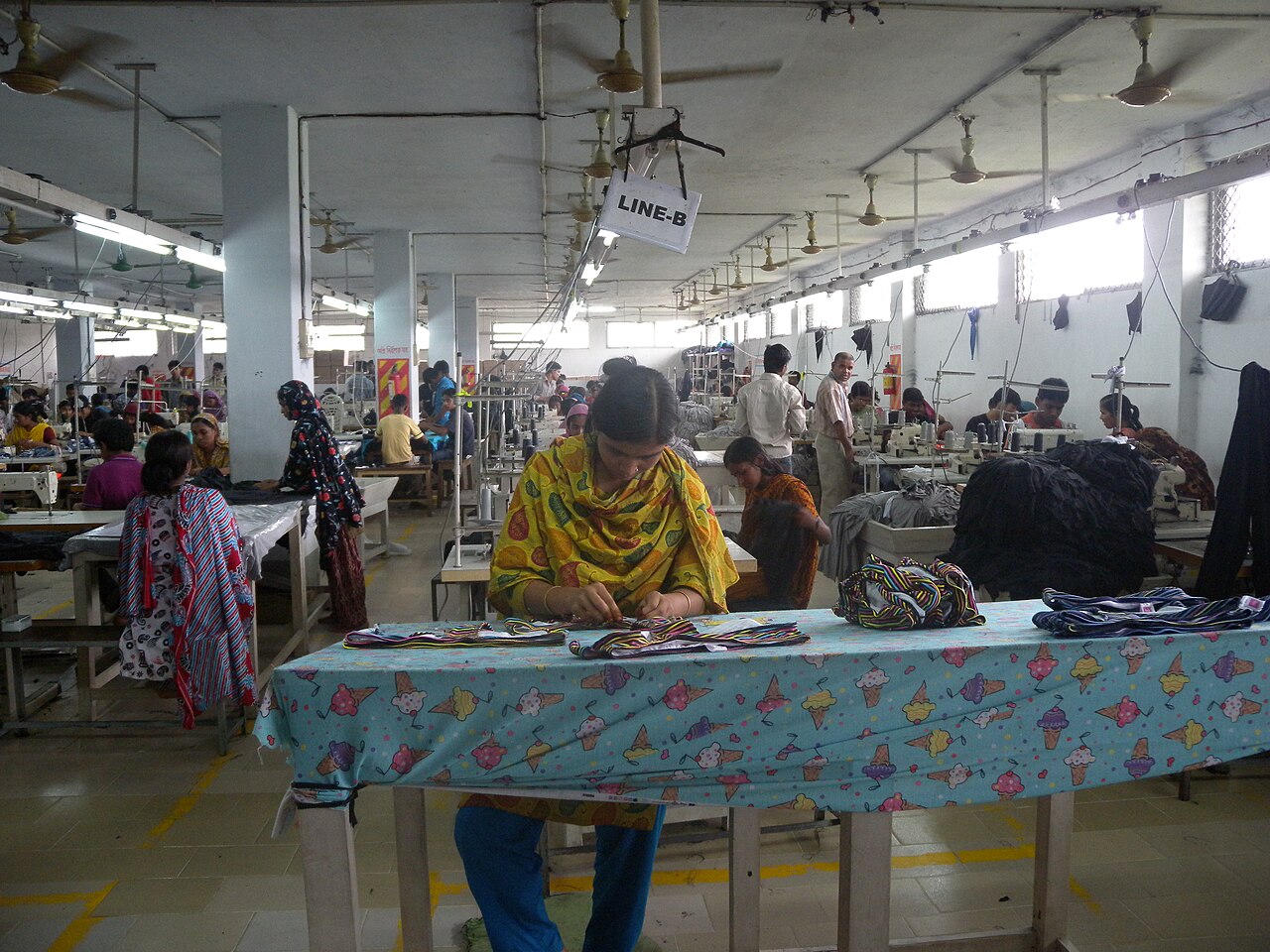
Wagdy Aziz, who runs finishing and pressing, comes up the stairs first. "Line 4 says it is making 660 a day. I have taken 440 shorts from them in seven working days. Four hundred and forty."
Nine minutes later Amany Rizk, who runs line 4, arrives with her output board under her arm. "My board says 4,620. Seven days, 660 a day. My operators have been paid on it. Ask the quality checker at the end of my line — every one of those pieces passed."
Both of them are telling the truth. The board says 4,620. Finishing has taken 440. And in a bay behind line 4, under a blue tarpaulin, there are 4,180 pairs of cargo shorts that nobody has counted because no document in the building has a place to write them down.
This lesson is about the space between two rooms, because that is where orders are lost. Not inside a room — rooms are usually well run, and the people in them can tell you their numbers to the piece. The loss happens at the join, and the reason is nearly always the same: two rooms that are each doing their job correctly are counting in different units, and nobody owns the conversion.
The order
| Buyer | Kronsted, a Danish clothing chain |
| Purchase order | KR-2809 |
| Style | CG-2118, men's cotton-twill cargo shorts |
| Quantity | 24,000 pieces — Slate 10,800, Sand 7,800, Olive 5,400 |
| Basis | CMT. Kronsted sends the fabric and the trims; the factory sells cutting, making and trimming |
| CM price | USD 1.38 a piece |
| Standard minute value | 18.40 minutes a piece |
| Sewing | Line 4, 48 operators, one eight-hour shift |
| Ex-factory | 30 June |
CMT matters for a foundation reader, because it strips the picture back to what a factory actually sells. Sabbour did not buy this twill and will not own these shorts. What it sells Kronsted is its own capacity to do work — and that is why lesson 2 is about the minute. Here we are still walking the building.
Six rooms, and what leaves each one
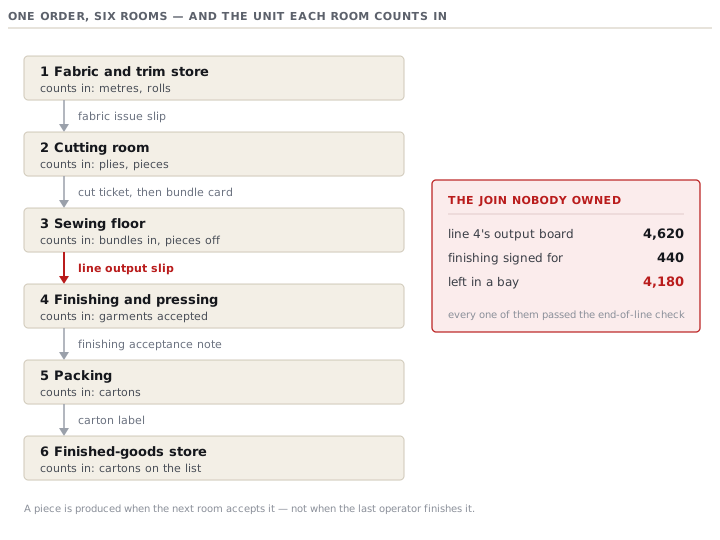
1. The fabric and trim store. Rolls come in, are measured, inspected and put away against a lot number. The store counts in metres and rolls. What leaves is fabric issued against a written request, and the paper that goes with it is the fabric issue slip: which lot, how many rolls, how many metres, to which cut ticket.
2. The cutting room. Fabric is spread into a lay, a marker is laid over it, and a knife cuts through every ply at once. The cutting room counts in plies and pieces. What leaves is bundles: 30 pieces of one size, one colour, one lay, tied together with a card. The paper is the cut ticket going in (planning tells cutting what to cut and in what size ratio) and the bundle card coming out.
Marker efficiency and where the metres go are course 4.5's subject, and what happens to a spread after the marker is agreed is course 5.2's. Here, the only thing that matters is what physically leaves the room: bundles, each with a card.
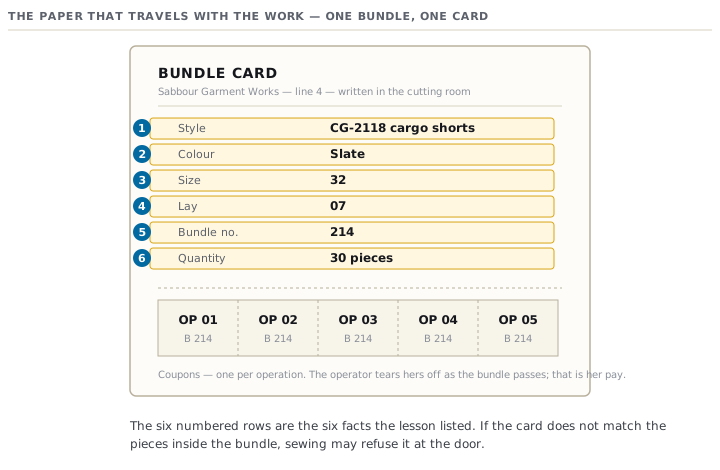
3. The sewing floor. A line of operators, each doing one operation, the work moving down the line in bundles. The sewing floor counts in bundles in and pieces off the end. The paper is the bundle card, which travels with the work and is the single most important document on the floor. It says style, colour, size, lay, bundle number and quantity. Each operator tears off or scans a coupon as the bundle passes, which is how the operator gets paid and how the factory knows where the work is.
4. Finishing and pressing. Thread trimming, inspection, pressing, folding, tagging. This room counts in garments accepted, and the word accepted is the whole lesson. What leaves is a pressed, folded, ticketed garment.
5. Packing. Garments go into polybags and then into cartons in the assortment the buyer asked for. Packing counts in cartons. Assortments, ratio packs and the buyer's packing manual are course 5.7's subject; the carton itself, its cube and how it fills a container are course 8.4's.
6. The finished-goods store. Cartons on a packing list, waiting for a truck. It counts in cartons on a list, and that list is the document the buyer's inspector, the freight forwarder and the customs broker all work from.
The document is not paperwork — it is the handover
A useful test for any factory document: if it disappeared, what would stop?
| Document | Crosses | What it actually does |
|---|---|---|
| Fabric issue slip | Store to cutting | Ties a physical roll to a lot number, so a shade problem can be traced back to rolls rather than guessed at |
| Cut ticket | Planning to cutting | Says what to cut, in what size ratio, and in what order — it is planning's only instruction to the knife |
| Bundle card | Cutting to sewing, then down the line | Carries identity with the work: style, colour, size, lay, bundle number, quantity. It is also the operator's payslip |
| Line output slip | Sewing to finishing | Says how many complete garments crossed the join, by size and colour |
| Finishing acceptance note | Finishing to packing | Says how many garments were accepted, not how many arrived |
| Carton label and packing list | Packing to the finished-goods store, then out | Says what is inside each numbered carton |
Notice the last three. Each one is written by the receiving room, not the sending room. That is not an accident of filing. A number written by the room that produced it is a claim; a number written by the room that received it is a fact.
What each room is allowed to refuse
A room that cannot refuse work is not accountable for anything, because it can always say the problem arrived that way. So every room in a well-run factory has a written right of refusal, and it is short.
- The store may refuse to issue a lot that has not passed its roll inspection, or that has not been left to relax after unrolling. Fabric behaviour is course 2.2's subject; the store's job is only to hold the line on it.
- Cutting may refuse a cut ticket with no marker, no size ratio, or no instruction on which lots may be spread together.
- Sewing may refuse a bundle whose card does not match the pieces inside it — wrong count, mixed size, a component missing.
- Finishing may refuse a garment that has not been passed at the end of the line.
- Packing may refuse a carton assortment that is not on the buyer's packing manual.
- The finished-goods store may refuse a carton whose label disagrees with the packing list.
Back to the bay behind line 4
Now the reconciliation. CG-2118 has an elasticated back waist with a drawcord, and the last two operations on the line are thread and tip the drawcord (0.86 minutes) and bar-tack the cord exit and close the waistband opening (0.42 minutes). A bar-tack is a short block of tight stitches that locks a stress point. Together, 1.28 minutes of a garment that takes 18.40.
Kronsted's nominated trim supplier shipped 24,000 cords. Only 440 sets of the metal tips arrived; the rest were held at the supplier for a cap-colour mix-up and cleared on 22 May.
On 13 May the tips ran out mid-morning. Amany then made a decision that any competent supervisor would recognise, and most would make: she did not stop the line. Forty-eight people were sitting at machines. Stopping them would have cost the factory every minute of that day. So the shorts were built to the second-last operation, tied in tens and stacked in the bay to be finished when the tips arrived.
That was a defensible call. What was not defensible was what the output board did with it.
| Pieces | |
|---|---|
| Line 4's output board | 4,620 |
| Received and signed for by finishing | 440 |
| Difference, in the bay behind the line | 4,180 |
Every one of the 4,180 had passed the checker at the end of the line, because the checker inspects the operations that were done. Every operator had been credited. The board was arithmetically correct. And the order was more than six days of production behind where the building thought it was, because the board was counting an operation, not a garment.
What the bay cost
The work itself is trivial: 4,180 pieces at 1.28 minutes is 5,350.4 minutes. Had it been done in sequence on the line it would have been invisible, because it is inside the 18.40-minute standard. At line 4's real running speed it would have consumed about 10,153 minutes of the line's paid time, which costs the factory USD 395.95.
Out of sequence it cost this:
| Task | People | Days | Paid minutes | Cost |
|---|---|---|---|---|
| Sorting loose shorts back to size and colour, and re-ticketing them | 4 | 4 | 7,680 | USD 299.52 |
| Threading and tipping on a temporary four-machine bench | 6 | 4 | 11,520 | USD 449.28 |
| Re-inspecting garments that had already been passed once | 2 | 4 | 3,840 | USD 149.76 |
| Total | 12 | 4 | 23,040 | USD 898.56 |
Three things in that table are worth sitting with.
23,040 paid minutes is exactly one full day of line 4 — 48 people times 480 minutes. The factory spent a whole line-day of its capacity finding and finishing work it had already made.
The sorting line earns nothing. There is no standard minute value for finding your own work again. Those 7,680 minutes produce no garment and appear in no efficiency report; they are simply gone.
The recovery cost USD 502.61 more than doing it in sequence — that is USD 898.56 against USD 395.95. Spread over the 4,180 pieces it is USD 0.12 a piece, on a CM price of USD 1.38. The factory gave away 8.7% of what it was paid to make those shorts, and it did so by doing the sensible thing.
And the twelve people were not free. They came off line 2, which was running a different buyer's order and lost four days.
The rule that fixes it
One sentence, and it is the most useful thing in this lesson:
A piece is produced when the next room accepts it. Not when the last operator finishes it.
Applied to line 4, that means the output board no longer counts coupons torn off at the end of the line. It counts what appears on the line output slip signed by finishing. On 14 May that board would have read 0, and on 17 May 0 again, and Wagdy would have been standing on the stairs on the second day instead of the seventh.
The same rule, applied at every join:
- The cut store issues complete bundles, and a bundle missing a component is not a bundle. Cutting's number is complete bundles issued, not pieces cut.
- Finishing's number is garments accepted, not garments received.
- Packing's number is cartons closed against the packing list, not cartons started.
Every one of those numbers is written by the receiving room. That is what makes them true.
Check yourselfLine 4 produced 4,620 shorts that all passed end-of-line inspection. Why is it wrong to call that production?Show the answer
Because 4,180 of them could not leave the room. Production is not the completion of the operations you happened to be able to do; it is work the next stage can take. A number that counts unfinishable garments does three harmful things at once. It hides a shortage that is getting worse every hour, it pays people for output the factory cannot sell yet, and it lets planning book more work into a line that is silently falling behind.
What to do on Monday
- Walk your factory and draw the six boxes. Write under each one the unit that room counts in. Wherever two adjacent boxes have different units, you have found a join.
- For each join, name the document that crosses it and who signs it. If the sender signs it, that is a claim, not a handover.
- Take one line's output board for last week and ask the next room what they received. If the two numbers differ, the difference is sitting somewhere in your building, and it is costing you money every day it sits there.
Prompt · Map my factory as rooms, units and joins
Before you promise a buyer a date, or the first week in a factory you have not worked in before.
Act as a garment factory production manager who has run cutting, sewing and finishing. Help me map my own factory as a chain of rooms and find the joins where work is being lost. Here is what I have. Factory: [NAME, LOCATION], [NUMBER] sewing lines, [NUMBER] machines, [NUMBER] people, [NUMBER OF SHIFTS]. Rooms I have, in order: [LIST THEM — STORE, CUTTING, FUSING, EMBROIDERY OR PRINT, SEWING, WASHING, FINISHING, PACKING, FINISHED-GOODS STORE, ANYTHING ELSE]. For each room tell me, if I know it: the unit its supervisor reports in, the number they reported last week, and the document that leaves the room. Order I want to trace: buyer [BUYER], PO [NUMBER], style [STYLE], quantity [QTY], colours and sizes [LIST], ex-factory [DATE]. Do the following. First, restate my factory as a numbered chain of rooms and write beside each one the unit it counts in — and flag every place where two adjacent rooms count in different units, because that is a join. Second, for each join name the document that should cross it, say who should SIGN it, and tell me plainly whether the number is currently written by the sending room or the receiving room. Third, ask me for last week's number from each room and reconcile them against each other; where two rooms disagree, tell me where the difference is physically sitting in my building. Fourth, list what each room in my factory should be allowed to refuse, in one line each, and ask me whether it actually does. Fifth, tell me which single join I should fix first and what the one-page document to fix it would contain. Do not give me a generic factory diagram — use my rooms and my numbers, and where I have not given you a number, ask for it rather than assuming one.
AI can make mistakes — check anything you act on.