Lessons · Lesson 2 of 3
The minute is the factory's currency
Turn one line's day into minutes, find where the missing minutes went, and read the efficiency that the agreed price already assumed.
Lesson 2 of 3 · 38 min
Why a factory does not quote in pieces
Ask a merchandiser what a factory sells and the answer is usually garments. The accountant sees it differently. Wages, rent, power, thread, machines and the canteen bus all cost money by the minute. They cost it whether a garment is being made or not. This lesson turns one line's whole day into minutes and asks where they went.
Forty-eight people sitting at machines cost the same whether the line is running or waiting for a bundle. So the only unit in which a factory's cost and a factory's output can be compared is the minute, and every serious number on a factory floor is a minute in disguise.
There are two kinds, and confusing them is the most common error a new merchandiser makes.
- An attendance minute, sometimes called an available minute, is a minute somebody was paid to be there. It is counted by the clock: 48 operators times 480 minutes is 23,040 attendance minutes, and no decision anybody makes today changes that number.
- An earned minute, or standard minute, is a minute of work that got done, valued at the standard the factory issued for the job. If the standard for CG-2118 is 18.40 minutes and the line produced 660 shorts, the line earned 660 times 18.40, which is 12,144 earned minutes.
Efficiency is one divided by the other, and nothing more mysterious: 12,144 divided by 23,040 is 52.71%.
One thing about that 18.40 matters immediately, because readers who meet efficiency for the first time nearly always object at the same point. The standard already contains rest. CG-2118's 18.40 carries a 12% allowance for relaxation and small contingencies, which means its basic work content is 16.43 minutes and 1.97 minutes of every pair of shorts is paid rest, already inside the earned figure. On 660 pairs that is 1,300 minutes of legitimate rest that has already been counted as earned. So when a lost-time report shows rest, it is showing rest taken on top of what the standard bought.
A minute has a price, and you already agreed it
Kronsted pays Sabbour USD 1.38 to cut, make and trim one pair. The standard says one pair is 18.40 minutes of work. Divide:
USD 1.38 divided by 18.40 minutes is USD 0.0750 for one standard minute.
That is the factory's selling price for a minute, and the merchandiser who negotiated USD 1.38 set it whether or not she thought of it that way.
Now the other side. Sabbour's finance office takes everything the factory spends in a month — direct wages, supervision, the mechanics, the store, power, rent, depreciation, the lot — and divides it by the attendance minutes the factory paid for in that month. For this year it comes to USD 0.0390 for one attendance minute.
Those two numbers together give the single most useful figure in the building:
Break-even efficiency = cost of an attendance minute divided by price of a standard minute = 0.0390 divided by 0.0750 = 52.0%.
Below 52.0% efficiency, this order loses money on every shift. Above it, it makes money. That number was fixed the day the price was agreed, in a room the sewing floor was not in — and nobody on line 4 had ever been told it.
Line 4 ran at 52.71%.
Where the minutes actually went
19 May, line 4, a completely ordinary Tuesday. 23,040 attendance minutes went in and 12,144 earned minutes came out, which leaves 10,896 minutes to account for. This is the sheet the work-study officer built the next morning, from the line's hour-by-hour board, the mechanic's log and the store's issue slips.
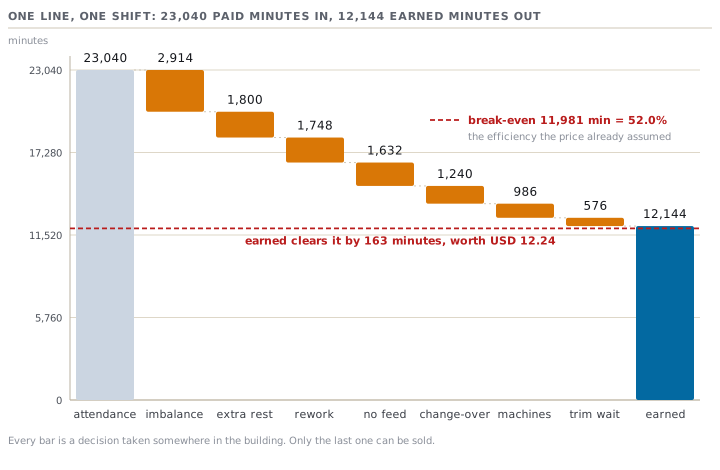
| Where it went | Minutes | Value |
|---|---|---|
| Line imbalance — operators idle waiting for the operation ahead of them | 2,914 | USD 218.55 |
| Rest and personal time taken beyond the allowance already inside the standard | 1,800 | USD 135.00 |
| Rework — pieces sewn a second time, which earns no new minutes | 1,748 | USD 131.10 |
| No feed at the start of the shift: bundles still in the cut store at 08:34 | 1,632 | USD 122.40 |
| Colour change-over and re-training two operators on a changed operation | 1,240 | USD 93.00 |
| Machines down, and waiting for the mechanic | 986 | USD 73.95 |
| Six operators stopped 96 minutes waiting for a trim the store had to go and find | 576 | USD 43.20 |
| Total lost | 10,896 | USD 817.20 |
Read the table as a list of decisions rather than a list of sins.
Line imbalance is the biggest line and it is not laziness. It is what happens when the work content of the operations is not matched to the number of operators doing them: somebody upstream is faster than the person downstream, so the fast operator waits. It is arithmetic, not attitude, and it is fixed on paper before the line is set — which is course 5.3's whole subject.
Rework earns nothing twice. A garment sewn a second time consumes minutes and adds no standard minutes at all, because the standard was already credited the first time. That is why a quality problem is a capacity problem before it is a quality problem, and why 1,748 minutes of rework is exactly as expensive as 1,748 minutes of an idle line.
The 1,632 minutes at the start of the shift are the join from lesson 1, seen from the other side. The cut store had the bundles; the line did not; nobody's number was wrong.
The 576-minute trim wait is the small one that becomes the big one. Six operators stopped for 96 minutes while the supervisor worked out what to do about a missing trim. What she then decided produced the bay of 4,180 shorts in lesson 1 — a decision that cost USD 502.61 more and does not appear anywhere in this table, because a bay is not a lost minute. It is a lost minute that has not happened yet.
Check yourselfThe line lost 1,800 minutes to rest, and the standard already includes a 12% allowance. Is the factory double-counting?Show the answer
No, and this is worth being precise about. The 12% allowance is inside the 18.40, so on 660 pairs the line was already credited with about 1,300 minutes of paid rest as earned time. The 1,800 minutes in the table is measured rest that was taken beyond that. The two numbers are close, which tells you something useful on its own: this line takes roughly 2.4 times the rest its standard pays for. That is a real finding, and it is a conversation about the standard and about the working conditions — not an accusation.
Whose minutes are in the denominator?
A foundation reader nearly always asks this next, and it is the right question. Sabbour employs 640 people. Only 240 of them are sewing operators earning standard minutes — five lines of 48. The other 400 are cutting, finishing, packing, the store, mechanics, quality, supervision and the office, and not one of them earns a standard minute, ever.
So which minutes are in the 23,040?
Only the sewing operators'. The attendance minutes in an efficiency calculation are the direct minutes — the people the standard was written for. Everybody else appears in the other number. The USD 0.0390 an attendance minute costs already carries the mechanics, the cutting room, the canteen and the rent, loaded onto the direct minutes because those are the only minutes the factory can sell.
That has a consequence worth taking away. There are two entirely separate levers on the same result, and factories confuse them constantly. Raising efficiency makes the 240 earn more minutes. Reducing indirect cost makes each of those minutes cheaper. A factory that hires a second work-study officer has made minutes more expensive in order to make more of them, and whether that was a good trade is an arithmetic question, not an opinion.
The same day, priced as the order
One day is a curiosity. The order is the decision.
The cost sheet Sabbour signed in February was built at 65% efficiency, which for CG-2118 is 814 pairs a day. Compare the two days side by side, using the same line, the same 48 people and the same cost.
| As costed, 65% | As it ran, 52.71% | |
|---|---|---|
| Attendance minutes | 23,040 | 23,040 |
| Pairs out | 814 | 660 |
| Earned minutes | 14,977.6 | 12,144 |
| Value of earned minutes at USD 0.0750 | USD 1,123.32 | USD 910.80 |
| Cost of attendance at USD 0.0390 | USD 898.56 | USD 898.56 |
| Margin on the day | USD 224.76 | USD 12.24 |
The gap is USD 212.52 a day, and here is the part that catches merchandisers: nothing in the second column looks broken. The line ran, the operators worked, the quality passed, the board filled in. The difference between a good order and a bad one is 154 pairs a day that nobody would notice going missing.
Carry it to the whole order.
| As costed | As it ran | |
|---|---|---|
| Line-days needed | 30 | 37 |
| Cost of those line-days | USD 26,956.80 | USD 33,246.72 |
| CM value of the order | USD 33,120.00 | USD 33,120.00 |
| Margin | USD 6,163.20 | minus USD 126.72 |
| Line cost per pair | USD 1.1232 | USD 1.3853 |
At 52.71% the order does not make a small margin. It loses USD 126.72, and it does so while every daily report in the building says the line is running. Look at the last row for the cleanest statement of it: the factory agreed to sell a pair for USD 1.38 and it cost USD 1.3853 of line time to make one.
And the seven extra line-days are not only money. They are seven days line 4 cannot give to the next order, which is why capacity and price are the same conversation — booking those days is course 7.4's subject.
What to do on Monday
- Take one line, one shift. Write down attendance minutes: operators times shift minutes. Write down pieces out and multiply by the SMV. The difference is your lost minutes.
- Account for them in categories, largest first, and put a value on each using your own price per standard minute. You will not get to zero on the first attempt; a sheet that accounts for 80% of the gap is already better than the one you have.
- Work out your own break-even efficiency and tell the floor. It is the only honest target, and it is far more useful than a round number somebody picked.
Prompt · Account for one line-day, minute by minute
The week you are told the line is working hard and the order is still late, and nobody can say where the time went.
Act as an industrial engineer doing a lost-time analysis on one sewing line, one shift. Be strict about arithmetic and never round a number away. My inputs. Line [NUMBER], [NUMBER] operators plus [NUMBER] helpers, shift [MINUTES], style [STYLE], SMV [MINUTES] a piece and the allowance it includes if I know it [PERCENT]. Pieces off the line that shift: [NUMBER]. Pieces the NEXT room signed for: [NUMBER]. My CM or CMT price a piece: [AMOUNT]. My factory cost per attendance minute, or my monthly cost and monthly attendance minutes if I do not have the rate: [AMOUNTS]. What I recorded during the shift: [LIST WHAT YOU HAVE — LATE START, MACHINE DOWNTIME, WAITING FOR BUNDLES, WAITING FOR TRIMS, REWORK, ABSENCE, CHANGE-OVER, TRAINING, REST]. Do the following. First, compute attendance minutes and earned minutes and give me the efficiency, showing the division. Second, compute what I sell a standard minute for, what an attendance minute costs me, and my BREAK-EVEN efficiency for this style, and say plainly whether the shift made or lost money and how much. Third, build the lost-minutes table: every category in minutes, largest first, valued at my price per standard minute, and reconcile the categories to the total gap — if they do not reconcile, tell me the size of the unexplained residual rather than hiding it in a category. Fourth, compare pieces off the line against what the next room signed for, and if they differ, tell me what that difference means and where those garments physically are. Fifth, project the shift onto the whole order: line-days needed, cost of those line-days, margin against the CM value, and the same figures at the efficiency my cost sheet assumed. Sixth, name the three categories I should attack first and what each is worth a day. Ask me for anything missing instead of assuming it, and label every assumption you do make.
AI can make mistakes — check anything you act on.