Lessons · Lesson 3 of 3
Who decides what, and the day the wrong person decided
Set out who owns which decision on a factory floor, and follow one entirely sensible decision taken by the wrong person to what it cost.
Lesson 3 of 3 · 32 min
The people, in the order you meet them
A factory is easier to read once you see how its people are organised. They are grouped around decisions, not around rooms. Two people can stand at the same machine, and only one of them owns what happens to it. This lesson maps who owns what.
- The line supervisor — Amany on line 4. Runs a shift against an issued method: who sits where, what happens when somebody is absent, when to call the mechanic, when to stop for a defect. She is judged on output and quality, and she is the only person on this list who is on the floor all day.
- The work-study officer, also called the industrial engineer — Nourhan Sabri at Sabbour. Owns the method and therefore the standard: how the job is done and how long the agreed method takes. She writes the operation bulletin the line is set from.
- Quality — inline checkers at the fourth and eighth stations, an end-of-line checker, and a final audit before packing. Doaa Shalaby runs it. Quality's power is not to inspect; it is the right to stop.
- Planning — Farida Selim. Owns the sequence: which order runs on which line in which week, when a colour changes, when a machine moves.
- The store — Mahmoud Attia. Owns what is issued and against which lot, and owns the refusal when the paperwork does not support it.
- The cutting manager — Hesham Fayed. Owns the lay, the knife and the cut store.
- The merchandiser — Karim Bassiouny. Owns the buyer's side of everything: the specification, the tech pack, the approvals, and the only route by which any of them may change.
- The production manager — Sameh Guindy. Owns the factory's promises: overtime, escalation, and any decision that trades one order against another.
Decision rights, on one page
| The decision | Decided by | Told at once | Must never decide it alone |
|---|---|---|---|
| Where operators sit today, and how to cover an absence | Line supervisor | — | — |
| What the method is: the sequence, the attachment, the folder, the machine type | Work study | Supervisor, planning | Line supervisor |
| Where a machine lives, and whether it moves between lines | Planning | Both supervisors, maintenance | Line supervisor |
| Whether a fabric lot may be cut | Store, with fabric quality | Cutting, merchandiser | Cutting |
| Whether a bundle may leave the cut store | Cut store keeper | Line supervisor | Sewing |
| Whether the line stops for a defect | Inline quality | Supervisor, production manager | Line supervisor |
| Whether a garment may differ from the tech pack | Merchandiser, in writing with the buyer | Everyone | Anybody on the floor |
| Whether to substitute a trim | Merchandiser, with the buyer's approval | Store, sewing | The store |
| Whether to work overtime, or to move an order between lines | Production manager | Planning, merchandiser | Line supervisor |
| Which colour runs first | Planning, advised by cutting and sewing | Merchandiser | Either room alone |
Two columns of that table do the real work. The third — told at once — is what turns a decision into a handover instead of a surprise. The fourth is deliberately blunt: it names the person whose judgement would be good and whose authority is wrong, which is a far more common failure than incompetence.
26 May: a good idea, taken by the wrong person
Operation 22 on CG-2118 is the bar-tack at the two top corners of the cargo pocket flap. It takes 1.05 minutes, it runs on the line's single bar-tack machine, and it is the bottleneck: one machine at 1.05 minutes can produce 457 pairs in a 480-minute shift, and line 4's target is 660.
Amany could see this. Anyone standing on the line could see it: a trolley of work stacked up in front of station 22 and three operators after it with nothing to do. So on the morning of 26 May she did two intelligent things.
First, she walked to line 2, which was between styles, and borrowed its bar-tack machine.
Second, she changed the order of two operations. In the issued method the flap is attached to the pocket first and then bar-tacked, which means tacking through four layers of twill. She had the flap tacked flat, before attachment. Tacking flat took 0.62 minutes instead of 1.05.
It worked. Line 4 went from 660 pairs a day to 731. The board went from 52.71% to 58.4%. Amany was congratulated, and she deserved to be — she had found a real improvement that the method sheet had missed.
Then it was measured properly.
What it actually did
The machine. Line 2 was not between styles for long; it started a different buyer's order on 27 May, with a standard minute value (SMV) of 22.00 minutes, and it now had no bar-tack machine at all. Its output fell from 540 pairs a day to 402.
| Pieces a day | Earned minutes a day | Value at USD 0.0750 | |
|---|---|---|---|
| Line 4 gained | 71 | 1,306.4 | USD 97.98 |
| Line 2 lost | 138 | 3,036.0 | USD 227.70 |
| The factory, net | minus 67 | minus 1,729.6 | minus USD 129.72 |
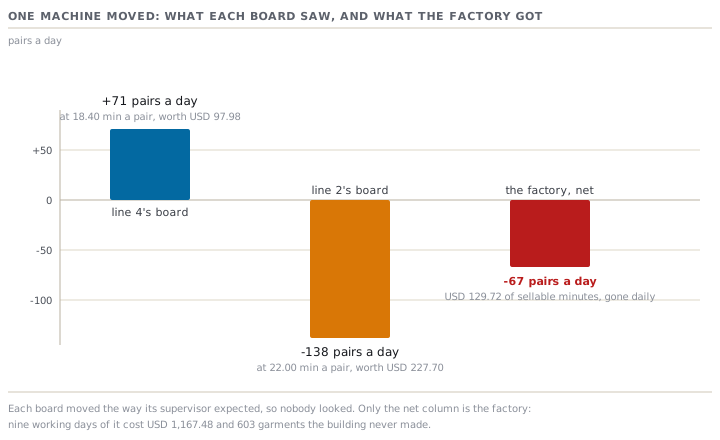
Nine working days at minus USD 129.72 is USD 1,167.48, and 603 garments that the building did not make. Nobody saw it, because each line has its own board and each board went in the direction its supervisor expected.
And here is the part that hurts. The method change alone would have removed the bottleneck. At 0.62 minutes, one bar-tack machine produces 774 pairs in a shift, comfortably above the 660 target. The machine never needed to move. The factory spent USD 1,167.48 buying capacity that the better method had already given it for free.
The second consequence: the standard stopped describing the work
This is the quieter damage, and for a factory it is the more expensive kind.
The moment the flap was tacked flat, CG-2118 stopped taking 18.40 minutes. Its new work content is 18.40 minus 1.05 plus 0.62, which is 17.97 minutes. That is a genuine saving of 0.43 minutes a pair — 2.3% of the whole garment's work content, worth USD 774.00 on this order at the factory's own price for a minute, and worth it again on every repeat.
But nothing on paper knew. So for nine days:
- Every efficiency number was measured against a standard that no longer described the job. Line 4's board read 58.4%. Against the true content of the work it was 57.0%. The real improvement was 52.71% to 57.0% — 4.3 points, which is excellent — and about 1.4 points of the reported gain was simply the old sheet.
- Payroll paid against the old sheet too. 6,579 pairs were credited at 18.40 minutes when the work was 17.97, over-crediting 2,829 minutes of incentive at the line's incentive rate of USD 0.0142 a minute, which came to USD 40.17 spread across 48 payslips. The money is trivial. The problem is that the factory's own record of what its people did is now wrong, and someone had to go back and explain a correction to forty-eight people who had done nothing but work.
- The improvement was invisible where it mattered. A saving of 0.43 minutes a pair is a real asset: it is worth USD 774.00 on this order and it is the factory's to keep, price into the next quotation, or trade with the buyer. Undocumented, it looks like an efficiency gain instead of a method gain — and an efficiency gain is exactly what a buyer asks you to give back at the next negotiation.
The three questions that settle any decision
You will not have a written sheet on the day somebody asks you. These three questions settle almost every case, and they are worth more than the table because you can carry them.
- Whose number changes? If the decision moves a figure that another person is measured on — line 2's output, work study's standard, the store's stock — that person is in the decision, whatever it says on the machine.
- Whose resource is it? A machine, an operator, a roll of fabric and a day of a line all belong to the factory, not to the room they happen to be standing in. Borrowing is a planning decision even when it takes ten seconds and everyone is being helpful.
- Who carries it after you leave the room? A substitution is carried by the merchandiser at the final inspection. A method change is carried by work study every time payroll runs. If somebody else lives with it for months, they decide it in minutes.
Amany's morning fails all three: line 2's number changed, the machine was the factory's, and work study lived with the standard afterwards. None of that makes her wrong about the bar-tack. It makes the bar-tack a proposal rather than a change, and a proposal that reaches work study by lunchtime costs nothing at all.
The opposite failure, and it costs the same
Decisions pushed up cost exactly what decisions pushed down cost, and factories tend to have both.
On 14 May, machine 17 on line 4 was dropping stitches on the yoke. The needle plate needed changing, which takes the mechanic four minutes. Amany had been told the previous month not to authorise anything without the production manager, who was in a meeting with a visiting buyer. The line stood for 22 minutes waiting for a decision that had always been hers.
Forty-eight operators times 22 minutes is 1,056 minutes, worth USD 79.20 — most of a whole day's margin on this order, spent waiting for permission that was never required.
Check yourselfAmany's method change was genuinely better. Why is it still a failure of decision rights?Show the answer
Because a factory's numbers are only as good as the standard behind them, and the standard is the one document a supervisor is not allowed to edit by acting. The instant the method changed, every efficiency figure, every payroll line and every capacity calculation on that style became a measurement against a description of a job nobody was doing any more. The improvement was real; what was missing was a route to make it official within a day. Note also the machine: even a perfect method change does not carry the right to move a machine that belongs to another line's capacity.
Three rights to leave with
- The right to run the method belongs to the supervisor. The right to change it belongs to work study. Everything a supervisor sees is worth having; it becomes a standard only when somebody re-times it.
- The right to accept work belongs to the receiving room. That is what makes an output number true, and it is lesson 1 in one line.
- The right to change what the garment is belongs to the merchandiser and the buyer, and to nobody on the floor. A substitution made in good faith by a store keeper at eight in the evening is still an unapproved garment in a carton.
What to do on Monday
- Write the decision-rights table for your own floor. Ten rows is enough. Argue about it with the people named in it — the argument is the exercise.
- For every row, ask the last person who took that decision whether they knew it was theirs. The gaps are usually in the same two places: methods and machines.
- Create the method-change note and give it a 24-hour turnaround. A factory where improvements have no route does not stop having improvements; it stops hearing about them.
Prompt · Write the decision-rights sheet for my floor
After the second time a sensible decision by the wrong person cost you a day, and before you write a rule that stops people thinking.
Act as an experienced factory general manager who has seen good people take decisions that were not theirs. Help me write a one-page decision-rights sheet for my floor. My situation. Factory: [NAME], [NUMBER] lines, [NUMBER] people, [PRODUCT TYPES]. The roles I actually have, with names or just titles: [LINE SUPERVISORS, WORK STUDY OR INDUSTRIAL ENGINEERING, QUALITY, PLANNING, STORE, CUTTING, MAINTENANCE, MERCHANDISING, PRODUCTION MANAGER, ANY ROLE I DO NOT HAVE]. Recent incidents where a decision went wrong, with what happened and who decided: [DESCRIBE THEM]. Do the following. First, build the table with four columns: the decision, who decides, who must be told at once, and who must never decide it alone. Cover at least these decisions — where operators sit today, what the METHOD is, where a machine lives and whether it moves between lines, whether a fabric lot may be cut, whether a bundle may leave the cut store, whether the line stops for a defect, whether a garment may differ from the tech pack, whether a trim may be substituted, overtime, and the order colours run in. Add any decision that my incidents show I am missing. Second, for each of my incidents, say who actually decided, who should have, and what the cost was in my own units — pieces, minutes or money — and be specific rather than saying it was expensive. Third, tell me where my sheet is likely to fail in the OTHER direction: decisions I have pushed UP that belong to the supervisor, because those cost the same and are harder to see. Fourth, write me the one-page method-change note: what the supervisor fills in, what work study must do and by when, and who signs a machine movement. Keep it to a page a supervisor will actually use. Fifth, tell me how to introduce this without teaching my supervisors to stop suggesting improvements. Do not invent roles I said I do not have, and where a decision genuinely depends on my factory's size, say so and give me the two options.
AI can make mistakes — check anything you act on.