Lessons · Lesson 2 of 3
The knife, the notch and the drill mark
Measure what a blade does between the top ply and the bottom, spend a tolerance band as a budget, and choose a knife for a job instead of for a habit.
Lesson 2 of 3 · 40 min
A failure that follows the bundle number
A stack of cloth is cut by driving one blade down through all of it. That is quick, and it is nothing like drawing round a pattern. The blade leans on curves. It presses the top plies flatter. It blunts as it goes. So pieces from the top come out larger than pieces from the bottom. This lesson measures that gap against the buyer's tolerance. It also reads the marks a cutting room makes on purpose.
11 June. The relaxation area from lesson 1 has been running for three weeks. The fabric now stands off the roll for a day, and Bracken is being cut: 4,320 jackets, twelve lays.
Naqada's inline check measures ten finished jackets a bundle. On Bracken the half chest is inside tolerance on every bundle, which is what you want to see. But somebody plots the readings against the ply block each bundle came from, and the picture is not flat.
| Plies the bundle came from | Mean half chest | Against the 570 mm spec |
|---|---|---|
| 1 to 15 | 573.6 mm | 3.6 mm over |
| 16 to 30 | 572.2 mm | 2.2 mm over |
| 31 to 45 | 570.8 mm | 0.8 mm over |
| 46 to 60 | 569.1 mm | 0.9 mm under |
Nothing fails. The whole range is 4.5 mm inside a band of 20 mm, and any inspector sampling across bundles would call this an excellent process.
It is also a gradient, and a gradient down the lay has one family of causes. The cutter is not drifting: he cut those four blocks in one pass, in one minute, following one line. The blade did this, and it did it in a way he could not see and cannot correct.
What a straight knife actually does to a deep lay
A straight knife is a vertical blade that moves up and down inside a frame. The operator pushes it through the lay by hand. Three things happen to it that do not happen to a pencil following the same line.
It leans. The blade is held at the top by the machine head and at the bottom by the base plate, and it is pushed sideways in between. On a straight run it stays where it is put. On a curve, such as an armhole or a sleeve head or a pocket mouth, side pressure bows it. The bottom of the cut then sits a fraction inside the top.
It compresses. The presser foot and the operator's forearm push down on the cloth ahead of the blade. On a 240 g/m² twill that is nothing. On a lofty brushed fleece, 60 plies stand about 62 mm high loose and cut at about 48 mm under the foot. Cloth cut while compressed comes back bigger when it is released, and the top plies are compressed most.
It heats and it blunts. A blade six lays past its last grind needs more push, and more push means more lean.
Naqada measured the first of these directly. Take one lay, cut it, and measure the cut width of the back panel at the chest line on plies 1, 15, 30, 45 and 60.
| Ply | Cut width of the back panel |
|---|---|
| 1 | 576.4 mm |
| 15 | 575.1 mm |
| 30 | 573.8 mm |
| 45 | 572.4 mm |
| 60 | 571.6 mm |
4.8 mm from the top of the lay to the bottom. The pattern nominal is 574.0 mm and the mean is 573.9, so the lay is centred. The panels are not wrong. They are all slightly different from each other, in an order that follows their height in the stack.
Spending a tolerance band as a budget
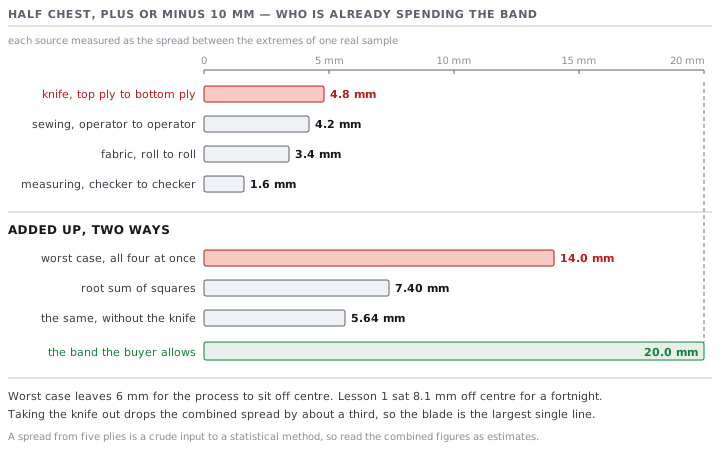
A tolerance is not a permission. It is a budget, and several people are drawing on it. Naqada measured the four that matter here. Each one is the spread between the extremes of a real sample.
| Source | Spread | How it was measured |
|---|---|---|
| Knife, top ply to bottom ply | 4.8 mm | five plies, twelve lays |
| Fabric, roll to roll in width and weight | 3.4 mm | twenty rolls |
| Sewing, operator to operator seam allowance | 4.2 mm | eight operators, same bundle |
| Measuring, checker to checker | 1.6 mm | three checkers, the same twenty garments |
Add them up in the worst case and they come to 14.0 mm against a band that is 20 mm wide. That sounds survivable until you notice what is left: 6 mm for the process to be off-centre. Lesson 1 has just shown you a process sitting 8.1 mm off centre for a fortnight.
Worst case overstates it, though. These four sources are independent and they are rarely all extreme at once. The usual approximation is to combine them as a root sum of squares, which means squaring each spread, adding the squares, and taking the square root. It is worth doing for what it says about the knife.
all four together   = sqrt(4.8² + 3.4² + 4.2² + 1.6²) = 7.40 mm
without the knife   = sqrt(3.4² + 4.2² + 1.6²)        = 5.64 mm
Take the knife out and the combined spread falls by a third. The blade alone widens the total by 31.4%. Treat those figures as an estimate rather than a measurement, because a range from five plies is a crude input to a statistical method. The conclusion does not depend on which arithmetic you prefer. On both, the knife is the single largest line in a budget that is already three quarters spent.
Four knives, four jobs
There is no best knife. There is a knife per job, and a cutting room that owns three of them uses each for what it is for.
| Knife | Working ply limit here | What it is for | What it cannot do |
|---|---|---|---|
| Straight knife | 60 | Block cutting and the bulk of the lay — long runs and gentle curves | Tight curves; and it leans, as measured above |
| Round knife | 25 | Straight lines and shallow curves, short lays, the sample room | Any curve tighter than the blade radius |
| Band knife | 40, in a block | Small accurate pieces — zip guard, pocket flap, collar — the blade runs in a fixed guide between two wheels and cannot lean | Nothing, except that you carry the work to it, so every piece is handled twice |
| Die press | 30 | One repeated small shape at volume — the pocket bag, the reinforcement patch | Anything that might change; a steel-rule die is about USD 340 and a week, which is one supplier's price rather than a market rate |
Those ply limits are Naqada's. They arrived at them by measuring this fabric, and they are not an industry constant. A denser, thinner cloth takes more. A looser, loftier one takes fewer.
The order of operations that follows is worth stating, because it is what a good cutting room does and a poor one does not. Block-cut on the straight knife, then finish on the band knife. Cut the lay into blocks around the difficult pieces, carry each block to the band knife, and cut the shape there against a fixed blade. It costs a second handling per block, and it removes the lean from the pieces where the lean matters.
The one you cannot buy your way out of, priced honestly
The obvious answer to all of this is a computerised cutter. That is a cutting head that follows a programmed path through a lay held flat by vacuum. On a borrowed machine Naqada measured a top-to-bottom spread of 1.1 mm against their own 4.8, and it cuts a 60-ply lay in 14 minutes instead of 25.
Now price it, and price it the way an owner will.
machine                    USD 168,000
life                       8 years          =  USD 21,000 a year
lays cut across the factory   2,100 a year  =  USD  10.00 a lay
today's total cutting labour                =  USD   4.50 a lay
The whole cutting-room wage bill on this order covers spreading, cutting, bundling and ticketing. It is 241 man-minutes a lay, USD 4.50, or 1.25 US cents a jacket. A machine that costs USD 10.00 a lay in depreciation, before anybody switches it on, is more than twice the entire labour it is supposed to replace.
So do not make the case on labour. At USD 1.12 an operator-hour the case on labour does not exist. Make it on variance, and then be honest about whether it closes. Naqada's Bracken data says the fixes below take out-of-tolerance garments from 3.4% to 0.6%. Across 756,000 garments a year, at a blended sort-and-rework cost of USD 0.38, that is USD 8,044 a year against USD 21,000 of depreciation.
It does not pay back on this alone. It starts to when you add the recuts it prevents, the notch depth it holds to a programmed number, and the styles a factory can accept once it can cut them. None of those is something Naqada can put a defensible figure on today. That is the honest position. A merchandiser who writes it that way is more use to an owner than one who produces a payback by choosing the assumptions that make it work.
What Naqada actually did, for almost nothing
| Change | Effect on the 4.8 mm spread | What it costs |
|---|---|---|
| Grind every 2 lays instead of every 6 | down to 4.1 mm | 13 extra grinds at 4 minutes, done while the next lay spreads — no table time. Blade wear USD 2.82 an order |
| Drop the ply height from 60 to 40 | down to 3.2 mm | 20 extra lays, 2.0 extra table-days, and more lay ends — course 4.5 prices those |
| Measure the bottom ten plies of every lay before the bundles leave | none | 40 lays × 10 pieces × 1.1 min = USD 8.20 an order |
They took the first and the third and refused the second. The refusal is the interesting one. On this factory's table arithmetic, two extra table-days is a real constraint cost, and it buys 0.9 mm. That is less than the grind schedule bought for nothing. The third change buys no accuracy at all. It turns an unknown into a known, and that is what lets you argue about the first two with numbers.
Notches: the cutting room's message to the sewing floor
A notch is a small cut in the edge of a panel that tells the operator where two pieces line up. It is not a decoration. It is the only instruction the cutting room sends the sewing floor, and on this fabric it is easy to send it badly.
A slit notch is a straight nick with the blade. In a lofty knit it closes up and disappears within an hour of being cut. The operator then sets a sleeve by eye. Naqada ran sixty sleeves each way.
slit notch:            0.94 min a sleeve set, 4.1% re-set
V notch, 4 mm deep:    0.62 min a sleeve set, 0.3% re-set
across 28,800 sleeve sets: USD 172 of time, USD 49 of re-sets = USD 221
USD 221 for a change that costs nothing. The time saving is the smaller half of it, because a re-set armhole on brushed fleece shows.
The depth has a hard ceiling. TJ-905's side and armhole seams are four-thread overlock at a 6 mm seam allowance, and the overlock knife trims about 1 mm before the stitch. A notch deeper than about two thirds of the seam allowance ends at or past the stitch line. It then shows on the face of a finished garment, where it cannot be repaired. Four millimetres on a six-millimetre allowance is the rule this room uses.
The drill mark, and the sample that could not have shown it
Cinder lays 11 and 12, 720 jackets, came off the line with a small dark mark just outside the chest pocket's topstitching.
The pocket position on TJ-905 is marked with a drill. A heated needle is punched through the whole lay, so every ply carries the same mark. The pattern puts the drill point 5 mm inside the finished pocket edge, and the pocket is topstitched 6 mm in from its edge. On a woven that is fine: the drill hole closes, and what is left sits under the pocket.
On a brushed fleece the hole does not close. The drill's heat glazes the pile around it. And 5 mm inside the pocket edge is 1 mm outside the topstitch line, on the visible side.
Nobody was wrong. The pattern was approved on a sample sewn in the sample room, where the pocket was positioned by hand against a paper template and no drill was used at all. The sample could not have shown this defect, because the sample was not made the way the bulk is made. That is a general point worth carrying. A first sample proves the pattern. It does not prove the cutting method.
| Step | Quantity | Time | Cost |
|---|---|---|---|
| Steam and brush the mark | 720 | 1.4 min each | USD 19 |
| Cleared by steaming | 439 | ||
| Front panel replaced — unpick zip, pocket, shoulder, side seam | 281 | 26 min each | USD 136 labour |
| Recut fabric, 0.21 kg a panel | 59.0 kg | USD 472 | |
| Replacement zips | 281 | USD 124 | |
| Total | 138.6 hours | USD 751 |
The 61% that steamed clear is Naqada's own trial on a hundred jackets, not a general figure. On a different pile or a different colour it would be a different number. And USD 751 is not the number that mattered in the room. 138.6 rework hours through a six-person cell is 2.3 shifts, taken out of the float before the port cut-off.
The forward fix costs nothing at all. Move the drill point 9 mm inside the pocket edge on the pattern, so that it falls under the pocket bag whatever the topstitch does. It went into the block that week, and into the tech pack comments for the repeat.
Check yourselfYour buyer's technologist proposes tightening the half chest tolerance from plus or minus 10 mm to plus or minus 7 mm on the repeat order, at the same price. What do you say?Show the answer
Show them the budget. Your measured sources combine to about 7.4 mm of spread before the process is off-centre at all, so a 14 mm band leaves you nothing. You would be shipping a process whose natural variation fills the entire tolerance, and a single roll running narrow puts you outside it. Then make it a costed offer rather than a refusal. The knife is the biggest single line at 4.8 mm, and it comes down to 3.2 mm by cutting at 40 plies instead of 60. That is 2.0 extra table-days on this order, plus the extra lay ends. Price that, quote it, and let the buyer decide whether the tighter band is worth it. A flat no loses the argument. A number turns a specification change into a purchase.
Prompt · Spend the tolerance band as a budget, and pick the knife
When measurements are inside tolerance but drifting, or when a buyer asks you to tighten a tolerance at the same price.
Act as a technical manager who owns both the cutting room and the measurement report, and who is willing to tell me my process is worse than I think. I want a tolerance budget and a knife decision for one style. Style facts: [STYLE], [FABRIC CONSTRUCTION AND WEIGHT], ply height [NUMBER], marker [NUMBER] garments and [LENGTH] m, lays in this order [NUMBER]. The measurement in question is [DIMENSION], specification [VALUE], tolerance [PLUS OR MINUS]. Data I have or can get: readings by ply position [PASTE OR SAY NONE], readings by operator [PASTE OR SAY NONE], roll-to-roll variation [VALUE OR NONE], checker-to-checker variation [VALUE OR NONE]. Cutting equipment available: [LIST — STRAIGHT KNIFE, ROUND KNIFE, BAND KNIFE, DIE PRESS, CNC]. Loaded labour [AMOUNT] an operator-hour, table-hours a day [NUMBER], lays cut across the factory in a year [NUMBER]. Do the following. First, tell me how to separate a cutting-room cause from a sewing-floor cause using data I already have, and name the exact plot to draw. Second, build the tolerance budget: each source, its spread, worst case added up, and a root-sum-of-squares estimate, and be explicit about which parts of that are approximations. Third, say what share of the band the knife alone is taking and whether the process is centred or off-centre, because those are different problems with different fixes. Fourth, list every change that reduces the knife's share — grind schedule, ply height, block cutting and finishing on a band knife, a different knife for specific pieces — with the cost of each in table-hours and money, and rank them by cost per millimetre recovered. Fifth, if a computerised cutter is on the table, price it per lay against my total cutting labour per lay, and tell me honestly whether the variance saving alone pays for it; if it does not, say so and list what else would have to be counted. Sixth, tell me what to say to a buyer who wants a tighter tolerance for the same price, as a costed offer rather than a refusal. Do not give me a range where a number is possible.
AI can make mistakes — check anything you act on.