Lessons · Lesson 3 of 3
Bundles, tickets, shade and the recut register
Build a bundle ticket that can still answer a question two months later, spread by shade group, and read a recut register for who actually pays.
Lesson 3 of 3 · 38 min
The cutting room's output is not panels
Ask a cutting master what he produced yesterday and he will give you a number of pieces. He is wrong, and this whole lesson is why.
Panels on their own are not usable. What the sewing floor consumes is a bundle: a tied stack of one panel, in one size, in a known order, with a ticket on it that says what it is. The bundle is the unit that moves, the unit that is paid for, the unit that is counted, and the unit an investigation runs backwards along. A cutting room that produces panels, and loses track of which stack came from where, has produced work in progress rather than output.
Naqada found that out on Oat.
Two panels, one garment, two rolls
22 June. Oat is the pale colour: 2,880 jackets, eight lays, the last of the order.
On 4 July Penhallow's final inspection stops the Oat lot. The finding is not a measurement and not a stitch. It is shading between the left front and the right front. The two panels meet along the zip, three centimetres apart, directly under the customer's eye.
Everything that produced it was correct.
Oat arrived as 92 rolls from four dye lots. Goods-in put every roll in the light box against the sealed standard, and every roll graded 4-5 or better. All of them were inside Penhallow's shade tolerance. Goods-in also sorted them into three visual groups, which was the right thing to do.
| Group | Rolls | Against the sealed standard |
|---|---|---|
| A, the lightest | 38 | 4-5 |
| B | 41 | 4-5 |
| C, the deepest | 13 | 4 |
| Total | 92 |
Every roll is acceptable. But group A held edge to edge against group C reads 3-4, which is not acceptable, and no rule anywhere was broken to get there. A shade tolerance is written between a specimen and a standard. Nothing in it describes two specimens against each other.
Then the store issued rolls in the order they were stacked. The spreader joined roll to roll exactly as the fabric manual allows, and course 4.5 prices what such a splice is worth in cloth. The lay swallowed the difference invisibly.
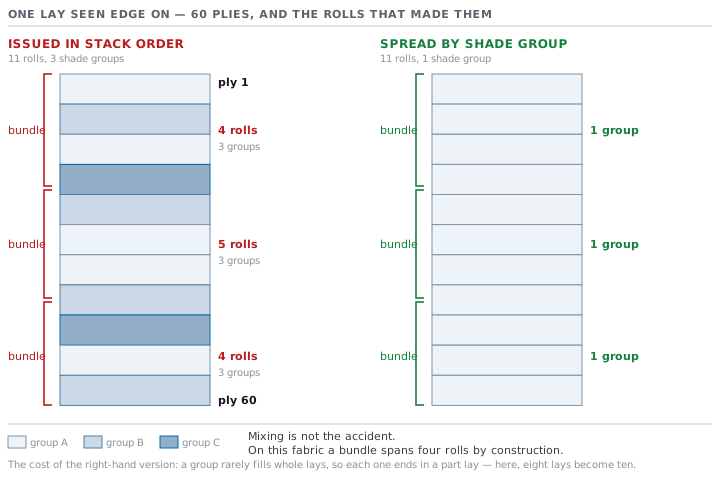
Every bundle in this room contains four rolls
This is the arithmetic that made it inevitable. Do it for your own fabric, because the answer is usually worse than people expect.
roll                 25 kg  ÷ (1.80 m × 0.300 kg/m²) = 46.3 m
plies from one roll  46.3 ÷ 8.60 m                   = 5.38
rolls in a 60-ply lay                                = 11.15
Eleven rolls go into one lay. Naqada bundles in blocks of 20 plies, three blocks to a lay, so:
rolls spanned by one 20-ply block = 20 ÷ 5.38 = 3.72Every bundle this cutting room produces contains cloth from about four rolls. Not occasionally. Always, by construction, on every order on this fabric. Mixing is not the accident. Mixing is the default, and the only question is whether the rolls in a bundle are near each other in shade.
What it cost, and what it nearly cost
The lot was sorted 100%, and 412 jackets, or 14.3% of Oat, carried a difference visible at arm's length.
| Step | Quantity | Cost |
|---|---|---|
| Sort the whole lot, 1.1 min a jacket | 2,880 | USD 59 |
| Replace one front panel, 26 min a jacket | 412 | USD 200 labour |
| Recut fabric, 0.21 kg a panel | 86.5 kg | USD 692 |
| Replacement zips | 412 | USD 181 |
| Total | USD 1,133 |
USD 1,133 is not the number that frightened anybody. 231.3 hours through a six-person rework cell is 3.9 shifts, against four days of float before the port cut-off. The fallback, if it had slipped, was air freight. 2,286 kg chargeable at USD 4.10 a kilo is USD 9,373, which is more than half the order's entire margin. Course 8.4 is where a chargeable weight comes from.
The fix, applied to the repeat, is this.
Spread by shade group. Issue group A until it is gone, then B, then C, and never let a lay cross a boundary. The cost is that the groups do not divide into whole 60-ply lays. Group A is 204.6 plies, B is 220.7, C is 70.0, so each one ends in a part lay and the eight lays become ten. That is two extra spreads, two extra cuts, two extra sets of lay ends, and about USD 9 of labour.
Grade the rolls at goods-in and write the group on the roll. 92 rolls at 6 minutes in the light box is USD 10.30.
That is the whole intervention: two extra lays and roughly twenty dollars, against a USD 1,133 rework and a USD 9,373 exposure. State it honestly, though. The twenty dollars is the marginal labour of doing it, not the cost of building the habit, and a factory that has never graded a roll will spend more than that learning to.
The ticket, field by field
Naqada's ticket before this order carried five things: cut order, lay, size, bundle number, piece count. Every one of them is about finding the bundle. Not one of them is about explaining it.
Here is the ticket they run now. The second column is the test. Each field earns its place by naming a question somebody will actually ask, weeks later, when the panels are gone.
| Field | The question it answers later |
|---|---|
| Cut order and lay number | Which plan produced this, against which cut quantity |
| Marker file and its version | Was this cut to the pattern that was approved, or to the one before it |
| Size and panel | The obvious one, and the only one most tickets get right |
| Ply range, first and last | Where in the lay these sat — the whole of lesson 2 is unanswerable without it |
| Roll numbers covering that ply range | Which cloth, which dye lot, whose fault a fabric fault is |
| Shade group | What a recut panel must be cut from |
| Bundle number and piece count | Is this bundle whole |
| Date, shift and spreader | Who to ask |
The two fields the incident turned on are roll numbers and shade group, and they are the two that cost the spreader something to record. He has to read a label at every roll change and write down a ply number. That is about forty seconds a change, ten changes a lay, seven minutes a lay.
That is the trade, and it should be stated as a trade rather than as good practice. Seven minutes a lay buys the ability to answer questions. Everything below is what those answers are worth.
Recuts: the loop, and who pays for it
A recut is a panel cut again because the first one cannot be used. Every cutting room does them. Most count them, few price them, and almost none can say who owes for them.
Across the forty lays of PH-6183, Naqada raised 214 recut requests covering 1,046 panels, which is 0.81% of every panel cut. This register excludes the 412 Oat fronts above, which were counted there.
| Cause | Requests | Panels | Who it belongs to |
|---|---|---|---|
| Fabric fault found after cutting | 96 | 512 | The mill — if you can name the roll |
| Sewing damage: needle cut, oil, iron burn | 71 | 214 | The factory |
| Cutting error: mis-cut, wrong notch, short ply | 28 | 186 | The factory |
| Shade, on Cinder and Bracken | 19 | 134 | Nobody, which means the factory |
| Total | 214 | 1,046 |
A recut panel costs USD 1.04 of fabric. It also takes about nine minutes of somebody's time to find the roll, spread it, cut one panel and ticket it. Call the whole thing USD 1.21 a panel. Add the part-garments that go back through the line and the register is worth USD 1,471 on this order. That is 8.9% of its margin, for work that produces nothing new.
Now the part that pays for the ticket.
Of the 512 fabric-fault panels, the ones cut on lays 21 to 40 carried roll numbers, because that is when the new ticket started. 232 panels traced back to nine rolls from a single dye lot with a repeating slub. Tahta Knitting issued a credit note for USD 280 without argument, because the claim named the rolls.
The other 280 panels were cut on lays 1 to 20. It is the same fault, on cloth from the same delivery, and it is not recoverable, because nobody can say which roll it came off.
lost purely to two missing fields on a ticket:    USD 338
Naqada cuts roughly 50 orders a year
Multiply that out and you get about USD 16,900 a year. Treat it as an estimate rather than a measurement: it is one order, extrapolated, and orders differ. The number that is not an estimate is USD 338 on this one, against seven minutes a lay.
The whole order, from the cutting room's side
| USD | |
|---|---|
| Markdown on 3,600 Cinder jackets cut before the cloth relaxed | 8,280 |
| Drill marks cleared on 720 jackets | 751 |
| Shade rework on 412 Oat jackets | 1,133 |
| Recut register, everything else | 1,471 |
| Total | 11,635 |
| Order margin | 16,560 |
| Share of the margin | 70.3% |
| Cutting-room labour on the whole order | 180 |
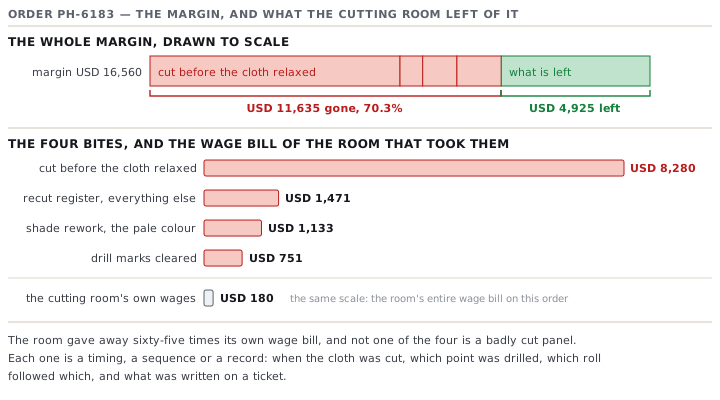
Sixty-five times its own wage bill. That ratio is the argument for everything in this course. It is why the cutting room is the cheapest place in a garment factory to be careless, and the most expensive place to have been.
Notice also what is not in the table. Not one of these four lines is a cutting error in the sense of a badly cut panel. Every one of them is a timing, a sequence or a record: when the cloth was cut, which pattern point was drilled, which roll followed which, and what was written on a ticket. The cutting room's real product is a bundle you can still explain in September.
Check yourselfA sewing supervisor sends back 40 jackets with the sleeve set visibly rotated. All 40 came from the same lay. What do you ask for, in what order?Show the answer
Ask for the bundle tickets first, before anybody unpicks anything, and read three fields. The ply range tells you whether all 40 came from one part of the lay, which points at the knife or at a lay-position gradient. If they are spread across all three blocks, it does not. The roll numbers tell you whether one roll behaved differently, because a slack roll spreads longer and its panels sit differently. The bundle numbers tell you whether the bundles were whole when they reached the line, because a broken bundle mixes plies, and mixed plies mean a sleeve head from one height meeting an armhole from another. Only then look at the notches, and look at them on an uncut panel from the same lay rather than on a sewn garment. If your tickets cannot answer those three questions, the honest answer to the supervisor is that you do not know, and the fix is the ticket rather than the sleeves.
Prompt · Rebuild the bundle ticket and read the recut register
After any defect that has to be traced back to a roll, and before the next order is cut the same way.
Act as a cutting-room systems manager who has had to answer a buyer's claim with nothing but a stack of bundle tickets. I want my ticket rebuilt and my recut register made usable. Facts: style [STYLE], PO [NUMBER], quantity [QTY], fabric [CONSTRUCTION AND WEIGHT], roll weight [KG], finished width [WIDTH], marker [NUMBER] garments and [LENGTH] m, ply height [NUMBER], bundle size [PLIES OR PIECES]. Shade information at goods-in: [HOW ROLLS ARE GRADED, HOW MANY GROUPS, OR SAY WE DO NOT GRADE THEM]. The fields my ticket carries today: [LIST THEM]. The defect or claim that prompted this: [DESCRIBE IT]. Do the following. First, work out from my roll weight, width, weight per square metre and marker length how many rolls go into one lay and how many rolls one bundle spans, and tell me plainly whether mixing is an accident in my cutting room or the default. Second, rebuild the ticket field by field, and for each field state the question somebody will ask weeks later that only that field can answer — refuse to add a field that fails that test. Third, tell me what recording roll numbers costs the spreader in seconds per roll change and minutes per lay, and put that against what it buys. Fourth, design the recut register: the fixed list of causes, who each cause belongs to, what evidence makes a claim against a mill collectable, and what makes it uncollectable. Fifth, take my quantities and price one recut panel end to end — fabric, the labour to find the roll and cut one panel, and the re-sew — then tell me what the register is worth as a share of my margin. Sixth, tell me the shade rule for spreading and for recutting, including what it costs in extra part lays, and be specific about the case where two rolls are each acceptable against the standard and not against each other. Name every assumption you make.
AI can make mistakes — check anything you act on.