Lessons · Lesson 1 of 3
The lay, and the relaxation the cloth still owes
Spread a knit lay so the panels you cut are still the panels you sew, and price the three ways a factory can buy relaxation time.
Lesson 1 of 3 · 42 min
The situation
Woven cloth mostly keeps the size you cut it at. Knitted cloth does not. Every machine that made it pulled it longer, and it is still creeping back. So a panel cut an hour after the roll is opened is not the size of the garment sewn a week later. This lesson is about giving the cloth the time it is owed. It also covers a brushed surface that slows the whole spread down.
14 May, 06:40, cutting room 1 at Naqada Apparel in Qena. Purchase order PH-6183 is for Penhallow, a British outdoor and athleisure retailer: 14,400 men's full-zip sweat jackets, style TJ-905. The cloth is brushed-back fleece, 95% cotton and 5% elastane, 300 g/m², knitted and dyed at Tahta Knitting. Three colours: Cinder 7,200, Bracken 4,320, Oat 2,880. FOB is USD 12.60, so the order is worth USD 181,440. It must be on board on 8 August.
The marker is the map of pattern pieces the cutter follows. This one arrived three weeks ago and is not this room's argument: six garments, 8.60 m long, approved. How you read a marker's efficiency, and what one point of it is worth, is course 4.5. This course starts the moment that file is opened on the cutting table.
Here is the cost sheet, per jacket.
| Line | USD |
|---|---|
| Fabric, 0.800 kg at USD 8.00 a kilo | 6.40 |
| Trims — zip, cords, labels, thread | 1.35 |
| Direct sewing labour, 24.0 SMV | 0.45 |
| Other conversion and factory overhead | 2.70 |
| Finishing and packing | 0.55 |
| Made cost | 11.45 |
| FOB | 12.60 |
| Margin | 1.15 |
USD 1.15 a jacket, USD 16,560 on the order. Remember that number. By the end of this course the cutting room will have given away 70.3% of it. The cutting room's own labour on this order is USD 180.
What happened on 14 May, and why nobody was wrong
The Cinder fleece cleared the store on the 13th. Line 2 finished its previous style on the 12th and had nothing to sew. The cutting master spread lay 1 that morning, and he spread it properly: the plies aligned, the selvedges tracking, no bowing, no tension he could see, ply count exact.
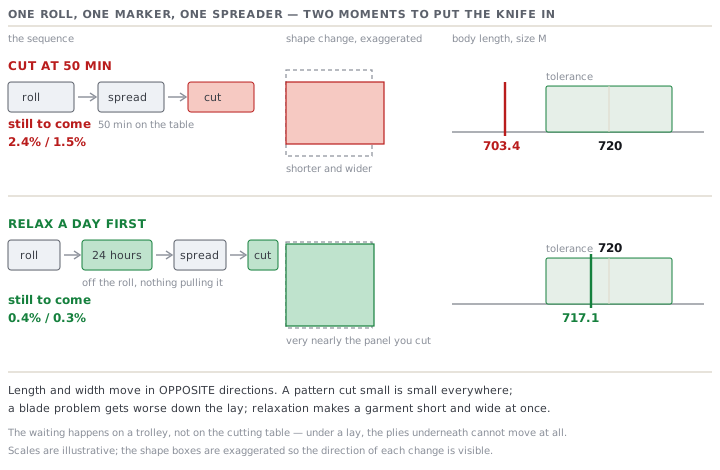
He cut it 50 minutes after the last ply went down, because the sewing line was standing.
Ten lays went out that way, 3,600 jackets, the first half of Cinder. On 23 May Naqada's own end-of-line check pulled thirty finished jackets in size M and found this.
| Measurement | Spec | Tolerance | Mean of 30 | Verdict |
|---|---|---|---|---|
| Body length from HPS | 720 mm | plus or minus 10 mm | 703.4 mm | 16.6 mm short — fail |
| Sleeve length from CB | 640 mm | plus or minus 10 mm | 626.2 mm | 13.8 mm short — fail |
| Half chest, 25 mm below armhole | 570 mm | plus or minus 10 mm | 578.1 mm | 8.1 mm over — pass |
Two measurements short, one over, and every step between them done correctly. The pattern was right. The marker was right. The spread was right. The sewing was inside its own tolerances.
The fabric was not finished moving.
A knit has no single length
A roll of fleece is wound under tension. It was knitted under tension, dyed and finished under tension, and stretched on a stenter to a width somebody chose. All of that left the loops distorted. A loop can change shape without the yarn stretching at all, and course 2.2 teaches that mechanism.
On the cutting table only this matters: the cloth has a length it is holding and a length it wants, and the two are not the same number. Spreading releases some of the difference. Time releases the rest. Cut in between, and you cut a panel that is still shrinking.
Naqada ran the measurement every knit cutting room should run once, and almost none does. Take one ply off the roll. Lay it free on the table. Mark a 1,000 mm square on it. Measure the square again.
| Rest after unrolling | Along the roll | Across the roll |
|---|---|---|
| 0 minutes | 1,000.0 mm | 1,000.0 mm |
| 30 minutes | 991.0 mm | 1,005.0 mm |
| 50 minutes | 988.5 mm | 1,006.5 mm |
| 2 hours | 979.5 mm | 1,012.0 mm |
| 4 hours | 976.0 mm | 1,015.0 mm |
| 24 hours | 976.0 mm | 1,015.0 mm |
A free ply contracts 2.4% in length and grows 1.5% in width. It has finished after about four hours.
Now put that beside what the finished jackets did. They came out 2.31% short on body length, 2.16% short on the sleeve and 1.42% over on the chest. That is not the 1.26% a free ply still had left at fifty minutes. It is very nearly the whole 2.4%, as though the cloth had not started at all.
It had not. A ply under a lay is not a free ply. The gap between those two tables is the most useful thing in this lesson, and it decides which of the three fixes below is real.
Why you cannot just call them a smaller size
The obvious escape is to relabel them. The body length is 16.6 mm short and this style grades 20 mm a size, so these jackets are 83.2% of the way to being a size S. Somebody always suggests it.
Do the arithmetic and it dies at once. A size S in this range is 700 mm body length and 550 mm half chest.
as an M:  body 703.4 vs 720  =  16.6 short   FAIL
          chest 578.1 vs 570 =   8.1 over    pass
as an S:  body 703.4 vs 700  =   3.4 over    pass
          chest 578.1 vs 550 =  28.1 over    FAIL BADLY
A grade step moves length and width the same way. Relaxation moves them opposite ways. So a relaxed-short garment is never the next size down. It is a garment of a shape nobody graded, and relabelling turns one failing measurement into a worse one.
What it cost
Penhallow's technologist saw the report on 26 May. Remaking was priced and refused. 3,600 jackets at a made cost of USD 11.45 is USD 41,220. It also needs 2,880 kg of Cinder fleece that does not exist and carries a five-week dye lead time, against an 8 August vessel.
The settlement was a markdown of USD 2.30 a jacket on the 3,600. They were sold through Penhallow's outlet channel, on condition that the remaining 10,800 were inside specification.
3,600 × 2.30 = USD 8,280
order margin  = USD 16,560
Exactly half the order's margin. It went on a colourway that was spread perfectly, by a man solving the right problem — a line with nothing to sew — with the only tool he had been given.
Three ways to buy the time, and only one of them works
Rest the lay on the table
This is the instinct. Spread it, leave it four hours, then cut. Naqada tested it before adopting it, and that test is why this section exists. It does not work, and the reason is not obvious.
They marked plies 1, 15, 30, 45 and 60 of a full 60-ply lay and measured them in place after four hours on the table.
| Ply | Released after 4 hours under the lay | Still to come after cutting |
|---|---|---|
| 1, the top | 2.4% | none |
| 15 | 1.5% | 0.9% |
| 30 | 1.0% | 1.4% |
| 45 | 0.7% | 1.7% |
| 60, the bottom | 0.5% | 1.9% |
A ply cannot relax while fifty-nine plies lie on it. Friction against the plies above and below holds it exactly where the spreader put it. It releases as soon as the lay is broken down, which is after the knife, not before it.
So resting on the table buys back the top of the lay and almost nothing else. Worse, it turns a uniform error into a gradient. The difference between ply 1 and ply 60 is 1.9 percentage points, which on a 720 mm body length is 13.7 mm of variation inside one lay. A uniform error shows up in the first garment anybody measures. A gradient hides from a sample.
It is also unaffordable.
lay cycle now:            spread 63 + cut 25 + strip and bundle 30 = 118 min
lay cycle with a 4h rest: 63 + 240 + 25 + 30                       = 358 min
Naqada has two spreading tables running one ten-hour shift. That is 20 table-hours a day, and they feed four sewing lines. Today those four lines need 13.8 table-hours a day, which is 69.1% utilisation. Comfortable. Multiply the cycle by 3.03 and the demand becomes 41.9 table-hours a day against 20 available: 209.7%. You would need at least five tables where you have two.
Factories do not rest knit lays on the cutting table. The reason is not ignorance. It is arithmetic.
Take the tension out at the spreader
Naqada's spreading machine has a driven let-off, which unwinds the roll under power instead of dragging it. Recalibrating it helped, and the help was measurable: total relaxation fell from 2.4% to 1.8%. It cost nothing and it should be done.
It is still not the answer. A driven let-off removes the tension you are adding. It cannot remove the tension the knitting machine, the dye jet, the stenter and the winder put in weeks earlier. Necessary, not sufficient.
Relax the cloth before it reaches the table
This is the one that works, and it works because it moves the waiting off the constraint.
Unroll the fabric onto a plaiting trolley. That is a powered unwinder that lays the cloth down in loose folds with nothing pulling it. Leave it a day. Naqada re-ran the free-ply trial on cloth that had been off the roll for 24 hours. Residual contraction was 0.4% in length and 0.3% in width. On a size M that is 2.9 mm of body length and 1.7 mm of chest, both well inside a 10 mm band.
The lay cycle stays at 118 minutes. The table never waits.
| Unwinder and plaiter | USD 4,200 |
| 30 trolleys at USD 240 | USD 7,200 |
| Total | USD 11,400 |
| Cloth the factory cuts in a day | 2,834 kg |
| Relaxed cloth 30 trolleys hold | 3,600 kg |
| Cover | 1.27 days |
| Floor taken from the fabric store | 52 m² |
USD 11,400 against USD 8,280 on one colourway of one order. It does not have to prevent this failure twice to pay for itself, and Naqada cuts about fifty orders a year.
Face one way, and the twenty-six minutes nobody books
One more thing the tech pack decided for this cutting room without saying so. TJ-905 is a brushed fleece. The back has a raised nap that lies in one direction. A panel cut with the nap running up reflects light differently from a panel cut with the nap running down. Two such panels side by side read as two different shades, even though they are the same cloth.
So this fabric can only be spread face one way. Every ply is laid in the same direction, the cloth is cut at the end of each ply, and the spreading head returns empty. Face to face spreading lays cloth down the table and back again, using both traverses. It is much faster, and it is forbidden here.
laying speed 14 m/min, return 30 m/min, 0.15 min to cut and clamp each ply
one lay = 60 plies × 8.60 m = 516 m

face to face:    516 ÷ 14                          = 36.9 min
face one way:    516 ÷ 14 + 516 ÷ 30 + 60 × 0.15   = 63.1 min
26 minutes a lay, 17.5 table-hours across this order. The point is not that you can choose. You cannot. The point is that face one way takes 1.71 times as long. A cutting room whose capacity was booked at plain-jersey spreading rates is booked 41% short before a single ply goes down. That is a capacity error, not a cutting error, and it lands on the person who promised the ship date.
There is a second consequence, and it bites once. Face-to-face spreading gives you mirrored pairs automatically, because alternate plies lie face down. Face one way does not. Every ply has the same side up, so the marker must contain a left and a right of every asymmetric piece. On TJ-905 that is the two front panels and the pocket bags. Get it wrong and you cut 360 left fronts and no rights, and you find out at the sewing line.
Check yourselfYour inline check reports size L jackets running 11 mm short on body length and 6 mm over on half chest, consistently, across every bundle from three different lays. Where do you look first, and what do you measure?Show the answer
The two dimensions move in opposite directions, and the result does not depend on ply position or bundle. That is relaxation. It is not the knife and not the sewing floor. Do not start by re-measuring garments. Take one ply of the current roll, lay it free, mark a 1,000 mm square and measure it again at 30 minutes, 2 hours and 4 hours. You will have the answer in an afternoon, and it will be a percentage you can multiply against every dimension on the spec. Then find out how long the cloth had been off the roll when it was spread. If the answer is less than a day, the fix is a relaxation area, not a pattern change. Resist the pattern change in particular. Enlarging the pattern to compensate for tension bakes today's roll tension into the block, and the next delivery will have a different one.
Prompt · Build a spreading and relaxation plan for one knit order
Before the first lay of a knit style, or the morning after a measurement report comes back short in length and over in width.
Act as a cutting-room manager in a garment factory who has run knit bulk for twenty years and has no reason to flatter my process. I want a spreading and relaxation plan for one order, with numbers. Order facts: buyer [BUYER], PO [NUMBER], style [STYLE], quantity [QTY] pieces in [NUMBER] colours split [LIST], FOB [PRICE], made cost [AMOUNT], ship date [DATE]. Fabric: [CONSTRUCTION], [WEIGHT] g per square metre, [FIBRE CONTENT INCLUDING ELASTANE], finished width [WIDTH], rolls average [KG] kg. Marker as approved by the marker room: [NUMBER] garments, [LENGTH] m long — do not re-derive its efficiency, take it as given. Cutting room: [NUMBER] spreading tables, usable length [LENGTH] m, [HOURS] hours a shift, feeding [NUMBER] sewing lines. Loaded labour [AMOUNT] an operator-hour. Ply height we normally use: [NUMBER]. Key finished measurements and tolerances: [LIST THEM]. Do the following. First, tell me the relaxation trial to run before I spread anything — what to mark, where, how often to measure, and for how long — and what result would make me change the plan. Second, from a stated contraction and growth percentage, convert it into millimetres on every measurement I listed, and say which ones would fail. Third, tell me whether the fabric needs to relax before spreading or whether resting the lay is enough, and justify the answer with what a ply under a lay can and cannot do. Fourth, price the three ways to buy the time — resting the lay on the table, controlling tension at the spreader, and relaxing off the roll — each in table-hours, in equipment, and in floor space, and say which is impossible for my table count rather than merely expensive. Fifth, tell me the spreading mode this fabric requires and what it does to my spreading minutes per lay against a plain fabric, and warn me if my capacity was booked at the wrong rate. Sixth, list what I must add to the cutting order so the next person does not have to work this out again. Where you assume a number, name it in a list at the end rather than burying it.
AI can make mistakes — check anything you act on.