Lessons · Lesson 3 of 3
Packing is a process, and the fold is its specification
Turn packing from a habit into a controlled process: a folding board, a pilot carton, a weight check, a metal policy that works on a garment made of metal, and packaging tested like a trim.
Lesson 3 of 3 · 30 min
The morning of the final audit
Folding is the one job nobody thinks needs a specification. Anybody can fold. But a folded garment has a thickness, and thickness decides how many fit in a box. Two people folding to their own judgement will fill a carton with different numbers. The packing list was printed a fortnight ago. This lesson turns the last station into a written process.
21 September, 09:40. Anfushi's packing hall is three days from finishing PO TH-6482 and one day from a final audit. A supervisor is standing on a stool, pushing down on a carton lid that will not sit flat.
The carton is specified. The count in it is specified. The garments in it are the right garments and they passed inspection. And it does not close.
By eleven o'clock, 41 cartons have been found in the same state. All of them come from one folding station. The audit was due to start after lunch, and it has to wait while they are opened and re-done.
The last station is a process, and almost nobody writes it down
A tech pack specifies the garment in obsessive detail. Every measurement, every stitch density, every trim. Then it says something like fold and polybag as per buyer's packing manual. And the manual, when it arrives, is a document about what goes in a carton rather than how a garment gets there. That side of it belongs to course 5.7, along with assortments, ratio packs, and the chargebacks that follow when a carton disagrees with the packing list.
The gap between the two is a process nobody specified, run by whoever is free that afternoon. Here is the sequence it should be.
- Final check, under proper light, against the sealed sample.
- Tickets and tags, attached at the specified position, before the fold, so they end up visible where the buyer expects them.
- Fold, on a board.
- Polybag, sized to the folded piece.
- Metal check. See below, because on this garment it cannot be here.
- Carton, packed to a pilot carton, and weighed.
- Close, tape and mark.
Every one of those steps has a number attached that somebody has to measure. The one that decides the most, and is measured least, is the third.
The fold is a dimension, and a dimension needs a gauge
A folded pair of trousers has three dimensions, and all three matter. The length and the width decide whether it sits in the carton's footprint. The thickness decides how many layers go on top of it.
WT-5062 folds to 300 by 220 millimetres. The carton takes four folded pairs to a layer and ten layers, which is 40 pairs a carton and 600 cartons for the order. That arrangement works because the folded piece is 35 millimetres thick and the carton's inside height is 350 millimetres.
Nobody at Anfushi was measuring the fold, because a fold is not on a measurement chart. Here is what the audit-day sample of forty pieces from each of the three folding stations looked like.
| Station | Mean folded depth, mm | Mean thickness, mm | Layers that fit | Pairs a carton |
|---|---|---|---|---|
| Folder A | 302 | 35 | 10 | 40 |
| Folder B | 305 | 36 | 9 | 36 |
| Folder C | 316 | 41 | 8 | 32 |
Folder C is a competent operator working quickly. She folds the leg a little short of the others, which makes the piece a little deeper and a good deal thicker. Sixteen millimetres of folded depth is inside nobody's idea of a serious error. Six millimetres of thickness is invisible on one garment.
Ten of them stacked is 410 millimetres, in a carton with 350 millimetres of inside height. That is why the lid would not close.
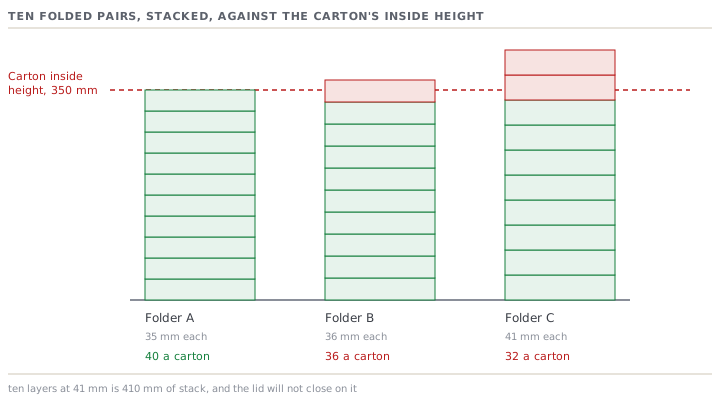
There are only two outcomes when that happens, and both cost something.
- Force the lid. The flaps bow, the board's stacking strength drops, and the cartons at the bottom of a stow fail. That is a crushed-carton chargeback three weeks later, on the other side of the world.
- Reduce the count. Thirty-two pairs a carton instead of forty. The 7,200 oatmeal pairs then need 225 cartons instead of 180. That is 45 more cartons than the packing list says, on marks that were printed a fortnight ago, and a cube that no longer matches the container plan. What extra cartons do to a stow is course 8.4. What a carton that disagrees with the packing list does to your invoice is course 5.7.
The direct cost of the re-pack at Anfushi was almost nothing. 1,640 pairs were re-folded and re-bagged in 19.1 hours of labour, which is USD 22.00, plus USD 29.19 of replacement polybags. USD 51.19 in total.
The cost was the day. And it landed on an order that was already three days late, on a floor whose days were worth 1,860 pairs.
The pilot carton, and the cheapest hundred per cent check you will ever run
Pack one carton first, before the run. Then measure it, weigh it, photograph it, and put it beside the packing bench as the standard. Every carton after it is compared against that one.
The weight is the part that earns its keep. A bagged pair of WT-5062 weighs 0.372 kilograms and the empty carton weighs 0.54, so a correct carton is 15.42 kilograms gross. A checkweigher at the carton close, set to a tolerance of 0.150 kilograms, weighs every carton in the order at no cost per carton and no extra labour.
A missing pair is 0.372 kilograms, which is 2.48 times the tolerance. A short carton cannot pass. No sampling, no AQL, no opening cartons at an audit. You get a hundred per cent count on every carton in the order, from one number.
Be equally clear about what it does not catch. A weight check catches a wrong count, not a wrong size or a wrong colour, because a small and a large weigh nearly the same. The size mix in a carton is controlled by the tickets and by the assortment rules, which is course 5.7's subject, and no scale will ever help you with it.
Metal: the control that cannot live where you think it does
WT-5062 closes with a metal hook-and-bar and a metal zip.
Run it through a conveyor metal detector and the detector alarms on every piece in the order. This is not a fault in the detector. You cannot metal-detect a garment that contains metal. A great many packing halls own a machine that has been turned down to a sensitivity so low it would not find a needle either.
The risk is real: a broken needle, a pin, a staple, a fragment of a snap. So the control has to move, and it moves in two directions.
Upstream, to the source. A needle control policy is the real answer, and it costs nothing but discipline.
- Needles are issued one for one. A mechanic hands out a new needle only against the broken one.
- Every fragment is recovered and taped to a broken-needle log, with the machine, the operator, the time and the bundle number.
- If a fragment cannot be found, the machine stops. The bundle is quarantined and searched until it is found.
- Staples and pins leave the building. A bundle ticket stapled to a panel is a metal source travelling with the work. Use clips or a tack stitch instead.
Earlier in the flow, where detection still works. Cut panels and sewn bundles can be passed through a detector before any metal trim is attached. That is where a detector on a garment like this one earns its price.
Trevanion's manual specifies the test cards that prove the detector each shift: ferrous 1.0 millimetre, non-ferrous 1.2 millimetres, stainless 2.0 millimetres. They are passed through in three orientations at the start of every shift and every two hours, with a signed log. Those are this buyer's specified sizes, written into their manual. They are not a legal threshold and not a number to carry to another buyer. Read the manual you are actually working to, every season. These numbers change, and the manual is the only place they are true.
The mistake nobody made: a better polybag
In August, Anfushi's packing department changed polybag supplier. The new film is anti-static, so bags do not cling to the operator's hands and bagging is faster. It costs USD 0.0178 against USD 0.021, which is 15.2% cheaper. Purchasing approved it. Packing preferred it. QA had no objection, because a polybag is not a garment component.
Across 24,000 bags it saved USD 76.80.
Five weeks after the container was discharged, the distribution centre reported a yellow cast on the oatmeal trousers. It was strongest along the fold lines and at the edges where the garment touched the bag. 1,940 pairs, which is 26.9% of the oatmeal, were graded unacceptable and taken at a 40% markdown: USD 7,604.80.
That is 99 times the saving, and nothing was wrong with the garment when it was packed.
The control is one sentence, and it is a rule worth carrying to every order. Anything that touches the garment inside the carton is a component. It is approved, tested and lot-controlled like a trim. Course 2.5 owns trims. A polybag, an interleaving tissue, a hangtag card and the carton board itself all belong in that list.
The test exists. Phenolic yellowing potential is assessed by sealing a control fabric together with the packaging material in warm, humid conditions, and grading the yellowing that develops. At roughly USD 55 a component, testing the bag, the tissue, the tag card and the carton board comes to USD 220. Set that against the USD 76.80 the cheaper bag saved, and the USD 7,604.80 it cost.
And ask the second question too. Is the new bag the same size? A bag cut to the old fold will pull a slightly larger folded piece into a curve, and that curve is the first place a fold line shows.
Where this course stops
The carton is closed, weighed, taped and marked. What happens to it next is course 8.4: how it stows, what its height does to a tier, how many fit in a container, and what a missed cut-off costs. That course begins exactly where this lesson ends.
Check yourselfYou have no budget for new equipment and one afternoon on the packing floor. What are the two things you do?Show the answer
Cut folding boards to the specified folded dimension for every station. Then pack, measure and weigh a pilot carton, and put it on the bench. The board removes the operator-to-operator variation that decides your carton count. The pilot carton, and the weight taken from it, turns every carton in the order into a hundred per cent count against one number. Between them they cost the price of some board and an hour of somebody's time, and they close the two failure modes that actually reach the buyer.
Prompt · Audit my packing process before the run, not after it
The week before packing starts on a new style, or the morning after a carton would not close, a count came up short or goods arrived discoloured.
Act as a packing engineer who has been on the receiving end of a distribution-centre chargeback. Audit my packing process before I run it. Facts: buyer [BUYER], style [STYLE], garment type [TYPE], fabric [COMPOSITION], colours [COLOURS] and the palest of them [COLOUR], quantity [QTY], sizes and their quantities [SIZES]. The buyer's manual says: folded dimension [MM BY MM], pieces per carton [NUMBER], carton internal dimensions [MM], polybag [SIZE AND SPECIFICATION], tickets and tags [WHAT AND WHERE], metal policy [WHAT IT SAYS], carton marks [WHAT]. My materials: polybag supplier and film [DETAIL], tissue [YES OR NO], hangtag card [DETAIL], carton board [GRADE]. Any of these changed this season: [LIST THEM]. Do the following. First, write the packing sequence as numbered steps and put a measurement against each one, naming who takes it and how often. Second, work out the folded thickness I need for the specified count to fit the carton, and tell me the tolerance on the fold and what a folding board for this garment should measure. Third, tell me what happens to my carton count, my packing list and my carton marks if the fold runs thicker than specified, and give me the numbers for a plausible overshoot. Fourth, specify a pilot carton: what to measure, what it should weigh with a correct count, the checkweigher tolerance, and state clearly what a weight check does NOT catch. Fifth, look at the metal policy: if the garment contains metal trims, tell me where detection can still work and what the needle-control policy must say. Sixth, list every material that touches the garment inside the carton, and for each one tell me what it should be tested for, what that costs and what it costs not to. Seventh, give me the five things most likely to go wrong on this specific style and the control for each. Flag anything in the buyer's manual that is missing or contradicts itself rather than filling the gap yourself.
AI can make mistakes — check anything you act on.
What to take onto a floor tomorrow
- Write the packing process down as a numbered sequence, with a measurement against each step. Put the folded dimension and the thickness on it.
- A folding board at every station, and a measured sample every hour. A fold that varies is a carton count that varies.
- Pack, measure and weigh a pilot carton before the run, and weigh every carton against it.
- Do not expect a metal detector to work on a garment full of metal. Control needles at the machine, and detect before the trims go on.
- Treat every packaging material that touches the garment as a component: an approved supplier, a lot number and a yellowing test. It is the cheapest insurance in the building, and it is almost never bought.