Lessons · Lesson 1 of 3
What finishing repairs, what it hides, and what it causes
Sort what a finishing room does into three groups: real repairs, faults it only hides, and faults it makes itself. Then write a press setting you can defend.
Lesson 1 of 3 · 35 min
The situation
Between the last sewing machine and the carton there is a room. It trims threads, cleans marks, presses and folds. It looks like the harmless end of making clothes. It is not. Heat and pressure change cloth for good.
This lesson sorts what that room does into three groups. On the day, all three look the same. The room repairs some faults. It hides others. And it makes a few of its own.
14 September, 08:10, Anfushi Garments, Assiut. Two emails, opened in the wrong order.
The second one is the production report. PO TH-6482 is for Trevanion and Hale, a British high-street chain. It is 24,000 women's tailored trousers, style WT-5062, navy 16,800 and oatmeal 7,200. The cloth is a 245 gsm suiting in polyester, viscose and elastane, blend 63/33/4. (Gsm means grams per square metre. It is how heavy the cloth is.) The FOB price is USD 9.80. FOB is the price of the goods loaded at the port, before freight. So the order is worth USD 235,200. It costs USD 8.71 to make, which leaves USD 1.09 a pair. Sewing started on the seventh. 9,600 pairs are sewn, and 5,580 of them have already been through the presses.
The first email is from a distribution centre. It is about 18,000 pairs of the same style, shipped in June against PO TH-6109. It says: pressed shine, seat and front crease, unacceptable against the approved sample. That is 2,150 pairs, or 11.9% of the delivery.
The presses running this morning are set exactly as they were in June.
The finishing room is a repair shop, and it keeps a ledger
A finishing floor is a sequence of stations. Each one has a different relationship with the truth.
- Thread trimming and turning. Loose ends are cut and pockets are turned. The garment reaches the shape it will be judged in.
- In-process check. The last cheap place to send a garment back to the line.
- Spotting. Marks removed with chemicals.
- Pressing. Shape, crease, flatness and hand feel.
- Final check. Under proper light, against the sealed sample.
- Packing. That is lesson three.
Course 3.5 covers what a mill's finishing does to cloth: the stenter, the resin, the width and the weight. This is a different room with the same name. Here you are looking at what a factory's finishing does to a made-up garment. Read that course for the cloth's history. This one starts when the garment arrives from the line.
The most useful thing you can carry onto a finishing floor is a ledger with three columns. The room is doing three different jobs at once, and nobody labels which is which.
| Finishing genuinely REPAIRS | Finishing CONCEALS, until the customer washes it | Finishing CAUSES |
|---|---|---|
| Loose thread ends, untrimmed chain | Seam pucker, pressed flat | Glazing and shine on seams, creases and the seat |
| Chalk, marking pen, dust and handling soil | A shade difference between panels, evened out by a uniform sheen | Impression: a pocket bag, a seam allowance or a zip tape showing through on the face |
| Creasing and pack marks from transport | Fusible bubbling, flattened for the day | Scorch, and the yellow cast that comes before it |
| An open seam, re-sewn and re-pressed | Leg twist, held straight by the crease | Dimensional change from over-steaming |
| A missing bartack, added | A slightly short measurement, stretched on the buck | Colour change and haloing where heat moves a disperse dye |
| A loose button, re-set | A grin-through at the seam, closed by pressure | Delamination of a fusible, and distorted plastic trims |
The middle column is the dangerous one. Everything in it passes final inspection. It ships, it arrives, it sells, and then it fails in a customer's machine six weeks later. At that point it is a return, not a defect. It costs you the full retail price instead of the cost of a remake.
Measure a finishing floor only on how many pieces it passes, and it will move work into the middle column. The middle column is faster.
Pressing is one dial, and it has two failure directions
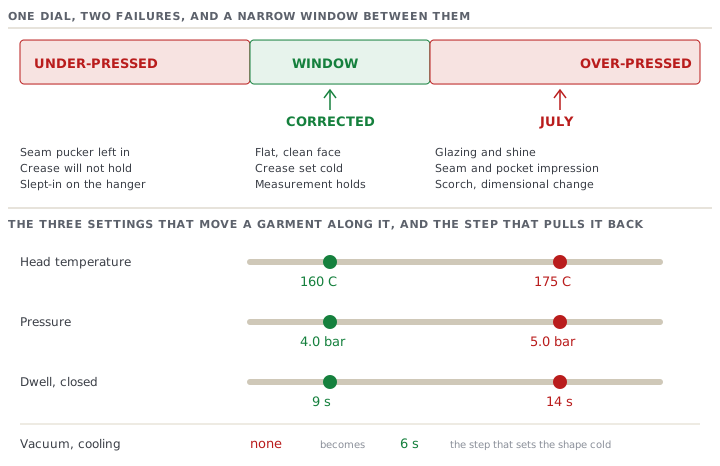
There are four variables. Every argument on a finishing floor is really about one of them.
- Temperature, at the head and at the buck.
- Pressure, in bar, from the head onto the buck.
- Dwell, the seconds the head stays closed.
- Steam and vacuum. These are not the same thing. Steam softens the fibres. Vacuum pulls the moisture and the heat back out and sets the shape cold.
Under-press, and you get pucker that never came out, a crease that will not hold, and a garment that looks slept-in on the hanger. Over-press, and you get the right-hand column of the ledger. The same dial, turned the same way, cures one and creates the other. No setting is safe in both directions. There is only a window, and the window is narrower on a blended synthetic than on cotton.
The machines differ in how much of that dial they hand to an operator.
- A buck press is a shaped buck with a head that closes onto it. It gives all four variables to a person. It is the only machine that can put a sharp crease in a trouser leg. It is also the only one that can glaze a garment in eight seconds.
- A legger and topper pair splits a trouser into two jobs. The topper does the seat, the fly and the waistband on a shaped form. The legger takes both legs flat and sets the crease. This is how tailored trousers are pressed at volume.
- A steam tunnel is a conveyor through a steam chamber. It has no pressure at all. It relaxes creasing and freshens a garment. It cannot make a crease or a flat finish. It is excellent for knitwear and soft garments, and useless for a tailored trouser.
- A form finisher is a dummy inflated with hot air and steam inside the garment. It presses from the inside out and nothing touches the face, so it cannot glaze anything. It cannot put in a crease either.
Read that list again as a risk list. Every machine that can make a sharp finish can also make shine. Every machine that cannot make shine also cannot make a crease. That is not a coincidence. It is the same physics.
How the shine got into 2,150 pairs
Nobody made a mistake. Here is the chain, in order.
March. The delivery before June was flagged at the same distribution centre for seam pucker at the side seam and the waistband join. That was 214 pairs, charged back at cost: USD 2,097.20.
July. The finishing manager did exactly what he was asked to do. He raised the press setting. Head temperature went from 150 to 175 degrees Celsius. Dwell went from 8 to 14 seconds. Pressure went from 3.5 bar to 5.0 bar. He also dropped the vacuum-cooling step, because it added seconds to a cycle everyone wanted shorter.
It worked. Pucker complaints went to zero. Nobody wrote down that anything had changed except the pucker.
September. 2,150 pairs, glazed.
Here is the physics, at the level worth knowing. Polyester is thermoplastic. It softens with heat and keeps the shape it is pushed into. That is exactly why a crease survives, and exactly why the surface can be flattened for good. Its melting point is far above any press setting, so the damage is not melting. What happens is that the fibres at the very surface of the cloth are flattened until they stop scattering light and start reflecting it in one direction. Pressure and dwell do that as well as temperature does. So raising the pressure and the seconds while leaving the temperature alone will still glaze a garment. And a floor that watches only the temperature will not see it coming.
The fix costs nothing. Hold three pieces an hour from each press set. Take them to a window or a daylight booth, at 30 to 45 degrees to the light, next to the sealed sample. Look along the cloth rather than at it. If your building has no daylight, buy a booth, and keep the sealed sample in it.
What it cost
| Pieces | Basis | Amount | |
|---|---|---|---|
| The problem being cured: pucker | 214 | Charged back at cost | USD 2,097.20 |
| Shine: markdown allowance | 2,150 | 35% of FOB | USD 7,374.50 |
| Shine: customer returns, destroyed | 340 | Full FOB | USD 3,332.00 |
| Total cost of the cure | USD 10,706.50 |
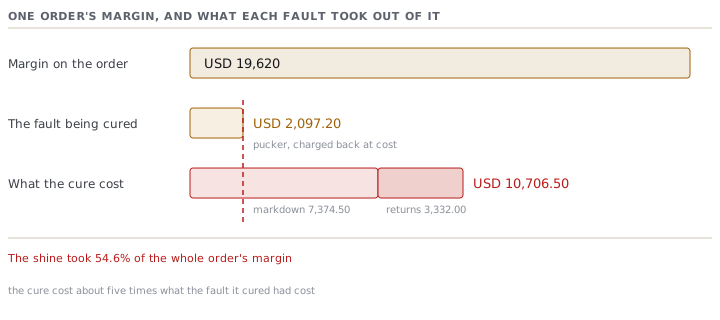
The margin on the June order was 18,000 pairs at USD 1.09, which is USD 19,620. The shine took 54.6% of it. The pucker it was curing had cost USD 2,097.20. So the cure was five times the disease. And every step of the chain was a reasonable decision, taken by a competent person.
The corrected setting, and the sentence nobody wants to hear
The press card for WT-5062 was rewritten on the fifteenth.
| July setting | Corrected setting | |
|---|---|---|
| Head temperature | 175 degrees Celsius | 160 degrees Celsius |
| Pressure | 5.0 bar | 4.0 bar |
| Dwell, closed | 14 seconds | 9 seconds |
| Steam | none | 4 seconds |
| Vacuum, cooling | none | 6 seconds |
| Buck cover | bare | silicone-coated, plus a press cloth on the crease |
| Cycle, whole pair, one set | 42 seconds | 50 seconds |
Steam does the softening that pressure and heat were doing badly. Vacuum sets the shape cold, and that is what actually makes a crease last. A press cloth between the head and the face means the head never touches the cloth the customer sees.
Then comes the sentence that decides the rest of this course: the correct setting is slower. Forty-two seconds became fifty. Each press set drops from about eighty-six pairs an hour to seventy-two. That is a loss of 14% of the floor's pressing capacity, on an order of 24,000 pairs, with a vessel already booked.
That is not an argument for the wrong setting. It is the reason lesson two exists. A finishing specification that nobody costed in minutes is a delivery problem wearing a quality label.
Spotting: the same shape, one station earlier
Spotting is chemical, and it fails the same way. A correct action, with a delayed consequence.
Identify before you spray. A water-based mark, such as a drink, chalk slurry or a water-soluble marker, needs water and steam. An oil or grease mark needs a dry solvent. Rust, ink and dye marks each need their own agent. Put a solvent on a water-based stain and you set it. After that, no amount of the correct chemical will lift it.
The ring is the tell. A solvent dissolves the stain and carries it outward. Then it evaporates and drops the stain at the edge. So work from the outside in, feather the edge, and dry with air rather than heat.
And then wait. Three delayed failures are common enough to plan for.
- An alkaline spotting agent that is not rinsed and neutralised keeps working in the carton. It shows up as a pale halo or a yellow cast weeks later.
- On a disperse-dyed polyester, local heat from a spotting gun or a later press can move dye to the fibre surface. The mark comes out and a faint ring of changed colour comes in.
- An optical brightener stripped in one spot by a solvent leaves a patch. It is the same colour under the tube lights and a different colour in daylight.
The control is one line on the spotting log: a spotted piece is re-inspected after twenty-four hours, in daylight, next to an unspotted piece. Not at the gun. Every spotting operator in the world has declared their own work perfect at the gun.
Measure after the press, and after the garment has calmed down
Pressing does one more thing that people forget to check. A legger clamps and stretches a leg, so the garment comes off longer than it went on.
On the corrected setting, WT-5062 measured 82.8 cm on the inseam straight off the legger. The specification is 82.0 cm with a tolerance of 1.0 cm, so a measurement taken there fails. Left flat for twenty-four hours, the same pieces measured 82.3 cm, and passed.
So measure after relaxation, not off the press. Build it into the schedule: a rack, a shift's wait, and the measuring table after it, never before. A final audit that measures pieces while they are still warm is measuring the press, not the garment. Course 6.x owns what happens when that audit fails.
Check yourselfYour final inspection passes a batch and the distribution centre rejects it for shine. Before you change anything on the press, what is the first thing to check?Show the answer
The light. Glazing is a specular defect. It is invisible under overhead diffuse light seen straight on, and that is the standard inspection geometry. Put a rejected piece and a passed piece side by side, at a low angle to daylight or in a daylight booth, before you touch a single setting. If your inspection cannot see the defect, changing the press only moves you to a different point on a dial you still cannot read.
Prompt · Change a press setting, and check the other failure
Before you raise a press to cure pucker, or lower one to cure shine, on any style where the press card has never been written down.
Act as a garment finishing manager who has seen both failures. I am about to change a press specification and I want the opposite failure checked before I do. Facts: buyer [BUYER], style [STYLE], garment type [TYPE], fabric [COMPOSITION] at [WEIGHT] gsm, colour or colours [COLOURS], quantity [QTY], FOB [PRICE]. Current press card: machine type [BUCK, LEGGER AND TOPPER, TUNNEL, FORM FINISHER], head temperature [C], pressure [BAR], dwell [SECONDS], steam [SECONDS], vacuum [SECONDS], buck cover [BARE OR COATED], press cloth [YES OR NO], cycle time per garment [SECONDS]. The defect I am trying to cure is [DEFECT], reported by [WHO] on [QUANTITY] pieces. Do the following. First, tell me which direction on the dial cures my defect and name every defect that lives at the other end for THIS fabric, specifically. Second, propose a revised press card, changing the fewest variables, and say what each change is for. Third, tell me what the revised card does to the cycle time in seconds and therefore to pieces per hour per press set, and say plainly whether that is a capacity problem for my order. Fourth, tell me the inspection geometry and light I need to see the opposite failure, and how many pieces an hour I should be pulling to check it. Fifth, tell me which measurements will move because of this change and when they should be taken relative to the press. Sixth, write the four lines that should go on the press card as a change record: date, reason, authoriser, and the check for the opposite failure. If a number I have given you is missing or looks wrong for this fabric, say so rather than working around it.
AI can make mistakes — check anything you act on.
What to take onto a floor tomorrow
- Write the ledger for your own style. Which of the faults your finishing floor "fixes" are really in the middle column? Those are your returns in eight weeks.
- A change to a press setting is a change to a product specification. It gets a date, a reason, an authoriser, and a check on the opposite failure.
- Inspect for shine in the geometry that shows it, and keep a sealed sample in that light.
- Every press card carries a cycle time. A quality decision that adds seconds is a capacity decision that nobody has costed yet.