Lessons · Lesson 2 of 3
The last week: what the finishing floor can actually do in an hour
Measure a finishing floor's real hourly rate, find the constraint that is not where you think it is, and price the queue before it prices you.
Lesson 2 of 3 · 35 min
Nobody had ever written the second number down
Every production plan is written from the sewing floor. That is where the people are, and where the minutes are measured. What comes after sewing is drawn as the last box on the chart. Everyone assumes it will swallow whatever arrives, the way a drain swallows water.
Drains have a diameter. This lesson measures one.
15 September. The planner's board on the wall of Anfushi's production office carries one number for each line and one for the order. Three sewing lines, 2,400 pairs a day, ten working days, 24,000 pairs, sewing complete on the seventeenth.
There is no number on that board for the finishing floor.
This is close to universal, and there is a reason for it. A plan is built from the sewing floor, because that is where the standard time is measured and where the money is spent. Finishing is the last box on the flow chart, and it is assumed to absorb whatever comes. For most of an order it does, because for most of an order the sewing floor has not yet reached full rate.
Then the line hits full rate, and the drain turns out to have a diameter.
Measure the floor, station by station, over a real week
Do not ask what a machine can do. Ask what this floor did, on days when it was working normally, on this style. Here are five days of counts, taken at the end of each shift, on WT-5062.
| Station | People | Rate per person-hour | Pairs a day |
|---|---|---|---|
| Thread trimming and turning | 12 | 30 | 3,060 |
| Spotting | 3 | 22 | 561 |
| Pressing, six sets | 14 | — | 1,860 |
| Final check | 6 | 52 | 2,650 |
| Packing | 9 | 35 | 2,700 |
Two readings come straight off this table.
Spotting looks tiny, and it is not a problem. About 6% of pieces need spotting. That is 144 a day against a capacity of 561. A station's capacity only matters against its own demand, and demand for spotting is a small fraction of the flow. Do not spend a day balancing a station that nothing queues at.
Pressing is the constraint, at 1,860 pairs a day. The sewing floor delivers 2,400. That is a shortfall of 540 pairs every single day. It is arithmetic, not bad luck. The floor is not badly run and every person on it is working. It simply cannot take what the building above it makes.
The queue, drawn day by day
A queue does not announce itself. It builds quietly in trolleys at the end of the sewing lines, where it looks like healthy work in progress rather than a delivery failure.
| Working day | Sewn, cumulative | Finished, cumulative | Waiting |
|---|---|---|---|
| Mon 7 Sep | 2,400 | 0 | 2,400 |
| Tue 8 Sep | 4,800 | 1,860 | 2,940 |
| Wed 9 Sep | 7,200 | 3,720 | 3,480 |
| Thu 10 Sep | 9,600 | 5,580 | 4,020 |
| Sat 12 Sep | 12,000 | 7,440 | 4,560 |
| Sun 13 Sep | 14,400 | 9,300 | 5,100 |
| Mon 14 Sep | 16,800 | 11,160 | 5,640 |
| Tue 15 Sep | 19,200 | 13,020 | 6,180 |
| Wed 16 Sep | 21,600 | 14,880 | 6,720 |
| Thu 17 Sep | 24,000 | 16,740 | 7,260 |
On the seventeenth the sewing floor finishes the order and goes quiet, and 7,260 pairs are standing in trolleys. At 1,860 a day that is another 3.9 days of finishing. Four working days, the nineteenth to the twenty-second, because the eighteenth is a Friday.
Planned ex-factory was the nineteenth. The container books out of Alexandria on the twenty-fourth, so the trucks have to leave Assiut on the twenty-second at the latest. The order finishes on the twenty-second, and the trucks do not leave until the twenty-third.
The whole delay was created before the fourth day of the run. It was visible on day one to anyone who divided 2,400 by 1,860.
Why pressing is 1,860 and not 2,790
This is the part that surprises people, and it is why you cannot fix the floor's rate by shouting at it.
Anfushi has six legger-and-topper sets. At the corrected fifty-second cycle from lesson one, a set does 72 pairs an hour. Six sets, 8.5 productive hours, and a measured utilisation of 76% give this:
six sets, at 72 pairs an hour each, over 8.5 hours, at 76% utilisation, is 2,790 pairs a day.
The floor produces 1,860. That is two thirds of what the presses can do on paper. And the missing third is not in the press room at all.
It is in the yard.
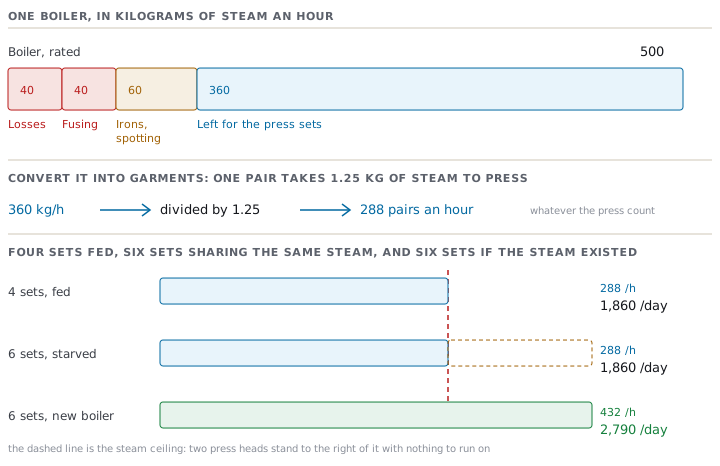
The finishing floor runs on a 500 kilogram-an-hour steam boiler. Steam is a mass, not a temperature, and every consumer on the header takes its share.
| Consumer | Kilograms of steam an hour |
|---|---|
| Boiler output, rated | 500 |
| Distribution losses: bare header, failed traps | 40 |
| Fusing press | 40 |
| Hand irons and the spotting station | 60 |
| Left for the press sets | 360 |
A legger-and-topper set running the corrected cycle uses about 90 kilograms of steam an hour. So the boiler can feed four sets. Anfushi has six.
Divide it the other way and the number becomes something you can plan with. A pair of WT-5062 takes about 1.25 kilograms of steam to press. 360 kilograms an hour divided by 1.25 is 288 pairs an hour. That ceiling does not care how many press heads stand under it. At 8.5 hours and 76% utilisation, 288 pairs an hour is 1,860 pairs a day. It is the number on the board, and it comes from a boiler rather than from a press.
Six sets sharing steam for four means the header pressure sags every time all six close together. The presses do not stop. They get slower and wetter, the operators wait for the gauge, and the shift ends with a third of the expected output missing and nobody able to point at the machine that lost it.
The two press sets that produced nothing
Now the mistake nobody made.
In July, after the June order shipped four days late for exactly this reason, Anfushi's management did the obvious, responsible thing. They bought two more legger-and-topper sets: USD 18,400 installed. The diagnosis was right. Pressing was the constraint. The action looked right too.
Output before the two sets arrived was 1,860 pairs a day. Output after they arrived was 1,860 pairs a day.
The extra sets cannot be fed. The steam that reaches the press room buys 288 pairs an hour, whether it is divided among four heads or six. Six starved sets add exactly two things over four fed ones: two more operators standing at them, and a longer wait at the pressure gauge. USD 18,400 bought nothing measurable.
The answer was always the boiler. A second 300 kilogram-an-hour unit costs USD 26,400 and has a seven-week lead time, which puts it well past this vessel. With it, the press room would have 660 kilograms an hour available. That is enough for 528 pairs an hour, more than the six sets can physically press. The floor would then be limited by the presses at 432 pairs an hour, which is 2,790 pairs a day. That is a gain of 930 pairs a day, half as much again as it makes now.
The missing 24%, and whether you can buy it back
Utilisation of 76% is not slackness. It was measured, and over the five days it breaks down like this. 9% starved and waiting for garments early in each shift. 6% waiting for steam pressure to recover after breaks. 4% changing over between navy and oatmeal. 5% unmanned during relief and meal rotation.
Read those four with the boiler in mind. The 6% is the boiler again. The 9% is the sewing floor's ramp, not the press room's fault. Only the 4% and the 5% are things a finishing manager can attack this week. Staggering the meal rotation, so that no press set stands idle, is worth roughly a hundred pairs a day and costs nothing. It is worth doing, and it does not close a gap of 540.
That is the honest position. The floor could have found perhaps a hundred pairs a day on its own, and it needed five hundred and forty.
Pricing the queue
There were two moments to spend money on this order, and they cost very different amounts.
Day one, planned. Three hours of overtime on the finishing floor, every production day. The floor is 44 people at a loaded rate of USD 1.15 an hour, so overtime at time and a half is USD 1.725. Three hours for 44 people is USD 227.70 a day. Across the ten production days, that is USD 2,277.00.
What does it buy? The press room runs at 218.8 pairs an hour. Three overtime hours at 85% of the daytime rate is 558 extra pairs, which takes the day's finishing to 2,418. That is just above the sewing floor's 2,400. The queue never builds, the order finishes on the nineteenth, and the trucks leave on time.
Day nine, in a panic. This is what actually happened, once somebody counted.
| Basis | Amount | |
|---|---|---|
| Twelve temporary staff, seven days | at USD 13.80 a day, loaded | USD 1,159.20 |
| Four hours of overtime, fifty-six people, six days | at USD 1.725 an hour | USD 2,318.40 |
| Late-shipment discount agreed with the buyer | 3% of order value | USD 7,056.00 |
| Total | USD 10,533.60 |
Set that against the USD 2,277.00 the overtime would have cost on day one. It is 4.63 times as much. The order's margin is USD 26,160, so the panic took 40.3% of it, and the prevention would have taken 8.7%.
Notice which line carries the money. The temporary staff and the overtime together are USD 3,477.60, a third of the total. The cost of a finishing bottleneck is almost never paid in the finishing room. It is paid in a discount, a chargeback or an air freight bill, by a department that never saw the trolleys.
The alternative to the discount was air freight for the tail, quoted at USD 9,148. How that quotation is built, and what a missed cut-off really costs, belongs to course 8.4. Read it before you ever have to ask for one. What matters here is that the quotation existed at all.
Check yourselfYour finishing floor produces 1,860 pairs a day against a sewing floor producing 2,400, and the order is 24,000 pairs. Without doing anything else, how late will the order be?Show the answer
The shortfall is 540 pairs a day for the ten days sewing runs, so 5,400 pairs are still unfinished when sewing stops. Add the day of lag at the start and you get 7,260 in the trolleys. Clearing that at 1,860 a day takes 3.9 days. So finishing ends about four working days after sewing does, instead of one: three working days late. All of it is knowable on day one, from two numbers you already have.
Prompt · Count my finishing floor and tell me when the order really lands
On the first day of a run, before the queue exists. Also the right prompt for the week you are told finishing is behind and nobody can say by how much.
Act as an industrial engineer who is sceptical of nameplate capacity. I want my finishing floor's real hourly rate and the date my order will actually be ready. Order facts: buyer [BUYER], style [STYLE], quantity [QTY], colours and their quantities [COLOURS], sewing output per day [PIECES] from [NUMBER] lines, first day of sewing [DATE], working days a week [NUMBER] and the rest day [DAY], ex-factory date [DATE], and the date the goods must leave the factory to make the booking [DATE]. Finishing floor: for EACH station — thread trimming, spotting, pressing, final check, packing — give me the people, the measured pieces per person-hour or per machine-hour, and the productive hours a day. Pressing detail: number of press sets, machine type, cycle time per garment in seconds, and measured utilisation with its breakdown if I have one. Shared services: boiler rating in kilograms of steam an hour, and everything else on the header. Do the following. First, give me each station's daily capacity and name the constraint station. Second, compare the constraint against the sewing output and give me the daily shortfall or surplus. Third, build a day-by-day table of cumulative sewn against cumulative finished and the pile between them, and tell me the pile on the day sewing ends and how many days it takes to clear. Fourth, give me the date finishing actually completes and compare it with both my ex-factory date and my truck date. Fifth, if the constraint is pressing, work out what one garment consumes of every shared service and tell me whether the presses or the service is the real ceiling. Sixth, price at least three ways to close the gap — overtime from day one, extra people, extra shifts, moving work off the constraint — each with a cost, the pieces a day it buys and the date it lands. Seventh, tell me what the shortfall will cost if I do nothing, including the commercial consequence, and compare it with the cheapest fix. Do not give me a range where a number is possible, and list every assumption at the end.
AI can make mistakes — check anything you act on.
What to take onto a floor tomorrow
- Every plan board carries the finishing floor's daily rate next to the line's. If you have never written it down, count it this week: five normal days, station by station, on the style you are actually running.
- The rate belongs to the constraint station, not to the average of the floor. The constraint is where the trolleys stand.
- Work out what one garment uses of every shared service, such as steam, air and extraction. Divide the supply by it before anyone signs an order for another machine.
- When the two rates differ, buy the overtime on day one. It is the cheapest thing on the table, and it is the only one that is still cheap in a week's time.
- The minutes side of this, meaning how a standard time is measured and defended and how capacity is booked across a season, belongs to courses 5.4 and 7.4. This lesson is only about the room everybody forgets to count.