Lessons · Lesson 3 of 3
Chargebacks: the deduction you find out about when you are paid
Read a chargeback schedule before it reads you: what a distribution centre charges for, why a barcode that scans can still fail, and what evidence has to exist before the deduction does.
Lesson 3 of 3 · 38 min
9 November
The last thing that happens to an order is that somebody pays for it. This lesson starts there, with a payment smaller than the invoice and no explanation.
A deduction like that is not a complaint you can answer. It is applied automatically, by a machine reading a label in a warehouse far away. And it is charged per garment, so a trivial-looking fee is multiplied by the largest number in the order.
The remittance advice arrives at 11:20. It is USD 21,751.82 short.
PO QU-6045 shipped 3,157 store-ready packs: 37,884 pieces in 790 cartons, invoiced at USD 221,621.40. It arrived at Quillon's distribution centre at Rugeley on 4 November. Nothing was late. Nothing was damaged. The audit passed. Nobody at Quillon telephoned.
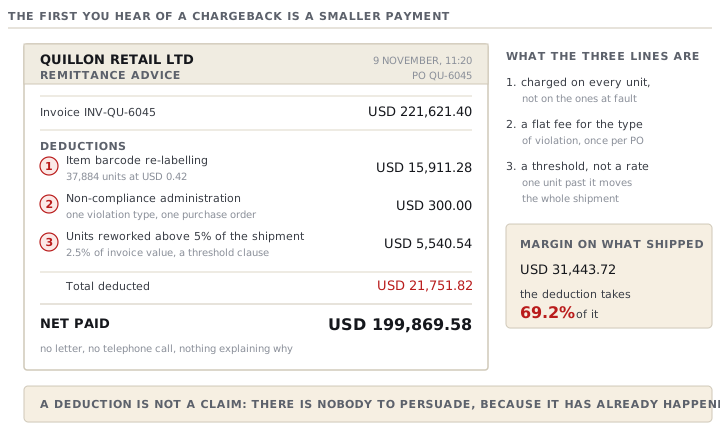
| Line | Basis | Amount |
|---|---|---|
| Item barcode re-labelling | 37,884 units at USD 0.42 | USD 15,911.28 |
| Non-compliance administration | One violation type on one PO | USD 300.00 |
| Units requiring rework above 5% of the shipment | 2.5% of invoice value | USD 5,540.54 |
| Total deducted | USD 21,751.82 |
The margin on what shipped is USD 31,443.72. The deduction is 69.2% of it. Nawara Apparel spent nine months on this order and kept less than a third of what it earned. The cause was a swing ticket that scanned perfectly two hundred times in a row on the factory floor.
What a chargeback actually is, and why it does not arrive as an invoice
A commercial claim is negotiated. Somebody writes to you, you answer, there is a conversation. Course 7.5 covers that whole exchange for a late delivery: how the recovery is priced and how the message is written.
A compliance chargeback is not that. It is a deduction, applied by the buyer's accounts payable system against a schedule you accepted with the purchase order. The first you hear of it is a payment smaller than your invoice. There is nobody to persuade at the moment it happens, because it has already happened.
Three consequences follow, and each one changes what you should do:
- It is calculated per unit or per carton, so it scales with your own order size. A fee that reads as trivial on the page is multiplied by the largest number in the order.
- It is applied by a system reading a scanner, not by a person forming a judgement. So it does not care why, and it does not care that the garments are perfect.
- It is disputed against evidence, inside a window, and the window is short. Quillon's is 30 days from the remittance date.
| Non-compliance | Charge |
|---|---|
| Item barcode fails to scan at induction | USD 0.42 a unit re-labelled, minimum USD 250 a shipment |
| Carton label missing, wrong or unreadable | USD 18 a carton |
| Packing list disagrees with carton contents | USD 16 a carton |
| Pre-pack ratio differs from the purchase order | USD 3.10 a pack rebuilt |
| Carton gross weight above the manual maximum | USD 12 a carton |
| Advance shipping notice not transmitted before the vehicle arrives | USD 500 a shipment |
| Purchase-order fill rate below 98% | USD 350 a purchase order |
| Non-compliance administration | USD 300 a purchase order, per violation type |
| Units requiring rework above 5% of a shipment | 2.5% of the purchase order's invoice value |
Read the last line separately from the rest. Every other row is linear: twice the fault, twice the money. That one is a cliff.
At 5% of 37,884 units the re-labelling charge is USD 795.48 and the administration fee is USD 300. One unit past it, the same shipment carries USD 5,540.54 more. The 1,895th re-labelled unit on this order costs USD 5,540.96.
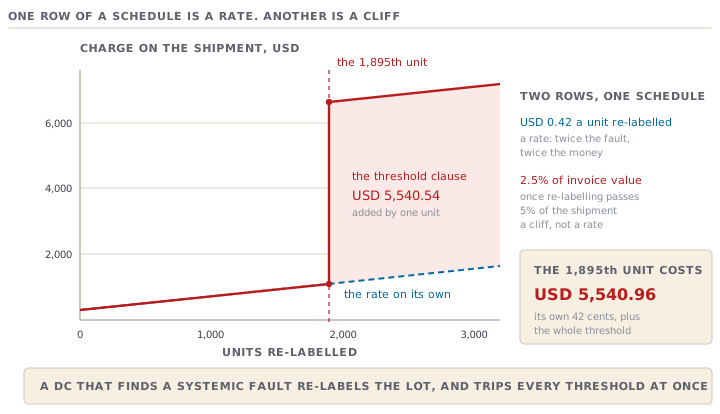
Threshold clauses are where the real money in a schedule lives. They are also the reason a shipment is never partly non-compliant in practice. Once a DC finds a systemic fault it stops sorting good units from bad, because sorting costs more than re-labelling. It re-labels the lot, which puts you over every threshold in the schedule at once.
The barcode that scanned
Here is what happened, in the order it happened. Every step is somebody doing their job properly.
11 May. Quillon's packaging design team approved a smaller swing ticket for the autumn basics programme: 38 by 60 mm instead of 50 by 80 mm. The reason was card consumption, the saving was real, and the artwork went to suppliers with an approval sheet. Nawara signed it.
2 September. Nawara's ticket station printed the tickets for LR-2840 on its thermal transfer printer. The operator loaded the new smaller template, dropped in the EAN-13 for each size and colour, and printed. The software fitted the symbol to the space available, which is what fitting to a template means, and printed it at 72% of nominal size. It gave no warning, because scaling artwork to fit is not an error.
2 September, the same afternoon. Nawara's QC pulled 200 tickets across the three colours and five sizes and scanned every one with the factory's handheld imager. 200 decoded, first pass. The check sheet was signed and filed. It is still in the file.
4 November. At Rugeley the cartons went onto the induction conveyor. Fixed laser scanners read the item barcode through the poly bag at about 700 mm, while the units move. The read rate on LR-2840 was poor enough that the line stopped. The DC pulled the shipment, verified one ticket, and re-labelled 37,884 units.
The verifier report is one page. Overall symbol grade 0.8, failing on modulation and edge contrast. Symbol magnification 72%. Quillon's manual requires an overall grade of 1.5 or better, and it requires the item symbol to be at least 80% of nominal size. Two clauses, both in the manual Nawara had, both broken by an approval Nawara signed.
A scan is not a verification
This is the part to take away, and it goes far past barcodes.
A scanner answers one question: did this symbol decode, for me, here, now? A handheld imager captures a two-dimensional picture and rebuilds the bars from it, so it decodes damaged, low-contrast and undersized symbols very willingly. Held still, at 150 mm, under a bench light, by a person who wants it to work, it will read almost anything. Two hundred out of two hundred is what you should expect it to say. It says nothing at all about the symbol.
A verifier answers a different question: does this symbol meet the standard, measured? It reports an overall grade under ISO/IEC 15416, together with the measuring aperture and the light wavelength it used. A grade quoted without those two is not a result. It also names the parameter that failed. That is a measurement, repeatable by anyone, and it is the only thing a DC will accept as evidence.
The gap between them is the entire failure. Nawara's evidence proved that a symbol decoded on a handheld imager. The clause it needed to satisfy was about a grade and a magnification, and it had measured neither.
Why it took six days to find
Quillon's e-commerce pick face is in a separate building, and its operators scan with handheld imagers. That is the same instrument Nawara's QC used. It had been picking LR-2840 without a single complaint since 6 November.
So for six days the buyer's two facilities gave opposite answers about the same ticket, and the argument stalled there. One building said the barcode is fine. The other had already re-labelled a shipment. What broke it was somebody putting a verifier on it, which is to say: replacing two opinions with a measurement.
Expect this. A symbol is not scannable or unscannable. It has a grade, and different equipment fails at different points on that scale. If two people disagree about a barcode, neither of them is wrong and neither of them has measured it.
What prevention actually costs
| Cost | When | |
|---|---|---|
| Print at 100% and make the ticket fit the symbol, rather than the reverse | nil | 11 May, at artwork approval |
| One verification report on one printed ticket, from a local laboratory | USD 40 | 2 September, before the bulk print |
| A desktop verifier at the ticket station, over the 61 styles Nawara prints in a year | USD 4,150, or USD 68 a style | Once |
USD 21,751.82 against USD 40. But the honest version of that comparison is not about the money, because the USD 40 buys something the USD 0 does not. The first row prevents this particular failure. The second row detects the ones you have not thought of.
Prevention as a process, not as care
Telling a packing hall to be careful is not a control. Four things are.
- A sealed first pack, approved before bulk. Build one complete pack and one complete carton exactly to the current manual revision. Photograph every face, and get the buyer's QA to sign it. Keep it sealed in the packing office for the whole run. Every dispute afterwards is settled by opening it, and every new operator is trained against it rather than against a description.
- A verifier report per symbol, per style, per ticket supplier, filed with the date. Not a scan log. The report names the grade, the aperture and the wavelength, and it is the only document that answers the clause.
- A manual revision register with a named owner. This is lesson 1's discipline applied to the other half of the manual. Log every revision the day it arrives, read its chargeback clauses, and push any change to a symbol, a label or a ratio back to whoever prints them. The register also tells you which revision was in force on your packing date, which is the first question in any dispute.
- A first-carton audit at the start of packing, against the schedule, not against the specification. Take the chargeback table itself onto the floor on the first morning and walk the first carton down it, row by row. Nine rows, twenty minutes, once per order. It is the cheapest audit in the factory, and it is the only one aimed at the thing that will actually be charged.
Disputing one, and why you usually cannot
Nawara disputed. It had a signed check sheet showing 200 tickets scanning first time, and a QC signature. It was submitted inside the 30 days.
Quillon refused it in two lines, correctly. The manual specifies a grade and a magnification. A scan log evidences neither. And the magnification was 72%, on the evidence Nawara itself supplied.
The rule to take from that is worth more than the USD 21,751.82:
The evidence that wins a chargeback dispute has to be created before the chargeback exists, and it has to measure the thing the manual measures.
After the deduction, no document you can produce is contemporaneous, and no measurement you take is of the goods that were charged. The four controls above are not paperwork. They are the only version of the evidence that will still be admissible in November.
Prompt · Audit yourself against the chargeback schedule before the carton closes
On the first morning of packing, and again before the pre-shipment inspection.
Act as a compliance auditor for a garment factory, working from a buyer's chargeback schedule rather than from a specification. Facts: buyer [BUYER], purchase order [NUMBER], [PIECES] pieces in [CARTONS] cartons, invoice value [AMOUNT], packs of [NUMBER] in ratio [RATIO]. Here is the chargeback schedule from the manual: [PASTE EVERY ROW WITH ITS FEE AND ITS BASIS]. Here is what my packing hall is actually doing: [DESCRIBE THE PRESENTATION, THE BAG, THE TICKET AND WHO PRINTS IT, THE LABELS, THE INNER PACK, THE CARTON, THE MARKS, AND HOW THE PACKING LIST IS GENERATED]. Do the following. First, restate every row of the schedule in MY numbers, which means the fee multiplied by my piece count or my carton count, so I can see what each row is worth on this order, and rank them by exposure. Second, identify every THRESHOLD clause. Tell me the exact unit count or percentage at which it trips, and what the unit immediately past it costs. Third, for each row, name the single document or measurement that would prove compliance in a dispute, and say whether that document exists in my process today or has to be created before the goods leave. Fourth, tell me specifically which of my checks measure the wrong thing: a scan log where a verifier report is required, a photograph where a sealed sample is required, a count taken from the purchase order where it should be taken from the carton. Fifth, write me a first-carton audit I can walk in twenty minutes on the first morning of packing, as a numbered list following the schedule row by row. Sixth, tell me what to do differently if a deduction has ALREADY landed and I am inside the dispute window. Be specific about evidence and dates, and do not tell me to be careful.
AI can make mistakes — check anything you act on.
Check yourselfYour buyer charges USD 0.35 a unit for re-labelling and 2% of invoice value once re-labelling passes 4% of the shipment. Your order is 22,000 units at USD 9.10. You find, before shipping, that about 700 units carry a doubtful label. What do you do?Show the answer
Re-label all 22,000 yourself, or fix the 700 with certainty and prove it. Work the cliff first. 4% of 22,000 is 880 units. Seven hundred is under it, so if the DC finds exactly your 700 the charge is USD 245 and no percentage clause. But you do not know it is 700. You know it is about 700, and the number that decides whether the threshold trips is the DC's count, taken on their equipment, not yours. If it turns out to be 900, the charge is USD 315 plus 2% of USD 200,200, which is USD 4,004: a difference of USD 4,074 hanging on 200 units nobody has measured. So the decision is not about the 700 units. It is about the distance between your count and the threshold, and about who is holding the instrument that produces the count. When the gap is that narrow, buy the certainty.
Check yourselfA DC deducts USD 3,100 for pre-pack ratios that differ from the purchase order. You are certain your packs were right. What do you look for first, and what would have made this winnable?Show the answer
Look first at which revision of the ratio was in force on your packing date, and then at what was printed on the inner content label. A pack whose contents are right and whose label says something else is charged as a wrong pack, and from the DC's side those two are indistinguishable. That is the same mechanism as the barcode: the system is reading a label, not a garment. What would have made it winnable is the sealed first pack. One approved, signed, dated pack, built to the revision you were working to and kept whole, is the only object that proves what a correct pack looked like on your packing date. A photograph of a pack you opened, taken afterwards, proves that you opened a pack.