Lessons · Lesson 1 of 3
The packing manual is a contract, and it is priced in
Read a buyer's packing manual as a cost. Turn each clause into minutes and trims, and find out at quotation what it does to your packing room.
Lesson 1 of 3 · 42 min
The situation
A buyer sends you instructions on how to fold, bag, label and box the garments. They read like housekeeping. Somebody acknowledges them, files them, and nobody ever costs them.
They are a contract. When you accept the order, you accept them. And every clause lands in the room furthest from the person who agreed the price. This lesson turns each clause into minutes of work, or into something you have to buy.
22 September, 06:40, the packing hall at Nawara Apparel in Sixth of October City. The first trolleys from line 2 have arrived. Hoda, the supervisor, is holding two documents that do not agree.
The order is PO QU-6045 for Quillon, a British value-fashion chain. Quillon has 212 stores and one national distribution centre at Rugeley. The order is 38,400 men's cotton jersey pyjama shorts, style LR-2840, 180 g/m² single jersey, elasticated waistband. Three colours: Marine 19,200, Sandstone 11,520, Fern 7,680. FOB USD 5.85 a piece. Order value USD 224,640. On board 12 October.
The first document is the packing instruction the sample room used in June. It came from Quillon Supplier Manual revision 8: fold flat, one poly bag a piece, sixty pieces to a carton.
The second is an email printed that morning. Quillon Supplier Manual revision 9, issued 6 April, effective for goods packed on or after 1 July. It requires every piece folded to a stated size over a card back-board, and a printed size strip on the face of the bag. The garments then go into sealed twelve-piece store-ready inner packs in a fixed size ratio, and each inner pack is labelled.
Nobody did anything wrong. Quillon's packaging team issued the revision on notice. Nawara's merchandiser acknowledged it on 9 April with "Noted, thank you", and filed it. Quality read it. The sample room did not. It was working in June from a packing instruction written in March.
The cost of those two documents is USD 3,234.10. It was decided in February.
What a packing manual actually contains
A buyer's packing manual is not a packing instruction. It is the operational annex to the purchase order. In most supplier agreements it is incorporated by reference, which means you agreed to it when you accepted the PO, whether or not you opened it.
It has nine parts. They arrive from at least three different departments inside the buyer.
| Part | What it fixes | Whose department |
|---|---|---|
| Presentation | Flat or hanging, fold sizes and tolerance, boards, clips, tissue, garment orientation in the bag | Visual merchandising |
| Poly-bag | Material, thickness, self-seal or heat-seal, perforation, the warning text and its languages, bag size against the folded garment | Packaging and compliance |
| Garment labels | Brand, size, care, fibre content, country of origin, the order they appear in and where they are sewn | Technical and legal |
| Price ticket | Ticket size, artwork, how it is attached, where it goes, and who prints it | Merchandising and design |
| Barcodes | Which number, which symbology, print quality, size, quiet zone, placement | Logistics systems |
| Assortment | Solid, ratio or pre-pack; the ratio itself; how the inner pack is built; mixed-colour rules | Buying and allocation |
| Carton | Sizes or maxima, gross weight limit, board grade, tape, strapping | Logistics |
| Carton marks | Shipping marks, side marks, the exact fields and where they sit, the logistics label | Logistics |
| Documentation | Packing list format, advance shipping notice and its timing, what travels inside the carton and what travels outside | Supply chain systems |
Two things in that table cause most of the damage.
The first: no single person at the buyer owns the whole manual. So a change made by one department, for a perfectly good reason, is never tested against the clauses another department wrote.
The second: every part of it lands in one room of your factory. That room is the packing hall, and it is the room furthest from the person who agreed the price.
There is a tenth part, the chargeback schedule. It is the subject of lesson 3.
Turning a clause into a number
The real skill in this lesson is a conversion. A manual is written in sentences. A cost sheet is written in minutes and cents. Every clause converts into one of these, or two of them, and nothing else:
- Minutes. Somebody performs an operation on every piece, or on every pack, or on every carton. Multiply by the right count. A clause reading "each inner pack shall be verified against its content label before sealing" is a person opening, counting and closing. Charge it per pack, not per piece.
- Trims and consumables. A physical item that goes in the box: board, strip, bag, label, ribbon, tape, tag pin.
- Neither. Many clauses cost nothing, because you already do the thing. Read them, tick them, move on.
The method is mechanical. Print the manual. Go through it clause by clause with the packing supervisor beside you, not with the merchandiser. Against each clause write min/piece, min/pack, min/carton, USD/piece, USD/pack, USD/carton, or nil.
It takes about two hours for a manual you have never seen, and forty minutes for a revision. It is the cheapest two hours in the order.
Revision 9, costed
Here is that conversion on the two versions of Quillon's manual, measured at Nawara's own packing benches.
| Operation | Revision 8 | Revision 9 |
|---|---|---|
| Thread trim and turn | 0.24 | 0.24 |
| Steam and fold | 0.48 | 0.72 |
| Poly bag, self-seal, attach ticket | 0.31 | 0.31 |
| Apply size strip to the bag face | nil | 0.14 |
| Build, verify, seal and label the inner pack | nil | 0.242 |
| Count into carton and close | 0.11 | 0.11 |
| Minutes a piece | 1.14 | 1.762 |
Two lines moved.
The fold went from 0.48 to 0.72. A fold to a stated size over a back-board is a different operation from a fold: the operator squares the garment to the board, and a piece outside the tolerance goes back.
The inner pack is 2.90 minutes of work spread over the twelve pieces inside it. Build the ratio, count it, check it against the content label, bag it, seal it, label it.
The difference is 0.622 minutes a piece. Over 38,400 pieces that is 23,884.8 minutes, or 398.1 operator-hours. Nawara's loaded packing rate is USD 4.74 an hour, which is USD 0.079 a minute. So the labour is USD 1,886.90.
Then the trims.
| Item | Unit cost | Count | Cost |
|---|---|---|---|
| Card back-board, 350 gsm | USD 0.021 | 38,400 pieces | USD 806.40 |
| Printed self-adhesive size strip | USD 0.009 | 38,400 pieces | USD 345.60 |
| Inner bag, twelve-piece | USD 0.043 | 3,200 packs | USD 137.60 |
| Inner content label and ribbon | USD 0.018 | 3,200 packs | USD 57.60 |
| Total | USD 1,347.20 |
USD 1,886.90 plus USD 1,347.20 is USD 3,234.10, or USD 0.0842 a piece.
The margin on LR-2840 is USD 0.83 a piece: FOB USD 5.85 against a made cost of USD 5.02. So the order carries USD 31,872 of margin. One document revision, acknowledged in a sentence, took 10.1% of it.
The clause that decides which revision binds you
Read that effective date again: goods packed on or after 1 July. Not goods ordered after. Not purchase orders issued after. Not seasons beginning after.
QU-6045 was costed on 4 February and issued on 26 February. Both against revision 8. It was packed in September.
A manual binds by the packing date. The packing date is the one date in the order that is furthest from the price. Every open order in the factory moved to revision 9 on the same morning, including the ones already cut.
Find that clause in your buyer's manual before anything else in it. It tells you how much of your order book a revision can reach. Three shapes are common, and they are very different:
- Binding on goods packed after a date reaches everything you have not yet packed.
- Binding on purchase orders issued after a date reaches nothing you have already priced.
- Binding on seasons commencing after a date reaches nothing until next year.
You do not choose which one your buyer uses. You do choose whether you know.
The packing hall becomes the constraint
The cost is the visible half. The half that moved the ship date is capacity.
Nawara ran three lines on LR-2840: 26 operators a line, 510 working minutes a shift, 82% efficiency against an SMV of 6.8 minutes. That is 1,599 pieces a line a day, and 4,797 a day across three lines. The plan was written on 4,800. Eight days of sewing for 38,400 pieces.
The packing hall is 14 people on a nine-hour shift: 7,560 working minutes a day.
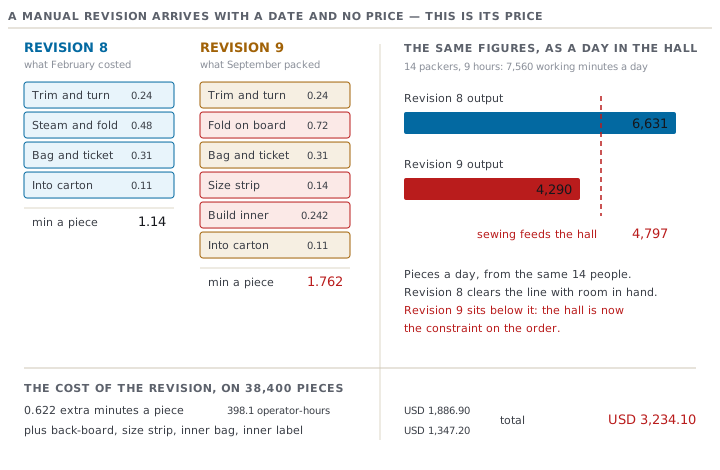
At revision 8's 1.14 minutes a piece, the hall can pack 6,631 pieces a day. The sewing lines feed it 4,797. The hall is 72% loaded. Nobody looks at it, and nobody has ever called it a constraint.
At revision 9's 1.762 minutes a piece, the hall can pack 4,290 pieces a day. That is 507 pieces a day less than the lines produce. The packing hall is now the constraint on this order, and it happened by email in April.
The whole 38,400 takes 8.95 days to pack instead of 5.79. Nawara bought 189 of the extra hours from a labour agency at USD 5.95 an hour, against the USD 4.74 the costing assumed. That is USD 228.69 more than costed, for the same work. It took the rest out of overtime, and the order still left the factory a day late.
What you do at quotation
The whole lesson collapses into one instruction: the manual is priced into the order whether or not anybody costed it, so cost it before you quote.
- Ask for the manual with the enquiry, and ask for the revision number. If a buyer will not send it before an order, that is information about the order.
- Find the effective-date clause first. It tells you what a future revision can reach.
- Do the clause-by-clause conversion with the packing supervisor. Put the result on the cost sheet as its own named line, "packing to Quillon manual rev 9". Never bury it inside a general finishing line. A named line survives a price negotiation. A buried one is invisible when the manual changes.
- Divide the packing minutes into the hall's daily capacity and compare it with the sewing plan. If packing is the smaller number, you have found your constraint before the order arrives, rather than on the first morning of packing.
- Register every revision the day it arrives. Give it a named owner, a costed difference and a decision: absorb, quote, or ask. Acknowledging is not one of the three.
Quillon would almost certainly have paid for some of revision 9 if asked in April. In April it was a conversation about a document. In September it was a request to change an agreed price, which is a different conversation with a different answer.
Prompt · Turn a packing manual into minutes and cents, before you quote
When a buyer sends a supplier manual with an enquiry, or issues a revision to one you are already working to.
Act as a garment factory packing manager who has to cost a buyer's packing manual before a price is agreed. Order facts: buyer [BUYER], style [STYLE], quantity [QTY] pieces, colours and quantities [LIST], FOB [PRICE] a piece, made cost before packing [AMOUNT], target ship date [DATE], planned packing window [DATES]. My packing hall is [NUMBER] people on a [NUMBER]-hour shift. My loaded packing rate is [AMOUNT] an hour. My sewing plan is [NUMBER] lines at [PIECES] a day. Here is the manual, or the revision: [PASTE IT, INCLUDING THE EFFECTIVE-DATE CLAUSE AND ANY CHARGEBACK SCHEDULE]. Do the following. First, find the effective-date clause and tell me plainly which of the three common forms it takes: binding on goods packed after a date, on purchase orders issued after a date, or on seasons commencing after a date. Then tell me which of my open orders it reaches. Second, go through the manual clause by clause. Against each one write minutes per piece, minutes per pack, minutes per carton, a cost per piece, per pack or per carton, or nil, and say which you had to assume. Third, total the minutes into a figure per piece and multiply it out to operator-hours and to money at my rate. Fourth, total the trims and consumables separately, with a unit cost and a count for each. Fifth, and do this even if the cost looks small: divide my packing hall's daily working minutes by the minutes per piece, compare the result with my sewing output, and say whether packing has become the constraint. Sixth, give me the single cost-sheet line I should add, named after the manual and its revision number. Seventh, list anything in the manual I should be negotiating rather than absorbing, with the reason. Do not give me ranges where a number is possible, and name every assumption in a list at the end.
AI can make mistakes — check anything you act on.
Check yourselfYour buyer's manual revision adds a hangtag that takes 0.09 minutes to attach and costs USD 0.014. Your order is 24,000 pieces and your loaded packing rate is USD 0.079 a minute. What is the number you put in front of the buyer, and what is the number you keep for yourself?Show the answer
The number in front of the buyer is the cost. 24,000 times 0.09 is 2,160 minutes. At USD 0.079 that is USD 170.64 of labour. Add 24,000 times USD 0.014, which is USD 336.00 of tag. Total USD 506.64, or USD 0.0211 a piece. That is what you ask for, and on most orders it is small enough that you will absorb it. The number you keep for yourself is the capacity one, and it is the one that can hurt you. 2,160 minutes is 36 operator-hours. Divide it into your packing hall's daily minutes and ask whether the hall still keeps up with the sewing lines. A clause that costs almost nothing a piece can still move your ship date, and no cost sheet has a column for that.
Check yourselfA manual revision arrives on 14 March, effective for goods packed on or after 1 May. You have four open orders. Which of them does it reach?Show the answer
Every one that will still be unpacked on 1 May. That includes orders priced last year, orders already cut, and orders whose fabric is already in the store. The trigger is the packing date, not the order date. So the reach of the revision is decided by your own production plan, not by the buyer's. The first thing to do is not to read the clauses. List your open orders against their packing dates and draw the line at 1 May. That tells you the exposure in pieces before you know the cost in cents. It also tells you which orders you could still pull forward past the date, if the cost turns out to be large.