Lessons · Lesson 2 of 3
Assortments: the pack is the unit, and the pack is indivisible
Build a cut plan for a ratio pack, price what one short size does to a whole shipment, and see where the buyer's ratio and an efficient lay disagree.
Lesson 2 of 3 · 40 min
Two complaints on one morning
A shop does not want a thousand garments of one size. It wants a few small, more of the middle sizes, and a few large. They arrive in one sealed bundle it can put straight on a shelf.
Once an order is sold that way, the thing you are shipping is the bundle. And a bundle missing one garment cannot be invoiced at all.
7 October, Nawara Apparel. Two people walk into the merchandiser's office within twenty minutes of each other.
The finished-goods storekeeper says he has 803 pyjama shorts he cannot put anywhere. They are good garments: audited, bagged, ticketed. There is no carton they belong in.
The shipping clerk says the shipment is 516 pieces short, and asks what to tell Quillon.
Those are the same event. Nobody made a mistake to produce it. The cutting room applied the factory's standing 3% cut allowance to every size, correctly. Total loss from cut to packed good was 2.187%, comfortably inside the allowance and the best figure the cutting room has posted this year. The fill rate on the shipment is 98.656%, inside Quillon's 98% floor. So no chargeback follows, and no report anywhere turns amber.
The cost to Nawara is USD 2,933.64. This lesson is how it was available in week one.
Three ways to pack an order
| Solid pack | Ratio pack | Store-ready pre-pack | |
|---|---|---|---|
| What is in the carton | One size, one colour | One colour, sizes in a fixed ratio | Sealed inner selling units, ratio inside each |
| Who breaks it down | The buyer's DC, piece by piece | The DC, carton to store | Nobody. The inner goes on the shelf |
| Packing minutes a piece | Lowest | Middle | Highest |
| Cutting-room freedom | Highest | Constrained by the ratio | Constrained by the ratio |
| What a short size does | Costs you that size | Costs you whole packs | Costs you whole packs |
| Who pays for the labour | The buyer, inside the DC | Shared | You |
| Where it is used | Wholesale, replenishment, single-size lines | Most fashion multiples | Value chains, promotions, big-box |
The trade is straightforward, and it is not a trade the factory makes. Every step to the right moves handling out of the buyer's distribution centre and into your packing hall. The buyer's manual is where that decision is recorded.
Lesson 1 priced the minutes. This lesson is about what the same decision does to the cutting plan, which is the part nobody prices at all.
The pack is the unit of shipment
QU-6045 ships as store-ready pre-packs: twelve pieces, one colour, sizes in the ratio 1/3/4/3/1 across S, M, L, XL and XXL. Quillon buys 3,200 of those packs: Marine 1,600, Sandstone 960, Fern 640.
Write the size requirement out, and the first thing worth noticing appears immediately.
| Size | In each pack | Pieces required | Share of the order |
|---|---|---|---|
| S | 1 | 3,200 | 8.3% |
| M | 3 | 9,600 | 25.0% |
| L | 4 | 12,800 | 33.3% |
| XL | 3 | 9,600 | 25.0% |
| XXL | 1 | 3,200 | 8.3% |
| Total | 12 | 38,400 |
You are not shipping 38,400 pyjama shorts. You are shipping 3,200 packs, and a pack is indivisible. Eleven pieces and a gap is not a pack. It is eleven pieces you cannot invoice. Quillon's DC will not open it, its scanner expects one number for the whole inner, and its allocation system has already told 212 stores what is arriving.
That single sentence contains the whole arithmetic of an assortment. It also contains the trap, because it means a shortage is not measured in the size that is short.
The multiplier
If a size runs short, the pieces you lose from the shipment are not the missing ones. They are the whole packs those missing pieces would have completed.
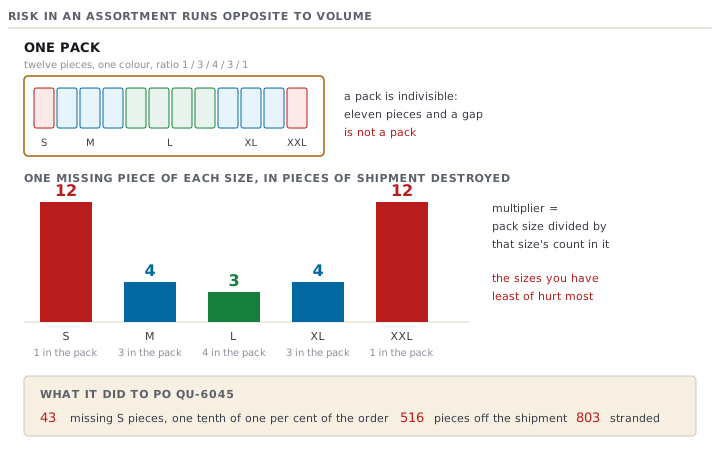
The multiplier is the pack size divided by that size's count in the pack.
| Size | In each pack | Multiplier | One missing piece removes | And strands |
|---|---|---|---|---|
| S | 1 | 12 | 12 pieces of shipment | 11 good garments |
| M | 3 | 4 | 4 pieces | 3 good garments |
| L | 4 | 3 | 3 pieces | 2 good garments |
| XL | 3 | 4 | 4 pieces | 3 good garments |
| XXL | 1 | 12 | 12 pieces | 11 good garments |
Read the first and last rows against the middle one. The sizes you have least of are the sizes that hurt most, by exactly a factor of four here. And they are the sizes a cutting room treats as an afterthought, because they are the smallest numbers on the plan and the shortest lays on the table.
That inversion is the finding. Everywhere else in a factory, attention follows volume. In an assortment, risk runs the opposite way from volume.
What the flat allowance did
Nawara's standing instruction is a 3% cut allowance, applied to every size. It is a good instruction. It has served this factory for eleven years on solid-colour, solid-size orders, where a surplus in one size is simply a surplus and a shortage in another is simply a shortage.
Here is the whole Marine colour, which is half the order.
| Size | Required | Cut at 3% | Loss | Good | Packs this size supports |
|---|---|---|---|---|---|
| S | 1,600 | 1,648 | 4.2% | 1,579 | 1,579 |
| M | 4,800 | 4,944 | 2.0% | 4,845 | 1,615 |
| L | 6,400 | 6,592 | 1.9% | 6,467 | 1,616 |
| XL | 4,800 | 4,944 | 2.0% | 4,845 | 1,615 |
| XXL | 1,600 | 1,648 | 2.4% | 1,608 | 1,608 |
| Total | 19,200 | 19,776 | 19,344 | 1,579 |
The last column is the only one that matters, and the answer is its smallest number: 1,579 packs, against 1,600 required. Twenty-one packs short. The other four sizes each carry enough for more than 1,600 packs, and every spare piece in them is now stock.
Why does S lose more? Because of where it sits. In a ratio marker the small sizes are nested at the ends of the marker length, and the ends of a lay are where the spread is least controlled. That means ply ends, splices, the last metres off a roll, and the end-of-ply allowance where the cloth is not fully relaxed. Fabric faults and shade steps land there too.
This is a cutting-room fact, not a coincidence, and every cutting master knows it. Nobody had ever needed to act on it, because on a solid order it costs you a few small garments.
Run the same table across the three colours and the order looks like this.
| Colour | Packs required | Cut | Good | Packs built | Packs short | Garments stranded |
|---|---|---|---|---|---|---|
| Marine | 1,600 | 19,776 | 19,344 | 1,579 | 21 | 396 |
| Sandstone | 960 | 11,865 | 11,606 | 947 | 13 | 242 |
| Fern | 640 | 7,911 | 7,737 | 631 | 9 | 165 |
| Total | 3,200 | 39,552 | 38,687 | 3,157 | 43 | 803 |
Forty-three pieces of S, which is 0.11% of the order, removed 516 pieces from the shipment and left 803 finished garments with nowhere to go. Both of the storekeeper's numbers and both of the shipping clerk's are on that line.
The money, and why nothing turned red
| Amount | Where it shows | |
|---|---|---|
| Margin on 516 pieces not shipped | USD 428.28 | Nowhere. The invoice is simply smaller |
| 803 stranded garments, made at USD 5.02, realisable at USD 1.90 | USD 2,505.36 | Finished-goods stock, at full value, until somebody writes it down |
| Total | USD 2,933.64 |
Cutting loss 2.187% against a 3% allowance: green. Fill rate 98.656% against a 98% floor: green. Two reporting lines exist precisely to catch this, and both said the order was fine, because neither of them is measured in packs.
The stranded 803 are an awkward shape as well as an awkward number. They are M, L, XL and XXL with no S at all, which is the one assortment nobody wants. A jobber prices that below a broken size run, because it cannot be re-sorted into anything a shop will take.
The plan that was available in week one
Do not raise the allowance. Redistribute it, and stop counting in pieces.
Work backwards from packs. For each size, the good pieces you need are packs times the count in the pack. The pieces you must cut are that number divided by one minus that size's own loss rate, which the cutting room already knows from its history. Then cut the ratio marker at the lowest number of plies any size needs, and put the difference into short balancing lays for the sizes that need more.
| Size | Good needed | Loss rate | Cut needed | From the ratio marker | Balancing lay |
|---|---|---|---|---|---|
| S | 1,600 | 4.2% | 1,671 | 1,631 | 40 |
| M | 4,800 | 2.0% | 4,898 | 4,893 | 5 |
| L | 6,400 | 1.9% | 6,524 | 6,524 | nil |
| XL | 4,800 | 2.0% | 4,898 | 4,893 | 5 |
| XXL | 1,600 | 2.4% | 1,640 | 1,631 | 9 |
| Total | 19,631 |
The ratio marker runs at 1,631 plies, the number L needs. Four short lays of 40, 5, 5 and 9 pieces follow it. The S lay is one marker, forty plies, about thirty minutes at the table including the spread. Call it USD 28 of set-up.
Across the three colours this plan cuts 39,266 pieces against the flat plan's 39,552. It is 286 garments smaller, it uses less cloth, and it builds all 3,200 packs instead of 3,157.
That is the sentence worth carrying out of this lesson. The flat allowance was too generous overall and too thin exactly where it mattered, at the same time. Both faults came from the same cause: a percentage cannot see a pack.
Prompt · Build the cut plan in packs, not in percentages
Before the first lay of any order that ships as ratio packs or store-ready pre-packs.
Act as a cutting-room planner working on an order that ships as fixed-ratio packs. Order facts: [QTY] packs, pack size [NUMBER] pieces, ratio [WRITE IT, e.g. 1/3/4/3/1] across sizes [LIST], colours and pack counts [LIST]. My standing cut allowance is [PERCENT]. My historical loss rate from cut to packed-good, BY SIZE, is [LIST — if I do not have it by size, say so and tell me how to get it from the last three orders]. Maximum practical plies for this fabric [NUMBER]. Do the following. First, write out the piece requirement size by size and colour by colour. State the multiplier for each size, which is the pack size divided by that size's count in the pack, so I can see which size is the dangerous one. Second, show me what my flat allowance actually delivers: cut quantity by size, expected good pieces by size, the number of complete packs each size supports, and therefore the packs I can build and the pieces that will be stranded. Third, rebuild the plan backwards from packs: for each size, the good pieces needed and the cut quantity that produces them at that size's own loss rate. Fourth, express that as a ratio marker run at the lowest number of plies any size needs, plus balancing lays for the rest, and tell me how many extra lays and set-ups that costs. Fifth, compare the two plans on total pieces cut, cloth used and packs delivered. Sixth, tell me what to put on the cutting room's daily board so the shortfall is visible on day two rather than at packing. Seventh, list what I could ask the buyer for that would reduce the risk at no cost to them. Do not raise my allowance uniformly as an answer, and show every calculation so I can check it.
AI can make mistakes — check anything you act on.
Where the buyer's ratio and an efficient lay disagree
The balancing lay resolves a real conflict. It is worth naming, because your cutting master will resist it, and he is not being difficult.
A cutting room is measured on fabric utilisation and on lays cut. Its instinct is few markers, long lays, high plies. A big mixed-size marker nests well, and a long lay spreads the cost of spreading. Four extra lays of forty pieces is the opposite of everything it is rewarded for.
How a marker's efficiency is built is course 4.5's subject, and this course does not re-derive it. What belongs here is that the ratio has already fixed the size mix before the marker is drawn. So the only freedom left in the plan is where the top-up comes from.
Three things you can negotiate with the buyer, before the order, that make the cutting room's life easier without costing the buyer anything:
- A pack tolerance. Ask for permission to ship a small number of packs over or under the ordered quantity. Most manuals already carry an order tolerance in pieces. Ask for it restated in packs, because in pieces it is worthless to you.
- Fewer sizes in the inner. A twelve-piece inner running 1/3/4/3/1 has two sizes at a multiplier of 12. Two inner types, one covering the small sizes and one the large, halve the worst multiplier. They often suit the buyer's store grades better anyway.
- Solid inners inside a mixed carton. The DC gets its ratio at carton level, the store still gets its sizes, and your packing hall builds four solid inners instead of one mixed one. This is usually the cheapest concession for the buyer to give and the most valuable one to receive.
Check yourselfA six-piece inner runs 1/2/2/1 across S, M, L, XL. Your audit rejects 30 pieces of M and 30 pieces of S. Which rejection costs more, and by how much?Show the answer
The S rejection, by a factor of two. S is 1 in 6, so its multiplier is 6: thirty missing S pieces destroy 30 packs, which is 180 pieces of shipment and 150 good garments stranded. M is 2 in 6, multiplier 3: thirty missing M destroy 15 packs, 90 pieces of shipment and 60 stranded. Same number of rejects, same garment, same value each, and one costs twice what the other does. The arithmetic is done on the pack, not on the piece. If you have limited capacity to repair rejects before the cut-off, this tells you exactly which pile to repair first, and it is not the biggest one.
Check yourselfYour buyer offers to change from a ratio pre-pack to solid packs at no change in price. Your packing hall is delighted. What do you check before you accept?Show the answer
Two things, and neither is in the packing hall. First, the cutting plan. Solid packs remove the ratio constraint, so the allowance can go back to being a single percentage and the balancing lays disappear. That is a genuine saving in set-ups and in cloth. Second, and more important, what the buyer now expects of the pieces themselves. A DC that breaks solid cartons will re-handle every garment, and manuals that specify solid packing very often specify individual polybagging, individual barcoding and a carton-level content label to compensate. You may be trading one packing operation you priced for three you did not. The answer is usually yes. But price the new manual clauses before you say it, because "no change in price" is a statement about the FOB and not about what is now inside it.