Lessons · Lesson 3 of 3
Chemical testing, and the trace-back
Work a chemical failure backwards from a composite result to one component, one supplier and one purchase date, and know what it costs to find out late.
Lesson 3 of 3 · 46 min
The situation
There is a second kind of laboratory test, and it has nothing to do with strength or washing. It asks whether the dyes, inks, coatings and metal fittings carry substances the law restricts. It behaves unlike anything else in a quality file. There is no acceptable number of failures, and no discount that makes one go away. This lesson follows one such failure back to a single item, a single supplier and a single purchase date.
6 May. Production is running, the shirts are two-thirds sewn, and the garment package goes to Halcyon along with the chemical package the Vasconcelos manual requires.
14 May, 11:20. One line on the chemical report reads FAIL: a listed aromatic amine detected in the trim composite. A composite is one test run on several components at once.
Nobody knows which trim. That is not a gap in the report. It is what a composite result is.
Chemical testing is a different animal, in five ways
The physical tests in lesson 2 measure a property on a scale, and the argument is about where the line sits. Chemical testing does not work like that, and treating it as more of the same is how merchandisers get surprised.
- It is pass or fail against a limit, and the limit moves. A restricted substance has a numerical limit set by law, or by the buyer's own restricted substances list, and those numbers get revised. Course 6.5 owns the limits themselves for exactly that reason. What you should carry in your head is the method and the process, never last season's number.
- The specimen is consumed. It is extracted, digested or dissolved. Nothing is left to look at again. No re-reading, no second opinion on the same piece.
- The result attaches to a material lot, not to a style. A pass covers the dye lot, ink lot or plating batch that was tested. New lot, new question. This is the single most misunderstood thing about a chemical certificate.
- The failure is usually not at your mill. It is a colourant, an auxiliary, a coating, an adhesive, an ink or a plating. Somebody two or three tiers back applied it, and that person has never heard of your buyer and does not know their material ends up in a shirt.
- It is not negotiable. There is no accept number, no concession and no argument about severity. A restricted-substance failure stops the shipment, and it stops it after a perfectly good AQL inspection.
The chemical package, taken apart
Lesson 1 costed it at USD 679 and left it closed. This is what is inside it. The column worth memorising is the method, not the price.
| Test | Method | USD |
|---|---|---|
| Azo colourant screen for regulated aromatic amines | EN ISO 14362-1 | 255 |
| Free and hydrolysed formaldehyde | ISO 14184-1 | 120 |
| pH of the aqueous extract | ISO 3071 | 54 |
| Extractable metals, shell composite | one composite | 95 |
| Alkylphenol ethoxylates, shell composite | one composite | 65 |
| Trim composite, azo and formaldehyde screen | one composite | 90 |
| Total | 679 |
The first three are bought per colourway, exactly like the fastness tests in lesson 1: three shades, three sets. The last three are bought once, as composites. And it is the last line, the cheapest one on the page, that stops this order.
What a composite result does and does not tell you
Laboratories combine components into one test to keep the price down, and buyers accept it because eight separate screens on a shirt's trims would cost more than the trims. Here is the composite that failed.
| Component | Supplier | Certificate on file |
|---|---|---|
| Sewing thread | nominated, ex-stock | yes, current |
| Fusible interlining | nominated | yes, current |
| Woven main label | Zafarana Labels | yes, current |
| Printed care label | Zafarana Labels | yes, dated 11 November |
| Printed size label | Zafarana Labels | yes, dated 11 November |
| Horn-look polyester button | local | yes, current |
| Hangtag string | local | none |
| Polybag | local | none |
The result says: a listed aromatic amine is present somewhere in this set of eight. It does not say where. It does not say how much is in each component. And it does not clear the seven that are innocent. Every one of those eight is now suspect, and the shirts they are sewn into cannot ship.
So the first decision after a chemical failure is not a corrective action. It is how you are going to find out which one, and that decision trades money against days.
| Route | Tests bought | Cost | Working days |
|---|---|---|---|
| Test all eight separately, in parallel | 8 | 720 | 4 |
| Halve, test one half, halve again | 3 | 270 | 12 |
The halving search is cheaper by USD 450 and slower by eight working days. On an order that has already lost its sailing, eight days is not available at any price. So you buy the parallel route: USD 720, back on 20 May.
There is a second reason to prefer it that has nothing to do with the calendar. A halving search assumes there is exactly one source. If two components carry the substance, the half you declare clean is not clean, and you find that out on the next composite, having spent twelve days proving the wrong thing.
Check yourselfYour composite of six trims fails and your ship date is nine weeks away. Which route do you buy?Show the answer
The halving search, and it is right for the same reason the parallel route was right on VC-5182: the constraint decides, not the habit. With nine weeks of float, the cheaper route costs days you have and saves money you do not. One thing you should still do is take a hard look at whether a single source is plausible. Two trims from the same printer with the same ink is a very ordinary way for two components to fail together.
The trace-back is the real work
20 May. Seven components clean. The printed care label carries it.
Now the part nobody budgets time for. A failing result is not a finding. It is the start of a question that runs backwards through purchase orders until it lands on a date.
Zafarana Labels, in Shubra El Kheima, is a small printer supplying woven and printed labels to four factories in the district. Its compliance certificate is in Qantara's supplier file. It is genuine, and it is signed by a real laboratory. It is dated 11 November, and in the body of it, in nine-point type, it names the pigment lot it covers: P-2244.
The care labels for VC-5182 were printed on 18 April, on pigment lot P-2610, bought in from a different ink supplier because the usual one was out of stock the week before. Zafarana did not hide this. Nobody asked, because nobody in the chain had a process that compares a certificate's lot number with the delivery note's.
That is the whole failure, and it is worth saying as a rule.
A compliance certificate is a statement about a named lot on a named date. It is not a statement about a supplier, and it does not renew itself when the supplier restocks.
The corrective action follows straight from that sentence. Zafarana's certificate is re-issued against P-2610 and every future lot. Its delivery notes now carry the pigment lot. Qantara's goods-in check compares the two before the labels go to the sewing floor. A corrective action that says "supplier to improve quality control" has not understood its own failure.
The audit that would have cost an afternoon
Here is what a certificate audit on this bill of materials looked like when it was finally run, on 21 May. It would have looked the same in March.
| Lines | |
|---|---|
| Lines on the bill of materials | 14 |
| Lines requiring a certificate under the buyer's manual | 11 |
| Lines with a certificate on file | 9 |
| Of those, certificates predating the lot actually delivered | 4 |
| Lines with no certificate at all | 2 |
| Lines genuinely covered on the day the order was cut | 5 |
Five of eleven. Not because anybody was careless. Every one of those nine certificates was real and filed. The file answered the question "is there a certificate?" Nobody had asked the question that matters, which is "does the certificate cover the lot that arrived?"
What the failure cost, and what it would have cost
| USD | |
|---|---|
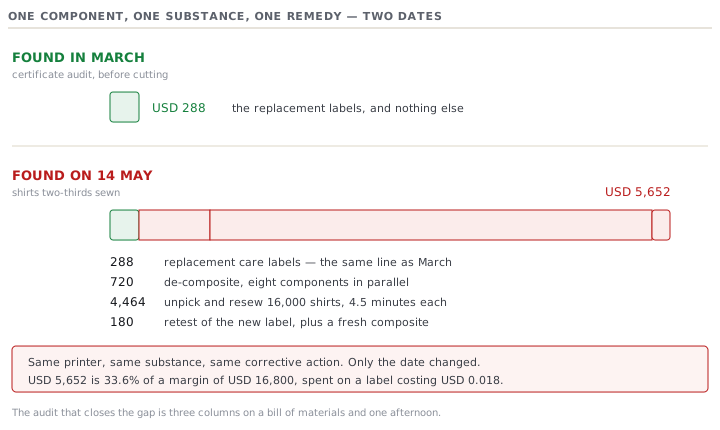
| De-composite, eight components in parallel | 720 |
| Replacement care labels, 16,000 at 0.018 | 288 |
| Unpick and resew, 4.5 minutes a shirt at 0.062 a minute | 4,464 |
| Retest of the new label, plus a fresh composite | 180 |
| Total | 5,652 |
USD 5,652 is 33.6% of the order's margin of USD 16,800, and it is spent on a component that costs USD 0.018.
Run the same failure in March and the bill is the labels: USD 288. Same printer, same problem, same substance. The labels are simply ordered against a certified pigment lot before anybody sews them into a garment. The entire difference between USD 288 and USD 5,652 is the date on which somebody looked.
The rework itself is four days on the floor, and the order sails on 12 June, the sailing it was already rebooked to after lesson 2. Be clear-eyed about why that fits. It fits because the order was already late. On an order that was still on time, a nine-day chemical trace-back in the middle of May is the thing that makes it late.
What a failure triggers, beyond the invoice
Read your own supply agreement for these, because this is where the real cost of a chemical failure lives.
- A hold on the lot. Not a downgrade, not a discount. The goods do not move, and the buyer is usually entitled to require them quarantined and identified.
- The retest at your cost. Lesson 1's clause: a failing test and any retest are for the supplier's account, whoever asked for it.
- A root-cause report, on a clock. Ten working days is a common figure and Vasconcelos uses it. A report that names a lot number and a date closes. A report that says "operator error" comes back.
- Escalated testing on the guilty supplier, at that supplier's cost, usually lot by lot for an agreed number of deliveries.
- A mark on your compliance record. A repeat within twelve months moves a factory's grade, and a factory's grade decides how much of its capacity a buyer is willing to book.
Prompt · Trace a chemical failure back through the bill of materials
Use this the morning a composite fails, when several components are suspect, the lot cannot move, and somebody has to decide how to find the guilty one without spending days you do not have.
Act as a senior restricted-substances and compliance manager. A chemical test has failed on my order and I need to work it backwards. Here are the facts: buyer [BUYER], PO [NUMBER], style [STYLE], [QTY] pcs, margin [VALUE], ship on board [DATE], port cut-off [DATE], today [DATE]. The failing result, pasted word for word, including the method and what was in the composite: [PASTE]. My full bill of materials, with supplier, component cost, and for each line the certificate reference, the certificate date and the material lot number if I have one: [PASTE]. My laboratory's price per single-component test and its turnaround: [PRICE, DAYS]. Do the following, in order. First, list every component the failing composite actually covers, and say plainly that none of them is cleared by this result. Second, give me two routes for breaking the composite apart: all components tested at once, and a halving search. For each route, give the number of tests, the cost and the elapsed working days. Then recommend one against my ship date, and say what the cheaper route assumes that may not be true. Third, rank the components by how likely each one is, given the method that failed and what that method actually detects. Say what in my bill of materials makes each one more or less likely. Fourth, audit my bill of materials: how many lines need a certificate, how many have one, how many of those certificates are older than the material lot that was actually delivered, and how many lines have none. Then give me the count of lines that are genuinely covered. Fifth, once I tell you which component failed, write the trace-back questions I must put to that supplier, in order, ending at a purchase date and a lot number. Sixth, draft a corrective action that fixes the process rather than the batch, and say why 'supplier to improve quality control' would be rejected. Seventh, cost the failure now against what it would have cost if the same audit had been run before cutting. Do not state or estimate any legal limit. Name the method and the process only, and tell me to read the current limit off the buyer's own restricted substances list.
AI can make mistakes — check anything you act on.
What a chemical report certifies
The same discipline as lesson 2, applied to a different kind of document. A chemical report certifies: this material, from this lot, tested by this method, on this date, against this limit.
It does not certify the next lot. It does not certify the same colour from a different dyeing, or the same trim from a different ink, or the finished garment as a whole. It is not a legal clearance, because the limits belong to regulations and buyer lists that move under it, which is course 6.5's subject. And it says nothing at all about the seven components in the composite that did not fail. A composite that passes is one statement about eight things. A composite that fails is one question about eight things.
Read the method, read the conditions, read the lot number, read the date. The verdict is the last line for a reason.