Lessons · Lesson 1 of 3
The test package is a calendar item with a price on it
Cost a whole test package for one order, and pick the submission date that leaves the cloth still changeable.
Lesson 1 of 3 · 47 min
The situation
Buyers make you send cloth and garments to an independent laboratory to be measured. How strong they are. How much they shrink. Whether the colour survives a wash. Most people treat this as a box to tick and a bill to pay. This lesson treats it as two decisions instead. What does the whole basket of tests cost? And when do you send the material?
11 February, 08:40, a merchandiser's desk at Qantara Apparel in Minya. Purchase order VC-5182 for the Portuguese retailer Vasconcelos: 16,000 women's long-sleeve shirts, style QT-706 — white 6,400, powder blue 4,800, ink navy 4,800. FOB USD 9.35, order value USD 149,600. On board 5 June out of Alexandria, port cut-off 1 June.
The cloth is a cotton poplin. 40s yarn in warp and weft, 118 g/m² finished, 148 cm usable width, with an easy-care resin finish. Easy-care means the shirt comes out of the wash smooth. The cloth comes from Sekhem Textile Mills in Beni Suef. Each shirt takes 1.55 m, so the order needs 24,800 m at USD 2.18 a metre.
The cost sheet says ex-works USD 8.30 against an FOB of USD 9.35. Margin is USD 1.05 a shirt. That is USD 16,800 on the order, or 11.2% of FOB. Every decision in this course is measured against that USD 16,800.
On the desk this morning is one page from the Vasconcelos supplier manual, headed Testing requirements — woven tops. Eleven physical tests, six chemical tests, a named laboratory, and one sentence about who pays. Most merchandisers read the sentence about who pays and file the page.
This lesson is what happens if you cost the page instead, and then put it on a calendar.
A test package is bought, and it has a price list
"Send it for testing" is not one purchase. It is a basket of separate tests. Each test has its own price and its own turnaround. And the basket has two halves that behave completely differently.
Some tests measure the construction: how the cloth is built and how strong it is. These depend on the yarn, the weave and the finish. They do not depend on the colour. So you buy them once for the quality.
The rest measure the colour, and the finish on top of that colour: fastness, and how much the cloth moves when it is washed. Dye and finish are applied one shade at a time, and every shade behaves differently. So you buy these once per colourway. Three colours means three sets.
Here is the Vasconcelos physical package, priced off the Halcyon Testing Services rate card. The prices and turnarounds below are one laboratory's list, invented for this course so the arithmetic is real. Your own lab's card will differ, sometimes by half. The methods are real, and they are the column you should be reading.
| Test | Method | USD | Working days |
|---|---|---|---|
| Tensile strength | ISO 13934-1 | 35 | 2 |
| Tear strength | ISO 13937 | 32 | 2 |
| Seam slippage | ISO 13936 | 38 | 2 |
| Pilling | ISO 12945 | 40 | 3 |
| Mass per unit area and construction | ISO 3801 | 18 | 1 |
| Fibre composition | quantitative chemical analysis | 60 | 4 |
| Subtotal, once | 223 |
| Test | Method | USD per colour | Working days |
|---|---|---|---|
| Dimensional change to washing | ISO 6330, marked to ISO 3759 | 45 | 5 |
| Colour fastness to washing | ISO 105-C06 | 30 | 3 |
| Colour fastness to rubbing | ISO 105-X12 | 22 | 2 |
| Colour fastness to perspiration | ISO 105-E04 | 28 | 3 |
| Colour fastness to light | ISO 105-B02 | 55 | 10 |
| Subtotal, per colour | 180 |
Three colours, so the fabric package is 223 plus three lots of 180 — USD 763.
That is not the whole bill. A garment package follows after production: dimensional change on the made-up shirt, and appearance after washing, for three colours. That is USD 396. Then a chemical package at USD 679, which lesson 3 takes apart. The order's total test bill is USD 1,838.
Against an order value of USD 149,600 that is 1.2%, which sounds like nothing. Against a margin of USD 16,800 it is 10.9%, which is not nothing at all. It is USD 0.115 a shirt.
The turnaround of a package is its slowest test, not its average
Look at the working-days column again. Ten of the eleven tests come back inside five days. Colour fastness to light takes 10 working days. The specimen sits under a lamp next to a set of reference standards and fades in its own time. Nothing speeds that up.
So the package comes back when light fastness comes back. Add two days for conditioning, the report and the courier. Now you have the number to plan with: 12 working days from the day the laboratory receives the sample, not from the day you post it.
That difference matters more than it sounds. Most physical tests need the specimen conditioned first. Conditioning means holding it in a standard atmosphere, so that the moisture in your cotton matches the moisture in everybody else's cotton. Cotton that is too dry is stiffer, stronger and a slightly different size, and a result taken on an unconditioned specimen cannot be compared with anything. That time sits inside the laboratory's clock, not yours.
Check yourselfYour lab quotes an average turnaround of three working days across its physical tests. What should you write on the calendar?Show the answer
Twelve working days, plus courier. A package finishes when its slowest test finishes, and one test on the Vasconcelos page needs ten days under a lamp. An average across a basket of tests describes the laboratory's workload. It does not describe your order.
Two submission dates for the same package
Now the decision this lesson exists for. The package costs the same money whenever you buy it. What changes is what you can still do with the answer.
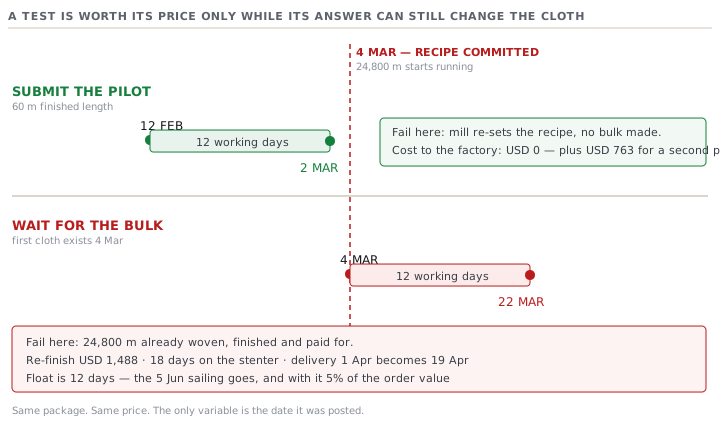
Sekhem's plan for this order has two moments when a piece of finished cloth exists.
- 12 February. The mill runs a 60 m pilot length of the white through the finishing line, on the recipe it means to use, to check the shade and the handle before it commits the bulk. This piece is real finished cloth. It is also the last physical object that exists while the recipe can still be changed for nothing.
- 4 March. Bulk finishing starts. From that day the recipe is set, the stenter is booked, and 24,800 m is going to be made on it. The stenter is the machine that dries and sets finished cloth to width.
Submit the pilot on 12 February and the report lands 2 March — two days before the recipe is committed. Wait for the bulk and the earliest a piece can go is 4 March, so the report lands 22 March. That is eighteen days after the window shut. The cloth it describes already exists, is already paid for, and is sitting in the mill's warehouse.
A test is only worth its price while its answer can still change something. The 22 March report cannot change the cloth. It can only tell you what you already own.
What a failure costs on each date
Say the finish is not right. The cloth moves too much in the wash, which is the failure lesson 2 walks through in detail.
Found on 2 March. The mill re-sets the finishing recipe before the bulk runs. That is six days inside its own schedule and it costs Qantara nothing, because no bulk cloth has been made yet. The only cost is that you bought the package twice: USD 763.
Found on 22 March. Now 24,800 m has to go back through the stenter. Re-finishing is USD 0.06 a metre — USD 1,488 — and it needs 18 days on a machine that has other people's orders on it. Fabric delivery to Qantara slips from 1 April to 19 April. The plan carries 12 days of float between the last garment out and the port cut-off. So 18 days of slip means the 5 June sailing is missed by six days.
Missing it costs one of two things, and you choose which.
- Airfreight. 400 cartons, 40 shirts a carton, carton 60 by 40 by 32 cm. Volumetric weight is 76,800 cm³ divided by 6,000, which is 12.8 kg a carton. So the chargeable weight is 5,120 kg. That is more than the actual 4,480 kg, so the actual weight does not count. At USD 4.10 a kilo that is USD 20,992, which is more than the entire margin on the order.
- The late-delivery discount. The supply agreement gives Vasconcelos 5% off the order value for a shipment that misses its window: USD 7,480.
So the second package — USD 763 spent in February — sits against a downside of USD 1,488 of re-finishing plus at least USD 7,480 of discount. USD 8,968.
Sekhem's own record is that about one resin-finished quality in five comes back off-standard on dimensional change the first time. Weigh USD 8,968 at one in five against a certain USD 763. The pilot package is worth USD 1,794 in expectation, against USD 763 in cost. You buy it.
Qantara did not buy it. The fabric purchase order for VC-5182 went out in January without that clause. Sekhem's pilot length ran on 12 February with nobody watching it. The first independent number anybody saw was dated 22 March. Lessons 2 and 3 are the invoice.
Who pays, and what the clause actually says
The Vasconcelos sentence about who pays says this, in substance. Testing required by the testing requirements page is arranged and paid for by the supplier, at the nominated laboratory. Tests Vasconcelos starts outside that page are at Vasconcelos's cost. But where such a test fails, its cost and the cost of any retest are for the supplier's account.
Read it slowly, because three things are hiding in it.
- You pay for the whole matrix. Every one of the USD 1,838 is yours, and it belongs in the cost sheet.
- A buyer-initiated test is only free if it passes. A spot check pulled off a shelf in Lisbon costs you nothing until the day it costs you everything.
- A retest after a failure is never free. There is no version of a failure where somebody else pays to look again.
And one thing is not in the clause at all. The laboratory is nominated by the buyer. You cannot shop around for a friendlier result, and every submission you make is visible to the buyer. Submission history is data. A quality that appears in the laboratory's system as a third submission is telling the buyer something before anybody reads the result.
What to do with this page in your own week
- Take the buyer's testing page and split it into the construction half and the colour half. Count your colourways and multiply.
- Price it at your nominated laboratory. Put the number on the cost sheet as a line, per garment.
- Find the slowest test on the page. Write that number, plus two days, on the calendar as the package turnaround.
- Find the last date on which the cloth can still be changed for nothing. It is almost always the mill's pilot or pre-production length, not the bulk.
- Count backwards from that date by the turnaround. That is your submission date. If it is in the past, you are testing to have a certificate, not to make a decision.
Prompt · Cost the test package and put it on the calendar
Use this the week you order the fabric, before the mill quotes. It prices the package, tells you how long it takes, and fixes the submission date while the cloth can still be changed for nothing.
Act as a senior apparel quality and compliance manager. I am setting up testing for one order. Here are the facts: buyer [BUYER], PO [NUMBER], style [STYLE], [QTY] pcs, [N] colourways named [LIST], FOB [PRICE], order value [VALUE], my ex-works cost [COST], margin [VALUE AND PERCENT]. Fabric: [CONSTRUCTION, WEIGHT, WIDTH, FINISH] from [MILL], consumption [METRES] per garment at [PRICE] per metre. Ship on board [DATE], port cut-off [DATE]. Here is the buyer's testing requirements page, pasted word for word: [PASTE]. Here is my laboratory's rate card and its quoted turnarounds: [PASTE]. Do the following, in order. First, split the physical tests into two groups: those that depend only on construction, which I buy once for the quality, and those that depend on colour or finish, which I buy once per colourway. Say which of my colourways multiplies which tests. Second, price the whole package, including the garment-stage tests and the chemical tests. Give me the total in dollars, as a percentage of order value, as a percentage of margin, and as a cost per garment. Third, tell me the turnaround of the package. That is the slowest single test on the page plus reporting. Name that test. Fourth, list every date in my fabric and production plan on which a physical specimen of the right thing will exist. Mark the last date on which a failure could still be fixed without re-processing cloth I have already paid for. Fifth, count backwards from that date by the turnaround, and give me the submission date. Sixth, cost the failure on each possible submission date. Include re-processing, delay, the late-delivery remedy in my contract, and airfreight with the chargeable weight worked out volumetrically. Seventh, quote the who-pays clause back to me, and tell me plainly which of these costs is mine. If the submission date you calculate has already passed, say so in one sentence at the top, and tell me what I am now testing for.
AI can make mistakes — check anything you act on.
Check yourselfThe buyer's matrix has eleven physical tests. Your order has four colourways. How many tests are you actually buying?Show the answer
Six of them are construction tests bought once. Five are colour tests bought four times. Six plus twenty is twenty-six tests, not eleven. The colourway count is the multiplier nobody applies when they are quoting, which is why the testing line on a cost sheet is usually wrong in the same direction.