Lessons · Lesson 2 of 3
The method is half the specification
Read a test report line by line against a buyer's matrix, and tell a fabric problem apart from a method problem and from a specification problem.
Lesson 2 of 3 · 47 min
The situation
The same roll of cloth can pass at one honest laboratory and fail at another. Nobody has done anything wrong. A test is named by the exact procedure used, not by the property it measures. So a requirement that names the property and not the procedure has specified nothing. This lesson reads a laboratory report from the top, instead of from the verdict at the bottom.
22 March, 16:10. The Halcyon report on the white QT-706 poplin arrives as a nine-page PDF. On page 2, five red lines.
This is the fabric Sekhem tested itself on 6 March, on its own equipment, and passed on every property. Nobody at the mill did anything wrong. The mill ran the test card it runs for every customer, and it is a perfectly good card. It is simply not the card on page 9 of the Vasconcelos manual. The difference between two good cards is where this lesson lives.
| Property | Sekhem, 6 March | Halcyon, 22 March | Vasconcelos requires |
|---|---|---|---|
| Tensile, warp | 428 N | 312 N | min 250 N |
| Tensile, weft | 301 N | 196 N | min 200 N |
| Dimensional change, warp | -1.8% | -3.9% | max -3.0% |
| Dimensional change, weft | -1.1% | -1.6% | max -3.0% |
| Pilling | grade 4 | grade 3 | min grade 3-4 |
The cloth did not change between the two dates. Everything else did.
The nine lines above the verdict
A test report is a decision document, and almost everyone reads it from the bottom. The word at the bottom is the least useful thing on the page. It is only a comparison of two lines further up. If either of those lines is not the line your buyer wrote, the word is answering a question nobody asked.
Read these nine, in this order, before you look for PASS or FAIL.
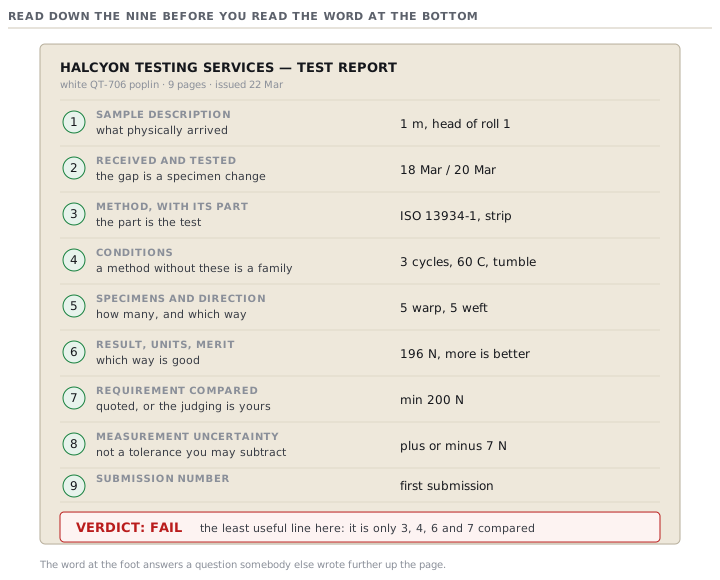
- The sample description. What physically arrived: one metre off the head of one roll, or a metre from each of five rolls across the batch. This decides what the result is about.
- Date received and date tested. A gap of nine days on a wet sample means a different specimen from the one you posted.
- The method, with its part number. Not "tensile strength" — ISO 13934-1 or ISO 13934-2. The part is the test.
- The conditions. Wash cycles, temperature, drying method, rub count, applied load, hours under the lamp. A method without its conditions is a family of tests, not a test.
- The specimen count and direction. Five warp and five weft is a different statement from two and two.
- The result, with its units and its direction of merit. Newtons, where more is better. Percent, where less is better. A grade, where the scale runs the opposite way to your instinct.
- The requirement it was compared with, quoted on the report. If the report does not carry the requirement, the laboratory has measured and not judged, and the judging is yours.
- The measurement uncertainty, where the laboratory states one.
- The submission number. First, second or third submission of the same quality is itself a finding.
Two of those red lines are not about the cloth at all
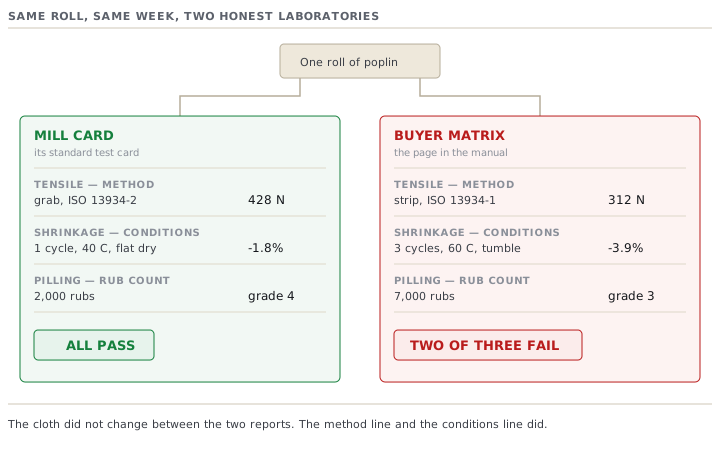
Tensile. ISO 13934 is published in two parts, and they are different tests. Part 1 is the strip method: the full width of the specimen is gripped in the jaws, so every yarn in the test area carries load and breaks in its own time. Part 2 is the grab method: the jaws are narrower than the specimen, so the yarns outside the jaws help support the ones inside. The same cloth returns a higher force under grab than under strip, because of that help.
Sekhem tested to part 2. Vasconcelos specified part 1. There is no conversion factor between them. The relationship depends on the construction, the cover factor and the finish, so you cannot take a grab result and argue it into a strip requirement. A tensile requirement that does not name its part has not specified anything, and plenty of the matrices you will be sent do not name it.
Dimensional change. ISO 6330 does not describe one wash. It describes a family of domestic washing and drying procedures, and the specification is the procedure you pick out of it. Sekhem ran one cycle at 40 degrees Celsius, dried flat. Vasconcelos requires three cycles at 60 degrees Celsius, tumble dried. Cotton relaxes most in the first cycle and keeps moving for several more. Heat and tumbling both speed that up. Two honest laboratories, two honest results, on the same cloth: -1.8% and -3.9%.
Pilling. Pilling is the small balls of fibre that form on a cloth when it is rubbed. ISO 12945 assesses a specimen after a stated number of rubs, and the rub count is part of the requirement in exactly the way the wash count is. Sekhem assessed at 2,000 rubs. Vasconcelos requires 7,000. A cloth that is grade 4 at 2,000 rubs and grade 3 at 7,000 has not contradicted itself.
Five red lines are not five problems
Read the full page and the Halcyon report carries five failures: weft tensile, warp dimensional change, tear strength, pilling, and abrasion. Reduce them before you spend anything.
One is a sampling artefact. Weft tensile came back 196 N against a 200 N minimum, with an expanded measurement uncertainty stated as plus or minus 7 N. Uncertainty is not a tolerance. You may not subtract it to turn a fail into a pass. But it does tell you the result is not far from the line, and that makes the sample worth examining. The sample description says: one metre, head of roll 1. Every specimen came from the same two metres of a 24,800 m batch.
Re-submitting one metre from each of five rolls spread across the batch is not a retest. It is a better sample, and you say exactly that on the submission form. The weft means came back 203, 197, 210, 199 and 206 N — batch mean 203 N. The Vasconcelos matrix requires the mean of five specimens, so the batch passes. Cost: USD 75 and three working days.
Note what turned on the wording. Had the matrix said "each individual specimen", 197 and 199 would have failed it, and the same cloth with the same numbers would have been rejected. Mean or individual minimum is part of the requirement. A matrix that does not say which has left the decision to whoever reads it last.
One is a real fabric failure. Warp dimensional change at -3.9% against a -3.0% maximum is the finish, and no amount of re-sampling will move it. This is the failure lesson 1 costed: re-finishing 24,800 m at USD 0.06 a metre is USD 1,488 and 18 days on the stenter.
Two have one cause and one fix — and the fix does not arrive in time for this order. Tear strength came back 9.1 N warp and 8.4 N weft against a 10 N minimum. Pilling came back grade 3 at 7,000 rubs against a minimum of grade 3-4. They look like separate problems. They are the same yarn.
The easy-care resin crosslinks the cotton, which is what buys the smoothness the matrix demands, and it spends tear strength doing it. The unfinished cloth tore at 14.2 N and 12.8 N. Meanwhile a conventional ring-spun 40s carries fibre ends that stick out of the yarn and migrate into pills under a rubbing head. A compact-spun weft answers both: fewer ends sticking out, so fewer pills, and a cleaner, stronger yarn, so more tear left after the resin. Sekhem's trial on compact weft returns tear 12.1 N and 11.4 N, and pilling grade 4 at 7,000 rubs, with the smoothness held at grade 3-4. It costs USD 0.11 a metre — USD 2,728 across 24,800 m, USD 0.17 a shirt, 16.2% of a margin.
But the yarn is already inside 24,800 m of woven, finished cloth. You cannot re-spin it. So this fix is a decision about the repeat order, taken now because the same quality will be bought again. For the lot on the floor there is only one honest route. Put both numbers in front of Vasconcelos in writing, and ask for a concession on this lot against a specified yarn change on the next. A failure found after the cloth exists often splits like this: the money buys the next order, and this one is bought with credibility.
One is the specification's own fault. The matrix asks for Martindale abrasion at 20,000 cycles with no more than 2 thread breaks. Halcyon broke a thread at 9,200 cycles. That requirement was written for a 320 g/m² cotton twill trouser and copied across into the woven-tops page. A cloth at 118 g/m² will not reach it. Choosing a heavier shirting to satisfy it would produce a garment nobody at Vasconcelos wants.
There is no test that fixes this. What you do is test it once anyway — USD 45 — and attach the number to a written request to amend that line for this product class, signed off before the pre-production meeting. Never leave an untestable requirement unresolved on a matrix. At the final compliance audit an unresolved line reads as an open failure, and by then the person who agreed verbally that it did not apply has changed job.
Retest, or accept?
Three questions, in order.
- Was the test right? Right method, right part, right conditions, right specimen count. If not, this is not a retest. It is the first correct test, and it should be described as one.
- Was the sample right? Cut from one place, from one roll, from the head end, from a piece the mill chose. If not, re-sample properly and say on the form that you have.
- Is there any reason to think a correctly-run test on a correct sample would come out differently? If you cannot name one, there is nothing left. Repeating the same test on the same sample and hoping for a different number is fishing, and the nominated laboratory records every submission. A third submission with no stated change is a sentence about you, not about the cloth.
The bill on this order: USD 75 to re-sample, USD 1,488 to re-finish, and USD 45 to test a requirement that should never have been on the page. That is USD 1,608, or 9.6% of the margin. The USD 2,728 of compact weft belongs to the next order.
The eighteen days are the expensive part. Fabric delivery moves from 1 April to 19 April, which eats all 12 days of float and six more, and the 5 June sailing goes. That is the USD 7,480 late-delivery discount lesson 1 costed, arriving exactly as it said it would, because nobody spent USD 763 in February.
Prompt · Read this test report back to me, line by line
Use this the hour a laboratory report lands, before you forward it to anybody. It tells you what the report certifies, what it does not, and every place the method or the condition differs from the specification you agreed.
Act as a senior textile testing manager. Below is a laboratory report, and below that is the buyer's testing requirements page it is supposed to answer. Report: [PASTE]. Requirements: [PASTE]. Order context: [BUYER, STYLE, QTY, FOB, MARGIN, FABRIC, MILL, SHIP DATE]. Do the following, and do not summarise before you have done it. First, build a table with one row per property and these columns: the method the laboratory actually ran, including its part number; the method the buyer specified; the conditions actually used (wash cycles, temperature, drying, rub count, applied load, hours of exposure); the conditions specified; the result; the requirement; and whether the two are comparable at all. Second, flag every row where the method or a condition differs. For each one, say whether the two can be converted, or whether the test simply has to be run again. Never invent a conversion factor. Third, tell me what the sample description says physically arrived, how many specimens were tested in each direction, and whether that sample can support a statement about the batch. Fourth, take every failure and put it in one of four classes: a method or condition mismatch, a sampling artefact, a genuine property failure of the cloth, or a requirement that does not belong on this product class. Say which evidence puts it in that class. Fifth, group the genuine failures by likely common cause. Tell me where one change closes more than one line, with the cost per metre and per garment if I give you a price. Sixth, tell me whether the requirement is written against the mean of the specimens or against each single specimen, and what the verdict would be under the other reading. Seventh, write in plain language what this report certifies and what it does not — the bulk, the other colourways, the next dye lot, the finished garment. Finally, state the measurement uncertainty if the report gives one, and say plainly that it is not a tolerance I may subtract.
AI can make mistakes — check anything you act on.
Check yourselfA mill sends you a tensile result of 340 N against your buyer's 250 N minimum. What do you need before you can call it a pass?Show the answer
The part number and the conditions. If the mill ran ISO 13934-2 and the buyer specified ISO 13934-1, the number is not comparable and there is no factor that converts it. You need the test re-run to the specified part. A comfortable margin over the requirement means nothing until you know the two numbers are the same kind of number.
What the word at the bottom certifies
PASS on a test report certifies exactly this: this specimen, tested by this method, under these conditions, on this date, gave this number, and this number met the requirement written next to it.
It does not certify the bulk, unless the specimen was drawn from the bulk. It does not certify the next dye lot. It does not certify the other two colours. It does not certify the garment, which has seams, interlining and a wash the fabric never saw. And it does not certify compliance with anything legal, which is lesson 3's subject and a different animal entirely.