Lessons · Lesson 1 of 3
A child's garment is a different legal object
Read a children's design for the hazards that make it a regulated product, and price the same change at five points in one calendar.
Lesson 1 of 3 · 35 min
The situation
The buyer's designer draws a feature. The buyer's technologist signs the sample. Most factories treat that as the end of the matter. On clothes made for children it is not. The law binds whoever puts the garment on sale. This lesson reads a children's design for the hazards that make it a regulated product.
21 July, 08:40, a knitwear unit in Tiruppur. PO PB-4471 is for the Belgian children's-wear retailer Pippin and Bloom: 14,400 girls' hooded sweatshirts, style KF-2207, brushed-back cotton-rich fleece, five colourways, sizes from 2-3y to 11-12y. FOB USD 6.85. Order value USD 98,640. The vessel sails 28 July, and the goods go on sale in the buyer's stores from 22 September. Of the order, 8,640 pieces go to Pippin and Bloom's own shops in Belgium, the Netherlands and Germany. The other 5,760 go to Cedarbrook Kids, a United States wholesale account the buyer supplies under the same style number.
Everything is on time. The bulk is sewn. The pre-shipment inspection is booked for the afternoon. Sennari Knitwear's merchandiser has spent the morning on carton marks.
At 14:20 the inspector stops. Not for a defect: the workmanship is clean and the lot would pass. He is holding a size 4-5y hood by its drawstring. There is a line on his checklist that reads cords and drawstrings in the hood and neck area.
Pippin and Bloom's own studio drew the design in October. The tech pack was approved in February with the drawstring on it. The pre-production sample was approved in March, photographed and signed. The fit sample passed. The AQL inspection would have passed.
And the goods cannot ship.
Approval transfers taste. It does not transfer liability
This one sentence separates safety from everything else in this track. In quality, the buyer's approval ends the argument. If the technologist signed the sample, the sample is right, because right means what the buyer wants.
Safety does not work like that. A market-surveillance officer is a government inspector who checks goods already on sale. He does not care who approved the drawing. The importer whose name is on the label carries an obligation. That obligation exists whether or not the factory did as it was told. The supply agreement then pushes the cost back down the chain to whoever made the non-compliant goods. A signature on a tech pack is evidence of what was ordered. It is not evidence that what was ordered was legal.
So a merchandiser on a children's style has a duty the same merchandiser does not have on an adult style: read the design for hazards before it is costed. Say so out loud when the buyer's own studio has drawn something that cannot be sold in the market it is drawn for. Nobody thanks you in October. They thank you in July.
What actually changes when the wearer is a child
An adult hooded sweatshirt and a child's hooded sweatshirt can be the same drawing, the same fabric and the same seams, and still be two different products in law. Four things change.
Mechanical hazards become regulated features. A cord, a toggle, a bead, an appliqué eye, a press stud, a rivet, a decorative pom: on an adult garment these are trims. On a child's garment they are entrapment, strangulation and choking hazards. Standards written specifically for children's clothing deal with them.
The age band is part of the specification. The same hood cord may be treated one way for a two-year-old and another way for a twelve-year-old, because the hazard is different. A small child is on playground equipment and cannot free themselves. An older child is not on the same equipment in the same way. Europe deals with cords and drawstrings on children's clothing through EN 14682. In the United States the CPSC, the Consumer Product Safety Commission, has long-standing guidance on drawstrings in children's upper outerwear, given standard form as ASTM F1816. Both split childhood into groups. Where the boundary sits, and what is allowed on each side of it, is in the current text of the standard. That is where you read it — not from a course, and not from what you did last season.
Third-party evidence becomes mandatory rather than optional. In the United States a children's product must be tested by a CPSC-accepted laboratory against the rules that apply to it. The importer then issues a Children's Product Certificate on the strength of those reports. That certificate is a document somebody signs. Signing it without the reports underneath is not an administrative shortcut. It is a false statement.
"It looks fine" stops being an argument. A mechanical-safety rule exists because the failure is rare, sudden and catastrophic. You will never see it on your inspection table. The rule exists because it was seen somewhere else.
| KF-2207 as an adult style | KF-2207 as a children's style | |
|---|---|---|
| Hood drawstring with toggles | A design feature | A regulated feature, restricted by age group |
| Press stud at the neck | A trim | A small part: needs pull-test evidence |
| Brushed fleece face | A hand feel | A raised surface, treated separately in US clothing flammability rules |
| Third-party testing | Buyer's programme, commercial | Legally required in the US, evidenced by a certificate |
| Who is exposed if it is wrong | The buyer's margin | The importer, then the factory, then the child |
Cords: the one that stopped this order
KF-2207 as drawn carries three cord features. Read them as a merchandiser. For each one, ask where on the garment is it, how long is the free end, and does it have a hard end-piece.
| Feature | Position | Detail as drawn |
|---|---|---|
| Hood drawstring | Threaded through the hood edge, exiting at two metal eyelets at centre front | Flat cord, two moulded toggles, free ends hanging |
| Waist adjuster | Inside the hem channel, exiting at the side seam | Round cord, knotted ends, free |
| Sleeve tab | Decorative loop at the cuff | Self-fabric, sewn down at both ends |
The sleeve tab is sewn down at both ends. It is not a free cord at all. The waist cord sits at the hem, and different provisions govern it from the ones that apply at the neck and hood. The hood drawstring is the problem, and it is worst in the youngest sizes.
A second trap sits underneath the first. It is the reason this order was stopped in full rather than in part. KF-2207 runs from 2-3y to 11-12y as one design, one tech pack and one carton mark. A standard may allow a feature in the older sizes. But a retailer running a single design across a full age range takes the strictest treatment across the range. A hood cord that is acceptable at 11-12y and unacceptable at 2-3y means two garments, two tech packs, two labels and two inspections. Pippin and Bloom does not do that on a fleece worth USD 6.85. So the whole range goes to the strictest reading.
Small parts, and what a pull test actually buys you
The 2-3y and 3-4y sizes of KF-2207 carry a metal press stud at the neck, put there so the head opening is big enough. That is 3,600 pieces of the order. A press stud is a small part. So is a toggle, a bead, an appliqué eye, a rivet, a metal cord end and a button.
The evidence a buyer wants is a pull test. The component is gripped and pulled with a set force for a set time, and it must not come off. What that test buys you is narrower than people assume, and the narrowness is the lesson.
- It tests the attachment as made on the day the sample was taken. A press stud attached with a worn die, or at a lower pressure because the operator was chasing output, is a different attachment.
- It tests that component on that fabric. Change the fleece and the stud's grip changes, because it is gripping the cloth.
- It says nothing about the component that is attached after the test: the hangtag pin, the size sticker, the spare-button bag.
So the useful control is not the test report. It is the in-line attachment check. The factory runs it during production, at a stated frequency, against a recorded force, and keeps the results. That is the document that covers the 14,400th piece. The report covers the first one.
The flammability question you must not answer yourself
Cedarbrook Kids sells its 5,760 pieces in a two-piece set with a matching jogger, presented as sleep and lounge. The factory calls KF-2207 a sweatshirt. The tech pack calls it a sweatshirt. The buyer's own range plan calls it a sweatshirt.
None of that decides what it is.
In the United States the CPSC regulates the flammability of clothing textiles in general. Children's sleepwear is regulated separately and much more strictly. Does a hooded fleece sold as part of a sleep set fall inside the sleepwear rules? That is a real question with a real answer, and the answer is not in this course. Two further facts make it urgent rather than academic. First, the general clothing-textile flammability rules treat raised-surface fabrics differently from flat ones, and a brushed-back fleece is a raised surface. Second, the answer would change the fabric. Changing the fabric changes the cost. So the question has to be asked before the fabric is bought.
The merchandiser's move here is one email, in February. It goes to the buyer's compliance contact, copied to the factory's own compliance manager: this style is being sold in a sleep set in the US. Please confirm in writing which flammability requirements apply and what evidence you need, before we place the fabric. If the answer is slow, the answer is still needed. What you must never do is decide it yourself because it seemed obvious.
The calendar is the whole cost
The cord change on KF-2207 is small. Remove the drawstring, close the channel, delete the eyelets, replace the adjustment with a sewn elastic. On paper it is a five-minute conversation.
What it costs depends entirely on when you have that conversation.
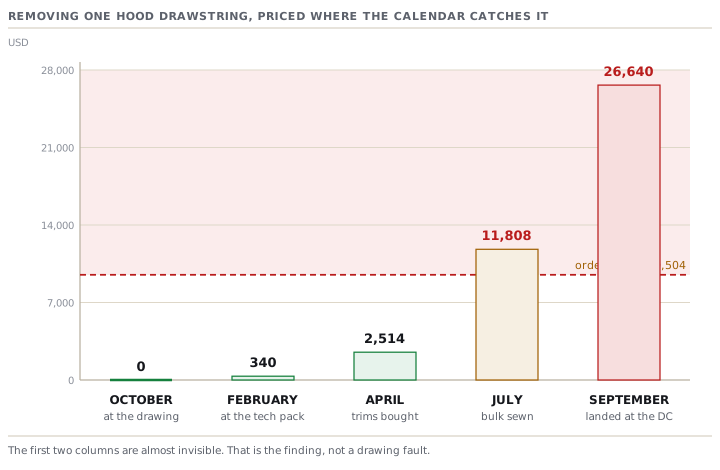
| When | What has to happen | Cost |
|---|---|---|
| October, at design | The studio draws it without a cord | USD 0.00 |
| February, at tech pack | Re-draw, re-sample, re-approve: two samples and three days | USD 340.00 |
| April, trims committed | Write off cord USD 792.00, toggles USD 604.80, eyelets USD 230.40; buy elastic USD 547.20; re-sample USD 340.00 | USD 2,514.40 |
| July, bulk sewn | Unpick and re-cut the hood: 12 minutes at USD 2.10 an hour is USD 0.42, plus USD 0.40 of hood panel and rib, on every piece | USD 11,808.00 |
| September, at the buyer's DC | Third-party rework on landed goods at USD 1.85 a piece | USD 26,640.00 |
Now put the order's margin on the same page. KF-2207 is made for USD 6.19: fabric USD 2.94, trims USD 0.61, cut-make-trim USD 1.58, finishing and packing USD 0.34, overhead USD 0.72. It sells at FOB USD 6.85. That is USD 0.66 a piece, USD 9,504.00 on the order.
The line between April and July is where the change costs more than the order earns. Everything to the left of it is a conversation. Everything to the right of it is a loss.
Here is what actually happened on 21 July. The lot was held. 14,400 pieces were reworked at USD 11,808.00. Re-inspection cost USD 450.00. The extra fourteen days of storage and handling cost USD 1,450.00. Total USD 13,708.00, against a margin of USD 9,504.00. The order lost USD 4,204.00. It lost it on a feature the buyer's own studio drew and the buyer's own technologist approved.
Sennari made the revised vessel on 11 August and the goods reached the shops before the on-sale date. That is the good version of this story.
Check yourselfThe buyer's studio drew the cord, the buyer's technologist approved the sample, and the buyer's tech pack shows it. Why does the factory carry the cost?Show the answer
Because approval and liability are different things. The technologist approved the look and the construction of what was submitted. Nobody warranted that it complied. The duty to place compliant goods on the market sits with the importer, and the supply agreement passes the cost of non-compliance to the supplier who made the goods. That is why the merchandiser's safety review has to happen at the drawing, where a change is free, rather than at the sample, where it is only cheap.
What you do on Monday
Build the safety read into the point in the calendar where it is free: before the style is costed. Not after the tech pack, not at the PP meeting, not at the size set.
- List the destination markets, by name, for every part of the order. One PO can carry two legal regimes, as this one does.
- Read the drawing for hazards, feature by feature. Every cord, every free end, every hard end-piece, every component small enough to detach, every raised surface, every part that goes near a face or a neck.
- Name the age band. Note that a single design across a wide range is priced at the strictest reading unless somebody decides otherwise in writing.
- Write down the questions you cannot answer and send them, in one email, to the buyer's compliance contact and your own. Keep the reply.
- Cost the evidence. Testing, certificates and in-line checks go on the cost sheet as a line, not into an overhead you absorb.
Prompt · Read a children's style for safety before it is costed
The week a children's drawing lands, before the cost sheet is built and while a change to the design still costs nothing.
Act as a product safety manager for a children's-wear buyer, working with a factory merchandiser. I want a hazard read of one style BEFORE it is costed. Style facts: [STYLE CODE], [DESCRIPTION], age or size range [RANGE], quantity [QTY], FOB [PRICE], fabric [DESCRIPTION INCLUDING WHETHER THE SURFACE IS RAISED OR BRUSHED]. Destination markets and the quantity going to each: [LIST THEM BY COUNTRY]. How the garment will be merchandised and sold in each market: [ON ITS OWN, AS A SET, AS SLEEPWEAR, AS OUTERWEAR, AS A COSTUME]. Every component on the drawing: [LIST EVERY CORD, TIE, DRAWSTRING, TOGGLE, BEAD, BUTTON, PRESS STUD, RIVET, APPLIQUE, POM, ZIP PULLER, BADGE, LABEL, TRANSFER, ELASTIC]. For each cord or tie, say where it sits on the garment, how long the free end is, and whether it has a hard end-piece. Do the following. First, list every component you consider a potential mechanical hazard, and for each one say WHICH hazard family it belongs to and WHY. Second, tell me which of my markets treat this as a children's product and what that changes, and flag where selling context rather than construction decides the rule. Third, give me the questions that MUST go to a qualified specialist rather than be answered by either of us, written as an email I can send to my buyer's compliance contact today. Fourth, list the third-party evidence each market is likely to want and who has to hold it. Fifth, price the same design change at five points in my calendar, from the drawing through to landed goods, using my quantity and a labour rate of [RATE] an hour, and tell me where that cost crosses the order margin. IMPORTANT: do not state any numeric legal limit, cord length, age boundary, ppm or flammability class. Where a number matters, tell me which document to read and who should read it. If you are not certain a rule applies, say so plainly rather than guessing.
AI can make mistakes — check anything you act on.