Lessons · Lesson 3 of 3
The RSL, the declaration and the certificate that certifies nothing
Turn a restricted substances list into supplier duties and test evidence you can defend, and see what a missing lot number on a carton is actually worth.
Lesson 3 of 3 · 31 min
The situation
A factory can hold a genuine, in-date report from a good laboratory and still have no defence. The report describes one batch of material. The goods were made from a later batch. This lesson is about the buyer's restricted substances list, or RSL: the list of substances that must not be in clothing. It turns hundreds of rows into duties that land on named suppliers.
6 November, 11:15. Pippin and Bloom's compliance team emails Sennari Knitwear with a laboratory report attached. Routine surveillance testing on style KF-2207 has found a substance in the printed chest motif above the buyer's own internal limit.
The email asks two questions. Which pieces are affected, and can you prove it.
Sennari's file is complete. There is a test report for the print ink, issued by Verinsa Laboratories in March, showing the ink well inside the limit. The merchandiser attaches it and replies within the hour. That is the worst thing he does all week, because the report is for ink lot IK-0417 and the garments in the buyer's laboratory carry ink lot IK-0631.
On 14 July, with the cord rework of lesson 1 running eleven days late, Marudhu Prints ran out of the approved ink. They bought an equivalent from a local distributor the same afternoon, matched the shade, ran the parameters and hit the revised date. Nobody at Marudhu was careless. They protected a delivery that three other people were fighting to protect.
An RSL is not a document. It is a distribution problem
The buyer's restricted substances list arrives as a workbook: 312 rows across 21 substance groups, each with a limit, a test method and an applicability note. It is emailed to the factory once a season and filed once a season. In most factories that is the entire life cycle of the document.
Nobody in a factory reads 312 rows. Nobody should have to. The merchandiser's job is to convert the list into duties that land on individual people. A substance restriction is never about a garment. It is about a component, made by a company that is not you, from a formulation you have never seen.
There are exactly three things you can do with any row. The skill is choosing correctly and quickly.
- Rule it out. The substance group cannot occur in any component of this style. Record why, once, and move on.
- Declare it. The supplier signs a statement, referencing the buyer's list and version, that the material they supply complies. A declaration is cheap, and it is not evidence. It is a contractual position and a place to send the bill.
- Test it. A named laboratory tests a named material from a named lot against a named method. This is the only line of the three that is evidence.
The whole art is deciding which rows get level three, because level three is where the money and the lead time sit.
| Component | Supplier | Declaration | Test evidence required |
|---|---|---|---|
| Fleece body fabric | Vellakoil Knits | Yes, per lot | Yes, per colour, per lot |
| Rib neck and cuff | Vellakoil Knits | Yes, per lot | Yes, per colour |
| Sewing thread | Ostara Labels | Yes, per season | Yes, per shade |
| Transfer print ink and carrier | Marudhu Prints | Yes, per lot | Yes, per print colour, per lot |
| Press stud, sizes 2-3y and 3-4y | Bhavani Fasteners | Yes, per season | Yes, nickel release |
| Woven labels and printed care label | Ostara Labels | Yes, per season | Yes, one package |
| Hangtag, string, polybag, carton | Ostara Labels | Yes, per season | Covered in the label package |
Two things in that table are the lesson. The words per lot appear wherever a chemical is applied rather than merely present, because a formulation can change between deliveries without anything visible changing. The words per colour appear on the fabric and the ink, because a dyestuff or a pigment is a different chemistry in every shade. So a five-colour style is five tests, not one.
What a certificate actually certifies
A test report is a statement about a sample, taken from a lot, on a date, tested by a named laboratory, against a named method, to a named limit.
It says nothing whatever about any other sample, lot or date. This is not a technicality. It is the entire content of the document. A file full of reports that do not match the goods is more dangerous than an empty file, because an empty file makes somebody nervous.
Here is the report Sennari sent, drawn as it arrived. The four numbered fields are the four questions below.
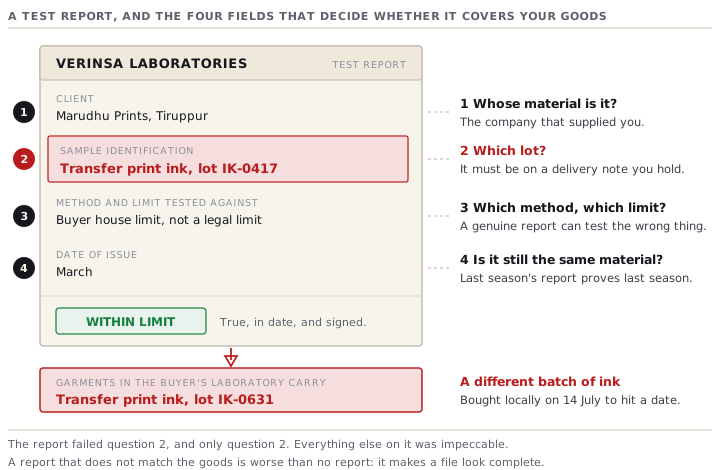
Four questions, asked of every certificate before it is filed:
- Whose material is it? The name on the report must be the company that supplied you, not their supplier and not a trading house.
- Which lot? The lot, batch or roll identifier on the report must appear on a delivery note you can produce.
- Which method, and against which limit? A report can be perfectly genuine and test the wrong thing, or test the right thing against a limit that is not your buyer's.
- Is it still the same material? A report from a previous season proves what was true then.
Sennari's ink report failed question two, and only question two. Everything else about it was impeccable.
The trim supplier who cannot answer
While mapping the list in February, the merchandiser asked Bhavani Fasteners for nickel release evidence on the neck press stud used in the 2-3y and 3-4y sizes. Bhavani replied that their studs are nickel-free and that they had never been asked for a report.
"We have never been asked" is the most common answer in this whole subject, and it is not a refusal. It is information: this supplier has never sold to a buyer who checks. Three options, priced.
| Option | Cost | Lead time | What it leaves you with |
|---|---|---|---|
| Buy the stud from an already-approved supplier | USD 0.019 more a piece on 3,600 pieces, USD 68.40 | None, stock item | Evidence held by somebody else, and a second supplier to manage |
| Send Bhavani's stud for testing yourself | USD 130.00 | Six working days | A report in your own name, on your own lot, and a supplier who now knows what a report is |
| Redesign the neck without a stud | USD 340.00 plus re-approval | Nine days | No component and no evidence needed, but a fit question reopened |
Option two, at USD 130.00, is almost always right. The reason is worth stating plainly: most compliance gaps are not resistance, they are ignorance, and ignorance is the cheapest thing on this table to fix. A supplier who has been walked through one test report will produce the next one unprompted. A supplier you drop teaches you nothing and takes their gap to the next factory.
What the whole evidence programme costs
Merchandisers habitually treat testing as an unbudgeted irritation absorbed somewhere in overhead. Put a number on it and the argument changes.
| Test package | Unit | Number | Rate | Cost |
|---|---|---|---|---|
| Fleece chemical package | Per colour | 5 | USD 145.00 | USD 725.00 |
| Rib chemical package | Per colour | 2 | USD 145.00 | USD 290.00 |
| Print ink package | Per print colour | 3 | USD 190.00 | USD 570.00 |
| Press stud nickel release | Per component | 1 | USD 130.00 | USD 130.00 |
| Sewing thread package | Per shade | 2 | USD 95.00 | USD 190.00 |
| Labels, hangtag and packaging | Per package | 1 | USD 110.00 | USD 110.00 |
| Small parts pull test | Per style | 1 | USD 240.00 | USD 240.00 |
USD 2,255.00 for the season. Across 14,400 pieces that is USD 0.16 a piece, or 2.29% of an FOB of USD 6.85. It is a real line, worth arguing about at the cost stage, and invisible if it is never written down.
Notice the shape of the bill. The single most expensive thing on the page is not a test. It is the five colourways, which multiply the fabric package by five. That is a merchandising decision made in a range meeting, usually without anybody costing its compliance consequence. And it is the one place a merchandiser can genuinely reduce this number before it is spent.
The line on the carton label worth sixteen thousand dollars
Back to 6 November. Marudhu's records show that ink lot IK-0631 was used from the afternoon of 14 July onwards. Sennari's production records show 5,900 pieces were printed from that point. So Sennari knows how many are affected.
What Sennari cannot do is say which cartons they are in. The carton label carries the PO, the style, the colour, the size ratio and a packing date. It does not carry an ink lot. The packing date does not separate them either, because printed panels sat in a buffer and were sewn in no particular order.
So the buyer cannot isolate 5,900 pieces out of 14,400. It withdraws all of them.
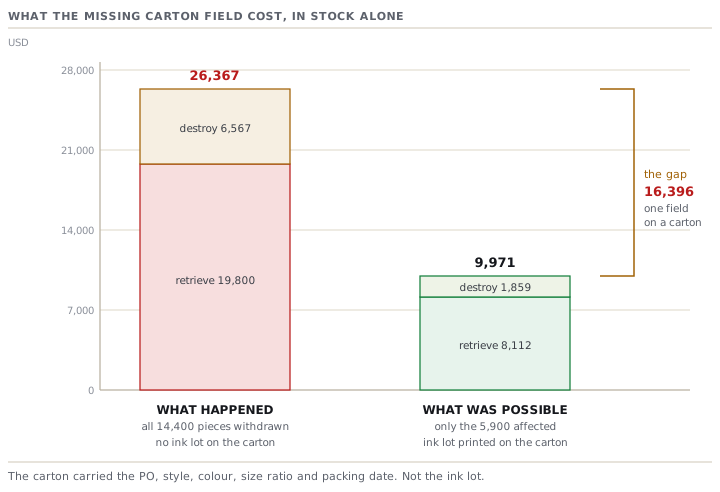
| All 14,400 pieces | Only the 5,900 affected | |
|---|---|---|
| Unsold stock to retrieve | 8,250 pieces at USD 2.40 | 3,380 pieces at USD 2.40 |
| Retrieval cost | USD 19,800.00 | USD 8,112.00 |
| Destruction, including returns | USD 6,567.00 | USD 1,859.00 |
| Stock cost of the event | USD 26,367.00 | USD 9,971.00 |
The difference is USD 16,396.00. The thing that would have earned it is one more field on a carton label and one more column on a packing list. That field costs nothing. Nobody adds it, because on the day you design a carton label there is no reason to.
The rest of the event does not divide so neatly. A public notice, a customer contact line and refunds are driven by what has already been sold, not by what is in the warehouse. Whether a public notice is required at all is a decision for the importer and its authority. It is not for the factory, and not for a merchandiser. On PB-4471, 6,150 pieces had sold by 6 November.
| Line | Cost |
|---|---|
| Public notice, press and website | USD 18,000.00 |
| Customer contact line, six weeks | USD 9,400.00 |
| Retrieval of 8,250 unsold pieces | USD 19,800.00 |
| Refunds on 3,690 returned pieces at USD 24.00 | USD 88,560.00 |
| Destruction of 11,940 pieces | USD 6,567.00 |
| Total | USD 142,327.00 |
Who pays
Not all of it lands in the same place. The split is written in the supply agreement long before anybody reads it. Pippin and Bloom's terms make the supplier liable for costs arising from non-compliant goods. The debit note to Sennari is the order value, USD 98,640.00, plus the stock costs, USD 26,367.00, giving USD 125,007.00. The buyer absorbs the notice, the contact line and the refunds. And it never buys from Sennari again, which is the larger number and is not on any invoice.
Hold that against the two figures this course has been building. The margin on PB-4471 was USD 9,504.00. The debit is more than thirteen times it. The entire test programme that would have caught a changed ink, including the per-lot ink test that IK-0631 never had, cost USD 2,255.00. That is 63 times less than the event.
And the cheapest moment of all was not a test. It was 14 July, when a print manager who had run out of ink had nobody to ring.
Check yourselfSennari's file contained a genuine, in-date test report from a reputable laboratory showing the ink was compliant. Why did it not help, and what single change to the factory's routine would have?Show the answer
Because a report certifies a sample from a named lot, and the goods carried a different lot. The report was true and irrelevant. The change is to reconcile every certificate against a delivery note rather than a purchase order. It is also to require a fresh declaration and test on any lot of an applied chemistry — ink, dye, coating, adhesive — that was not covered by the report on file. Applied chemistries are the ones that change silently, which is why they are the ones tested per lot.
What you do on Monday
- Convert the RSL into a component map for each style before costing. Write rule-out, declare or test against every component, and name the test frequency as per season, per colour or per lot.
- Price the programme onto the cost sheet. If it is not a line, it is a loss.
- Reconcile certificates to delivery notes, and make lot numbers a receiving requirement in the store.
- Test applied chemistries per lot: ink, dye, coating, adhesive, finish. They are the ones that change without changing appearance.
- Put the lot identifiers of applied chemistries on the carton label and the packing list. It costs nothing, and it is the difference between a withdrawal and a recall.
- Treat a supplier who cannot answer as a supplier who has not been asked. Price the three options and choose the one that leaves you holding evidence.
- Keep a written escalation route for the day a material runs out. Every failure in this course started with somebody protecting a date and having no one to ask.
Prompt · Turn a restricted substances list into a component plan
The day a buyer's restricted substances list arrives, and again whenever a supplier says they have never been asked for a test report.
Act as a chemical compliance manager in a garment factory. I have a buyer's restricted substances list and a bill of materials, and I need the list converted into obligations that land on named suppliers. Style facts: [STYLE], [QTY], [NUMBER] colourways, FOB [PRICE], destination markets [LIST]. Bill of materials, one line per component with its supplier: [LIST EVERY COMPONENT - BODY FABRIC, TRIMS, THREAD, INTERLINING, ELASTIC, PRINT INK, COATING, FASTENERS, ZIPS, LABELS, HANGTAG, POLYBAG, CARTON]. For each component say whether any chemistry is APPLIED to it during production, such as dye, print, coating, adhesive or finish. Laboratory rates I have been quoted: [LIST THE PACKAGES AND PRICES]. Do the following. First, for every component give me one of three verdicts - rule out, declare, or test - with a one-line reason. Second, for everything you put in TEST, state the unit of testing: per season, per colour, per lot, or per component, and say why. Treat applied chemistries differently from inherent ones and explain the difference to me in one paragraph. Third, build the full test programme as a costed table and give me the total, the cost per garment, and that cost as a percentage of my FOB, so I can put it on the cost sheet. Fourth, tell me which merchandising decisions - number of colourways, number of print colours, number of thread shades - are driving that bill, and what each additional one costs. Fifth, give me the four questions to ask of every certificate before I file it, and a rule for reconciling certificates against goods received. Sixth, tell me exactly what to do about a supplier who says their component is compliant but has never been asked for a report, with at least three priced options. Do NOT quote any legal limit, threshold or concentration; where a limit matters, say which document holds it and who must read the current version.
AI can make mistakes — check anything you act on.