Lessons · Lesson 2 of 3
The label is part of the product
Trace every line of a garment label back to the document that proves it, and see what one unrecorded material change does to two markets at once.
Lesson 2 of 3 · 34 min
The situation
Most factories treat the strip of tape sewn into a side seam as artwork. It gets filed near the barcodes and the carton marks. To the people who police what may be sold, it is part of the garment. One of its lines states what the garment is made of, and a laboratory can disprove that. This lesson takes such a label apart, line by line.
14 October, Pippin and Bloom's distribution centre outside Antwerp. The 8,640 European pieces of PO PB-4471 landed on 8 September and went to the shops on the 22nd. A routine content check pulls three garments off a pallet of returns and sends them to the buyer's contract laboratory.
The woven label sewn into the left side seam of style KF-2207 reads 80% cotton, 20% polyester.
The report reads 64.1% cotton, 35.9% polyester.
Every remaining piece in the building is blocked, and the shops are told to stop selling.
Fifteen days later, on 29 October, Cedarbrook Kids in the United States raises a separate complaint about the same style. Nothing to do with labels: the printed motif on the chest is cracking and lifting after three home washes. They have 5,760 pieces and a customer service queue.
Two complaints, two continents, two subjects. One cause.
What happened in May
On 19 May, Vellakoil Knits told Sennari that the cotton yarn lot for the approved fleece was short. The fabric delivery would be eleven days late. They offered an alternative in the same weight, the same brushed construction, the same shade, at the same price: 280 g/m² fleece at 65% cotton, 35% polyester instead of 80% cotton, 20% polyester.
Sennari's fabric manager took it. On its own terms that was the right call. The delivery date was protected, the price did not move, and the hand was indistinguishable. The buyer's quality manager handled the swatch on a factory visit on the 27th and said it looked fine.
Nobody asked the second question. A material change is not finished when the material is accepted. It re-opens three documents, and on this order it re-opened all three.
- The fibre content label, which is a statement of fact about the garment and is now false.
- The care instruction, which was validated on the old fabric. It is now a promise about a garment nobody has tested.
- The transfer print parameters. Marudhu Prints validated them in February at 165 degrees Celsius for 12 seconds at medium pressure, on the old fabric. More polyester at the surface changes how the adhesive keys into the face. Marudhu ran exactly the parameters it had validated, on a substrate it had never validated them on, and did nothing wrong at any point.
That is the whole of it. One unrecorded substitution, three consequences. The two complaints that arrived in October are numbers two and three.
What a label has to carry, and why it is not one question
A merchandiser tends to think of "the label" as one artwork. It is not. It is a bundle of separate legal statements that happen to share a piece of tape. Each has its own rules, its own market variations and its own evidence.
Here is the label itself, drawn as it arrives from the label supplier. The numbered lines are the six statements below.
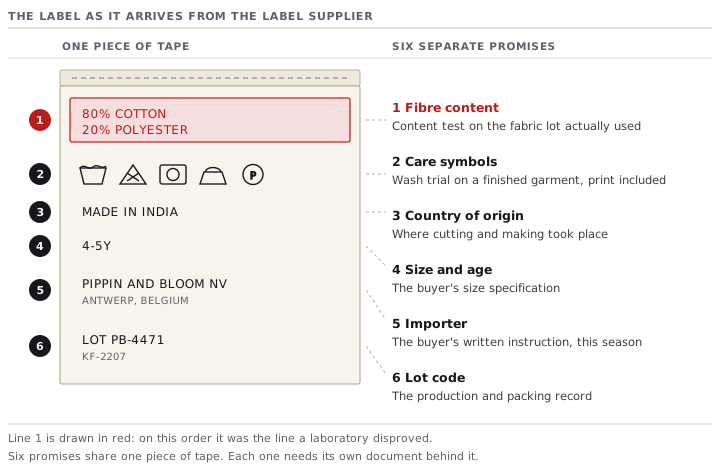
Fibre content. Mandatory in most markets, and expressed in words. That is why it is the line that changes by destination: the required language or languages differ, and so do the rules for how a blend is expressed and what tolerance applies. It is a statement of fact, so a test can prove or disprove it. That is exactly what happened at Antwerp.
Care instructions. In Europe the symbol set comes from ISO 3758, and the symbols themselves are the property of GINETEX, licensed for use. In the United States the FTC, the Federal Trade Commission, sets the care labelling rules, and the presentation convention is not the same. Care is not a statement of fact. It is a promise about the future: this garment will survive this treatment. So it has to be validated on the finished garment, not on the fabric.
Country of origin. Where the garment was made. Note the trap for merchandisers: origin for labelling and origin for duty are two separate questions with two separate rule sets. An answer to one is not an answer to the other. Ask both, separately.
Size and age designation. The buyer specifies it. But on children's wear the age band interacts with the safety rules in lesson 1, so it is not purely commercial.
Who placed it on the market. The name and address of the responsible economic operator, normally the importer rather than the factory. It is the buyer's legal entity, and the buyer must give it to you in writing. Never carry it over from last season. Entities get reorganised, and the name on the label is the name a regulator writes to.
Traceability. A code that ties a specific garment back to a specific production lot. People often treat it as a housekeeping detail. Lesson 3 is about what it is worth.
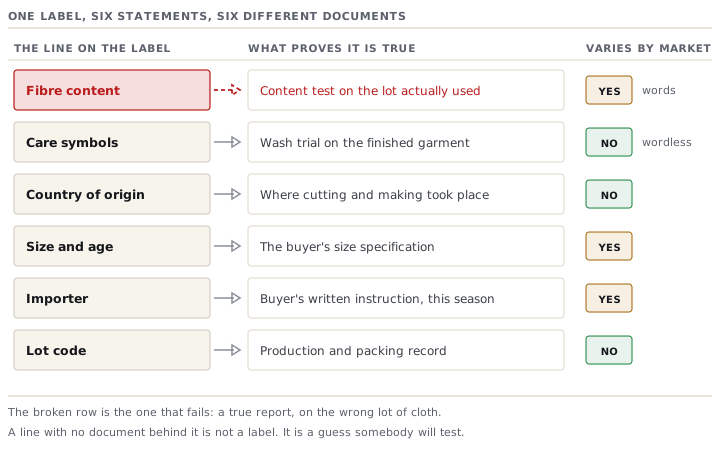
| Label line | What proves it | Who owns the document |
|---|---|---|
| Fibre content | Content test report on the fabric lot actually used | The mill, verified by the factory |
| Care symbols | Wash trial on a finished garment including print and trims | The factory, approved by the buyer |
| Country of origin | Where cutting and making took place | The factory |
| Size and age | The buyer's size specification | The buyer |
| Importer name and address | The buyer's written instruction for this season | The buyer |
| Traceability code | The factory's production and packing record | The factory |
Read the first row against what happened. The content test report on file at Sennari was for the February fabric. The garments were made from the May fabric. Nobody had lied. The file simply described a different cloth.
A wrong label is a defective product
Merchandisers file labelling under administration, somewhere near barcodes and carton marks. Market-surveillance officers do not. To them the label is a part of the product, in the same way a seam is. A garment carrying a false fibre content is non-conforming whether or not a single stitch is out of place.
That reframing changes three habits.
It changes when you settle the label. If the label is a part, you specify it with the other parts, at the same meeting, from the same bill of materials. It is not drafted by whoever is free the week before the labels are ordered.
It changes who signs it. A part that carries legal statements is signed off by whoever is accountable for those statements. On a children's style that is the buyer's compliance function, not only the buyer's technologist.
It changes what a change means. Nobody substitutes a zip without telling the buyer. On PB-4471 the single largest component in the garment was substituted, and nobody looked at the label once, because the label was not on anybody's list of parts.
One more market-by-market variable catches people out, and it is the reason care symbols exist at all. Care symbols are deliberately wordless, so one label can serve many languages. Fibre content is words, so it cannot. Which language or languages the content must appear in, and how a blend must be expressed, varies by destination. On a single PO going to two continents, that is not a detail. It is two artworks. Ask the buyer for the market list and the language requirement for each, in writing, before the label artwork is drawn.
Care is a promise about the whole garment
The second consequence is subtler than the first, and it costs more.
The KF-2207 care label says warm machine wash and tumble dry on a low setting. That instruction was arrived at honestly in February. A wash trial on three finished garments in the approved fabric, with the approved print, gave clean results after five cycles, and the buyer signed it.
Nobody repeated the trial in May, because the fabric was "the same weight and the same shade" and the print was "the same print". But the care instruction is not a property of the fabric. It is a property of the assembly: fabric, print, thread, interlining, elastic, label, appliqué, and every process that touched them. Change one member of the assembly and the promise on the label is unproven.
The same job, priced by when you do it
The content label on KF-2207 is a woven care and content label costing USD 0.042 a piece. Replacing it means unpicking a side-seam label, sewing a new one and re-pressing: 3.8 minutes at a loaded USD 2.10 an hour is USD 0.133, so USD 0.175 a piece all in.
That number never changes. What changes is where the garment is standing when you do it.
| When | What it takes | Cost |
|---|---|---|
| 19 May, at the substitution | Change one line of label artwork | USD 0.00 |
| 2 June, before the label order goes out | Change one line of label artwork | USD 0.00 |
| 20 June, labels woven and delivered | Scrap USD 604.80 of labels, reorder USD 604.80 | USD 1,209.60 |
| 14 July, labels sewn in, goods in the factory | Rework 14,400 pieces at USD 0.175 | USD 2,520.00 |
| 14 October, goods landed at the buyer's DC | Third-party rework of 8,640 pieces at USD 1.15 | USD 9,936.00 |
The DC rate is 6.57 times the factory rate for the identical piece of work, and the difference is not skill. A garment in your own finishing room is beside the operator, the labels and the press. A garment at a distribution centre has to be unpalletised, unbagged, handled, re-bagged, re-ticketed and re-palletised by somebody whose business is not sewing.
And that is only the label half. The print half lands on the other side of the order. Cedarbrook Kids takes a markdown allowance of USD 1.35 a piece across its 5,760 pieces, which is USD 7,776.00. Sennari's bill for one unrecorded substitution is therefore USD 17,712.00.
Set that against the order. The margin on PB-4471 was USD 9,504.00. Lesson 1's cord rework had already taken it to a loss of USD 4,204.00. This takes the running loss to USD 21,916.00 on an order with a value of USD 98,640.00.
Check yourselfThe mill's substitute was the same weight, the same shade and the same price, and the buyer's quality manager saw it and approved it. Name the three documents that still had to be re-opened, and say why a quality approval does not close them.Show the answer
The fibre content label, the care instruction, and any process parameter validated on the original material — here, the transfer print. A quality approval answers a quality question: does this cloth look, feel and perform like the one we approved. None of the three documents is a quality document. The content label is a factual claim a laboratory can disprove. The care instruction is a promise about an assembly that has changed. The print parameters were validated against a substrate that no longer exists in this order. A material change note forces all three to be signed before the substitute is cut.
What you do on Monday
- Write the label brief with its evidence column. For every line, name the document that proves it and who holds it. A line with no document is a line you are guessing.
- Get the importer identity in writing, this season. Never inherit it.
- Ask origin twice, once for labelling and once for duty, and accept that the answers may differ.
- Make the care instruction an output of a wash trial on a finished garment, never a copy from a similar style.
- Raise a material change note for every substitution, including ones that look free. Make labelling, care and process re-validation compulsory boxes on it.
- Keep the content test report for the lot you actually used. A report for a different lot is the subject of lesson 3, and it is worth less than nothing, because it makes a file look complete.
Prompt · Audit a label against the documents that prove it
Before the label artwork is released, or the morning a shipment is held for a content or care question.
Act as a labelling compliance reviewer. I want every line of a garment label traced back to the document that proves it. Style facts: [STYLE], [DESCRIPTION], [QTY], destination markets and quantity to each [LIST]. Paste the label artwork as text, line by line, exactly as it will be woven or printed: [PASTE IT]. Now the evidence I actually hold: fibre content [WHAT TEST REPORT, WHOSE MATERIAL, WHICH LOT, WHAT DATE], care instruction [WHAT WASH TRIAL, ON WHAT, WHEN, INCLUDING WHICH PRINTS, TRIMS AND INTERLININGS], country of origin [WHERE CUTTING AND MAKING HAPPENED], size and age [WHOSE SPECIFICATION], importer identity [WHOSE WRITTEN INSTRUCTION AND FROM WHICH SEASON], traceability code [WHAT IT ENCODES]. Also list every material substitution made since the style was approved, with the date and what changed: [LIST THEM, OR SAY NONE]. Do the following. First, build a table with one row per label line: what it claims, what document I hold, whether that document actually covers the goods being made, and a verdict of PROVEN, STALE or UNPROVEN. Second, for every substitution I listed, tell me which label lines and which validated processes it re-opens, including print, fusing, bonding and embroidery parameters. Third, tell me which lines vary by destination market and which do not, and why. Fourth, price the correction of any unproven line at four points: at artwork, once labels are made, once labels are sewn in, and once the goods have landed, using [LABOUR RATE] an hour and [LABEL COST] a label. Fifth, write the material change note I should have raised, as a one-page form. Do NOT tell me what any market's legal requirement says in numbers or in words - name the question and who must answer it instead.
AI can make mistakes — check anything you act on.