Lessons · Lesson 2 of 3
A round is a queue, not a garment
Price one sample round in cash and in calendar days, read the sample room as a capacity limit, and buy first-time approvals at a known price per day.
Lesson 2 of 3 · 36 min
What one round costs in cash
Ask what a sample costs and almost everybody names the cloth. This lesson adds up the rest of the bill.
Then it prices the same sample a second time, in days rather than money. Because a sample is also a wait. One identical garment costs one thing when the schedule has room, and another thing when it does not. The sample room has a fixed number of working hours in the week.
Here is the whole bill for one fit round on CW-2260, the coat from lesson 1.
| Line | Basis | USD |
|---|---|---|
| Shell, sample yardage | 2.9 m at 18.90 | 54.81 |
| Lining | 2.2 m at 2.40 | 5.28 |
| Interlining | 1.4 m at 1.45 | 2.03 |
| Buttons, pads, sleeve heads, labels, thread | sample store | 5.60 |
| Pattern room | 2.5 h at 5.20 | 13.00 |
| Sample machinist | 7.5 h at 4.10 | 30.75 |
| Pressing and finishing | 1.2 h at 3.40 | 4.08 |
| Measure, photograph, pack | 0.7 h at 3.40 | 2.38 |
| Courier, Alexandria to Toronto | 7.5 kg chargeable at 12.80 | 96.00 |
| One round | 213.93 |
Three lines in that table are worth stopping on.
The shell costs USD 18.90 a metre. Bulk costs USD 12.60. Levantis will not cut three metres off a bulk run. So sample cloth comes from hanger stock at a premium, in a 30 m minimum. The first round in a colour therefore carries USD 567.00 of cloth, whether you make one coat or ten. The other twenty-seven metres sit in the sample store. This is why a sample room that plans its rounds a colour at a time is cheaper than one that buys reactively. The minimum is a fixed cost, and you should spread it on purpose.
The courier is the largest single line, and it is not priced on weight. The coat weighs 2.4 kg in its box. The box is 55 by 40 by 17 centimetres, which is 37,400 cubic centimetres. An express carrier divides that by 5,000 to get a volumetric weight of 7.5 kg. You are charged on the larger of the two. A coat is mostly air, so a coat sample is charged at three times its weight. Flattening the fold is worth more than arguing about the rate.
The sample machinist is 7.5 hours. Hold on to that figure. It is the one that turns into days.
What one round costs in days
Now the same round, in the only currency the ship date understands.
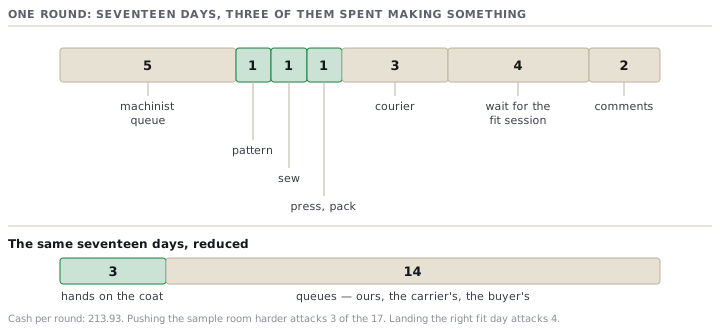
| Step | Days |
|---|---|
| Waiting for a machinist to come free | 5 |
| Pattern amendment and cutting | 1 |
| Sewing the coat | 1 |
| Pressing, measuring, photographing, packing | 1 |
| Courier, Alexandria to Toronto | 3 |
| Waiting for the buyer's fit session | 4 |
| Session to written comments | 2 |
| One round | 17 |
Somebody has their hands on that coat for three of those seventeen days. The other fourteen are queues: our queue, the carrier's queue, and Aldermere's queue. Their fit model comes in on Tuesdays, so a sample landing on a Wednesday waits six days for the next session.
This is the most useful idea in sample management. A round is not a garment. It is a place in three queues. Pushing the sample room to sew faster attacks three of seventeen days. Getting a sample onto the right Tuesday attacks six.
The fourth queue, and it is entirely yours
The seventeen days in that table start when the sample room has a docket — the work order that puts the job on its board. There is a queue before that, and it appears on no report, because it sits between two departments and neither department's report covers it.
On CW-2260 the comments from fit round 1 landed on 13 February. The next round was cut on 17 February. Four days, inside our own building. They went on reading a comment sheet, deciding what "shoulder 1 cm narrow" means for a pattern, and getting the work onto the board. The buyer's clock stopped when they sent the comments. The sample room's clock started when the docket arrived. Nobody was late, and four days went missing.
Measure it. Comment date to cut date, one column, every round. On most sample programmes it is the second-largest number after the wait for a machinist. It is also the only one you can shorten without asking anybody's permission.
The fix is a rule, not a project. Comments are read on the day they arrive, by the merchandiser and the pattern room together. Every comment leaves that reading with an action and an owner. Anything that cannot be decided in that half hour is a question for the buyer, and it goes out the same afternoon. It does not travel three days later inside the next submission.
The same round, in March and in July
Here is where the two currencies meet.
A fit round in March sits on a chain with twenty-one days of float. It costs what it costs: USD 213.93. Nothing else moves.
A pre-production round in July sits on a chain with none. If the pre-production sample comes back rejected and needs a second round, that is seventeen more days against six of float. So the order lands eleven days late. That sits inside Aldermere's clause for days one to seven, at a 4% discount, or USD 15,872. And it only stays that low because you would fight the last four days back out of packing and inspection.
| Cash | Calendar effect | Total | |
|---|---|---|---|
| Fit round, March | 213.93 | absorbed by float | 213.93 |
| Pre-production round, July | 213.93 | past the float, into the clause | 16,085.93 |
The same garment, the same machinist, the same courier. Seventy-five times the money, and 52% of everything AM-8815 will earn.
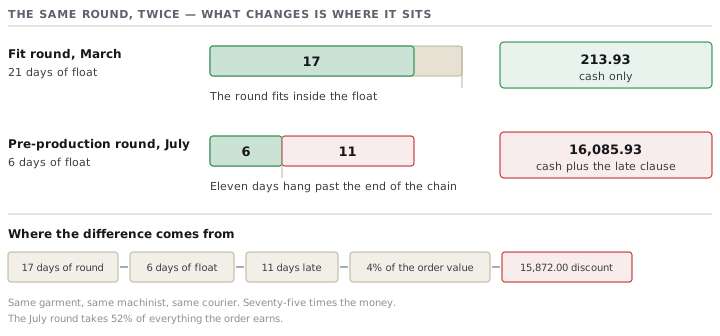
That number is the whole argument for treating early rounds generously and late rounds obsessively. A merchandiser who fights the sample room over USD 213.93 in March, and waves a pre-production sample through in July, has the economics exactly backwards.
The sample room is a capacity limit
A sample machinist is not a service. She is a resource with a fixed number of hours, and every rush you insert comes out of somebody's week.
Sirocco's sample room is four machinists, six days, 8.5 hours: 204 hours a week. Here is the book for the week beginning 25 May, the week the CW-2260 size set has to be made.
| Work | Garments | Hours each | Hours |
|---|---|---|---|
| CW-2260 size set, sizes 8 to 20 | 7 | 7.5 | 52.5 |
| CW-2260 fit round 3 | 1 | 7.5 | 7.5 |
| Tailored jackets, two other orders | 9 | 6.2 | 55.8 |
| Shirt fit and pre-production samples | 12 | 2.2 | 26.4 |
| Knit top protos and fits | 18 | 1.4 | 25.2 |
| Coat protos, new blocks | 2 | 10.5 | 21.0 |
| Showroom duplicates | 14 | 3.4 | 47.6 |
| Booked | 236.0 | ||
| Available | 204.0 |
The room is 32 hours over. That is four coats' worth of work, and nobody in that room can create an hour. So one of two things happens. Somebody decides what slips. Or the loudest merchandiser decides for everyone, by standing at the machinist's shoulder.
A rush sample does not create capacity. It re-orders a queue. Insert a rush coat at the front and 7.5 hours of somebody else's work moves to next week. If the displaced garment was a fit sample at the same stage on another order, that order does not lose 7.5 hours. It loses a round, which is seventeen days. Your rush is paid for by the order behind you. Next month you are the order behind somebody else.
The priority rule, and why it must be published
The rule is one line: rank by float. Not by volume, not by value, and not by who asked.
- Pre-production and top-of-production samples, in date order. These have zero float, by construction.
- Anything whose next gate is inside its remaining float.
- Fit and size-set samples, by days of float remaining, fewest first.
- Protos and showroom duplicates.
Then publish the queue where every merchandiser can see it, with the float figure next to each line. Two things change immediately. Arguments become arguments about float rather than about urgency, and float is a question with an answer. And a merchandiser who can see that their fit sample sits behind two pre-production samples stops chasing on Tuesday and re-plans on Monday.
What buys a first-time approval
The cheapest round is the one you do not have to run again. A first-time approval is bought, not hoped for. Four things buy it, and all four are cheap.
Send the photographs and the measurement chart before the courier, not with it. On the day the sample is packed, email a front, back, side and inside-detail set, plus the measured chart against the tech pack. It costs 0.4 hours. It puts the obvious questions into the three days the box is in the air. Then the fit session begins with the answers already there, instead of ending with the questions.
Answer the last round's comments line by line. A response sheet takes each previous comment and says one of three things: done, done differently and why, or not possible and here is what we suggest. One hour. It is also the document that decides, later, who owns a change.
Name the tech pack revision on the submission. Free. Lesson 3 is largely about what happens when you do not.
Keep a duplicate in the sample room. One more garment without the courier, USD 117.93. It removes the round that dies with "we cannot discuss it, we do not have one in front of us."
Total: USD 127.59 a submission.
Now the honest part. Sirocco ran that routine across fourteen styles last season. First-time pre-production approvals went from five of fourteen to eleven of fourteen. Six second rounds avoided, worth USD 1,283.58 in cash. The routine cost USD 1,786.26 across all fourteen styles.
It loses money. Net cash cost USD 502.68, and it bought 102 calendar days.
That is USD 4.93 a day. Lesson 1 told you what a day costs on the wrong side of the float. Buy them while they are cheap.
Prompt · Price one sample round in cash and in days
Before you agree to a second round on anything, and before you argue with the sample room about the first.
Act as a sample-room manager who costs work properly. I need one sample round priced twice: in cash and in calendar days. Garment: [DESCRIPTION], style [STYLE], for buyer [BUYER]. Materials for one sample: shell [METRES] at [SAMPLE PRICE] a metre against a bulk price of [BULK PRICE], plus a supplier minimum cut length of [METRES]; lining, interlining and trims [LIST WITH PRICES]. Labour rates: pattern room [RATE] an hour, sample machinist [RATE] an hour, pressing and finishing [RATE] an hour. Hours: pattern [HOURS], sewing [HOURS], pressing and packing [HOURS]. Courier: box [LENGTH] by [WIDTH] by [HEIGHT] centimetres, actual weight [KG], carrier volumetric divisor [NUMBER], rate [PRICE] a kilogram. Queue facts: the sample room has [NUMBER] machinists working [HOURS] a week and currently has [HOURS] booked; my sample waits [DAYS] for a machinist. Buyer facts: courier transit [DAYS], fit sessions on [DAY], comments [DAYS] after the session. Order facts: this round sits before [MILESTONE], which has [DAYS] of float behind it, and the late clause reads [PASTE IT]. Do the following. First, build the cash cost line by line to a single figure, and state which line is largest — I expect it to surprise me. Second, compute the courier's chargeable weight from the box dimensions and say whether I am paying on weight or on air. Third, break the round into calendar days step by step to a total, and separate the days where somebody is working on the garment from the days it is queueing. Fourth, tell me what this round costs where it actually sits: cash only if it is inside the float, cash plus the clause if it is not. Fifth, list the three cheapest things I could do to raise the chance of a first-time approval, with a cost for each. Do not give me a range where a number is possible.
AI can make mistakes — check anything you act on.
Check yourselfYour sample room is 32 hours over for the week. A merchandiser wants a coat proto pushed in front of a pre-production sample because their buyer is visiting Thursday. What do you say?Show the answer
No, and give the reason in float. The pre-production sample has zero days behind it and a cutting date attached. The proto is development work with weeks of room. The buyer's visit is a real constraint, so solve it somewhere else: send the previous season's block in the new cloth, or a half-made shell for the meeting. Displacing a zero-float garment to satisfy a meeting turns a scheduling problem into a shipping problem.
Check yourselfA buyer asks you to courier every sample overnight instead of on the three-day service. What does that actually buy?Show the answer
Two days out of seventeen, at roughly double the freight. Worth it on a pre-production or top-of-production sample, where every day is on the critical path and the freight is a rounding error against USD 15,872. Not worth it on a proto, where the two days disappear into float and you have simply paid more for the same date. Speed is worth buying only where the calendar is actually tight. That is the same rule as everything else here.
Check yourselfWhy is the volumetric weight of a sample box a merchandiser's problem rather than the shipping clerk's?Show the answer
Because it is the biggest line in the round, and it is set by how the garment is folded and boxed. That is a sample-room decision. At 7.5 kg chargeable against 2.4 kg actual, the coat is paying for air. A flatter box on the same coat moves real money across a season of rounds, and nobody in the shipping office is allowed to refold a buyer's sample.