Lessons · Lesson 1 of 3
Six samples, six questions
Say what each sample type is for, build the sample calendar backwards from the ship date, and know what a buyer's yes commits each side to.
Lesson 1 of 3 · 38 min
The order
Before a factory makes thousands of a garment, it makes a few. They go to the customer one at a time, to be looked at. This lesson is about those few garments.
Each one is asked a different question. Mix the questions up and a garment gets made from the wrong cloth, by the wrong person. The approval it earns is then worth nothing.
Sirocco Apparel, Kafr El Dawwar. Monday 2 March 2026.
- Buyer Aldermere Outfitters, Toronto — city outerwear, 148 stores, third season with us
- PO AM-8815, season AW26. A PO is a purchase order: the buyer's written order
- Style CW-2260, women's single-breasted tailored overcoat, three buttons, welt pockets, back vent, full Bemberg lining
- Shell 620 gsm wool-blend melton, 55% wool / 45% polyester, napped, from Levantis Woollens in Turkey
- Quantity 6,400 pcs — Charcoal 2,800, Camel 2,240, Oxblood 1,360, sizes 8 to 20
- Price USD 62.00 FOB Alexandria. FOB is the price with the coats loaded on the ship. Order value USD 396,800
- On board ship 7 September 2026
Making one coat costs USD 57.15. So the factory keeps USD 4.85 a coat, USD 31,040 on the order, 7.8% of the FOB price. That is a thin coat order, and a normal one. Measure every decision in this course against USD 31,040.
You have 189 days from the PO to the ship. Your critical path — the chain of steps that decides the ship date, built the way course 7.1 builds one — leaves six days of float. Float is spare time. Not six days per step. Six days, once, for the whole chain.
The order was won by a sample, before it was an order
Aldermere did not place AM-8815 because of a price. They placed it because a coat arrived in Toronto on Tuesday 24 February, it hung correctly on their fit model, and their buying director signed off the range on the Monday after.
That coat was the third garment Sirocco had made for CW-2260:
- 14 January — proto, in a stand-in melton of roughly the right weight from the sample store. The real cloth had not been chosen yet. Approved 22 January.
- 6 February — fit sample. Right pattern, right weight, wrong colour. Comments back 13 February: shoulder 1 cm narrow, back vent gaping, sleeve pitch forward.
- 24 February — fit sample, round two. All three comments done. Approved on sight.
Three garments, six weeks, roughly USD 640 of sample-room money. All of it spent before there was a purchase order to charge it to. If Aldermere had bought elsewhere, that money was gone.
Sampling is a selling cost wearing the clothes of a production cost. A factory that treats it as production accounting will keep refusing the rounds that win orders.
Six samples, six questions
The mistake that costs the most calendar time is not skipping a sample. It is not knowing which question a sample is being asked. Then it gets made from the wrong thing, sent to the wrong person, or approved for the wrong reason.
Every sample type answers exactly one question. If you can say the question, you can say what the sample must be made from, who has to approve it, and what a yes commits each side to.
| Sample | The question it answers | Made from | What a yes commits |
|---|---|---|---|
| Proto | Is this the right garment at all? | Anything of the right weight | Nothing. Silhouette only |
| Fit | Does the pattern fit the body? | Correct pattern, near-correct cloth | The pattern. Changes after this are buyer changes |
| Size set | Does the grade hold across the range? | Correct pattern, graded | The grade rules and the measurement chart |
| Pre-production | Can the line make this, from this cloth, this way? | Bulk cloth, bulk trims, the line | The construction, the method and the cut |
| Top of production | Does bulk equal what was approved? | The first output off the line | Nothing new. It is evidence |
| Shipment | What did we actually ship? | A packed carton | Nothing. It is the record |
Read the "made from" column twice. That column is where sample programmes fail.
A fit sample in the wrong cloth weight answers a question nobody asked. A pre-production sample in bulk cloth, but made by a sample machinist, answers a different question from the one on the letter. Lesson 3 is about what that cost this order.
Two more samples sit outside the sequence, and they get forgotten until somebody shouts. Photo and press samples are needed by a marketing calendar, not by production. Aldermere wanted CW-2260 in the studio on 3 April, three months before bulk cloth existed. That means a sample in sample yardage and a diary entry in February. Showroom duplicates are a sales tool, and fourteen of them are on the sample room's book in May whether you planned for them or not.
Building the sample calendar backwards
The ship is the only fixed point, so you work back from it. The port sequence and the production plan give you the date cutting must start. Everything in the sample programme is then a date on which somebody has to say yes.
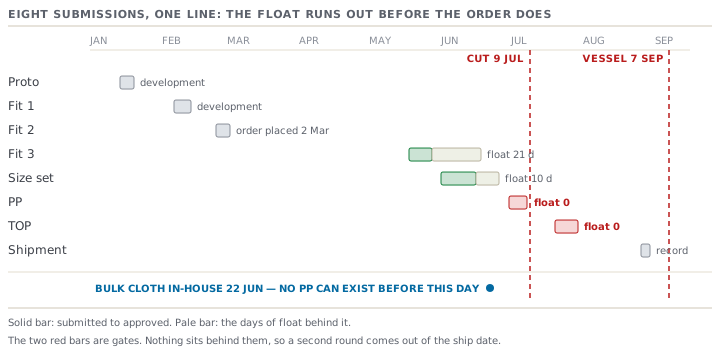
| Sample | Submitted | Approved | Float behind it |
|---|---|---|---|
| Proto | 14 Jan | 22 Jan | development |
| Fit, round 1 | 6 Feb | 13 Feb, with comments | development |
| Fit, round 2 | 24 Feb | 2 Mar, with the order | development |
| Fit, round 3 — bulk quality cloth | 18 May | 28 May | 21 days |
| Size set, sizes 8 to 20 | 1 Jun | 16 Jun | 10 days |
| Pre-production, Charcoal | 30 Jun | 8 Jul | 0 days |
| Top of production | 20 Jul | 30 Jul | 0 days |
| Shipment sample | 26 Aug | — | record only |
After that last approval the order runs on rails. Cutting from 9 July. Sewing 13 July to 21 August, at 210 coats a day after a five-day ramp-up. Packing 24 August, final inspection 26 August, customs clearance 28 August. Into the port 3 September, on board 7 September.
The sewing plan makes 6,895 coats in the 34 working days available. The order is 6,400. So the sewing window holds 495 coats of slack — about two days. Note that number now. It is the only cushion under a top-of-production comment, and lesson 3 spends it.
The gate with nothing behind it
Look at the float column and one thing jumps out. Everything up to the size set has room. From the pre-production sample onward there is none.
The reason is not scheduling. It is physics: a pre-production sample cannot exist before bulk cloth exists.
Bulk Charcoal landed 22 June. That is the earliest a real pre-production sample could be started. Cutting has to begin 9 July. So the whole gate — make it, courier it, get it in front of a fit technologist, get a written decision — has seventeen days. It needs every one of them.
This is why a merchandiser who plans the sample programme forwards from the PO always discovers the same thing in June. The early samples had weeks of slack that could not be moved. The one that matters has none.
The decision that saved twelve days
Bulk melton did not land in one delivery. Charcoal 22 June, Camel 29 June, Oxblood 4 July.
Most people read "pre-production sample" as one coat in every colour, submitted together. Follow that and the sample cannot start until 4 July. Submitted around 12 July, approved around 20 July, cutting begins 21 July. That is twelve days after 9 July, against six days of float.
So the order ships six days late. That lands inside Aldermere's late clause: days one to seven cost a 4% discount on the order, or USD 15,872. Half the margin on the order, spent to satisfy a habit.
So on 15 June you write and ask a specific question, not a general one. May we submit the pre-production sample in Charcoal only, for construction and method? And may we submit Camel and Oxblood as bulk shade approvals against the approved lab dips?
Aldermere agreed the same week. Why they agreed is worth understanding. Construction does not depend on colour. The question a pre-production sample asks — can this line make this garment, from this cloth, this way — has the same answer in all three colours. The question that does depend on colour is shade, and shade has its own approval. It does not need a made-up garment.
That one email is worth USD 15,872. It took eleven minutes to write.
Prompt · Build my sample calendar backwards from the vessel
When a buyer asks for a sample plan and you are about to write one forwards from today.
Act as an experienced apparel merchandiser building a sample programme. Order facts: buyer [BUYER], PO [NUMBER], style [STYLE], product [DESCRIPTION], quantity [QTY], FOB [PRICE], on-board date [DATE], PO confirmed [DATE]. Production facts: cutting must start [DATE], sewing runs [DATES] at [RATE] a day, packing, inspection, clearance and gate-in each take [DAYS]. Material facts: bulk fabric is promised in-house on [DATE] per colour — list the colours and their dates. Buyer facts: their fit sessions happen on [DAY OF WEEK], courier transit is [DAYS], and their late clause reads [PASTE IT]. Sample-room facts: [NUMBER] machinists, [HOURS] a week, and this garment takes [HOURS] of one machinist. Do the following. First, list every sample type this order needs — proto, fit, size set, pre-production, top of production, shipment, plus any photo or showroom samples — and for each one state in a single sentence the question it exists to answer. Second, work backwards from the on-board date and give me a submitted date and a required-approval date for each, showing your steps. Third, put a float figure against every submission: how many days I could lose before the ship date moves. Say plainly which submissions have zero float and why. Fourth, name every place where a sample cannot exist before something else exists, bulk fabric most of all. Fifth, tell me which submissions could legitimately be overlapped or split by colour, what I would be giving up in each case, and draft the exact wording of the request to the buyer including the date I need the answer by. Sixth, convert every day past the float into money using the late clause I pasted. Do not give me ranges where a date is possible, and list every assumption at the end.
AI can make mistakes — check anything you act on.
What a yes actually commits
The last column of the first table is the one merchandisers skim. It decides who pays when something moves.
Before fit approval, a change is free. The buyer is still designing. Do it, say what it cost in days, move on.
After fit approval, a pattern change is a buyer change. It costs a round — seventeen days and roughly USD 214. You can charge for it and move your dates, if the fit approval was clean and recorded. Most factories never claim it, because they cannot show what was approved and when.
After pre-production approval, a change is a variation to a cut order. Cloth is cut. The conversation is no longer about a pattern. It is about panels that already exist.
A top-of-production rejection commits nobody to anything new. That is the point of it. It says bulk has drifted away from what was already approved. The remedy is to bring bulk back, not to renegotiate the standard.
Read those four in order and the shape of the whole programme appears. Each approval closes a door, and the cost of reopening it roughly multiplies each time. The sample calendar is not a list of deliveries. It is the order in which you are allowed to stop changing your mind.
Check yourselfYour buyer asks you to skip the size set because the block is a carryover and the fit sample was approved. What have you actually removed?Show the answer
Not a garment. A question. The size set asks whether the grade holds across the range. A carryover block only answers that if the grade rules and the size range are unchanged too. If Aldermere added size 20 this season, the fit approval says nothing about it, and the first garment anyone sees in size 20 will be a bulk coat. Skipping a sample never removes the risk it was carrying. It moves the risk to the next gate, where it is more expensive.
Check yourselfWhy can the pre-production sample not be pulled earlier by making it in sample yardage of the same cloth?Show the answer
Because sample yardage is a different lot. The pre-production sample's question includes the bulk cloth: its shade, its hand, how it behaves under the fusing press and in the sleeve setting. A coat made in hanger stock answers the fit and construction half, and leaves the cloth half untested. That is exactly the half that surprises you. It is a legitimate thing to make. But it is a late fit sample wearing the wrong name, and it must be declared as one.
Check yourselfAldermere's late clause costs 4% for days one to seven. Why is that number in a lesson about samples?Show the answer
Because it is the price of every day the sample programme overruns. A sample decision that looks like a preference — submit all three colours together, wait for a tidier submission — turns straight into calendar days. Past the float, those days have a published price. On AM-8815 that price is USD 15,872, which is more than the whole sample programme costs to run.