Lessons · Lesson 3 of 3
The PP gate, and the decision to cut without it
Make a pre-production sample that answers the real question, price the decision to cut before approval, and write a submission letter that survives the comment which arrives afterwards.
Lesson 3 of 3 · 36 min
Five words, each one load-bearing
One sample exists to prove that the factory's own line can build the garment. It must use the cloth and the buttons that were actually bought, and the method the line will actually use.
This lesson is about how easily that proof gets faked, without anybody meaning to fake it. Give the job to the sample room's best craftsman and you have proved that a good tailor can make the coat. That was never in doubt.
A pre-production sample is a garment made from bulk cloth, with bulk trims, on the production line, by production operators, to the production method.
Every one of those five carries a different failure. A sample that drops one is not a slightly weaker pre-production sample. It is a different sample, with the wrong name on the letter.
- Drop bulk cloth and you have not tested shade, hand, shrinkage, or how the cloth behaves under a fusing press.
- Drop bulk trims and you have not tested whether the buttons hold in melton, or whether the zip tape shrinks.
- Drop the production line and you have not tested whether the line can make it.
- Drop production operators and you have tested a craftsman, not a process.
- Drop the production method and you have approved a garment nobody will ever make again.
The last three are the ones factories drop, because dropping them is convenient and looks harmless. Here is what it cost AM-8815.
The sample that was right about everything except who made it
Bulk Charcoal landed on 22 June. Cutting had to start 9 July. That is seventeen days for the whole gate: make it, courier it, get it in front of Aldermere's technologist on a Tuesday, get a written decision. Lesson 2 told you what seventeen days looks like when you own only three of them.
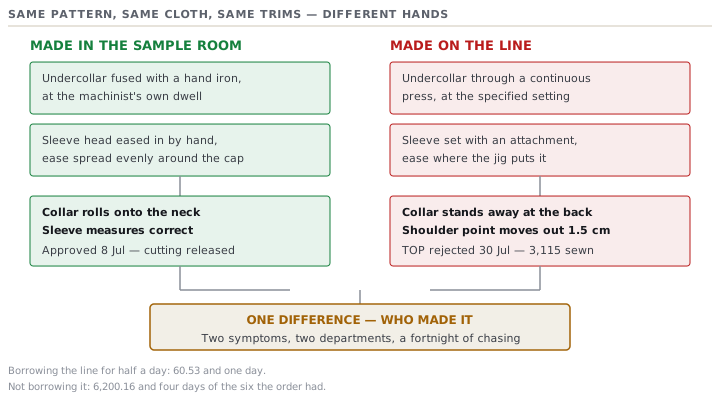
So the merchandiser did the sensible thing. The line was still finishing another order. Pulling operators and the fusing press off it to make one coat looked like a pointless disruption. The sample room had a machinist free. The coat was made there: from bulk Charcoal and bulk trims, to the approved pattern, by a machinist who has been making coats for nineteen years.
It was submitted 30 June and approved on 8 July, with two minor comments. Cutting started 9 July, sewing 13 July. Nobody did anything wrong.
Top of production was pulled from the first output on 20 July, couriered the same day, fitted in Toronto on Tuesday 28 July. The comments came back on Thursday 30 July.
Rejected. Two findings, from two different people at Aldermere.
- Their fit technologist: the collar stands away from the neck at the back and does not roll. It rolled on the pre-production sample.
- Their quality auditor: sleeve length measures 1.5 cm short across the graded sizes, against a tolerance of 1.0 cm.
The merchandiser did what almost everybody does. He treated them as two problems, opened two conversations, and asked the pattern room about the sleeve and the pressing section about the collar.
They are one problem.
The bill
The comments landed on 30 July. Between the approval on 8 July and that Thursday, twenty-two days had passed and the line had sewn 3,115 coats.
| Line | Basis | USD |
|---|---|---|
| Collar-forming press attachment | bought 31 Jul | 640.00 |
| Re-press collars, coats already sewn | 3,115 at 3.2 min, 3.15/h | 523.32 |
| Added pressing on the balance | 3,285 at 3.2 min, 3.15/h | 551.88 |
| Unpick and re-set both sleeves | 3,115 at 11 min, 3.15/h | 1,798.91 |
| Coats marked beyond recovery when unpicked | 47 at 57.15 | 2,686.05 |
| Total | 6,200.16 |
USD 6,200.16 is 20% of everything AM-8815 earns. A rework cell of sixteen people ran it in seven working days. That did not stop the line, but it did consume the 495 coats of sewing slack from lesson 1, and four of the order's six days of float.
Now price the alternative that was rejected on 28 June as too disruptive.
A line-made pre-production sample does not need a free line. It needs the line's machines, the line's settings and the line's operators for half a day: three operators for 4.5 hours, a mechanic to set the fusing press and the sleeve attachment, and a supervisor. USD 60.53, and one calendar day.
Rushing saved three days and spent four. It also spent USD 6,200.16.
Cutting before approval, priced honestly
Sometimes you cannot wait. The honest answer is not "never cut before approval". It is this: cutting before approval turns a calendar risk into a fabric risk. So price both, and cut only what a rejection could not invalidate.
On 30 June, with the pre-production sample in the air, the fabric risk of cutting all of Charcoal was the fabric itself: 2,800 coats at 2.9 metres at USD 12.60 is USD 102,312. Panels cannot be un-cut. Against that, waiting cost six days of float, and those days had a known price at the far end.
Neither number decides it on its own. The real question is narrower: what could a rejection actually change? On 30 June two comments were open, both on the pocket welt and the front facing. Nothing open touched the front panels, the backs or the sleeves.
So the cutting room split the lay. Fronts, backs, sleeves and under-collars went down on 1 July. Welts, welt facings and front facings — 0.36 metres a coat, USD 12,700.80 of Charcoal — were held for a second, small lay after approval.
| Line | Basis | USD |
|---|---|---|
| Second marker | 3.0 h at 5.20 | 15.60 |
| Spreading and cutting the small-part lay | 18.5 h at 3.60 | 66.60 |
| Fabric efficiency lost on the short lay | 21.17 m at 12.60 | 266.72 |
| Cost of splitting | 348.92 | |
| Exposure removed | 12,700.80 |
That is the rule in one table. You buy almost all of the calendar, and you carry almost none of the risk, for less than the cost of two sample rounds.
What an approval actually says
Aldermere's reply on 8 July said "approved to cut, comments to note". Those are three different words doing three different jobs. A merchandiser who reads them as one word signs up for things nobody offered.
- Approved — make it exactly like this.
- Approved with comments — make it like this, with these named changes, and do not re-submit.
- Approved subject to — not approved. Something must come back before you may cut, and it will not be on anybody's calendar unless you put it there.
An approval is always against something. That is why the submission letter matters more than the sample. Every submission from Sirocco carries the same eight lines.
- Style and PO.
- Sample type and round number.
- The tech pack revision it was made to, with its date.
- The fabric lot, or the words "sample yardage".
- Each previous comment, and how it was addressed.
- Any deviation being declared.
- The measurement chart, attached.
- The date a reply is needed by.
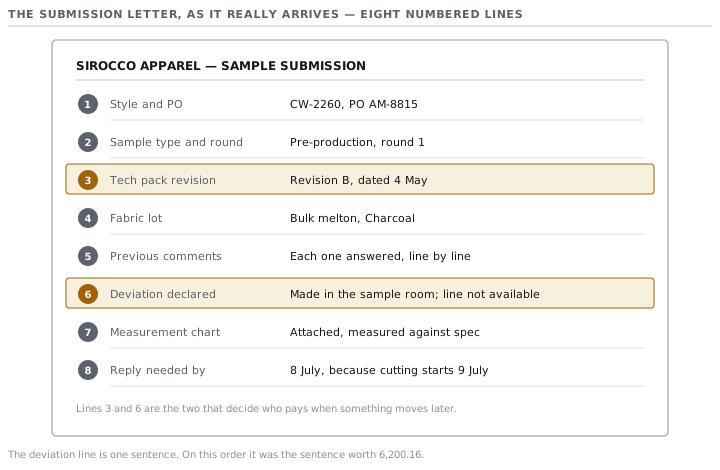
The line that would have saved USD 6,200.16 is the deviation line. "Made in the sample room; line not available" is one sentence. Aldermere's technologist reads that sentence and asks for a line-made coat, because that is her job, and the whole of this lesson does not happen.
A deviation you declare is the buyer's decision. A deviation you do not declare is your liability.
The comment that arrives after the approval
On Friday 10 July, with cutting already under way, an email arrived: please note the welt should be 13 cm, not 12.5 cm, per tech pack revision C.
Revision C had been issued on 2 July and never sent. Sirocco's submission letter named revision B, dated 4 May, which is the revision the coat was built to and approved against. That single line turns the email from a defect into a buyer change: chargeable, and re-datable if it moves a date.
It cost almost nothing, and not by luck. The welts were in the parts held back from the first lay, because a comment was open on them. Had they gone down on 1 July with everything else, 2,800 coats' worth of Charcoal welts — USD 3,880.80 — would have been scrap, plus the re-marking.
Two habits, one from this lesson and one from the last, met on the same Friday and cancelled a bill.
Top of production, and the sample nobody looks at again
Top of production is not a second pre-production sample. It asks one question: does bulk equal what was approved? Pull it from the first real output, not from a good one. Pull it early enough that a rejection still leaves sewing days to correct in, which on AM-8815 means before 12 August. That is why 20 July was right.
The shipment sample is not a gate at all. It is a packed carton opened, photographed, and kept: the record of what actually left. It is worth one hour on the day it is packed, and it is worth a great deal eighteen months later when a claim arrives.
The sealed sample is the approved garment, tagged, signed by both sides and kept. It is the standard everything else is judged against. Two exist: one at Aldermere, one in a locked cupboard at Sirocco. Not on a rail in the sample room, where somebody borrows it for a photograph and returns it creased. A sealed sample that cannot be produced on request is the same as no sealed sample. And it is the only piece of evidence in the whole programme that is a garment rather than a document.
Prompt · Write the pre-production submission letter
Every time a pre-production or top-of-production sample leaves the building, and especially when it was not made the way it should have been.
Act as a senior merchandiser writing a sample submission letter that will still be readable as evidence in a year. Facts: factory [NAME], buyer [NAME], PO [NUMBER], style [STYLE], sample type [PROTO, FIT, SIZE SET, PRE-PRODUCTION, TOP OF PRODUCTION], round number [N], submission date [DATE], reply needed by [DATE] and here is why that date matters [REASON]. Made from: tech pack revision [ID] dated [DATE]; shell fabric lot [ID] or sample yardage; trims [BULK OR SUBSTITUTE, ITEM BY ITEM]; made in [SAMPLE ROOM OR PRODUCTION LINE]; sewn by [SAMPLE MACHINIST OR PRODUCTION OPERATORS]; fusing, sleeve setting and pressing done on [MACHINES AND SETTINGS]. Previous comments: [PASTE THEM]. Measurements: [PASTE THE MEASURED CHART AGAINST SPEC AND TOLERANCE]. Do the following. First, write the letter, with the revision and the lot in their own named lines rather than buried in a paragraph. Second, restate every previous comment with one of three answers — done, done differently and here is why, or not possible and here is what we propose. Third, and most important: read my facts and tell me every DEVIATION from a true sample of this type, then write each one as a plain declared sentence in the letter. Do not soften them and do not leave one out because it looks minor. Fourth, list the measurements that are outside tolerance and say for each whether it is a make issue or a pattern issue. Fifth, tell me exactly what I am asking the buyer to approve and what I am not. Sixth, list separately the questions I should ask the buyer that are not part of the approval. Keep it under one page.
AI can make mistakes — check anything you act on.
Check yourselfYour line is fully loaded and your buyer needs the pre-production sample this week. What is the smallest thing you can do that still makes it a real pre-production sample?Show the answer
Borrow the line's method rather than the line's schedule. You need the production operators for the operations where method decides the outcome: fusing, sleeve setting, collar attach, final press. And you need the machines set exactly as they will run in bulk. That is a few hours, not a shift. If even that is impossible, make it in the sample room and declare the deviation in writing, so the buyer decides whether to accept a sample that answers only part of its question.
Check yourselfA buyer approves your pre-production sample and adds a comment changing a topstitch margin. Is that an approval?Show the answer
Yes. An approval with comments, which means cut, and make the named change. What it is not is a licence to make the change silently. Write it back the same day, state which operation it affects and which bundle it starts from, and file it with the approval. The next time anybody compares a bulk coat to the sealed sample, they will find a topstitch that does not match. The only thing standing between you and a claim is that written line.
Check yourselfYou cut 2,800 coats before approval and the sample is rejected on the collar. How much of the exposure was real?Show the answer
Only the collar and under-collar panels, provided you cut with the open comments in front of you. That is the whole point of splitting the lay. The exposure is never the full USD 102,312. It is the value of the parts a rejection can actually invalidate. A merchandiser who cannot name which parts are exposed is not making a calculated decision. They are gambling with the fabric store.