Lessons · Lesson 3 of 3
What you can actually offer, and what each answer costs
Price every way out of a capacity shortfall against the same order margin, rank orders by contribution per minute, and write a booking note a buyer can act on.
Lesson 3 of 3 · 41 min
Friday 13 February, and an answer is due
"We have no capacity" is rarely true and never useful. A factory that cannot take a job on the date asked can usually take it on other terms. Later. In two shipments. On a second line. With extra hours in the evening. Every one of those has a price you can work out first. This lesson prices six of them against the profit on the order.
Hoda has the truth now. On Line 3 alone, Ollerton's 34,000 pairs are 22,483 by the 19 May sewing deadline, and complete on 10 June. Packing takes the lot to 15 June, final inspection to 16 June, and ex-factory to 22 June, against a promised 1 June.
So Marsam does have capacity. It has it at a price. The whole job now is to know each price before choosing.
The number every option is measured against
Nothing below means anything without the cost sheet, so here it is.
| Line | Per pair |
|---|---|
| Fabric, 1.45 m at USD 2.35 | USD 3.41 |
| Trims: zip, shank button, thread, labels, drawcord | USD 0.72 |
| Making, 24.8 SAM at USD 0.0727 | USD 1.80 |
| Finishing and packing | USD 0.28 |
| Inland to Alexandria, documents, third-party inspection | USD 0.22 |
| Total cost | USD 6.43 |
| FOB | USD 8.40 |
| Margin | USD 1.97 |
That is 23.5% of FOB, and USD 66,980 on the order. Every option below gets measured against that USD 66,980. An option that costs more than the order earns is not an option. It is a slower way of losing.
When minutes are the constraint, rank orders by the minute
Here is the piece of arithmetic that changes how a merchandiser argues in a booking meeting.
When demand is your constraint — you have lines standing empty — you take the order with the best margin, because the alternative is nothing. When capacity is your constraint, margin per garment is the wrong ranking entirely, because what you are selling is not garments. It is minutes.
| Order | Pairs | Margin per pair | SAM | Contribution per standard minute |
|---|---|---|---|---|
| Brekke BK-9040 | 9,000 | USD 4.90 | 31.5 | USD 0.1556 |
| Fenwold FW-2605 | 30,000 | USD 1.28 | 13.2 | USD 0.0970 |
| Ollerton OT-7150 | 34,000 | USD 1.97 | 24.8 | USD 0.0794 |
The biggest order in the book earns the least per minute. Brekke's 9,000-pair technical trouser is the small, fussy, taped-seam order that everyone on the floor complains about. It earns nearly twice as much from every minute of Line 4 as Ollerton's big straightforward cargo. Fenwold's plain trouser, which nobody thinks of as a good order at all, beats Ollerton by 22% a minute.
This is not an argument for refusing large orders. Large orders buy stability, buy a buyer's attention and buy the ramp back. It is an argument for knowing what the minutes you are about to spend are currently earning, before you displace anything.
Six answers, each with a number on it
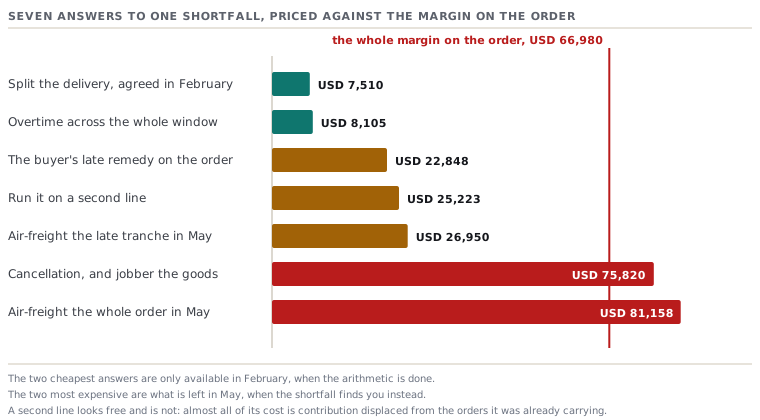
One: offer the honest date. Ex-factory 22 June. It costs Marsam nothing and risks everything. Ollerton's purchase order terms let them cancel without liability once delivery is more than twenty-one days late, and 22 June is exactly twenty-one days past 1 June. An honest date sitting precisely on a buyer's cancellation trigger is not a safe answer. It is an invitation.
Two: split the delivery. 22,000 pairs ex-factory 1 June on the vessel already planned, and 12,000 pairs ex-factory 18 June. Both tranches finish sewing on the same days the single-line plan gives. The second one clears the factory four days earlier than the 22 June above only because a 12,000-pair lot packs and inspects faster than a 34,000-pair one.
- Second final inspection: USD 450.
- Second set of inland transport, documents and clearance: USD 640.
- Letter-of-credit amendment: USD 180.
- Ollerton's second-receipt handling, which they will pass on at USD 0.06 a pair on the late tranche: USD 1,200.
- A late allowance on the second tranche. Ollerton's standard remedy is 8% on any tranche more than seven days late: 12,000 pairs at USD 8.40 is USD 8,064. Negotiated to 5% it is USD 5,040.
Total, at the negotiated allowance: USD 7,510, which is 11% of the order margin. Sea freight is unaffected either way: 34,000 pairs is 1,700 cartons and 93.5 cubic metres, which is two forty-foot high-cube containers whether it moves once or twice.
Three: run it on two lines. Line 4 frees on 22 April. Line 3 delivers 22,483 pairs by 19 May. Line 4, starting on 22 April with its own full ramp, adds 12,902. That is 35,385 in total, and it makes the date.
The tooling is trivial: three more bellows folders at USD 480 each is USD 1,440, plus USD 340 to air-freight them so they arrive in time. The real cost is what Line 4 stops doing.
| Line 4, 22 April to 19 May | Standard minutes it earns | Contribution |
|---|---|---|
| OT-7150 — new style, full ramp, at USD 0.0794 a minute | 319,968 | USD 25,405 |
| BK-9041 as booked, at USD 0.1556 a minute | 236,250 | USD 36,760 |
| A Fenwold repeat in the minutes left over, at USD 0.0970 | 124,614 | USD 12,088 |
The book earns USD 48,848 from that window. Ollerton earns USD 25,405. So handing Line 4 to Ollerton costs USD 23,443 in displaced contribution, plus USD 1,780 of tooling. The option that looked free is the most expensive answer on this list, and its cost appears on no cost sheet anywhere in the building.
Four: overtime. Two hours a day on Line 3.
- It buys 60 operators × 120 minutes × 44% overtime efficiency = 3,168 standard minutes a day, which is 127 pairs.
- It costs the wage half of the attended rate — USD 0.0175 — at the overtime premium of 1.35, plus about USD 0.0060 of extra power, transport and supervision. That is USD 0.029625 an attended minute, or USD 213.30 a day.
- So an overtime standard minute costs USD 0.0673, which is below the normal USD 0.0727. The overhead is already paid. You are only buying wages. Overtime, at this fatigue level, is the cheapest minute in the factory.
- The break-even is worth remembering. USD 213.30 a day has to earn 2,933 standard minutes to match the normal rate, and 2,933 out of 7,200 attended minutes is 40.7%. Above that efficiency, overtime is cheap. Below it, you are paying a premium for tired minutes.
And it still does not solve this problem. Thirty-eight working days from 1 April to 19 May at 127 pairs is 4,826 pairs for USD 8,105. All it does is move 4,826 pairs from the late tranche to the early one, avoiding USD 3,243 of allowance. Spending USD 8,105 to save USD 3,243 is a bad trade. Unless those pairs take the late tranche under a cancellation threshold — in which case you are not buying pairs, you are buying insurance, and it is cheap. Overtime is a five-day lever. It has never closed a twenty-two-day gap and it never will.
Five: subcontract. Sherbini Garments in Belbeis has four lines and quotes a CM of USD 2.25 against Marsam's internal USD 1.80.
- On 12,000 pairs, the CM premium is USD 5,400.
- A resident Marsam inspector for twenty working days at USD 55 a day: USD 1,100.
- A second PP sample, a second sealed shade band, a second set of measurement reports and a second inline gate. Real work, by people who are already busy.
Then the gate that is not a price at all: Sherbini is not on Ollerton's approved factory list. Getting a unit approved means a social audit and a technical audit, and takes six to ten weeks. That is longer than the gap it was meant to close. And Ollerton's code of conduct, like every buyer's, treats production at an undisclosed unit as a breach of the whole supply agreement, not a complaint about one order. The downside is not a chargeback. It is being removed from the vendor list.
Six: sell less. Offer 22,000 pairs and decline the rest. The 12,000 pairs you did not take are USD 23,640 of margin. But that is only true if those minutes then sit empty, and they will not. They go to the next order, at whatever that order earns per minute.
What saying yes wrongly would have cost
Suppose Hoda had confirmed on 11 February, and the shortfall surfaced in May. May is when it surfaces if nobody converts pieces into minutes.
| What you do in May | What it costs | Against a USD 66,980 order margin |
|---|---|---|
| Air-freight the late 12,000 pairs | 7,440 kg at USD 3.85 is USD 28,644, less USD 1,694 of sea already paid: USD 26,950 | 40% of the margin |
| Air-freight the whole order | 21,080 kg at USD 3.85: USD 81,158 | The order loses USD 14,178 |
| Ollerton cancel and you jobber it | 34,000 pairs at USD 4.20 against a cost of USD 6.43: USD 75,820 | The margin, and the order value with it |
| Ollerton accept it late with their standard remedy | 8% on 34,000 pairs at USD 8.40: USD 22,848 | 34% of the margin |
Every one of those is worse than the USD 7,510 the split delivery costs in February. The gap between the cheapest February answer and the cheapest May answer is what the twenty minutes of arithmetic in the first lesson is really worth.
And there is a cost none of these lines carries. Ollerton place four orders a season. A supplier who accepts a date and misses it by three weeks does not usually lose that order. It loses the next four, quietly, in a range review it never sees.
What Hoda sends on Friday
The offer, in one message, with the reasoning visible:
- 22,000 pairs ex-factory 1 June, on the vessel already planned.
- 12,000 pairs ex-factory 18 June, with a 5% allowance on that tranche.
- Conditions, dated. Order confirmed by 20 February. Fabric nominated and the mill's order placed by 24 February. PP sample submitted 10 March and approved by 31 March. Every one of those dates is the reason the 1 June tranche is possible.
- The reservation expires on Friday 20 February. After that, Line 3 goes to the next order in the book.
- What Marsam is doing at its own cost: three additional folders air-freighted, and the line's ramp shortened by pre-training four operators on the bellows pocket during the Fenwold run.
That is a supplier a buyer can plan around. It names the constraint, prices the remedy, dates the conditions and puts an expiry on the hold. And it is written four months before anybody would otherwise have known there was a problem.
Check yourselfYour factory is full. A buyer offers a 5,000-pair repeat at USD 1.10 margin a pair, 9.5 SAM. Your worst current order earns USD 0.0794 a minute. Take it?Show the answer
Yes, and it is not close. USD 1.10 over 9.5 SAM is USD 0.1158 a standard minute, which is 46% better than the order you would displace, on a repeat style with almost no ramp. The trap is that USD 1.10 a pair on 5,000 pairs sounds small next to a 34,000-pair order at USD 1.97 — USD 5,500 against USD 66,980 — and small orders get refused on that comparison every week. When the factory is full, the total is the wrong number. You are not choosing between two revenues. You are choosing what to do with a minute.
Check yourselfA buyer refuses the split and refuses a later date. What do you offer before you agree to air freight?Show the answer
The one thing air freight cannot buy: an earlier start. Ask what they can move on their side. An earlier PP approval. Accepting a fabric already in your warehouse in a near colour. Dropping one size from the first tranche. Taking the first tranche on a faster routing rather than the whole order by air. Then price the levers on your side against their remedy. Overtime is worth buying only if it crosses a cancellation threshold. A second line is worth buying only if what it displaces earns less per minute than they do. Air freight at USD 26,950 against USD 5,040 of allowance is what you agree to when you have run out of arguments, not when you have run out of days.
Prompt · Price every way out of a capacity shortfall
The day you know the order does not fit and you have to send the buyer something better than an apology.
Act as a merchandising manager who has to answer a buyer today with priced options rather than an apology. Order facts: buyer [BUYER], style [STYLE], [QTY] pieces, FOB [PRICE], required ex-factory [DATE], the date my factory can actually achieve [DATE], and the shortfall in pieces at the required date [NUMBER]. Cost sheet per piece: fabric [AMOUNT], trims [AMOUNT], making [AMOUNT] built from [SAM] SAM at [RATE] a standard minute, finishing and packing [AMOUNT], export costs [AMOUNT]. Other orders competing for the same line: [FOR EACH ONE, QUANTITY, MARGIN PER PIECE AND SAM]. Buyer terms: late-delivery remedy [PERCENT OR AMOUNT], cancellation threshold [DAYS], approved-factory rules for subcontracting. My levers, with whatever facts I have: overtime [HOURS A DAY, WAGE PREMIUM, EXPECTED EFFICIENCY IN THOSE HOURS], a second line [WHICH ONE, WHEN IT FREES, WHAT IT IS RUNNING NOW, ANY TOOLING THE STYLE NEEDS AND ITS LEAD TIME], subcontract [UNIT, QUOTED CM, AUDIT STATUS], air freight [WEIGHT PER PIECE, RATE PER KG, THE SEA COST ALREADY IN THE PRICE]. Do the following. First, compute the order's margin per piece and on the order, and the contribution per standard minute for my order and for every order competing for the same line. Second, price each lever separately: what it costs in dollars, how many of the missing days it actually recovers, and what can still go wrong. For a second line, the cost is the contribution of whatever it displaces, not the tooling — compute that explicitly. For overtime, give me the cost per standard minute in overtime against the normal rate, and the efficiency below which overtime stops being cheap. Third, rank the options by cost against the order margin and say which you would send. Fourth, compute what saying yes and failing would cost — air freight, the buyer's remedy, cancellation — so I can see the gap between deciding now and discovering later. Fifth, write the message to the buyer: the offer, the conditions with their dates, and an expiry on the reservation. Do not recommend an option whose cost exceeds the margin on the order without saying so plainly.
AI can make mistakes — check anything you act on.