Lessons · Lesson 2 of 3
The book, not the total: why a factory with spare minutes says no
Load an order into a dated week grid instead of a capacity total, and find the constraints that are not sewing minutes at all.
Lesson 2 of 3 · 44 min
The second wrong answer
Add up a season's spare working time. Compare it with what the order needs. The arithmetic will tell you the order fits. That is the second wrong answer in this course. A season total pretends every week is the same. Some weeks hold a holiday. Some are shortened. Some are closed altogether.
Hoda now has the number from the first lesson. OT-7150 needs 843,200 standard minutes of sewing, plus a 44,352-minute ramp. Call it 887,552 minutes in all.
So she does the sensible next thing. Only two of Marsam's six lines can build a woven bottom at all. Lines 1 and 2 have no waistband unit, no belt-loop machine and no side-seam feller. Lines 5 and 6 are outerwear and short runs. That leaves Lines 3 and 4. Between Saturday 14 February and Tuesday 19 May, the day sewing has to be finished, those two lines will earn:
2,068,992 standard minutes
The book already committed to Fenwold and Brekke uses 1,075,692 of them, ramps included. That leaves:
993,300 standard minutes free
Ollerton need 843,200. There are 150,100 minutes to spare, which is 18% more free capacity than the order needs. The total says yes, comfortably.
The order still cannot be made, and the total was never going to find that out. A total is a stock. Capacity is a schedule. A standard minute that exists in the week beginning 7 March cannot be spent in the week beginning 9 May. Every one of those 150,100 spare minutes sits in a week Ollerton cannot use.
Weeks are not equal, and the difference is enormous
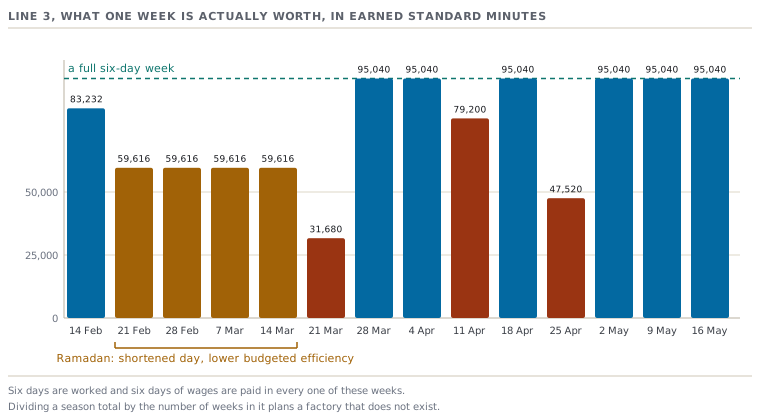
The most useful object in a planning office is not a capacity total. It is a table of what each week is really worth on each line. Here is Line 3's, for this season:
| Week beginning | Working days | Why | Standard minutes earned |
|---|---|---|---|
| 14 Feb | 6 | Four normal days, then Ramadan begins | 83,232 |
| 21 Feb | 6 | Ramadan: shortened day at reduced efficiency | 59,616 |
| 28 Feb | 6 | Ramadan | 59,616 |
| 7 Mar | 6 | Ramadan | 59,616 |
| 14 Mar | 6 | Ramadan | 59,616 |
| 21 Mar | 2 | Eid shutdown, four working days closed | 31,680 |
| 28 Mar | 6 | Normal | 95,040 |
| 4 Apr | 6 | Normal | 95,040 |
| 11 Apr | 5 | Sham El-Nessim falls on the Monday | 79,200 |
| 18 Apr | 6 | Normal | 95,040 |
| 25 Apr | 3 | Sinai Liberation Day, then two days of line maintenance | 47,520 |
| 2 May | 6 | Labour Day falls on the Friday, which is already the day off | 95,040 |
| 9 May | 6 | Normal | 95,040 |
| 16 May | 6 | Normal | 95,040 |
A week on Line 3 this season is worth anywhere between 31,680 and 95,040 standard minutes. The best week is three times the worst. Anyone who divides a season total by the number of weeks in it is planning a factory that does not exist.
Three things in that table are worth pulling out.
Ramadan is a capacity event, not a cultural footnote. Marsam, like most Egyptian factories, shortens the working day through Ramadan: 360 attended minutes instead of 480. Its planners budget Line 3 at 46% instead of 55%, because a fasting workforce in the last hour of the day is not the same workforce. A Ramadan week earns 59,616 minutes against a normal week's 95,040. That is 63% of a week, for six days of attendance and six days of wages. Four of those in a row is not a rounding error. It is the loss of a fortnight.
A holiday costs whatever the calendar decides. Sham El-Nessim falls on a Monday this year and costs a full working day. Sinai Liberation Day falls on a Saturday and costs another. Labour Day falls on the Friday the factory is closed anyway, and costs nothing. The same three holidays in a different year cost one day, or three. That is a fact about the year, not about the factory. Look it up. Do not assume it.
The dates you plan around are not all fixed. Ramadan and Eid are set by sighting, so Marsam's shutdown is planned on dates the factory does not control and which may move by a day. You cannot book a week you cannot date. Plan on the earliest plausible Eid, and hold the difference as float you sell to nobody.
Loading the order finitely
Now put Ollerton into the grid instead of into the total. Line 3 frees on Wednesday 1 April. Run OT-7150 from there, at Line 3's own ramp and Line 3's own weeks:
| Week | Working days | Standard minutes earned | Pairs made, running total |
|---|---|---|---|
| 1 and 2 Apr | 2 | 15,552 | 627 |
| 4 Apr | 6 | 69,984 | 3,449 |
| 11 Apr | 5 | 76,032 | 6,515 |
| 18 Apr | 6 | 95,040 | 10,347 |
| 25 Apr | 3 | 47,520 | 12,263 |
| 2 May | 6 | 95,040 | 16,095 |
| 9 May | 6 | 95,040 | 19,928 |
| 16 May | 6 | 95,040 | 23,760 |
| 23 May | 6 | 95,040 | 27,592 |
| 30 May | 6 | 95,040 | 31,425 |
| 6 Jun | 6 | 95,040 | 35,257 |
Sewing has to be finished on 19 May. On that date the line has made 22,483 pairs of 34,000. The thirty-four thousandth pair goes through on 10 June.
Read the first three rows again. They are the ramp made visible. Six full working days in the week of 4 April earn 69,984 minutes. Six identical days in the week of 18 April earn 95,040. Same line, same operators, same holidays, twenty-five thousand minutes apart, purely because in April the line was still learning the style.
Three constraints that are not sewing minutes
An order can clear the minutes and still be unbookable. Every booking has to clear four gates, not one.
A machine, an attachment or a folder. OT-7150's bellows knee pocket needs a particular folder and template set. Marsam owns three, and all three are on Line 3. Putting the style on a second line means three more at USD 480 each, six weeks by sea from the maker in Japan. Or the same six weeks compressed by paying USD 340 to air-freight them. A line free in minutes and short of an attachment is not free.
A skill, not a headcount. Line 4's sixty operators are excellent. They are excellent at Brekke's taped-seam technical outerwear. The operator who sets a bellows pocket corner and bartacks it is not the operator who tapes a seam. Move a style to a line with the same number of people and a different skill history, and it does not inherit the ramp table you looked up in the first lesson. It needs its own, and its own will be worse.
The rooms on either side. Cutting has to feed the line and finishing has to clear it. A cargo trouser has fourteen pattern pieces where a plain trouser has six. So the marker is longer, the lay yields fewer pairs, and the cutting room turns fewer of them a day. Finishing has to press, fold, bag and carton a garment with eight pockets. Neither of these usually binds on a bottoms order. But "usually" is not a plan, and the day the sewing schedule peaks is the day to check them.
The fourth gate: the approval calendar is part of your capacity
This is the one that catches good planners.
A line cannot start bulk on a style that is not approved. Ollerton's pre-production sample cycle runs about twenty-one days from submission to written approval, and their PP sample needs bulk fabric and bulk trims. So booking Line 3 from 1 April is a promise: PP sample submitted by 10 March, which needs bulk fabric in the sample room by 1 March, which needs the fabric order placed within days of Ollerton confirming.
If any of that slips, Line 3 does not quietly start late. It stands idle, because the next order on the board was scheduled to start after Ollerton, and there is nothing to put on the line. An idle Line 3 day costs USD 1,152 and earns no standard minutes at all. It is the most expensive thing that happens in a garment factory. It never appears on a cost sheet, because there is no order to charge it to.
Reserve, do not sell
The board outside the planning office should hold three states for every line-week, not two: committed, held and free. A hold is a real thing with a real cost. A hold with no expiry date is simply a week you have sold to somebody who has not bought it.
Marsam holds Line 3 from 1 April while Ollerton decide. Suppose Ollerton take eleven working days to come back, and then place the order elsewhere. Those eleven days are gone. At six days a week, a whole held week is 95,040 standard minutes. They earned nothing and cost USD 6,912 to keep the lights on. That is the price of the option. It is why a hold gets an expiry — "this reservation stands until Friday 20 February" — in the first message, not in a chasing email three weeks later.
Check yourselfYour planner says the factory has 2.1 million spare standard minutes this season and the order needs 1.4 million, so it fits. What do you ask for?Show the answer
The week grid, by line. A season total answers a question nobody asked. You need four things. Which line can build this product at all. What is already committed on it, and until when. What each week between the free date and the deadline is really worth after holidays and shutdowns. And what the cumulative output looks like against the date sewing must finish. If the answer to any of those is "roughly", the order is not booked. It is hoped for.
Check yourselfA supplier offers you an earlier date if you let them run the order in the four weeks before Eid rather than the four weeks after. Good deal?Show the answer
Look at the week grid before you answer. The weeks before Eid are Ramadan weeks: shorter days, lower efficiency, and at this factory worth about 63% of a normal week. Four of them hold roughly two and a half normal weeks of minutes. So an "earlier" date bought with Ramadan weeks may not be earlier at all. It also puts the last and most error-prone part of the order into the days before a shutdown, when the line is thinnest and the buyer's office is about to close too. The right question is not when the order starts. It is how many earned minutes sit between the start and the deadline.
Prompt · Load the order into the weeks, not into the total
When a planner tells you there is enough capacity this season and you have to know whether that is true in the weeks the order actually needs.
Act as a factory production planner who works in a finite week grid, not in season totals. Build me a capacity grid and load one order into it. Factory facts: lines that can build this product [LIST THEM WITH OPERATORS, ATTENDED MINUTES A DAY AND TARGET EFFICIENCY], working week [WHICH DAYS], and why the other lines cannot build it. Calendar facts between now and the deadline: public holidays with their dates and which day of the week each falls on, any religious month with a shortened working day and the efficiency the factory budgets for it, any planned shutdown, any line maintenance, and which of these dates are fixed and which can still move. Book facts: every order already committed on those lines, with quantity, SAM, start date and whether it is a new style or a repeat. My order: [STYLE], [QTY], [SAM], required sewing-complete date [DATE], required ex-factory [DATE]. Do the following. First, build a table of what each individual WEEK is worth on each line in earned standard minutes, with a one-line reason for every week that is not a full one. Second, tell me the total free minutes in the window and then tell me plainly why that total is not the answer. Third, load my order into the grid from the first date the line frees, week by week, with the cumulative pieces made, and give the date the last piece is sewn. Fourth, state the shortfall in pieces at the deadline and in working days. Fifth, list every constraint that is NOT sewing minutes — an attachment or folder the style needs, a skill the line does not have, cutting and finishing capacity, and the approval calendar the bulk start depends on — and for each one give me the date it has to be cleared by. Sixth, tell me what would have to be true for the order to fit, as a list of specific changes with dates. Ask me for any calendar fact you need rather than assuming it.
AI can make mistakes — check anything you act on.