Lessons · Lesson 1 of 3
A line does not make pieces. It makes minutes.
Turn a line's output into standard minutes, put a price on one minute, and cost the learning curve before you accept a booking.
Lesson 1 of 3 · 45 min
The enquiry
A customer asks how fast you can make thirty thousand pairs of trousers. Someone looks at the board on the wall that says how many garments a line makes in a day. That number is true. Reaching for it is the mistake this lesson corrects. It was measured on a much simpler garment. A line does not really make garments at all.
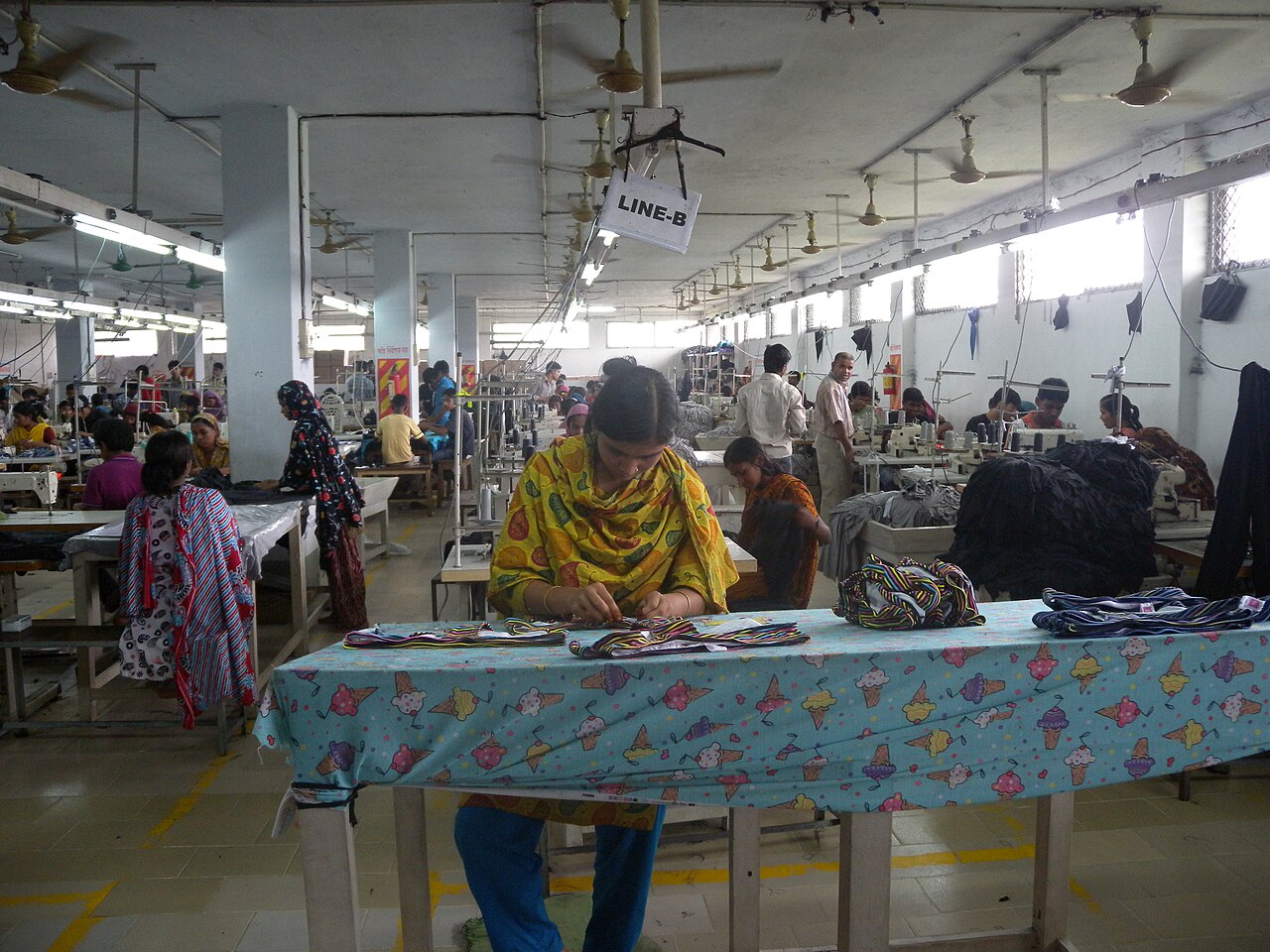
Monday 9 February, 08:40. Marsam Garments, in Qalyub. Six sewing lines and 280 operators on the floor.
An enquiry arrives from Ollerton, a UK high-street retailer Marsam has supplied for three seasons. Style OT-7150 is a men's cotton-twill cargo trouser. It has eight pockets, a bellows knee pocket on each side, a gusseted crotch, a coin pocket and a hem tab held by a bartack. 34,000 pairs, FOB Alexandria USD 8.40, order value USD 285,600. Ex-factory 1 June. Ollerton want an answer by Friday.
Hoda books orders. She does what her job asks. She opens the capacity board outside the planning office. Line 3 sews woven bottoms. It is committed to Fenwold until the end of March and free from 1 April. The board gives Line 3 as 1,200 pairs a day.
Thirty-four thousand pairs at 1,200 a day is 29 working days. Twenty-nine working days from 1 April lands on 9 May. Sewing has to be finished by 19 May to leave the factory on 1 June. That is ten days of float. She confirms the order on Wednesday.
Sewing will actually finish on 10 June. That is twenty-two working days past the deadline. Three weeks late, on an order Marsam has already accepted and Ollerton has already put into a range plan.
Nobody lied. Nobody was careless. The board was measured, and it was measured in the wrong unit.
Pieces are an output, not a capacity
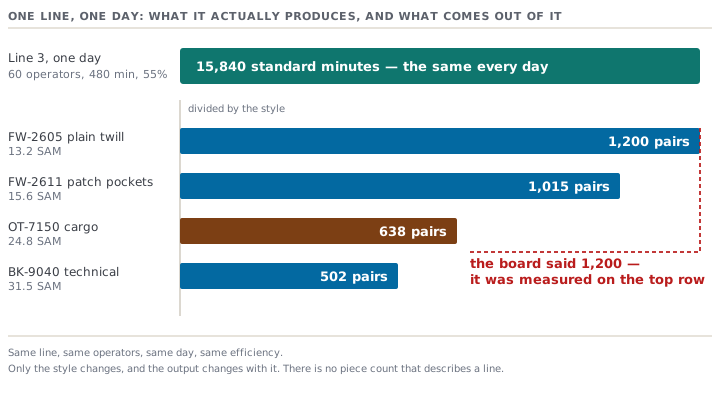
The 1,200 was measured on Line 3, in November. It was measured on FW-2605, Fenwold's plain flat-front twill trouser: two pockets, a plain waistband, no bellows pocket, no gusset. FW-2605 runs at 13.2 SAM. SAM is short for standard allowed minutes, and it means the minutes of work inside the garment.
Line 3 has 60 operators. Marsam runs a 480-minute attended day, six days a week, Saturday to Thursday. Attended minutes are the minutes an operator is at the machine. Line 3's target efficiency on a woven bottom is 55%. So:
60 operators × 480 attended minutes × 55% = 15,840 standard minutes earned a day
Fifteen thousand eight hundred and forty minutes divided by 13.2 is 1,200 pairs. The board's arithmetic is perfect. But the board is telling you about FW-2605, not about Line 3.
OT-7150 runs at 24.8 SAM. Same line, same operators, same efficiency, same day:
15,840 ÷ 24.8 = 638 pairs a day
| Style | What it is | SAM | Pairs a day on Line 3 |
|---|---|---|---|
| FW-2605 | Plain flat-front twill trouser | 13.2 | 1,200 |
| FW-2611 | Twill trouser, patch pockets, elastic back | 15.6 | 1,015 |
| OT-7150 | Cargo trouser, eight pockets, bellows knee | 24.8 | 638 |
| BK-9040 | Technical trouser, taped seams, articulated knee | 31.5 | 502 |
| BK-9041 | The same trouser, second colourway | 31.5 | 502 |
The board can be right about one of those styles and wrong about the other four. No number of pieces describes a line. The only thing a line really produces is minutes.
What a standard minute is, and where it comes from
A standard minute is not a stopwatch reading. You watch an operation and you time it. Then you adjust that time for how fast the operator was working while you watched. That adjustment is called the rating. Then you add allowances for rest, machine delay and small interruptions. That is the definition every apparel factory uses. The trade took it from the International Labour Office's Introduction to Work Study.
Two things follow from it, and both are where bookings go wrong.
The sample room's number is not the line's number. A sample machinist sews the whole garment at one bench. The pieces are in front of her and nobody is waiting. A line sews the same garment in forty operations, with bundles moving between them. Handling the bundles, moving them, and the imbalance between a 0.42-minute operation and a 1.30-minute one: that is all real work, and it belongs in the SAM. A sample-room time is usually well below a line SAM for the same garment. A booking built on it is built on a number nobody has ever achieved.
A SAM you did not measure yourself is a starting point, not a booking basis. Marsam built OT-7150's 24.8 from a predetermined-time system, operation by operation, on the size-set garment, before the enquiry was even answered. That is the right amount of effort for a 34,000-pair order. It is still not final. Marsam restudies the line on day ten of bulk and adjusts, because the operation breakdown always changes once the line is really running.
Putting a price on a minute
Marsam costs Line 3 at USD 0.0400 per attended operator-minute. That rate covers wages, supervision, quality, services, allocated overhead and depreciation. So a Line 3 day costs:
60 × 480 × USD 0.0400 = USD 1,152 a day
That day earns 15,840 standard minutes. So:
USD 1,152 ÷ 15,840 = USD 0.0727 per standard minute
That gives the making cost of the two styles straight away. FW-2605 at 13.2 SAM costs USD 0.96 to sew. OT-7150 at 24.8 SAM costs USD 1.80.
Look at what the second sum really is. Dividing the attended rate by the earned minutes is the same as dividing it by the efficiency:
USD 0.0400 ÷ 55% = USD 0.0727
The cost of a minute is set by efficiency, not by the wage. Marsam pays the same rate on every line, and a standard minute costs:
| Line | What it runs | Target efficiency | Cost per standard minute |
|---|---|---|---|
| Line 1 | Jersey tops | 62% | USD 0.0645 |
| Line 3 | Woven bottoms | 55% | USD 0.0727 |
| Line 5 | Outerwear | 48% | USD 0.0833 |
| Line 6 | Short runs | 40% | USD 0.1000 |
Line 6's minute costs 55% more than Line 1's, on identical wages. That is not a scoreboard. It is a price list. It is why a factory that lives on short orders is a different business from one that lives on long orders, even when the two look the same from the road.
The efficiency you plan for is not the efficiency you get on Monday
Here is the second half of the booking error. It survives even after you switch to minutes.
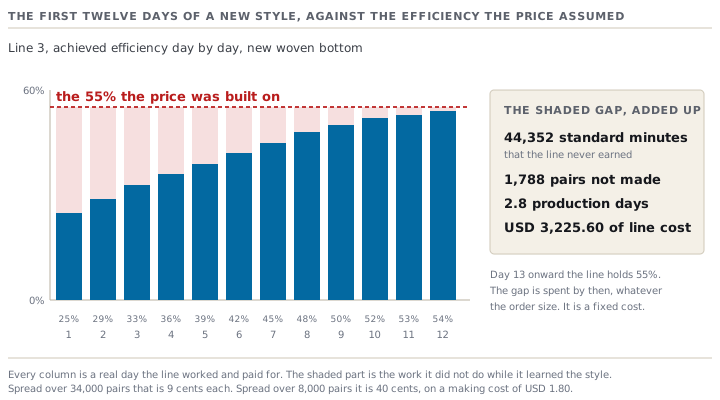
Fifty-five per cent is Line 3's steady-state efficiency on a woven bottom. It is not what the line does on day one of a style it has never sewn. The operators are learning a new operation. The folders and guides are being set. The balance is wrong. The supervisor is moving people about. Marsam keeps the record of its own last four new woven bottoms on Line 3:
| Day | 1 | 2 | 3 | 4 | 5 | 6 |
|---|---|---|---|---|---|---|
| Efficiency | 25% | 29% | 33% | 36% | 39% | 42% |
| Day | 7 | 8 | 9 | 10 | 11 | 12 |
| Efficiency | 45% | 48% | 50% | 52% | 53% | 54% |
From day thirteen the line holds 55%. Add up the shortfall against target across those twelve days and you get 154 percentage points of a day. The line's attended day is 28,800 minutes, so:
1.54 × 28,800 = 44,352 standard minutes never earned
That converts three ways, and a merchandiser needs all three:
- In pieces: 44,352 ÷ 24.8 = 1,788 pairs of OT-7150 the plan assumed and the line never made.
- In time: 44,352 ÷ 15,840 = 2.8 production days, added at the front of the order.
- In money: 2.8 days × USD 1,152 = USD 3,225.60 of line cost that produced nothing.
So the honest sewing time for Ollerton is not 53 days of steady-state work. It is 53 days plus the ramp. On Line 3's own record, that is 57 working days.
The ramp is a fixed cost, so it is a short-order problem
Notice that the USD 3,225.60 barely moves with order size. Learning the style costs what it costs, whether you make 34,000 pairs or 8,000. Spread it:
- On 34,000 pairs: USD 0.09 a pair, against a making cost of USD 1.80. Nine cents. Ignore it if you like.
- On 8,000 pairs: USD 0.40 a pair, against the same USD 1.80. That is 22% on top of the making cost, and it appears on no cost sheet in the building.
It gets worse than the money. An 8,000-pair run is only about thirteen days of steady-state work. The line spends most of the order climbing, and reaches full speed roughly as the last bundles go through. A short order never gets to the efficiency the price was built on. If your factory quotes one CM per style whatever the quantity, it is paying for every short run out of the margin on the long ones. And the merchandiser who books a season of 6,000-piece drops is the one spending that subsidy.
Back to Ollerton
Fifty-seven working days from Wednesday 1 April, on a six-day week, through Sham El-Nessim, Sinai Liberation Day and two days of line maintenance, ends on 10 June. Sewing had to be complete on 19 May.
The order is twenty-two working days late. Every number needed to know that was available on 9 February. It took one SAM, one efficiency, one multiplication and one ramp table. About twenty minutes of work, four months before anyone would otherwise have found out.
Check yourselfA supplier tells you their line does 1,500 pieces a day and they have the production records to prove it. What is the single next question?Show the answer
"On which style, and what is its SAM?" The records are almost certainly true, and almost certainly about a garment that is not yours. Turn their claim into minutes: pieces a day multiplied by that style's SAM gives you their earned minutes a day. Then divide those minutes by YOUR style's SAM. That is their capacity for your order. If they cannot tell you the SAM of the style the record was set on, you have learned something more useful than the answer. They are booking in pieces too, and the next order on that line will be quoted the same way.
Check yourselfYour factory's costing gives 24.8 SAM and USD 0.0727 a minute, so USD 1.80 CM. The order is 8,000 pairs. What is the CM really?Show the answer
About USD 2.20. The USD 1.80 assumes the line runs at 55% for the whole order, and on a new style it does not. The twelve-day ramp costs 44,352 standard minutes whatever the quantity. That is USD 3,225.60, or USD 0.40 a pair on 8,000. Whether you tell the buyer is a commercial decision. Whether you know it before you quote is not.
Prompt · Convert the line into minutes before you promise a date
The moment an enquiry lands and somebody quotes you a capacity in pieces a day.
Act as an apparel industrial engineer and production planner. I have an enquiry and I need to know whether the line can actually make it, in minutes rather than in pieces. Enquiry facts: buyer [BUYER], style [STYLE], description [WHAT THE GARMENT IS, EVERY OPERATION THAT MAKES IT UNUSUAL — POCKETS, PLEATS, TAPED SEAMS, LININGS, PRINTS], quantity [QTY], FOB [PRICE], required ex-factory date [DATE]. Line facts: operators [NUMBER], attended minutes a day [NUMBER], working days a week [NUMBER], target efficiency on this product family [PERCENT], the line's cost per attended operator-minute [AMOUNT] and what that rate includes. The number I have been given for this line is [PIECES] a day, and it was measured on style [OTHER STYLE] at [SAM] SAM, if known. My style's SAM is [SAM] and it came from [TIME STUDY, PREDETERMINED SYSTEM, THE BUYER, A SIMILAR STYLE, A GUESS]. The line's achieved efficiency by day on the last new style of this family was [PASTE THE RAMP, DAY BY DAY], if I have it. Do the following. First, restate the line as earned standard minutes a day and show the arithmetic. Second, convert the pieces-a-day figure I was given back into earned minutes and tell me whether it agrees with the line, and if it does not, say which of the two inputs is wrong. Third, give me the daily output for MY style at steady state. Fourth, cost the ramp three ways — in standard minutes never earned, in pieces the plan assumed and the line will not make, and in money at my minute rate — and add the ramp days to the duration. Fifth, give me the honest number of working days the order needs, and the finish date if the line starts on [DATE]. Sixth, tell me which of my inputs the answer is most sensitive to, and what a five-point efficiency error or a two-minute SAM error would do to the finish date. Name every assumption in a list at the end, and do not give me a range where a number is possible.
AI can make mistakes — check anything you act on.