Lessons · Lesson 2 of 3
Every amendment is a new contract
Price a change before you answer it, and answer it against the order as it stands rather than against the order you were sent.
Lesson 2 of 3 · 44 min
Four emails and a portal notice
Orders do not stay still. Months after one is agreed, the customer moves a colour, adds quantity or pulls the date forward. Hardly any of that arrives as a document that calls itself a change. It comes as an email from an assistant, or as a line buried in a longer message. This lesson follows one order through several such changes.
HK-8802 was confirmed on 10 February: 24,000 pieces, USD 284,400, on board 26 June. Between 6 March and 13 May it changes four times. Not one of the four arrives as a document called an amendment. Two are emails from the buyer's assistant. One is a portal notification. One is a line inside a longer message about lab dips.
Each of the four is handled correctly on the day it arrives. The order still ends up two and a half days short of its ship date before a single panel is cut, because nobody ever added them up.
That is the whole lesson. An amendment is not an event. It is a new position. And the useful question about it is not do I accept? but what does the order look like afterwards?
One word you need first. Float is the spare time on your plan: the gap between the day the last carton is packed and the day the vessel closes. Float is what every amendment quietly spends.
Rev B, Friday 6 March: a colour split
Hallvik's buyer writes: Bone has been split. Take 2,400 pieces out of Bone and put them into a new colour, Moss. Total unchanged.
Nothing about the order value moves. Same quantity, same price, same ship date. On the face of it this is housekeeping, and the temptation is to reply noted, thank you and update a spreadsheet.
Now cost it. Your mill, Zohour Knit Mills in Mahalla, dyes this ponte at USD 7.20 a kilo on lots of 3,000 kg or more. Below that they add USD 0.75 a kilo. Consumption is 0.69 kg a piece.
| Colour | Pieces before | Kg before | Pieces after | Kg after | Lot charge |
|---|---|---|---|---|---|
| Black | 12,000 | 8,280 | 12,000 | 8,280 | none |
| Ink Navy | 7,200 | 4,968 | 7,200 | 4,968 | none |
| Bone | 4,800 | 3,312 | 2,400 | 1,656 | short lot |
| Moss | — | — | 2,400 | 1,656 | short lot |
Before Rev B, Bone was one lot of 3,312 kg, and it cleared the minimum. After Rev B there are two lots of 1,656 kg, and neither clears it. So the surcharge lands on the whole 3,312 kg: USD 2,484. Add USD 180 for the Moss lab dip. USD 2,664, which is 9.3% of the order's margin, for a sentence that changed no quantity and no price.
It also adds fourteen days to the Moss fabric clock. A new colour needs a dip submitted and approved, and only then does a bulk dye date exist.
You accept it. You would accept it anyway — it is 9.3% of margin on a four-season relationship. But you accept it in writing, with the number on it. A cost you absorb in silence is a cost you cannot mention later. And in six weeks Hallvik are going to ask you for something else.
Rev C, Thursday 2 April: two amendments wearing one coat
A portal notification: quantity increased to 26,400 pieces. Black up 2,400. Bone deleted, Moss up to 4,800.
Read that again. It is two changes, and only one of them is good news.
The increase. 2,400 more Black at USD 11.85 is USD 28,440 more revenue. Order value: 24,000 pieces at USD 11.85 plus 2,400 at the same price is USD 312,840.
The deletion. Bone is gone. Zohour started the Bone dye lot on 30 March, and it comes off the machine on 6 April. On 3 April they confirm in writing that it cannot be stopped. That fabric is now yours. It is a colour nobody has ordered, and it is a cancellation claim — which is lesson 3's problem, and it carries a fourteen-day deadline you are about to meet.
The credit nobody offers you. Moss goes from 1,656 kg to 3,312 kg. It crosses the 3,000 kg minimum. So the USD 1,242 short-lot charge you accepted on 9 March no longer applies. You ask Zohour on 3 April and they credit it. Rev B's true cost drops to USD 1,422. Nobody would have told you. An amendment can cancel a cost you already agreed, and the only person who will ever notice is the one holding both revisions.
The days. This is the line that is not in the email. PTD-450 takes 24.5 standard minutes to sew. You have two lines of 42 operators, running at 55% efficiency on an eight-hour day. That is 452 pieces a line, so 904 pieces a day. 24,000 pieces is 26.5 working days. 26,400 pieces is 29.2. So the increase costs 2.7 working days. Your plan had 7 days of float.
Float after Rev C: 4.3 days. Still comfortable. You accept on 3 April.
Rev D, Thursday 30 April: seven days
A portal notification, four lines long. Hallvik's vessel booking has changed. On board moves from 26 June to 19 June. The Malmö window moves to 13 to 20 July.
Seven days. You check the calendar. The fabric is on schedule, the trims are in. It looks tight but possible, so you acknowledge it the same day. Every part of that judgement is defensible on its own.
Float after Rev D: minus 2.7 days.
The order is now late, on 30 April, before anyone has cut a panel. And nothing in the building says so. The 2.7 days were spent on 3 April, by a different message. The person answering Rev D measured seven days against the float on the original plan, not against the float that was left.
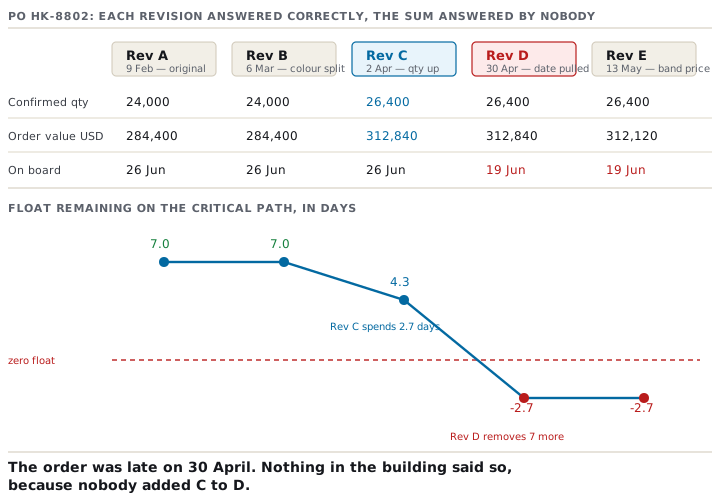
This is the mechanism, and it is trivially cheap. Every amendment is answered against a single line that carries forward: current confirmed quantity, current confirmed value, current ship date, current float. You do not answer the amendment. You answer the order after the amendment, and you write those four numbers into the reply. Had that line existed on 30 April, the reply to Rev D would have read: accepted, and the order is now two and a half days short — here is what we need. On 30 April there were seven weeks to fix it.
Rev E, Wednesday 13 May: the price band
An email from Hallvik's sourcing office, three lines. The order now exceeds 26,000 units, so the band price of USD 11.55 applies, and a revised order confirmation will follow.
At USD 11.55 across 26,400 pieces the order is worth USD 304,920. That is USD 7,920 less than the USD 312,840 you have been planning against, and it would take the margin to USD 23,496.
So you open Rev 9 of the Supplier Terms of Purchase and read clause 6.4, which you looked at in February. It says a revised band price applies to units ordered under the amendment that crossed the band. Not to the whole order, and not backwards.
24,000 pieces at USD 11.85 plus 2,400 at USD 11.55 is USD 312,120. The gap between the two readings is USD 7,200, and it is settled by quoting their own clause number back to them, in one sentence, on 15 May. Hallvik agree the same day. They were not trying anything. Their system applied a band the way their system applies bands.
Final position: 26,400 pieces, USD 312,120, on board 19 June, margin USD 30,696, 9.8%.
Which amendments are you obliged to accept?
Almost none, and this surprises people.
Under the CISG, Article 19(3), some added or different terms count as material changes to the offer. Among others, they are terms about the price, the quantity, the quality of the goods, the place and time of delivery, and how far each party is liable. Quantity, price and delivery date are the three things a buyer amendment almost always touches. So a typical amendment is a new offer, not a correction to the old one. It needs your acceptance before it binds you.
Article 29(1) says a contract can be changed by simple agreement between the parties. No formality is needed. And Article 29(2) closes the trap. A written contract that says changes must be in writing cannot be changed any other way. But a party may lose the right to rely on that clause through his own conduct, so far as the other party has relied on that conduct. Your terms may say no amendment is binding unless issued as a revised purchase order. The day you cut fabric against an email, that sentence is worth nothing.
Which is why the practical rule is not a legal one at all:
- Nothing is accepted until it is acknowledged. An acknowledgement is a written restatement of the whole current position, not a reply saying noted.
- Nothing is worked on until it is acknowledged. Conduct is acceptance. If you are not ready to accept, do not start.
- Every acknowledgement carries a price and a date consequence, even when both are zero. Writing no cost, no date impact is how you prove you looked.
The four questions, and the reply
Every amendment, four questions, in this order. On HK-8802 they take between ten and forty minutes each.
- What does it change? Quantity by colour, price, dates, specification, packing. Write the before and the after, not the difference.
- What does it cost? Material at the new lot sizes, tooling, testing, and anything it credits back.
- What does it move? Days on the fabric clock and days on the line, measured against the float you have now.
- What does it undo? Which earlier amendment does this one partly reverse, and is there a charge to unwind it.
Then reply in one of exactly four shapes: accepted · accepted, and here is what it costs · accepted, and here is the date it moves · not accepted, and here is what we can do instead.
Prompt · Price an amendment before you answer it
Whenever a buyer sends a change — quantity, colour split, size ratio, date, packing, price — and you are tempted to reply that it is noted.
Act as an apparel merchandiser costing a purchase order amendment. Do not tell me whether to accept it. Tell me what it costs and what it moves, so that I can decide.

THE ORDER AS IT STANDS RIGHT NOW (not as originally confirmed):
- Current revision: [LETTER], confirmed on [DATE]
- Confirmed quantity by colour: [SPLIT], total [QTY] pcs
- Confirmed price: [PRICE] [INCOTERM]; confirmed order value [VALUE]
- Unit cost [COST], margin per piece [MARGIN], total margin [TOTAL MARGIN]
- On board [DATE]; float remaining on the critical path [DAYS] days
- Fabric: [CONSUMPTION] kg per piece at [PRICE] per kg, minimum dye lot [KG], surcharge below the minimum [AMOUNT] per kg
- Sewing: [SAM] standard minutes, [LINES] lines of [OPERATORS] operators at [EFFICIENCY] efficiency, [HOURS] hour day

THE AMENDMENT:
[PASTE IT WORD FOR WORD, INCLUDING THE DATE IT ARRIVED AND HOW IT ARRIVED]

Give me:

1. BEFORE and AFTER, as a table, for quantity by colour, price, order value and ship date. Show both columns, never just the difference.
2. COST. Every material consequence: dye lot sizes crossing a minimum in either direction, new lab dips, new trims, tooling, testing, changeover. Show the arithmetic line by line. Include anything the amendment CREDITS BACK — a charge I accepted on an earlier revision that this one cancels — because nobody will offer me that.
3. DAYS. Days added or removed on the fabric clock and on the sewing line, worked out from the SAM and line data above. Then the new float, worked out from the float I have NOW rather than from the original plan.
4. WHAT IT UNDOES. Which earlier revision does this one partly reverse, and is there a cost to unwind it.
5. A draft reply in one of exactly four shapes: accepted · accepted and here is what it costs · accepted and here is the date it moves · not accepted and here is what we can do instead. The reply must restate the full position after the amendment, not just answer the change.

Show every calculation. If a number I gave you is missing or does not add up, say so rather than assuming one.
AI can make mistakes — check anything you act on.
Check yourselfRev C added 2,400 pieces and Rev D pulled the ship date forward by seven days. Both were accepted on the day they arrived, by two people who each checked the calendar. What did the process lack?Show the answer
A carried-forward position. Each reply was measured against the plan as originally confirmed, so Rev D was answered against 7 days of float that Rev C had already cut to 4.3. The fix is not more care, because both people were careful. It is one line at the top of the order record — confirmed quantity, confirmed value, ship date, float — that every amendment reply has to restate. When the reply must carry the number, somebody does the arithmetic.
What you should be able to do now
For any amendment on any order, do four things. State the position before and after. Put a cost on it, including anything it credits back. Put a number of days on it, measured against the float you have left rather than the float you started with. And send a reply that a stranger could read in six months and know exactly what was agreed.