Lessons · Lesson 3 of 3
One order, one answer
Build the governance that makes the current confirmed terms of an order knowable in seconds, and see what it costs when they are not.
Lesson 3 of 3 · 43 min
Monday 11 May 2026, 06:40
The most expensive kind of mistake is the one where everybody did their job correctly. This lesson opens on a cutting room slicing into cloth for a colour the customer deleted a month earlier. It then walks back through the week looking for the negligence. There is none. Every person acted properly on the paperwork in front of them.
The cutting room at El Manara lays a marker for PTD-450 and cuts 2,400 pieces in Bone.
Bone was deleted from HK-8802 on 2 April. It has not existed on this order for five and a half weeks. Hallvik have already approved a cancellation claim for the Bone fabric, in writing, for USD 13,165.
Nobody did anything wrong.
Six correct actions and one wrong outcome
Lay the week out and look for the mistake.
- 9 March. Production order PRD-2261 is created from PO HK-8802 Rev B: Black 12,000, Ink Navy 7,200, Bone 2,400, Moss 2,400. Correct on the day.
- 2 April. Rev C arrives: Bone deleted, Black up 2,400, Moss up to 4,800, total 26,400. You acknowledge it on 3 April, in writing, with the cost and the days on it.
- 3 April. You tell Zohour to stop the Bone lot. They reply the same day that it went on the dyeing machine on 30 March. Committed.
- 7 April. You re-read clause 11.3 and find the claim window is fourteen days from the cancellation notice, not the thirty you had in your head from a previous buyer. The deadline is 16 April.
- 8 April. You file the claim with Zohour's invoice attached: 1,656 kg at USD 7.95, USD 13,165. Eight days inside the window.
- 22 April. Hallvik approve it. That money is now coming.
Six actions, all correct, all fast, all documented. And on 11 May the cutting room worked from a cut plan generated out of PRD-2261, which still says Bone 2,400, because nothing re-issued it. A production order created on 9 March from Rev B stayed the factory's instruction while the order moved to Rev C, Rev D and Rev E in the commercial system.
The cutting master's job is to cut what the plan says. He did. Bone fabric was in the store, because it is a paid-for claim waiting for collection instructions. It looked exactly like fabric waiting to be cut, because that is what fabric in a store looks like.
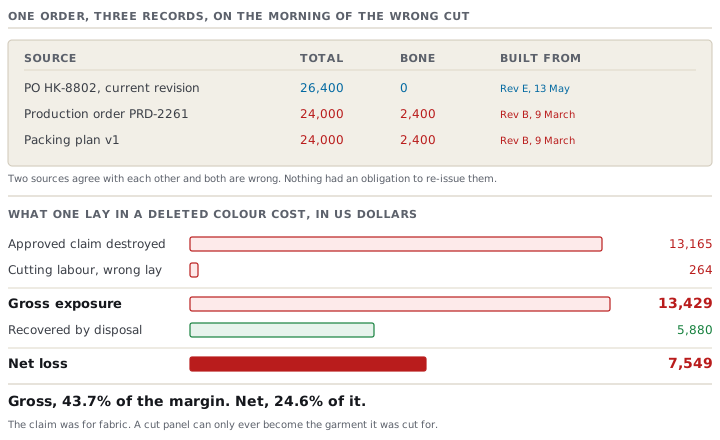
What the cut cost
Before 06:40 that Monday, the Bone was an asset: 1,656 kg of dyed fabric with an approved claim of USD 13,165 against it. Hallvik's approval was for fabric.
After 06:40 it is 2,400 sets of dress panels in a colour nobody has ordered. There is no fabric to claim for. There is no roll to return. A cut panel can only ever become the garment it was cut for.
| Line | Amount USD |
|---|---|
| Approved claim destroyed, 1,656 kg at USD 7.95 | 13,165 |
| Cutting labour spent on the wrong lay, 2,400 at USD 0.11 | 264 |
| Gross exposure | 13,429 |
| Recovered by disposal, after conversion cost | 5,880 |
| Net loss | 7,549 |
Gross, that is 43.7% of the order's margin of USD 30,696. Disposal brings it down, and it is not automatic. Hallvik's Supplier Terms forbid anybody selling their styles. So you ask, and on 19 May they allow disposal outside the European Union with every brand marking removed. The panels are sewn with plain labels and no hangtag, at a conversion cost of USD 3.15 a piece — USD 7,560 — and sold to a regional wholesaler at USD 5.60, USD 13,440. Net recovery USD 5,880, and a net loss of USD 7,549, 24.6% of the margin.
And a day. The wrong lay used a day of cutting capacity on an order that Rev C and Rev D had already left 2.7 days short. After 11 May it is 3.7 days short. Buying those days back is course 7.5's arithmetic, not this course's. What this course owns is that the number existed on 30 April, and nobody in the building could have told you it.
The mechanism, and what it costs to run
Four things. None of them is software, all of them survive being done on paper, and together they take about twenty minutes a week per order.
1. One record owns the confirmed position. For HK-8802 that is the purchase order at its current revision. Quantity by colour, price, ship date, payment terms. Everything else in the building — the production order, the cut plan, the packing plan, the shipping instruction, the costing sheet — displays that position. It does not keep its own copy. When somebody asks what the confirmed quantity is, there is one place to look and one person who owns it.
2. Every downstream document carries the revision it was built from. One line at the top of the cut plan: PO HK-8802 Rev B. That is the whole fix for 11 May. The cutting master does not need to understand the amendment. He needs to see that his paper says Rev B while the board on the wall says Rev E, and to stop. Print it on the cut plan, the job card, the packing list and the fabric issue note.
3. An acknowledgement is a state change, not an email. Acknowledging Rev C means three things happen together, or none of them counts: the reply goes to the buyer, the order record moves to Rev C, and the production order is re-issued. If re-issuing the production order needs a conversation with planning, that conversation is part of the acknowledgement, not a follow-up. On 3 April step three did not happen, and nothing anywhere was built to notice.
4. A weekly reconciliation of three numbers. Every Monday, before the production meeting, three sources per live order, side by side.
| Source | Total | Black | Ink Navy | Bone | Moss |
|---|---|---|---|---|---|
| PO HK-8802, current revision | 26,400 | 14,400 | 7,200 | 0 | 4,800 |
| Production order PRD-2261 | 24,000 | 12,000 | 7,200 | 2,400 | 2,400 |
| Packing plan v1 | 24,000 | 12,000 | 7,200 | 2,400 | 2,400 |
Three sources, two answers, and one of them is a colour that does not exist. This table takes four minutes to build, and it was available on any day between 3 April and 11 May. An order that does not reconcile does not get a line allocation that week. That single rule is what makes the reconciliation happen. A rule with no consequence is a habit, and habits are the first thing a busy week removes.
The change log
One row per revision, kept on the order, never on a person's laptop. This is what HK-8802's looks like at the end.
| Rev | Received | Channel | What changed | Qty | Value USD | On board | Float days | Cost effect USD |
|---|---|---|---|---|---|---|---|---|
| A | 9 Feb | original order | 24,000 | 284,400 | 26 Jun | 7.0 | — | |
| B | 6 Mar | Bone split, Moss added | 24,000 | 284,400 | 26 Jun | 7.0 | 1,422 | |
| C | 2 Apr | portal | Black up, Bone deleted, Moss up | 26,400 | 312,840 | 26 Jun | 4.3 | claim 13,165 |
| D | 30 Apr | portal | ship date pulled forward | 26,400 | 312,840 | 19 Jun | minus 2.7 | — |
| E | 13 May | band price on added units | 26,400 | 312,120 | 19 Jun | minus 2.7 | 720 |
Nine columns, five rows. It answers every question anybody will ask about this order for the next two years, including the ones asked by a buyer's audit, an insurance claim and whoever takes your desk. Note that Rev B's cost is USD 1,422, not the USD 2,664 you agreed on 9 March, because Rev C crossed the lot minimum and the short-lot charge came back. A log written once per revision catches that. A memory does not.
Prompt · Reconcile one order across three systems
Every Monday before the production meeting. And straight away on any order where a cut, an issue note or a packing plan is about to be built from paper you did not re-issue yourself.
Act as an order governance analyst in a garment factory. I am going to give you the same order as it is recorded in three different places. I need to know where they disagree and which one is wrong.

SOURCE 1 — the buyer's purchase order at its CURRENT revision:
[REVISION LETTER, DATE, QUANTITY BY COLOUR AND SIZE, PRICE, SHIP DATE, PACKING INSTRUCTION]

SOURCE 2 — the production order the factory is working to:
[PRODUCTION ORDER NUMBER, DATE CREATED, THE PO REVISION IT WAS BUILT FROM IF STATED, QUANTITY BY COLOUR AND SIZE]

SOURCE 3 — the packing or shipping plan:
[PLAN VERSION, DATE, QUANTITY BY COLOUR AND SIZE, CARTON CONFIGURATION, SHIP DATE]

AMENDMENT HISTORY, if I have it:
[EVERY CHANGE SINCE THE ORIGINAL ORDER: DATE RECEIVED, HOW IT ARRIVED, WHAT IT CHANGED, WHETHER IT WAS ACKNOWLEDGED]

Produce:

1. A reconciliation table: one row per source, columns for the total and for each colour. Mark every cell that disagrees with the purchase order.
2. For each disagreement, the amendment that caused it and the date the downstream document should have been re-issued.
3. An EXPOSURE list: for each disagreement, what physically happens next if nobody catches it — fabric cut in a deleted colour, a short cut, cartons packed to a superseded ratio, a shipment that cannot be presented under the credit — and roughly what that costs, using any cost figures I gave you.
4. The single most urgent action, with the person who has to do it and the document that has to be re-issued.
5. A change log I can adopt: one row per revision with received date, channel, what changed, confirmed quantity, confirmed value, ship date, float and cost effect. Fill in every row you can from what I pasted, and mark the rest as unknown rather than guessing.

Do not smooth over a disagreement. If two sources give different numbers, the answer is that the order is not governed, not that one of them is probably right.
AI can make mistakes — check anything you act on.
Cancellation: what the clause says and what happens
Rev C cancelled 2,400 pieces. Buyers rarely call that a cancellation, and neither did Hallvik. It arrived as a colour change inside a quantity increase.
What the clause says. Rev 9, clause 11.3: the buyer may cancel any undelivered part of an order; the supplier's only remedy is documented, unavoidably committed material cost, backed by supplier invoices, claimed within fourteen days of the notice. Three words in that sentence decide whether you are paid. Documented — an email from your mill is not an invoice. Unavoidably committed — you must show you tried to stop it, which is why the 3 April instruction to Zohour and their reply are worth more than the invoice. Fourteen days — from the notice, not from the day you noticed the notice.
What the law would give you. If the CISG applies and has not been switched off, Article 74 measures damages as the loss suffered because of the breach, including lost profit, capped at what the party in breach foresaw or should have foreseen. On 2,400 pieces at a margin of USD 1.19 that is a further USD 2,856. Article 77 requires you to limit your loss, which is exactly what the disposal did.
What actually happens. You claim under clause 11.3, because it is quick, uncontested and paid inside the relationship. You do not claim the USD 2,856. Pursuing it means arguing that clause 11.3 does not limit your remedy, and that is a legal fight with a four-season customer over less than one month of the account. Knowing the number is still worth it. It is what you hold in reserve if the cancellation is not 2,400 pieces but 26,400.
Check yourselfSomebody asks what the current confirmed quantity is on an order you run. How long should it take you to answer, and where from?Show the answer
Seconds, from the order record, without opening email. If the honest answer is that you would need to check the last few messages, the order is not governed, and its real quantity is whatever the next person to act happens to believe. The test is not whether you know the number today — you probably do. It is whether the cutting master, the planner and the person covering your desk next week would all give the same answer from paper.
What you should be able to do now
For every live order, do four things. Name the current revision. State the confirmed quantity by colour and the confirmed value. Show the change log that got there. And produce a reconciliation of the commercial, production and packing numbers that either agrees or names the row that does not.
And one habit worth more than the rest of it together: when an amendment is acknowledged, re-issue the paper the factory works from, in the same hour. That is the whole of 11 May.