Lessons · Lesson 1 of 3
What you actually signed
Read a purchase order for the terms that move money, including the ones that are not printed on it.
Lesson 1 of 3 · 43 min
Monday 9 February 2026
A purchase order looks like the whole agreement. One page: a garment, a quantity, a price, a date. It is not the whole agreement. Near the bottom of the page there is usually one short sentence. It says the order is placed under the customer's published terms. That sentence pulls dozens of pages you have never opened into the contract. Lawyers call this incorporation by reference: a document counts as part of the contract even though nobody attached it.
A purchase order arrives from Hallvik Retail AB in Malmö. You are the merchandiser at El Manara Apparel in Tanta. This is your fourth season with them.
- PO HK-8802, season SS26
- Style PTD-450, women's ponte knit sheath dress, 290 gsm, 66% viscose / 30% polyamide / 4% elastane
- Quantity 24,000 pcs — Black 12,000, Ink Navy 7,200, Bone 4,800
- Sizes 34 to 42 at a ratio of 1:3:4:3:1
- Price USD 11.85 FOB Alexandria
- Payment irrevocable letter of credit at sight, opened by Sundsbanken, advised through Nile Commercial Bank
- On board 26 June 2026; Malmö distribution centre window 20 to 27 July
Two of those lines need a plain explanation. FOB means your price covers everything up to the goods being loaded on the vessel at Alexandria. The buyer pays the sea freight. A letter of credit is a promise from the buyer's bank, not from the buyer. The bank pays you when you hand over documents that match what the credit asks for. At sight means it pays as soon as those documents are accepted. Irrevocable means nobody can withdraw the promise on their own.
Order value USD 284,400. Your cost sheet says USD 10.66 a piece. So the margin is USD 1.19 a piece, USD 28,560, 10.0% of the selling price. Hold that number. Every clause in this lesson is measured against it.
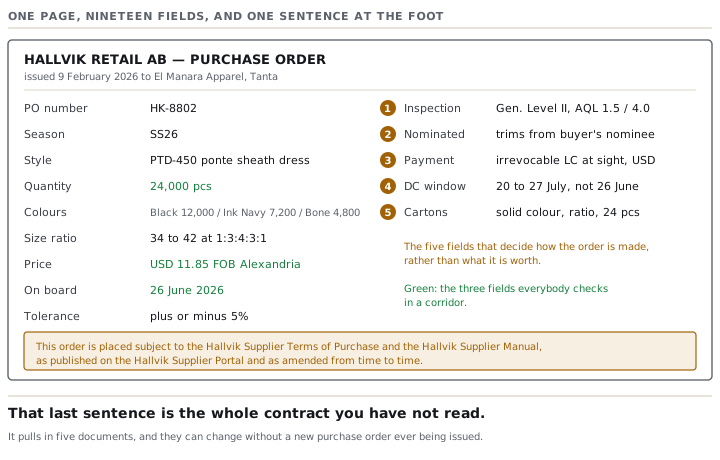
The PO itself is one page with nineteen fields. Everything in the list above is on it. Almost nothing that will cost you money this season is.
The face of the order, and the line at the bottom
At the foot of the page, in the same small text as the delivery address, is one sentence:
This order is placed subject to the Hallvik Supplier Terms of Purchase and the Hallvik Supplier Manual, as published on the Hallvik Supplier Portal and as amended from time to time.
Two things just happened. Five documents you have not opened became part of this contract. And they can change without a new purchase order — that is what as amended from time to time does. The PO in your hand is a cover sheet.
So on the morning the order lands, you download the whole pack. You read it against last season's copy. It takes about ninety minutes. It is the highest-paid ninety minutes of the season.
Before you open the pack, read the face of the order itself. Everybody checks quantity, price and ship date. Those are the three numbers a colleague asks you about in a corridor. The unread fields are the ones that decide how the order is made, not what it is worth. There are five of them:
- The inspection level.
- The nominated suppliers, whose lead time you do not control.
- The currency and the payment instrument.
- The delivery window, which is not the same thing as the on-board date.
- The carton and label instruction.
On HK-8802 two of those will cost money before June. Both are settled in February by one email.
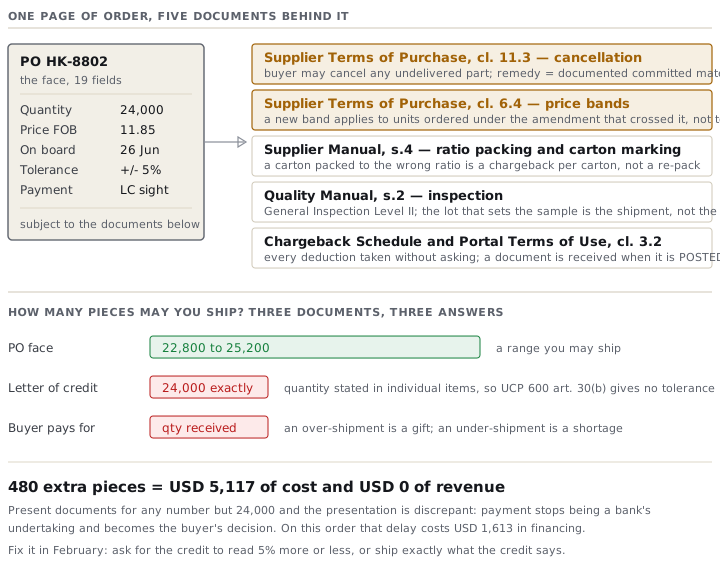
| Document | The clause that matters | What it does |
|---|---|---|
| Supplier Terms of Purchase, Rev 9 | 6.4 — volume price bands | A band price applies to units ordered under the amendment that crossed it, not to the whole order |
| Supplier Terms of Purchase, Rev 9 | 11.3 — cancellation | Buyer may cancel any undelivered part; your only remedy is documented committed material, claimed within fourteen days |
| Supplier Manual, Section 4 | ratio packing and carton marking | A carton packed to the wrong ratio is a chargeback per carton, not a re-pack |
| Quality Manual, Section 2 | General Inspection Level II, AQL 1.5 major and 4.0 minor | The lot size that sets the sample is the shipment, not the order |
| Chargeback Schedule | the whole table | Every deduction Hallvik can make without asking you first |
| Supplier Portal Terms of Use | 3.2 — service of documents | A document posted to the portal is treated as received when posted |
Read those six rows again and see where the money sits. The price is on the PO. The cancellation remedy, the claim deadline, the packing chargeback and the definition of when you were told something are not. On this order the cancellation clause alone is worth USD 13,165. The fourteen-day deadline inside it will nearly cost you all of it. You meet both in lesson 3.
Prompt · Find the clauses that move money
The morning a purchase order lands, before you acknowledge it. And again on the first order of every new season, when the buyer's terms document has quietly been re-issued.
Act as a sourcing contracts manager at an apparel exporter. I am about to acknowledge a buyer purchase order, and I need to know what I am actually agreeing to.

Order facts: buyer [BUYER], PO number [NUMBER], style [STYLE], quantity [QTY] pcs split by colour as [SPLIT], price [PRICE] [INCOTERM] [PORT], on board [DATE], delivery window [WINDOW], payment terms [TERMS].

Here is the face of the purchase order:
[PASTE EVERY FIELD ON THE PO, INCLUDING ANY SMALL PRINT AT THE FOOT OF THE PAGE]

Here are the documents it pulls in by reference:
[PASTE THE SUPPLIER TERMS OF PURCHASE, THE SUPPLIER OR PACKING MANUAL, THE QUALITY MANUAL, THE CHARGEBACK SCHEDULE AND ANY PORTAL TERMS OF USE — OR THE SECTIONS YOU HAVE]

Do five things, in this order.

1. List every document this order pulls in by reference. Flag any that I have not pasted, so I know what is still missing.
2. For each document, name the ONE clause that can change how much money I receive or when I receive it. Quote the clause number and the sentence. Do not paraphrase a clause you cannot see — say it is absent instead.
3. Build a table of every deadline that runs against ME: claim windows, notice periods, acknowledgement windows, document presentation dates. Give the clause number, the number of days, and what starts the clock.
4. Check the quantity I may ship against the quantity I will be paid for. Compare the PO tolerance clause with the payment instrument. If payment is by letter of credit, tell me whether the credit states quantity in individual items or in units of weight or length, and what that does to any tolerance.
5. Give me a numbered list of the questions I should put to the buyer IN WRITING before I acknowledge, worded as I would send them.

Where the documents contradict each other, say so plainly and name both clauses. Do not invent a clause number, a legal rule or a standard. If you are not certain, write UNVERIFIED and tell me what to look up.
AI can make mistakes — check anything you act on.
The tolerance clause that does not do what it says
Field 11 on the face of HK-8802 reads: quantity tolerance plus or minus 5%.
Read straight, that says you may ship anywhere between 22,800 and 25,200 pieces. Merchandisers read it as insurance. Cut a small extra quantity, and if final inspection pulls some pieces, you still ship a full order.
So you plan an extra 480 pieces. At USD 10.66 that is USD 5,117 of cost you are carrying on purpose. That is a fair trade against shipping short.
Now open the letter of credit. Field 45A says: 24,000 pieces of style PTD-450. The credit amount is USD 284,400.
UCP 600 is the rulebook banks use for letters of credit. Article 30(b) allows a tolerance of 5% more or less on quantity — but only where the credit does not state the quantity as a number of packing units or individual items. 24,000 pieces is a number of individual items. So the tolerance does not apply. The credit pays against documents for 24,000 pieces and no other number.
You now have two documents in the same order that cannot both be obeyed. The PO allows a range. The credit allows one number. Ship 24,480 pieces and the invoice and packing list say 24,480. The documents do not match the credit, and the bank refuses them.
What a refused presentation actually costs
It is not a fee. It changes who owes you the money.
Documents that match the credit are a bank's promise. Documents that do not match are a request for the buyer's waiver, and the buyer answers when their sourcing manager gets to it. Under UCP 600 Article 16(d), the bank must send its refusal notice by the close of the fifth banking day after the day you present. So you learn quickly. Getting the waiver is the slow part.
Present on 3 July. Refusal notice on 10 July. Waiver on 30 July. Payment on 31 July instead of 8 July. Twenty-three extra days of financing on USD 284,400 at 9% is USD 1,613. That is 5.6% of the order's whole margin, for shipping 480 pieces nobody paid you for.
The fix is one email in February, before the credit is opened. Either ask Hallvik to have the credit read 24,000 pieces, 5% more or less allowed, or accept that the shipment is exactly 24,000 and keep the extra pieces in your own store as replacements. Both are fine. What is not fine is finding the contradiction in the packing hall.
What counts as acceptance
You did not sign anything. There is no signature block on HK-8802, and there will not be one on any of the five amendments that follow. So what makes this a contract that binds you?
The answer is usually the CISG — the United Nations Convention on Contracts for the International Sale of Goods. It is a treaty that supplies the sales law for cross-border trade, and both Egypt and Sweden are party to it. Article 18(1) has two halves, and both matter to a factory.
Take the second half first: silence or inactivity does not by itself count as acceptance. An amendment sitting unanswered in your inbox is not agreed.
The first half is the one that catches factories. A statement or other conduct showing that you agree is an acceptance. Cutting fabric is conduct. Booking a vessel is conduct. Issuing a production order is conduct. You can accept an amendment you never replied to, simply by acting on it. You meet exactly that in lesson 3.
One more thing worth writing on the wall. Many buyer terms switch the CISG off in a single line — the United Nations Convention on Contracts for the International Sale of Goods shall not apply — and pick the buyer's home law instead. Hallvik's Rev 9 does not switch it off. Check yours. It changes what a cancellation is worth to you, and it is one search inside a PDF.
The acknowledgement
You acknowledge HK-8802 on 10 February. Not with received, thank you.
An acknowledgement is your written statement of what you believe you have agreed. Its whole purpose is to make a disagreement surface in February instead of June. It repeats the terms in full — quantity by colour, price, ship date, payment, inspection standard — and it names anything you are not accepting.
On this order there is one of those. The Supplier Manual, Section 4, requires ratio packing in single-colour cartons of 24, with the size ratio inside each carton. Your carton holds 20 pieces. Twenty does not divide by the ratio 1:3:4:3:1, which needs twelve. You say so on 10 February and ask for cartons of 24. Hallvik confirm on 12 February. That exchange took two emails in week one. Found in the packing hall in June, it is a chargeback on every one of the 1,200 cartons you would have packed, and a shipment that misses the vessel.
Check yourselfThe PO says plus or minus 5% and the credit says 24,000 pieces. Which one governs how many pieces you ship?Show the answer
Both, and that is the problem. The PO governs what you owe Hallvik: shipping 23,500 pieces is not a breach of the order. The credit governs whether the bank pays you: documents for any number other than 24,000 pieces are a discrepancy, because Article 30(b) of UCP 600 gives no quantity tolerance when the credit states the quantity in individual items. Somebody has to reconcile the two documents in writing before the credit is opened. That somebody is you, because you are the only person who reads both.
What you should be able to do now
Take any live order and answer four questions from the paper, not from memory:
- Which documents does this PO incorporate, and do I have the current version of each?
- Which clause governs cancellation, and what is the deadline for claiming under it?
- Does the quantity I may ship match the quantity I will be paid for?
- What did I acknowledge, when, and did I record anything I refused?
If any answer is I would have to look, the order is not governed. It is being remembered, and memory is not a system.