Lessons · Lesson 2 of 3
Conditional, silent and unauthorised
Handle the three approvals that look like approvals and are not, and price the decision to proceed against each of them.
Lesson 2 of 3 · 38 min
Friday 8 January 2027, 16:20
Three kinds of message look like permission and are not. The first says yes, then attaches a list of things to put right. The second is a genuine yes from a real person who was never entitled to give it. The third is not a message at all: the deadline passes in silence, and the factory has to move anyway.
The pre-production sample decision on NRV-8106 lands three hours before the weekend. PP-2 went to Copenhagen on 29 December. Line loading is booked for Monday 18 January, two lines, 1,920 pcs a day, twenty working days to sew 38,400 pcs.
Freja Boysen writes:
PP-2 approved subject to: (1) the functional hood drawcord to be replaced with a tacked, non-functional cord. (2) the care label to move from the left side seam to the back neck. (3) Petrol shade to be re-submitted against the standard, the submitted swatch reads dull.
Hoda Sabry reads the first word and the last word. She has to decide, before Monday, whether the cutting room starts.
Almost everyone reads that email as one thing: approved, with a few points to fix. It is not one thing. It is three separate decisions with three different risk profiles, wearing a single word. Treating it as one is how a conditional approval becomes the most expensive document on the order.
A conditional approval is one decision per condition
Take the conditions apart and ask the same three questions of each. What does this condition change? What does it block? What is my exposure if I proceed against it and it turns out to be worse than I think?
| Condition | What it changes | What it blocks | Exposure if you proceed |
|---|---|---|---|
| Hood cord becomes non-functional | A bartack at the cord ends | Nothing in cutting; the finishing operation only | Near zero — the cord is bought, the panels are unaffected |
| Care label moves to the back neck | The operation bulletin and the line balance | Nothing in cutting; the sewing sequence | One line-day, once, and only if it is found late |
| Petrol shade re-submitted | Nothing yet — the shade is not approved | Cutting and sewing of Petrol only | The whole Petrol colour |
Now the arithmetic on each, because that is what makes it a decision rather than an opinion.
The cord. Marsa bought 40,000 cords at USD 0.11 each, USD 4,400. The cord itself does not change. It is threaded, cut short and bartacked at both ends instead of running free. Adding a bartack is USD 0.03 a piece, USD 1,152 across the order. Nothing about the cut is affected. This condition blocks nothing.
The care label. This one looks like stationery and is not. Moving the care label out of the side seam means it is now set into the back-neck tape operation, which on QTZ-514 is already the bottleneck. It adds 0.11 minutes there. So until the bulletin is re-balanced, the line runs at 1,850 rather than 1,920 pcs a day, and the re-balance itself costs a day of line time. Twenty sewing days becomes twenty-one working days. That one extra line-day at USD 1,240 a line, two lines, is USD 2,480. After that, output is back at 1,920. Real, small, and only expensive if you discover it on the floor in week three instead of pricing it on Friday afternoon.
The Petrol shade. This one is not a condition at all. It is a refusal wearing the same email as an approval. There is no approved shade for Petrol. So there is no risk transfer on Petrol. So every metre of Petrol fabric cut is cut at Marsa's expense.
The decision that Friday afternoon
Three options were on the table. Only one survives being priced.
Hold everything until all three conditions are closed. The earliest a re-submitted Petrol swatch can be back is Thursday 14 January, and a cautious reading adds a few days for the pattern room and the bulletin. Call it six working days of both lines standing idle. Two lines at USD 1,240 a line-day for six days is USD 14,880, which is 38% of the order's USD 39,168 margin. It is also six days that the ship date does not have.
Cut and sew everything, and carry the Petrol risk. If Petrol comes back approved, this costs nothing and looks like decisiveness. If it does not, 9,600 finished garments in an unapproved shade have a made cost of USD 8.83 each, which is USD 84,768, or 216% of the margin. Even catching it at the fabric stage, before a stitch, 4,032 kg of dyed Petrol fleece at USD 7.35 a kilo is USD 29,635. This is the option that feels brave and is simply gambling with someone else's colour standard.
Split the order by condition. Ecru, Dusty Rose and Charcoal Marl total 28,800 pcs. None of the three conditions blocks cutting on any of them. At 1,920 pcs a day that is exactly fifteen working days, so those three colours can load on Monday 18 January and run until Wednesday 3 February. Thursday 4 February is the changeover, and the bulletin is re-balanced on the same day rather than twice. Petrol, 9,600 pcs, moves to the back of the sequence and loads on Saturday 6 February. That is more than three weeks after the re-submitted swatch is due back. Sewing completes on Wednesday 10 February. The cost is one extra changeover, a re-sequenced set of markers and a split fabric issue from the store: USD 3,900, which is 10% of margin. The exposure on Petrol falls to zero, because nothing Petrol is cut until it is approved.
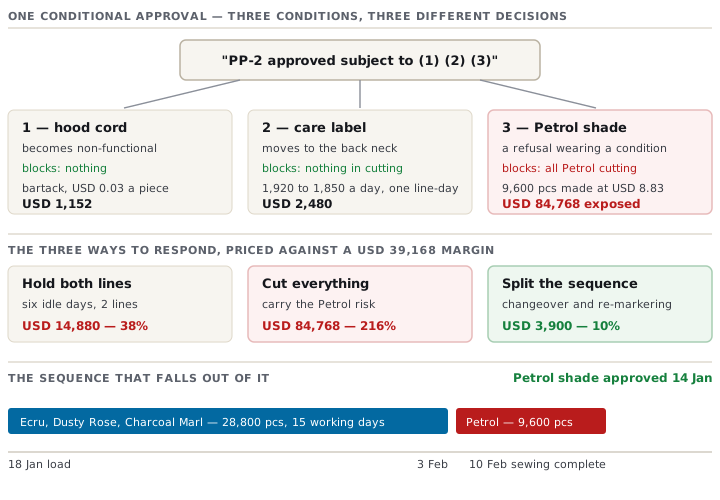
Marsa took the split. Petrol came back approved on Thursday 14 January against a re-submitted swatch, three weeks before it was needed.
Who is allowed to say yes
The second failure has nothing to do with wording. An approval is worth exactly what the person giving it is authorised to bind, and buying offices are full of helpful people answering questions that are not theirs.
| Class of decision | Examples | Who at Norvind |
|---|---|---|
| Administrative | Carton artwork, packing lists, delivery-window admin | Ida Krog, assistant merchandiser |
| Aesthetic within an issued standard | Shade band acceptance, strike-off colour, print placement | Ida Krog, referred up when outside the standard |
| Technical | Fit, measurements and tolerance, construction, sample approvals | Freja Boysen, garment technologist |
| Commercial | Price, quantity, ship date, concessions, chargeback waivers | Line Dahlgaard, buying manager |
| Legal and safety | Childrenswear cord and drawstring rules, fibre content, care claims, chemical limits | Mikkel Torp, product safety — and even then only to confirm compliance, never to waive it |
Read the last row twice. Every other row names somebody who can say yes. The last row names somebody who can only ever say this complies or this does not. Nobody in a buying office can approve a garment into legality.
The cord, again
On Tuesday 24 November, Marsa submitted the hood drawcord for approval. Ida Krog replied the same day: "Cord is fine, go ahead." That is the line that scored one out of six in lesson 1. The missing element that mattered was not the version. It was the authority.
QTZ-514 is a children's garment in sizes 98/104 to 122/128 cm. EN 14682, the European standard for cords and drawstrings on children's clothing, prohibits cords and drawstrings in the hood and neck area of garments intended for young children. Every size in this order sits inside that group. So a functional hood drawcord on QTZ-514 is not a preference somebody in Copenhagen is entitled to hold. It is a garment that cannot lawfully be sold.
The useful question was never did somebody approve it. It was is this garment legal in the market it ships to, and the answer to that does not change when an email arrives.
Had it shipped, USD 378,240 of goods would have been unsaleable in the destination market, with a withdrawal on top. What it actually cost was USD 1,152 of bartacks, because Freja caught it at the PP sample seven weeks later. The gap between those two numbers is the whole argument for reading a tech pack against the destination market's requirements. Read it on the day the PO confirms, 5 October, rather than trusting that the buyer's own compliance people have already done it.
Check yourselfA buyer's assistant emails you approving a change to the fibre content declared on the care label, because the mill substituted a yarn. What do you do?Show the answer
You do not act on it, and you say why in a way that helps rather than accuses. Fibre content is a legal declaration in most destination markets. So it sits in the legal and safety class, and cannot be settled by the buying office at all. Route it to the buyer's compliance contact by name, with the mill's substitution documented, and keep the item open on your register until that person confirms. The assistant did nothing wrong. She answered the question she was asked. It was the wrong person to have asked.
The approval that never came
The third failure is the one nobody wants to touch. The deadline passes, the buyer is silent, and the factory has to move.
Silence is not consent by default. Under the CISG, which governs most cross-border sales between traders unless the contract excludes it, silence or inactivity does not in itself amount to acceptance. So deemed approval is never something you can simply assume. It works only where the parties agreed it in advance, in writing.
NRV-8106 has that clause, because Marsa asked for it at PO stage:
Submissions listed in Annex 3 are deemed approved if the buyer has not commented within five working days of receipt. Items in Annex 4 are excluded and are never deemed approved.
How that clause earned its keep
Print strike-off SO-3 went to Copenhagen on Thursday 3 December. The courier's proof of delivery is timestamped Monday 7 December, 09:41. Five working days from receipt is Monday 14 December. On Thursday 10 December, Hoda sent a reminder to Freja by name, copying Line Dahlgaard, with the deemed date in the subject line. Nothing came back. On Tuesday 15 December, Marsa released print production under the clause and recorded it in the register as deemed approved, with the proof of delivery reference and the reminder attached.
Norvind's design team commented on Wednesday 6 January. The comments were minor and were absorbed.
Here is what the clause was worth. The print house had a slot on 15 December or on 4 January, after their shutdown. Waiting for an explicit answer would have printed on 8 January and pushed line loading from 18 January to 27 January. Nine calendar days, on a calendar that does not have nine days in it.
The five things that made it defensible, all done before the deadline
- The clause exists in this PO, in writing, and names which submission types it covers.
- Delivery is provable. A timestamped proof of delivery, quoted in the register line, not "we sent it".
- The submission was complete. Nothing was outstanding that the buyer needed in order to comment. A deemed approval on a half-submission is worthless.
- A reminder went to the named approver before the deadline, copying their manager, with the deemed date in the subject line. The first draft of that reminder went to the shared buying mailbox, which is a room rather than a person, and Ida was on leave that week. A room cannot be put on notice.
- The item is not on the carve-out list.
The carve-out list, and why you want it
Annex 4 on this order excludes five things from ever being deemed approved: anything legal or safety-related, fibre content and care-labelling claims, brand identity artwork such as logos and licensed prints, price, and the ship date.
That list protects the factory more than the buyer. A deemed approval on the hood cord would have been worth nothing, because no clause makes an unlawful garment lawful. But it would have given Marsa a false reason to proceed. Writing the carve-out into the PO means the factory never has to make that judgement at half past four on a Friday.
Check yourselfYour PO has a five-working-day deemed-approval clause. You submit a licensed cartoon print artwork and hear nothing for two weeks. Can you print?Show the answer
No. Licensed artwork is brand identity, and it is the exact category a carve-out list exists to protect. The licensor, not the buyer, ultimately controls it, and a clause between you and the buyer cannot bind a third party. Chase it up the buyer's chain by name, say plainly what the silence is costing in days and slot fees, and offer to hold the print slot at a stated price. Everything else in the submission, such as ground shade, placement and hand feel, may well be deemed. The artwork is not.
Prompt · Split a conditional approval into decisions
A sample comes back approved subject to a list, a line is booked, and you have to decide today what can start and what cannot.
Act as a garment factory planning manager who has to answer a cutting room before the end of the day. I have a conditional approval and I need it taken apart into separate decisions, each priced. The approval, verbatim: [PASTE IT WITH THE FULL LIST OF CONDITIONS]. Order facts: buyer [BUYER], PO [NUMBER], style [STYLE], total [QTY] split by colour or size as [BREAKDOWN], FOB [PRICE], made cost per piece [AMOUNT], order margin [AMOUNT]. Production facts: lines booked [NUMBER], daily output [PCS], loading date [DATE], sewing must finish by [DATE], idle cost per line-day [AMOUNT], fabric cost [AMOUNT] a kilo and [KG] a piece, changeover and re-markering cost if I split the sequence [AMOUNT]. Do the following. First, take each condition separately and say what it changes, what it blocks, and what my exposure is if I proceed against it — and flag any condition that is not a condition at all but a refusal. Second, cost at least three responses in full: hold everything, proceed against everything, and split the work so that only the blocked part waits. Give each a dollar figure, a share of my margin, and the effect on the ship date. Third, recommend one and say what your recommendation depends on that I have not told you. Fourth, write the register lines I should open today, one per condition, each with what closes it and by when. Fifth, write the short message to the buyer confirming exactly what I have understood as released and what I am holding, in a tone that does not sound like an argument. Never treat a shade, a fit or a safety point as a minor condition because the others are minor.
AI can make mistakes — check anything you act on.
What you own at the end of this lesson
You can take a conditional approval apart into one decision per condition, price each of the three ways to respond, and choose the one that costs USD 3,900 rather than the two that cost USD 14,880 and USD 84,768. You know which classes of decision each person in a buying office can bind, and that the legal class cannot be bound by any of them. And you know what a deemed approval needs to be a defence rather than a hope: a clause, proof of delivery, a complete submission, a named reminder, and a carve-out list.
Lesson 3 is the artefact that holds all of this: the register, what it does to a comment that arrives after approval, and the five questions that tell you whether an approval survives a dispute.