Lessons · Lesson 1 of 3
What an approval has to carry
Read any approval email and say in one minute whether it releases work, and what it is worth if there is a dispute.
Lesson 1 of 3 · 36 min
Monday 5 October 2026
The word "approved" arrives in a factory's inbox dozens of times on one order. Most of the time it moves nothing at all. This lesson is about the difference between a yes that shifts responsibility and a yes that is only a friendly remark. A garment is made two or three times over before it is right. So "the sample is approved" means nothing when three samples exist.
A purchase order confirms at Marsa Knitwear in Borg El Arab, west of Alexandria.
- PO NRV-8106 from Norvind Retail A/S, Copenhagen, season SS27
- Style QTZ-514, girls' hooded jersey dress, 280 gsm brushed-back fleece, 95% cotton / 5% elastane
- Sizes 98/104, 110/116 and 122/128 cm
- Quantity 38,400 pcs — Ecru 12,000, Dusty Rose 9,600, Petrol 9,600, Charcoal Marl 7,200
- Price USD 9.85 FOB Alexandria, order value USD 378,240
- Cost to make USD 8.83, so margin is USD 1.02 a piece, USD 39,168 on the order, 10.4%
- On board 18 February 2027, Copenhagen DC window 16 to 23 March
Between today and 18 February, Norvind will say the word approved to Marsa about thirty times. Lab dips, the bulk shade band, a print strike-off, four trim submissions, three fit rounds, a size set, a pre-production sample, care labelling, carton artwork and a shipping sample.
Each of those is the moment a decision stops being Norvind's and becomes Marsa's. Each one releases money. Fabric gets cut, a line gets loaded, a container gets booked.
Most of them will arrive as one line in an email. This lesson is about which of those lines are worth anything.
An approval is a transfer of risk, not a compliment
When a buyer says approved, one specific thing happens. From that moment, if the goods match the thing that was approved, the risk of the goods being wrong sits with the buyer instead of the factory. That is the whole commercial content of the word. It is why an approval is worth chasing, worth waiting for, and worth refusing to proceed without.
So an approval only transfers risk over the thing it identifies. If it does not identify anything precisely, it transfers nothing precisely. What you are holding is not an approval. It is a sentence that two people will remember differently in April.
That is not a legal nicety. It is the difference between a conversation that takes eleven minutes and one that takes a season.
The six things an approval has to carry
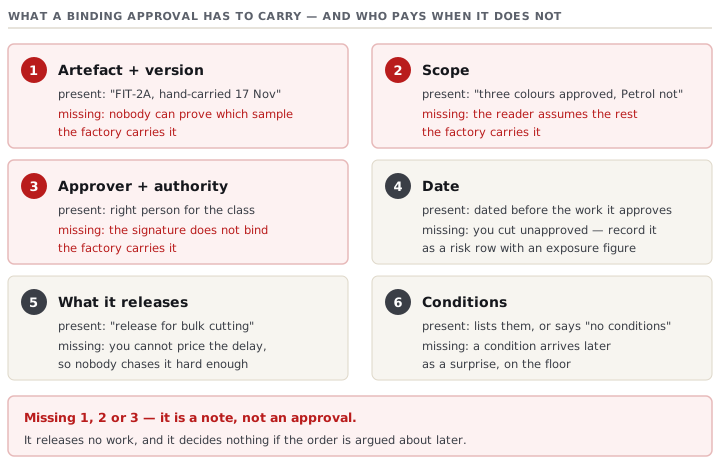
Write these six on a card and keep it beside the screen. Every approval you receive either has them or is missing them. You can check all six in under a minute.
1. The artefact, and its version. Not "the fit sample" but "FIT-2A, hand-carried 17 November". Not "the strike-off" but "strike-off SO-3, Dusty Rose ground, submitted 3 December". Physical samples travel, get re-made, and cross in the post. A version is the only thing that survives that.
2. The scope, meaning what is approved and what is not. An approval that names only what is in it invites the reader to assume everything else came with it. "Shade bands approved for Ecru, Dusty Rose and Charcoal Marl. Petrol not approved, re-submit" is a scope. "Shade bands approved" is a hazard.
3. The approver, and what that person is allowed to bind. A named human, not an address that four people read. And a person whose authority covers this class of decision: a shade band, a fit, a construction change, a price, a legal requirement. Lesson 2 is entirely about this, because it is where approvals fail most expensively.
4. The date, and what was done before it. An approval dated after the work it approves is not an approval. It is a record of the risk you took. Sometimes taking that risk is the right decision. It has to be written down as what it was.
5. What it releases. The best approvals name the next step: "release for bulk cutting", "proceed to line loading", "book the vessel". An approval that releases nothing named is a compliment. A merchandiser who cannot say what an approval released cannot say what it is worth when it is late.
6. Its conditions, or the words "no conditions". A conditional approval is a different instrument with different rules, and it must announce itself. Silence about conditions is how a condition becomes a surprise.
The email that cost eleven minutes and could have cost the vessel
Two fit samples are in play on QTZ-514 in November. This is completely ordinary.
FIT-2 goes by courier on 11 November. Norvind's technologist, Freja Boysen, visits Marsa on 16 and 17 November, sits in the sample room, and takes away FIT-2A in her hand luggage. It is the same garment with the hood depth reduced, a correction she asked for while standing at the table.
On Thursday 19 November, Ida Krog in the Copenhagen buying office writes to Hoda Sabry at Marsa:
Hi Hoda — fit sample is approved, please proceed. Ida
Hoda has been waiting for that line for eight days. The pattern room grades from FIT-2A, because that is the sample they last worked on and the one Freja carried out of the building. The comment sheet on Ida's desk is written against FIT-2, because that is the sample the courier delivered to Copenhagen and the one the fit session was booked around. The two hoods differ by 15 mm.
Nobody has done anything careless. Two competent people are each looking at the sample in front of them.
What it would have cost
Hood panels on QTZ-514 take 0.11 kg of fabric a piece including wastage. Re-cutting them across the order is 4,224 kg at USD 7.35 a kilo, USD 31,046. Unpicking and re-attaching a hood with its topstitch is USD 0.14 a piece, USD 5,376. Together USD 36,422, which is 93% of the entire margin on NRV-8106.
That is the small number. The cutting overage on this order is 3%, which is enough fabric for 1,152 pieces, not 38,400. The fabric to re-cut every hood does not exist in the building. The mill quotes 42 days for a re-order, and on the day the error would have surfaced there are 30 days to the vessel. So the real cost of a fit approval with no version on it is not USD 36,422. It is the ship date.
What actually happened
Hoda replied the same afternoon with two lines:
Confirming: approved against FIT-2A, hand-carried by Freja on 17 November, hood depth revised. Please confirm this is the sample your comments were written against, and I will release grading today.
Ida checked, found FIT-2 on her desk, walked to Freja, and came back an hour later confirming FIT-2A. Eleven minutes of typing across two people.
Score it before you act on it
Here are three lines that arrived on NRV-8106 in November and December. Score each out of six and decide what you are allowed to start.
| What arrived | Artefact and version | Scope | Approver and authority | Date before the work | What it releases | Conditions stated | Score |
|---|---|---|---|---|---|---|---|
| "Fit sample is approved, please proceed" | no | no | named, but assistant | yes | "proceed" is not a step | not stated | 2 |
| "Shade bands approved for Ecru, Dusty Rose, Charcoal Marl against standards issued 30 Oct. Petrol not approved — re-submit. Release bulk dyeing for the three approved colours only. F. Boysen" | yes | yes | yes | yes | yes | yes | 6 |
| "Cord is fine, go ahead" | no | no | named, no authority here | yes | no | no | 1 |
The scoring is not academic. Anything missing the artefact, the scope or the authority is a note, not an approval, and it does not release work. Those three decide a dispute. A missing "what it releases" is a nuisance you can fix by writing back with your own sentence. A missing version cannot be fixed after you have cut.
The middle row is what a usable approval looks like. Notice how little effort it took to write. Six elements, one sentence each, forty seconds. Nothing in this course asks a buyer to do more work. It asks them to do the same work in a form that survives being read again in March.
What each approval on this order releases
An approval you cannot price is an approval you will not chase hard enough. Before the season starts, write down what each one lets you begin.
| Approval | Releases | If it slips a week |
|---|---|---|
| Lab dips, four colours | Bulk dyeing at the mill | Fabric date moves one to one, no recovery |
| Bulk shade band | Fabric acceptance and cutting | Fabric sits in the warehouse, cannot be cut |
| Print strike-off | The print house's booked slot | Slot lost to another order, next slot is weeks away |
| Trim submissions | Trim POs to be released | Nominated suppliers add their own lead time on top |
| Fit round | Pattern grading and the marker | Everything downstream, including the cut |
| Size set | Bulk cutting | Cutting stops; the line has nothing to sew |
| Pre-production sample | Line loading | Two lines idle at USD 1,240 a line-day |
| Care labelling and test report | Packing | Goods finished and unpackable |
| Carton artwork and shipping sample | Vessel booking | Gate-in missed; next sailing |
Keep the last column. An approval nobody can price is an approval nobody chases. An approval with "two lines idle" written next to it gets chased at nine in the morning.
Check yourselfA buyer writes: 'PP sample approved, well done, lovely make.' What are you allowed to start?Show the answer
Nothing yet, and the reason is not pedantry. The line names no version, so you cannot prove which PP sample it refers to if two were sent. It names no scope, so you cannot tell whether the fabric shade, the trims and the measurements are all inside it or only the make. And it names nothing released, so if it turns out to be late you cannot say what it cost. Reply with your own sentence supplying all three: "understood as PP-2 submitted 29 December, approved in full including measurements and trims, releasing line loading on 18 January". Then ask for a one-word confirmation. You now hold an approval instead of a compliment.
Check yourselfWhy is the version of a physical sample harder to pin down than the version of a document?Show the answer
Because a document has one copy that everybody opens, and a sample has several that travel independently. On QTZ-514 there were two garments with the same name in two countries, one couriered and one hand-carried, and each side was looking at the one nearest to them. Give every physical submission a version code the moment it leaves the sample room. Write that code on the garment's own submission card, and quote it in every message about it. It costs a marker pen.
Prompt · Audit an approval before you act on it
The moment an email arrives containing the word approved and somebody is waiting for you to release cutting, a trim PO or a line load.
Act as an experienced apparel merchandiser who has been through a chargeback dispute and reads approvals for what they would be worth in one. Here is the approval I have received, pasted verbatim: [PASTE THE FULL EMAIL OR MESSAGE, INCLUDING THE SENDER, THE DATE AND ANY QUOTED TRAIL]. Order context: buyer [BUYER], PO [NUMBER], style [STYLE], quantity [QTY], FOB [PRICE], made cost [AMOUNT], ship date [DATE]. What I am about to start on the strength of it: [THE WORK — CUTTING, TRIM PO RELEASE, LINE LOAD, BOOKING]. The submissions currently in circulation for this item are: [LIST EVERY VERSION SENT, HOW IT TRAVELLED AND ON WHAT DATE]. Who sent the approval and their job title: [NAME AND ROLE]. Do the following. First, score it against six elements — the artefact and its version, the scope, the approver and whether their authority covers this class of decision, the date relative to the work, what it releases, and whether conditions are stated or explicitly absent — marking each present or missing and saying why. Second, tell me plainly whether this releases the work I named, or whether it is a note. Third, if any element is missing, write the exact reply I should send to supply it, short enough that a busy buyer answers it in one word. Fourth, tell me which single question, if I do not ask it today, is most likely to cost money later, and estimate what it would cost using my figures. Fifth, list what I should record in my approval register for this item, column by column. Do not soften the assessment to be polite and do not invent facts I have not given you; where you need something, ask.
AI can make mistakes — check anything you act on.
What you own at the end of this lesson
You can look at any line containing the word approved and say, in under a minute, which of the six elements it carries, whether it releases work, and what it would be worth to you in a dispute in April. You know that the three that decide the dispute are the artefact and its version, the scope, and the authority.
Lesson 2 takes the three approvals that look like approvals and are not: the one with a condition attached, the one that never arrived, and the one signed by somebody whose signature does not bind.