Lessons · Lesson 3 of 3
The register, and the comment that arrives late
Run one approval register for a live order, price the comment that arrives after approval, and test whether any approval would survive a dispute.
Lesson 3 of 3 · 36 min
The document that makes the other two lessons work
Over the life of one order a customer says yes to dozens of separate things. Colours, buttons, labels, measurements, artwork, the garment itself. Each yes comes in its own email, to a different person, on a different day. This lesson gathers those scattered yeses into one place.
Everything in lessons 1 and 2 is a judgement made in a moment. Is this an approval? Does it release work? Who signed it? What am I proceeding against? Judgements made in moments are not a system. The system is one table, and it is the only artefact in this course you have to actually build.
An approval register is not a status report and it is not a to-do list. It is a ledger of transferred risk. For every artefact this order needs somebody to say yes to, it records what was submitted, who has it, what it releases, and what it is costing you to wait. And then the column most registers do not have: what you are exposed to right now because you did not wait.
The ten columns
Anything less than these ten and the register stops being able to answer a question you will be asked.
- Ref — a stable code.
AP-18is easier to quote in an email than "the hood cord thing". - Artefact and version —
HC-1,PP-2,SO-3,SS-2. Lesson 1's first element, in a column. - Class — administrative, aesthetic, technical, commercial, legal. This tells you whether the person holding it is allowed to answer.
- Submitted, and proof of delivery — a date and a courier reference or a read receipt. Not "sent".
- Named approver — a person, never a mailbox.
- Due, and the deemed date — the date you asked for, and the date the clause bites if there is one.
- Status — open, approved, conditional, deemed, refused, or risk.
- Releases — the named next step this unlocks.
- Days outstanding — counted from proof of delivery, not from submission.
- Exposure — the money at risk today because work has started ahead of this approval, or because the goods are already made against it.
The board on Friday 18 December 2026
| Ref | Artefact | Class | With | Status | Days out | Releases | Exposure USD |
|---|---|---|---|---|---|---|---|
| AP-11 | Strike-off SO-3 | aesthetic | deemed on 14 Dec | deemed | closed | Print house slot on 15 Dec | closed |
| AP-14 | Petrol lab dip LD-4 | aesthetic | Ida Krog | open | 9 | Bulk dyeing, Petrol | 0 |
| AP-16 | Main label ML-2 | administrative | Ida Krog | open | 4 | Trim PO release | 0 |
| AP-18 | Hood cord HC-1 | legal | Ida Krog | approved | closed | Cord purchase, done | 378,240 |
| AP-19 | Test report TR-1 | legal | Mikkel Torp | open | 2 | Packing and shipping docs | 0 |
| AP-21 | Size set SS-2 | technical | Freja Boysen | open | 1 | Bulk cutting | 0 |
Read that board the way most people read it, down the days out column, and the answer is the Petrol lab dip at nine days. It is genuinely urgent, because it moves the fabric date one for one.
Now read it down the exposure column instead. The largest number on the board sits on the one row marked approved and closed.
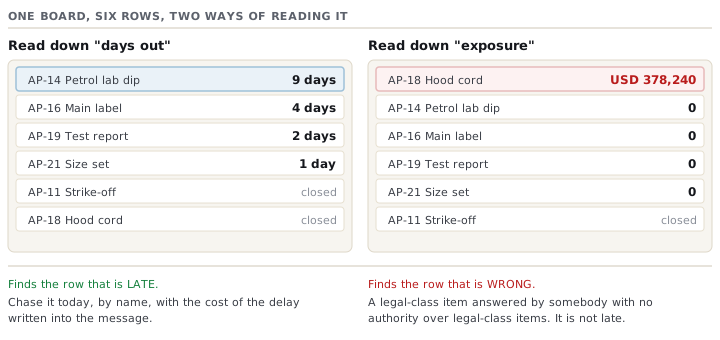
AP-18 is the hood cord. It was submitted, it was answered in a day, it is green, it blocks nothing, and nobody has looked at it since 24 November. It is also a legal-class item that was answered by somebody with no authority over legal-class items. So 38,400 garments are being built around a component that cannot lawfully be sold. Every routine on that board, the chasing, the escalating, the amber highlighting, is pointed at rows that are late. This row is not late. It is wrong.
The Friday read, in three questions
Once a week, in front of the board, ask three things in this order.
Which rows are past due? Counted from proof of delivery. These get chased today, by name, with the cost of the delay in the message.
Which rows are not yet due but will block work that starts inside their own remaining lead time? AP-21, the size set, is one day old and perfectly healthy, and bulk cutting is booked to start in three weeks. If the approval takes a fortnight, cutting starts against nothing. A row that is not late can still be about to be.
Which rows carry live exposure? Anything with a number in column ten. Every one of those is a decision somebody made to proceed, and it stays on the board until it is closed. This is the question that finds AP-18.
Cutting before the approval lands
On Saturday 9 January, cut ticket CT-114 went down for 4,800 pieces of Ecru against size set SS-2. SS-2 was approved on Tuesday 12 January. The cutting room cut for three days against an unapproved size set.
That is a perfectly reasonable commercial decision and it is made in every factory in the world. The problem is never that it happens. The problem is when it happens silently. A register that shows "SS-2 approved 12 January" beside a cut ticket dated 9 January is a document pair that, read by anybody in April, proves you cut goods nobody had approved.
There are exactly two wrong ways to handle it, back-dating the approval or saying nothing, and one right way. Record it as what it is.
AP-21 — risk cut. CT-114 released 9 January against SS-2, unapproved, at merchandiser's risk. Quantity 4,800 pcs Ecru. Exposure: fabric 2,016 kg at USD 7.35 = USD 14,818, cutting labour USD 0.06 a piece = USD 288, total USD 15,106. Authorised: H. Sabry. Closes on SS-2 approval.
Three line-days bought for USD 15,106 of exposure is USD 5,035 a day. Writing that sentence is what turns a habit into a decision. Some days that trade is obviously right, because the grading has been stable for three seasons and the buyer's technologist has already seen the size set in the room. Some days it is obviously wrong. You cannot tell which without the number, and nobody produces the number unless the register has a column for it.
Check yourselfYour cutting manager wants to release a marker two days before the fit approval is due, to protect the line load. What do you write in the register?Show the answer
A risk row, not a silence and not an early approval. Name the ticket, the artefact and version it is being cut against, the quantity, the money exposed if the approval comes back with a correction, the person who authorised it, and the event that closes it. Then ask one more question before signing: what is the plausible correction? If the open point is a sleeve length, the exposure is the sleeve panels. If it is a body block, it is the whole cut. Exposure is not the value of the goods. It is the value of what a realistic correction would ruin.
The comment that arrives after the approval
Monday 1 February 2027. Sewing closed on Sunday night with 23,040 pieces through the line, 60% of the order. Freja Boysen emails:
The back-neck tape should be self-fabric, not herringbone. Please correct on the balance and advise on what is made.
Two entirely different situations produce that sentence. They cost very different amounts, and the register is the only thing that tells you which one you are in.
If it is a correction, the goods deviate from a specification that was never changed, the deviation was never disclosed, and the buyer's approval of a sample that happened to contain it does not cure the deviation. Fixing it is Marsa's cost.
If it is a change, the buyer approved the construction knowing what it was, and has now changed their mind. Fixing it is a variation, and it is priced.
The test between them is not the tech pack and it is not the approval. It is disclosure.
What the register held
PP-2's submission card, scanned into the register on 29 December, carried a line item under substitutions:
Back-neck tape: herringbone 12 mm substituted for self-fabric binding. Self-fabric binding not achievable in the 5% elastane quality without roping at the neck. Please confirm.
Freja approved PP-2 on 8 January with three conditions, and none of them mentioned the tape. The substitution was declared, in writing, on the face of the submission, and it was approved. That makes 1 February a change.
What the change costs
| Line | Basis | USD |
|---|---|---|
| Unpick and re-tape what is made | 23,040 pcs at USD 0.31 | 7,142 |
| Pieces damaged in rework, replaced | 0.7% of 23,040 is 161 pcs at USD 8.83 made cost | 1,422 |
| Material delta on the balance | 15,360 pcs at USD 0.04 | 614 |
| Total | 9,178 |
USD 9,178 is 23% of the order's USD 39,168 margin, plus four line-days on a programme that has none, against an 18 February vessel.
Because the substitution was on the submission card and the card was in the register, that conversation took eleven minutes. Norvind took herringbone for SS27 and wrote self-fabric into the SS28 tech pack with a costed allowance for the roping problem. Nobody paid USD 9,178.
Had the substitution not been declared, the tech pack would have governed, the approval would not have saved Marsa, and USD 9,178 plus four days would have been Marsa's. The register did not win that argument. The submission card did, five weeks earlier, in one sentence, written by whoever packed the sample.
Check yourselfA buyer approves a PP sample. Five weeks later they object to a stitch density that was in the sample but not in the tech pack, and was never mentioned on the submission card. Who pays?Show the answer
You do, most likely, and the reason is worth understanding rather than resenting. The tech pack is the specification. A sample approval confirms the sample, and a deviation the buyer was never told about was not something they had the chance to accept. Approval is not an inspection: the buyer is not obliged to find your deviations for you. The rule that follows is simple and it works in both directions. Anything not in the tech pack has to be declared on the submission, or the approval does not reach it.
The five questions that test any approval
At the end of the season, or on the day a claim arrives, every approval you hold is worth what these five answers make it worth. Run them on any line containing the word approved.
- Can you name the artefact and its version, and produce that exact artefact today? A garment on a rail with a card on it, or a scanned submission sheet.
- Does it say what is approved and what is not? Or does it leave a reader to assume?
- Did the person who gave it have authority over that class of decision? Match the class column against the approver.
- Is it dated, and is your work dated after it? If not, is the gap recorded as a risk row with an exposure figure and a name?
- Does it name what it released? If it does not, did you write back with your own sentence saying what you were starting?
Five out of five and the risk moved. Three out of five and you are holding an email, and the goods are yours.
Prompt · Build the approval register for a live order
At the start of a season, or the first week you inherit an order somebody else was running.
Act as a senior merchandiser setting up governance on a live export order. Build me an approval register I can maintain in a spreadsheet. Order facts: buyer [BUYER], PO [NUMBER], style [STYLE], product type [DESCRIPTION], destination market [COUNTRY OR REGION], quantity [QTY] split as [BREAKDOWN], FOB [PRICE], made cost [AMOUNT], ship date [DATE], line loading date [DATE], idle cost per line-day [AMOUNT]. Approval clauses in the PO, if any: [PASTE THE DEEMED-APPROVAL WORDING AND ANY CARVE-OUT LIST, OR SAY NONE]. Buyer contacts and their roles: [NAMES AND JOB TITLES]. Do the following. First, list every artefact this order needs an approval for, from lab dips to the shipping sample, and for each one give the class — administrative, aesthetic, technical, commercial, legal — and what it releases. Second, for every legal-class row, name the requirement that makes it legal-class in my destination market, and say if you are not certain rather than guessing a standard number. Third, work backwards from the dates I gave you and set a submit-by and an approve-by date for each row, showing the lead time you assumed. Fourth, map my buyer contacts onto the classes and tell me which rows currently have no correctly authorised approver, which is the gap most likely to hurt me. Fifth, give me the column headings and one worked example row, including an exposure column, and explain what I write in it when work starts ahead of an approval. Sixth, write the three questions I should ask this register every week. Ask me for anything missing rather than assuming it.
AI can make mistakes — check anything you act on.
What you own at the end of this course
A register with ten columns for one live order, read every Friday against three questions, with a class column that catches the green row that is wrong and an exposure column that turns a habit into a priced decision. A sample room that declares every deviation on the card. And the ability to read any approval and say, in a minute, whether it would survive being read again in April by somebody who is not on your side.
The word approved is not a mood, a compliment, or the end of a conversation. It is the moment a risk changes hands, and it only changes hands over the things it actually names.