Lessons · Lesson 3 of 3
Buying what you did not choose
Handle a nominated supplier, find the lead time whose clock starts somewhere else, and price the fabric you book before the order is confirmed.
Lesson 3 of 3 · 40 min
The situation
Sooner or later a customer stops asking who you buy from and starts telling you. Being handed a supplier moves the choosing away from the factory. It leaves every consequence behind. You get a price you did not negotiate, a wait you cannot shorten, and full liability for the component. This lesson is the short set of documents that costs nothing while everybody is still friendly.
On 18 February, two weeks after Sherif finished the comparison in lesson one, Kerckhove nominates. The shell will be bought from Uludag Weaving, and the front zip from Kanaoka Fastener, an Osaka supplier Tanis has never used. The email is three lines long and does not explain itself.
This is normal, and it is not an insult. A brand nominates because it has approved that mill's cloth across a whole range, or because it has negotiated a price the factory could not, or because a compliance team has audited that supplier and not yours. What the email does is move a set of risks from the brand to the factory without moving the liability with them. Your job for the next ten minutes is to notice exactly which risks, and to write them down while it is still February.
What a nomination actually transfers
Sherif now has, on this order, a mill he did not choose and cannot discipline.
- He cannot walk away. The commercial threat that makes a supplier answer the phone is the next order, and that belongs to Kerckhove now, not to him.
- He cannot negotiate the price. It was agreed above his head, and lesson one has already told him it costs USD 10,986 more than the alternative.
- He cannot compress the lead time. Fifty-five days is now a fact he has to build a calendar around.
- He is still liable. If the cloth is late, Tanis ships late. If the cloth fails a test in bulk, Tanis has already cut it. If the zip releases nickel above the limit, the garment carrying it has Tanis on the packing list.
That last line is the one people miss. Nomination transfers the choosing, never the answering. The retailer's customer complains about the garment, and the garment was made by you.
The five things you do about it, this week
None of these is a refusal, and all of them are free in February and impossible in June.
- Get the nomination in writing, with the terms in it. Not "please use Uludag" but the mill, the exact quality, the price, the width and the tolerance. Also the lead time, the minimum per colour, the minimum for a top-up and the payment terms, as agreed between the buyer and that mill. Without it you will be quoted a different price from the one the brand negotiated, and you will have no document that says so.
- Put the difference on the cost sheet as its own line. Sherif adds a line reading nominated supplier differential, USD 0.591 a garment, with the working from lesson one attached. He does not bury it in the fabric rate. A buyer who sees the number can decide to spend it. A buyer who never sees it has spent it without knowing, and the factory has absorbed it.
- Ask for a performance carve-out, in one sentence. Delay caused by a buyer-nominated supplier does not count against the factory's on-time delivery score and does not trigger the late-delivery clause. This sentence costs nothing at nomination. You cannot get it after a delay, when it reads as an excuse.
- Make the buyer own the top-up. If a nominated mill's lot runs short, the extra lot is authorised and paid for by the buyer. You did not choose the mill, you did not set its minimum, and you should not be funding its shortfall out of a margin of USD 2.55.
- Keep your own supplier alive anyway. Wadi gets an enquiry every season whether or not it wins, and its header goes into the sample room. The only reason Sherif can put USD 0.591 on the cost sheet is that he still has a live quotation to measure the nomination against. A supply base you have stopped quoting is a price you have stopped knowing.
The trim card, and the column nobody has
Trims are 10.0% of the FOB on this style, and about 100% of the reasons a sewing line stops. A line waits for a label exactly as completely as it waits for cloth, and it does so for a component costing less than two cents.
| Component | Per garment | Rate, USD | Cost, USD |
|---|---|---|---|
| Two-way moulded front zip | 1 | 0.840 | 0.840 |
| Snap fasteners, ring and socket | 9 | 0.031 | 0.279 |
| Fusible interlining, collar and facings | 0.21 sq m | 1.70 | 0.357 |
| Pocket bag cloth | 0.16 m | 1.55 | 0.248 |
| Drawcord and two cord locks | 1 set | 0.185 | 0.185 |
| Sewing thread | 340 m | 0.42 per thousand metres | 0.143 |
| Carton, tape and desiccant | 1 in 20 | 1.86 | 0.093 |
| Hangtag, sticker and polybag | 1 set | 0.092 | 0.092 |
| Woven main label and size tab | 2 | 0.024 | 0.048 |
| Cuff elastic tape | 0.30 m | 0.14 | 0.042 |
| Care and content label | 1 | 0.017 | 0.017 |
| Total | 2.344 |
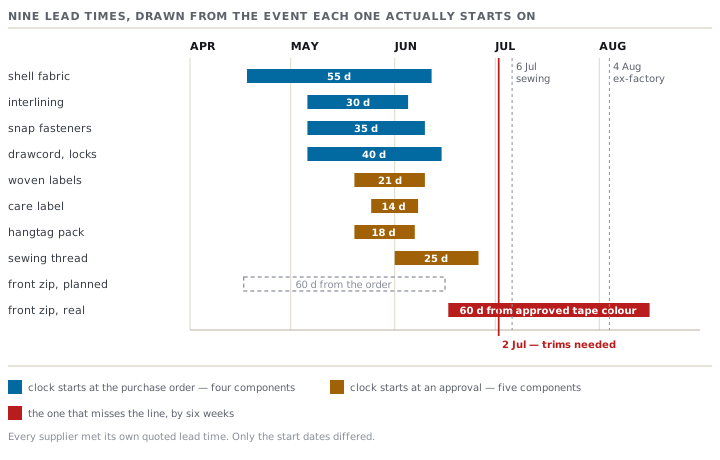
Most trim cards carry a lead time. Almost none carry the column that matters, which is what the clock starts on.
| Component | Lead time, days | The clock starts on |
|---|---|---|
| Shell fabric | 55 | the fabric purchase order |
| Fusible interlining | 30 | the purchase order |
| Snap fasteners | 35 | the purchase order |
| Drawcord and cord locks | 40 | the purchase order |
| Woven labels | 21 | approved artwork |
| Care and content label | 14 | approved artwork and a final fibre composition |
| Hangtag and packaging | 18 | approved artwork |
| Sewing thread, dyed to shade | 25 | the approved lab dip |
| Two-way front zip, tape dyed to shade | 60 | the approved tape colour |
Five of the nine clocks do not start at the purchase order. They start at an approval. And an approval is not a supplier's milestone. It is yours.
The mistake nobody made
The purchase order was confirmed on 6 May, and Sherif did not wait for it. Sixty days is the longest lead time in the trim bill, and sewing needed zips on 2 July, so he placed the zip order at risk on 17 April, a day ahead of the fabric. Sixty days from 17 April is 16 June: sixteen days of float on the tightest trim in the bill. He reported it to his manager as covered, and by every number in front of him it was.
But Kanaoka's sixty days does not start at the purchase order. It starts at approved tape colour, because a moulded chain and a woven tape are dyed to the shell before anything is assembled. The tape colour cannot be submitted until the shell lab dips are approved, and Uludag's first two lab dips came back off-shade. So the shell was approved on 1 June, the tape was submitted on 3 June, and Kerckhove approved it on 17 June.
Sixty days from 17 June is 16 August. Sewing needed the zips on 2 July. Ex-factory was 4 August.
Nobody was late by their own clock. Kanaoka quoted sixty days and would have delivered in sixty days. Kerckhove approved the tape in fourteen days, which is fast. Uludag re-dyed twice, which is normal. Sherif built a calendar from the numbers he was given. Every participant did their job correctly, and the order was six weeks short of a front zip.
What it cost, and what would have prevented it
Kanaoka holds this chain and size in three stock colours, twelve days out. Kerckhove accepts gunmetal on Basalt and Cypress and refuses it on Bone, which is the campaign colour. So the order splits. 12,000 pieces ship on time, and 6,600 Bone wait for a matched tape.
- Late-delivery clause: 2% of the value of the late portion per week begun. Bone ships fourteen days late, which is two weeks, so 4% of 6,600 at USD 23.40, or USD 6,178.
- A second booking, a second set of export documents and a second final inspection: USD 1,850.
- Total USD 8,028, which is 17% of the margin on the order.
The prevention was one question, asked of Kanaoka on 18 February, the day of the nomination: what does your sixty days start on? The answer would have made the tape-colour approval a dated milestone owned by the merchandiser, chased in March instead of noticed in June, and the zips would have landed before the cloth did.
Booking before you have an order
One more thing happened in this story, and it was handled well, so it is worth taking apart.
Uludag needs 55 days. Cutting starts on 20 June and the cloth must be in-house on 12 June, so the fabric purchase order has to go on 18 April. Kerckhove's confirmation arrived on 6 May. For eighteen days Tanis was buying fabric for an order it did not have.
Uludag's cancellation schedule: nothing owed until the greige is allocated on day eight, 40% after that, and the whole value once dyeing starts on day twenty-six. On 6 May the order was eighteen days old, so the exposure was USD 69,323.
There are two honest ways to carry that, and one dishonest one.
- Get an authority to purchase. A letter from the buyer naming the fabric, the value and the cancellation schedule, authorising the factory to commit. It costs an email, and it is the correct answer.
- Price it, out loud. If the buyer will not sign one, put a number on it. Kerckhove has confirmed eleven of the last twelve enquiries that reached this stage, so Sherif calls the risk one in twelve: USD 5,777 expected, or USD 0.311 a garment, written on the cost sheet as an exposure line.
- Book it, say nothing, and hope. This is the common one. It is not a decision. It is an undocumented bet with the factory's money, taken by a person with no authority to take it.
And check the alternative before you call booking early reckless. Waiting for 6 May puts the cloth in-house on 30 June and the vessel eighteen days late. That is three weeks begun on the whole order, 6% of USD 435,240, or USD 26,114. Booking at risk is right by a factor of four and a half. It is right as a decision, with a number attached and a name against it. It is wrong as a habit nobody wrote down.
Check yourselfA buyer nominates a trim supplier who quotes a price 30% above your own qualified supplier and will not talk to you about it. What do you do first?Show the answer
Write it down, this week. Ask the buyer for the nomination in writing, with the agreed price, the lead time, the clock-start event and the minimums in it. Then put the difference on the cost sheet as a named line, rather than inside the trim total. Then ask for the carve-out sentence that keeps a nominated supplier's delay off your delivery record. Only then discuss the price — and discuss it with the buyer, who has the relationship, not with the supplier, who has no reason to answer you. What you must not do is absorb the difference quietly to look easy to work with. It is not read as cooperation. It is read as your real cost, and next season it becomes the baseline.
Prompt · Find the lead time whose clock starts somewhere else
Before you build the materials calendar, and again the day a nomination lands.
Act as a critical-path planner for a garment order's materials. My order: style [STYLE], quantity [QTY], purchase order confirmed [DATE], fabric in-house needed [DATE], cutting starts [DATE], sewing starts [DATE], trims needed in-house [DATE], ex-factory [DATE]. Here is my bill of materials with the lead time each supplier quoted: [PASTE COMPONENT, SUPPLIER, QUANTITY PER GARMENT, RATE, MINIMUM, LEAD TIME]. Do the following. First, for every component tell me what event that supplier's clock most plausibly starts on: the purchase order, an approved artwork, an approved lab dip, an approved tape or trim colour, a confirmed fibre composition, or a released technical package. Mark clearly where you are inferring rather than being told, so I know which ones to go and ask about. Second, for every clock that starts on an approval, name who owns that approval and what has to happen upstream before it can even be submitted. Third, build a dated table: component, clock-start event, the date that event realistically happens, the lead time, the delivery date, and the float against the date I need it. Fourth, list every component with negative or thin float, worst first, and say what the earliest recoverable action is for each. Fifth, tell me which single question, asked of which supplier today, removes the most risk from this calendar. Sixth, write me the four-question email to send to every supplier: what does your lead time start on, what does it start on if the colour changes, what is your minimum for a top-up, and how long does a top-up take. Be concrete about dates, and do not smooth over a component whose start event you could not determine.
AI can make mistakes — check anything you act on.