Lessons · Lesson 1 of 3
Two quotations are not two prices
Turn two fabric quotations into one cost per garment, and find the money that is not in the rate.
Lesson 1 of 3 · 42 min
The situation
Two mills quote the same cloth. The one with the lower price per metre is not always the cheaper mill. A quotation is a bundle of promises, and the rate is only one of them. Width, replacement time, payment date and approved quality all turn into money later. This lesson turns all of it into one number: what the cloth in one garment really costs you.
Kerckhove Workwear is a workwear brand in Antwerp. On 12 January it sent Tanis Apparel a tech pack. Style KW-118 is a utility overshirt in cotton-nylon ripstop, piece-dyed, nominal 200 g/m². The order is 18,600 pieces in three colours: Basalt 8,400, Bone 6,600, Cypress 3,600. Ex-factory 4 August. On board 11 August.
Sherif Abaza, the merchandiser, sent the shell fabric to seven mills. Five answered. Two were serious. On 3 February they sat side by side on his screen.
- Wadi Textile Mills, El Mahalla El Kubra: USD 4.62 per metre.
- Uludag Weaving, Bursa: USD 4.35 per metre.
Same construction, same finish. Both delivered to the factory door, with freight and duty inside the price. The sample room accepted both headers. A header is a short length of the real cloth that the mill sends you to check.
The two rates are twenty-seven cents a metre apart. The fabric plan called for 36,616 metres, so that reads as a saving of USD 9,886. The purchase manager wanted Uludag.
He had checked everything a careful person checks. The mill's audit was current. The header matched the standard. The reference customer answered the phone and said good things. Every single thing he checked was correct. He was still wrong by USD 10,986, which is 23% of the margin on the whole order.
Nobody made a mistake. The unit of comparison was wrong.
A quotation contains six things, and only one of them is the price
Read a fabric quotation as six separate promises, because that is what it is:
- a rate, per metre or per kilogram
- a width, with a tolerance
- a lead time, counted from something
- a minimum per colour, and a different minimum for a top-up
- payment terms
- a quality, either already approved for this buyer or not
Only the first is a price. You pay for the other five later. You pay in cloth you did not use, in money you could not use, in a laboratory bill, or in a delivery you could not make. Your job in this lesson is to turn all six into one number: the delivered cost of the fabric, per garment. Everything else is opinion.
| Wadi Textile Mills | Uludag Weaving | |
|---|---|---|
| Rate, USD per metre | 4.62 | 4.35 |
| Nominal width, cm | 150 | 148 |
| Width tolerance, cm | minus 1, plus 2 | minus 3, plus 2 |
| Selvedge, each side, cm | 1.5 | 3 |
| Lead time, days | 35 | 55 |
| Minimum dye lot, metres | 3,000 | 4,000 |
| Payment | 30% with the order, 70% net 30 days from delivery | 100% by telegraphic transfer with the order |
| Quality status with this buyer | approved last season | new, untested |
The width you were sold and the width you can cut
The width on a quotation is a nominal number. The number that decides your consumption is the width the marker can be laid on. The marker is the cutting plan: all the pattern pieces arranged across the cloth. It is three subtractions away from the nominal:
- start with the nominal width
- take off the negative side of the tolerance, because you must be able to cut the worst roll in the lot
- take off the selvedge on both sides, which is not cloth you can cut into
Wadi: 150 minus 1, minus 1.5 twice, is 146 cm. Uludag: 148 minus 3, minus 3 twice, is 139 cm.
Two centimetres apart on the quotation. Seven centimetres apart on the cutting table.
Now go to the sample room and have the marker laid twice, once at each width. The same twenty garments, in the same size ratio:
- at 146 cm the marker measures 36.40 m, so net consumption is 1.820 m a garment
- at 139 cm it measures 38.50 m, so net is 1.925 m a garment
Add the cutting allowances: end allowance, ply-to-ply, splices, roll faults and cut-piece rejects. In this factory on this cloth they come to 6%. Gross consumption is 1.93 m against 2.04 m.
So the cloth in one garment costs 1.93 at USD 4.62, which is USD 8.917. Against 2.04 at USD 4.35, which is USD 8.874. The cheaper mill is four cents a garment cheaper. Not twenty-seven cents. USD 9,886 of imagined saving has become USD 800 on the order, and we have not finished yet.
The metres you buy are not the metres in the garments
You never buy exactly what the marker calls for. You buy an insurance margin. It covers a shade that comes up short, a roll that arrives faulty, a re-cut. The question is how much, and the answer is not a habit. It depends on one thing: how late a top-up would arrive.
Wadi will run a top-up dye lot in 35 days. Cutting starts on 20 June. A shortage found at the first spread on 20 June can still be covered by 25 July, which is inside the sewing programme. So 2% is enough.
Uludag needs 55 days. A shortage found on 20 June is covered on 14 August, after the vessel has sailed. With Uludag you cannot afford to be short, so the insurance goes to 5%.
| Colour | Pieces | Wadi at gross consumption plus insurance | Uludag at gross consumption plus insurance |
|---|---|---|---|
| Basalt | 8,400 | 16,536 | 17,993 |
| Bone | 6,600 | 12,993 | 14,137 |
| Cypress | 3,600 | 7,087 | 7,711 |
| Total metres | 18,600 | 36,616 | 39,841 |
| Fabric invoice, USD | 169,166 | 173,308 |
The rate the mill quoted has now reversed itself. The cheaper mill sends the bigger invoice, and it did so honestly. It quoted a narrower cuttable width and a longer top-up, and both of those are metres.
The money you cannot use while the fabric sits in a warehouse
Kerckhove pays Tanis 45 days after the bill of lading date. On an 11 August shipment that is 25 September. That date is the same whichever mill you use. The end of the count is fixed, and only the start moves.
- Wadi. The fabric purchase order goes on 8 May for a 12 June delivery. 30% leaves on 8 May, which is 140 days before you are paid. 70% leaves on 12 July, 30 days after delivery, which is 75 days before you are paid. Weighted, your money is out for 94.5 days.
- Uludag. A 55-day lead time means the order goes on 18 April, and the whole invoice is paid with it. Your money is out for 160 days.
Tanis borrows working capital at 14% a year. That is not a theoretical cost. It is a line on the bank statement.
- Wadi: 169,166 at 14% for 94.5 days is USD 6,132.
- Uludag: 173,308 at 14% for 160 days is USD 10,636.
Note what that says about a negotiation. Move Uludag from 100% with the order to 30% with the order and 70% against documents before shipment. That is worth USD 2,234 on this order alone. It costs one email, and nobody ever sends it. Payment terms feel like a finance department's business, and the rate feels like a merchandiser's.
The quality that is already approved
Wadi's cloth is on Kerckhove's approved-fabric list from last season. The physical and chemical test package was run then, and the report is still current. Uludag's quality is new, so it needs the full package: composition, dimensional stability, tensile and tear, colourfastness to washing, water, rubbing and light, and the buyer's restricted-substance screen. That is USD 780 a colour, three colours, USD 2,340.
That is the small number. The large one has no invoice. A package submitted in April that fails in May sends the mill back to a re-dye or a re-finish, and you find out with the vessel already booked. An approved quality is not only cheaper to buy. It is a quotation with the risk already taken out of it, and that is worth paying for.
One number
| Wadi | Uludag | |
|---|---|---|
| Fabric invoice, USD | 169,166 | 173,308 |
| Cost of the money, USD | 6,132 | 10,636 |
| Test package, USD | 0 | 2,340 |
| Delivered cost, USD | 175,298 | 186,284 |
| Per garment, USD | 9.425 | 10.015 |
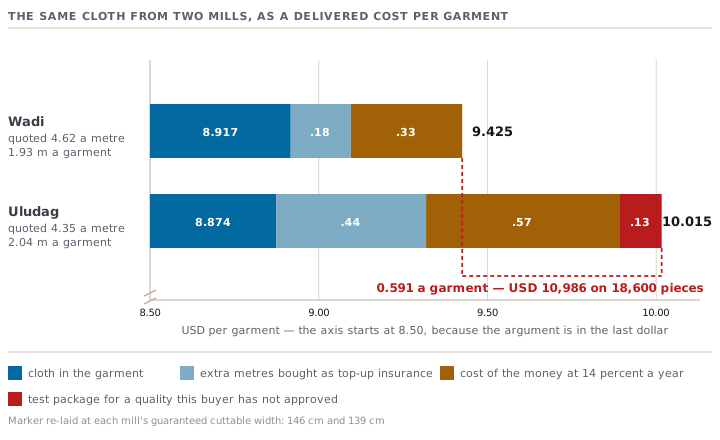
The mill that quoted twenty-seven cents a metre less is fifty-nine cents a garment more. That is USD 10,986 on the order, against a planned margin of USD 2.55 a garment. So the decision that looked like a saving of USD 9,886 was really a swing of USD 20,872. It would have taken 23% of the profit on the order.
Fabric at USD 9.425 is 40.3% of the FOB of USD 23.40. FOB is the price of the goods delivered on board the ship. Nothing else on the cost sheet moves this much for so little work.
Check yourselfA third mill quotes USD 4.20 per metre, 152 cm nominal with a plus or minus 4 cm tolerance, a 2 cm selvedge, 45 days, a 5,000 m minimum and 100% in advance. Is it cheaper?Show the answer
Cuttable width is 152 minus 4 minus 4, which is 144 cm. That is narrower than Wadi's 146, even though the nominal is wider, because a wide tolerance is a hidden width reduction. Re-mark at 144 before anything else. Then price the 5,000 m minimum against your smallest colour. Cypress at 3,600 pieces needs about 7,100 m and clears it, but a fourth colour would not. Then add the money: 100% in advance on a 45-day lead time puts your cash out about 150 days. Then add the test package, because a new mill is a new quality. The rate is the last thing you look at, not the first.
Prompt · Turn two fabric quotations into one number
When two mills have quoted the same cloth and the cheaper rate is about to win the argument on its own.
Act as a sourcing manager in a garment factory. I have two fabric quotations for the same quality. I want them reduced to one delivered cost per garment, not compared on the rate. Order facts: buyer [BUYER], style [STYLE], quantity [QTY] pieces, colour split [COLOUR AND PIECES FOR EACH], FOB [PRICE] a piece, planned margin [AMOUNT] a piece, ex-factory [DATE], cutting starts [DATE], and the buyer pays me [DAYS] days after the bill of lading. My working capital costs [PERCENT] a year. For each mill I have: name, rate and unit, nominal width, width tolerance, selvedge each side, lead time and what it counts from, minimum per colour, minimum and lead time for a top-up dye lot, payment terms, and whether this quality is already approved by this buyer. Here they are: [PASTE BOTH QUOTATIONS IN FULL]. Do the following. First, work out each mill's guaranteed cuttable width from the nominal, the negative tolerance and the selvedge, and tell me plainly that I must re-mark at each one. Second, use the marker lengths I give you — [MARKER LENGTH AND GARMENTS PER MARKER AT EACH WIDTH] — and my cutting allowance of [PERCENT], and give gross consumption per garment for each mill. Third, choose a top-up insurance percentage for each mill. Justify it from whether a top-up would arrive before or after my cutting date, not from habit. Fourth, work out metres to buy colour by colour, the fabric invoice, the weighted days my money is out, and the cost of that money. Fifth, add any test package a new quality needs. Sixth, give me one table ending in the delivered cost per garment for each mill, the difference per garment, the difference on the order, and that difference as a percentage of my planned margin. Seventh, tell me what the naive rate comparison would have said, so I can see the size of the error. List every assumption you had to make at the end, and do not give me a range where a number is possible.
AI can make mistakes — check anything you act on.