Lessons · Lesson 2 of 3
The dye lot is the unit you buy in
Price a colourway against the minimum that really governs it, and answer a buyer with a menu instead of a refusal.
Lesson 2 of 3 · 38 min
The situation
Cloth is quoted by the metre. That invites everybody to believe it is bought by the metre. It is not. A dyed colour is produced in batches, and a batch has a floor under it. That floor has nothing to do with how many garments anyone wants. Order below it and the colour costs more per garment than the price list says.
On 18 March, six weeks after the quotations, Wies Terlouw at Kerckhove sends a short email. The campaign team has fallen in love with a rust shade. Could Tanis add a fourth colour, Persimmon, 900 pieces, on top of the three already confirmed?
The costing clerk answers in four minutes. Fabric is USD 4.62 a metre and consumption is 1.93 m, so the cloth in a Persimmon overshirt costs USD 8.917, the same as every other colour. No change to the price. Send it.
That answer is arithmetically correct and financially wrong. The gap between those two sentences is this whole lesson.
A rate per metre is only a rate per garment when the lot is full
You do not buy metres. You buy dye lots, and a dye lot has a floor under it.
A piece-dyeing machine holds a batch. Around that batch sit costs that do not shrink when the batch does: the lab dip, the strike-off, the shade approval, the machine set-up, the cleaning down between shades, and the finishing line's threading and its first wasted metres. Wadi's commercial floor for a dyed colour on this quality is 3,000 metres. Below that they will still run it, at a part-lot surcharge of USD 0.95 a metre. They will not go below 1,500 metres at any price.
Now do the Persimmon arithmetic properly.
- 900 pieces at 1.93 m is 1,737 m
- plus the 2% top-up insurance from the fabric plan: 1,772 m
- the minimum lot is 3,000 m
| Route | What you buy | Cloth you do not use | Cost | Per Persimmon piece |
|---|---|---|---|---|
| Buy the minimum lot | 3,000 m | 1,228 m | USD 5,673 | USD 6.30 |
| Buy a part lot with the surcharge | 1,772 m | none | USD 1,683 | USD 1.87 |
| Take the whole lot as garments | 3,000 m | none | none | none |
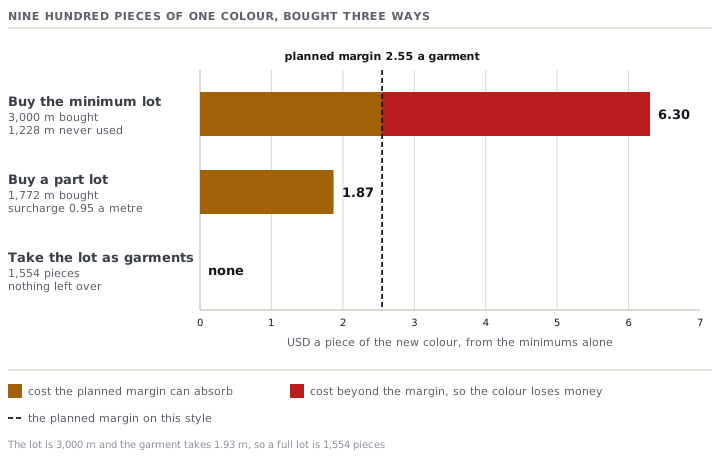
Read the first row against the planned margin of USD 2.55 a garment. The fourth colour, bought the obvious way, loses two and a half times its own profit. Nobody would approve that if they saw it. Nobody sees it, because the cost sheet says USD 4.62 a metre, and the cost sheet is telling the truth about a lot that is full.
The second row is the one nobody asks for. A part lot has a price. Ask what it is before you tell a buyer no, because USD 1.87 is a conversation and USD 6.30 is a refusal.
The third row is the best answer in the email, and it is not a cost at all. Three thousand metres divided by 1.93 is 1,554 pieces. If Kerckhove takes 1,554 Persimmon instead of 900, the colour costs exactly what every other colour costs, and the buyer gets 654 more pieces of the shade their campaign team is excited about.
The minimum on the fabric is not the only minimum
A colourway is not just cloth. Every component that is matched to the shade carries its own floor, and the fabric's floor is not always the one that bites.
Run the whole bill of materials for Persimmon against its 900 pieces:
| Component | Matched to the shade | Minimum | Needed for this colour | Bites |
|---|---|---|---|---|
| Shell fabric | yes | 3,000 m | 1,772 m | yes |
| Two-way front zip, tape dyed to match | yes | 3,000 pieces | 927 | yes |
| Sewing thread, dyed to match | yes | 30 cones | 62 cones | no |
| Snap fasteners, antique brass | no | 20,000 pieces | shared with all colours | no |
| Woven main label | no | 5,000 per size | shared with all colours | no |
| Care and content label | no | 3,000 | shared with all colours | no |
| Pocket bag cloth, one shade for all | no | 2,000 m | shared with all colours | no |
Two floors bite, not one. The zip is the surprise. 900 pieces plus 3% spares is 927 zips, against a 3,000-piece minimum on a dyed tape. The 2,073 zips left over at USD 0.84 are USD 1,741, which is USD 1.93 a Persimmon piece.
Add them up. A 900-piece Persimmon with a matched zip carries USD 3.80 a piece of minimum-driven cost, against a margin of USD 2.55. The colour loses money on itself, even on the sensible fabric route.
But look at the table's second column before you despair. The zip is expensive because it is matched. Ask the question that column is for: does it have to be? Kanaoka Fastener holds this chain and size in stock in three colours, shipped in twelve days, at USD 0.79. That is five cents less than a dyed tape. A gunmetal zip on a Persimmon shell is a design decision, and design decisions have owners.
The email you actually send
Sherif's reply to Wies goes out the same afternoon. It contains no refusal and no lecture, only four priced options:
- 1,554 pieces Persimmon, matched zip. No surcharge. FOB stays USD 23.40. This is the full dye lot and the full zip minimum, used.
- 900 pieces Persimmon, gunmetal stock zip. Surcharge USD 1.87, FOB USD 25.27. Persimmon exists, but the zip is not the shade you drew.
- 900 pieces Persimmon, matched zip. Surcharge USD 3.80, FOB USD 27.20. Everything as drawn, and you can see what it costs.
- No Persimmon; 900 pieces added to Cypress. No surcharge, no new approvals, no new lead time.
Wies takes option one within the hour. She was never asking for 900 pieces. She was asking for a rust colourway, and 900 was a guess at what the online store could sell. The quantity in a buyer's request is usually softer than the colour in it, and you will never find that out by answering the quantity.
The same arithmetic, run forwards
The minimum does not only price a colour that has been asked for. It decides how many colours a style can carry at all, and that is a conversation worth having in January rather than March.
Take the confirmed 18,600 pieces and ask how thin they can be spread before a colour stops paying for itself. A colour needs 3,000 metres of shell to avoid the surcharge, which is 1,554 pieces. It also needs 3,000 zips, which with spares is 2,913 pieces. The binding floor is the zip, at roughly 2,900 pieces a colour. So 18,600 pieces supports six matched colourways and no more, and the sixth should be checked against the label and thread minimums too before anybody promises it.
Now the same style at 6,000 pieces supports two matched colourways, not six. This is why a small order in many colours is a different product from a large order in the same colours. It is also why "we will keep the colour range and cut the quantity" is a sentence that has to be re-costed, not accepted.
Where the colour enters decides how big the floor is
The floor is not a property of the colour. It is a property of the point in the chain where the colour is added, and that point is a sourcing decision you can still make in January.
- Piece-dyed, as here. Colour goes on woven cloth, so the floor is a dye lot of cloth. On this quality that is 3,000 metres, or about 1,554 garments.
- Yarn-dyed, for a check or a stripe. Colour goes on the yarn, before weaving. The floor is a yarn lot per shade plus a loom set-up per design, and it is far higher. A small check can need several thousand metres of one design before the mill will thread the loom at all.
- Garment-dyed. Colour goes on after making. Now you buy one greige quality for every colourway, so the fabric floor collapses to a single lot for the whole order. The minimum moves to the dye house, which batches in garments rather than in metres and counts in hundreds.
That last line is the one worth carrying. A style with many small colourways and a piece-dyed shell is a style fighting its own construction. Garment dyeing is not only a look. On a range with six shades and 900 pieces in each, it is the answer to a minimums problem. And it has to be proposed before the fabric is chosen, not after the cost sheet has been sent. It brings its own costs — shrinkage control, a narrower range of shades, and sewing thread and trims that must either dye with the garment or resist dyeing entirely — and those belong on the same page as the saving.
Check yourselfA buyer cuts an order from 18,600 to 9,000 pieces and keeps all three colours. Nothing else changes. Does your price still hold?Show the answer
No, and you have to say so immediately. Three colours at 9,000 pieces is 3,000 pieces a colour, which is about 5,800 metres a colour. That is still above the 3,000 m fabric floor, so the cloth is fine. But check every matched and every shared minimum again. The snap fastener floor of 20,000 pieces was cleared by nine snaps on 18,600 garments, and is still cleared at 9,000. The woven label floor of 5,000 per size is cleared in the large sizes and may not be in the smallest one, which is a size-ratio question, not a quantity question. Then re-run the fabric. At 9,000 pieces the fixed costs of the order — testing, sampling, first-lay waste, the strike-offs — are spread over half the garments, and that is the real reason the price moved. Answer within a day, with the lines named.
Prompt · Price a colourway against the minimums that govern it
The moment a buyer asks for one more colour, or cuts the quantity and keeps the colour range.
Act as a merchandiser costing a colourway against supplier minimums. My buyer has asked for [COLOUR NAME], [PIECES] pieces, on style [STYLE], which is already confirmed at [QTY] pieces in [NUMBER] colours. FOB is [PRICE] and my margin is [AMOUNT] a piece. Gross fabric consumption is [METRES] a garment. Here is my minimums sheet, one row per component: component, whether it is matched to the shade or shared across all colours, minimum per colour, part-lot surcharge if any, and rate — [PASTE THE SHEET]. Do the following. First, list only the components that are matched to this shade, because those are the only ones the new colour can trigger. Second, for each of them work out what this colour needs, what the minimum forces me to buy, the quantity I will not use, and its cost, both in total and per piece of the new colour. Third, tell me which minimum actually binds, and at how many pieces the colour stops carrying a surcharge at all. Fourth, ask for each matched component whether it truly has to be matched, and price the stock-colour alternative where one exists. Fifth, give me a reply to the buyer as a numbered menu of priced options. Include taking the full lot as garments, taking the requested quantity with a substitution, taking it exactly as drawn with the surcharge shown, and dropping the colour into an existing one. Put an FOB against each. Do not write a refusal, and do not put an option in the list whose cost you had to guess. List your assumptions at the end.
AI can make mistakes — check anything you act on.