Lessons · Lesson 2 of 3
A payment term is a number and a trigger
Price every rung of the payment ladder in money instead of in adjectives, and find the event that really starts the clock you agreed to.
Lesson 2 of 3 · 40 min
Monday 4 May 2026
Waiting to be paid is not free. Nobody sends you an invoice for it, which is why payment terms get argued over with adjectives instead of arithmetic. What the waiting costs is a short calculation. This lesson puts every common way of being paid onto one table at that price. Beside it runs a second column: what you are holding if the customer never pays.
PO MR-7326 confirms. 6,200 gilets, USD 24.60 FOB Alexandria (Incoterms 2020), order value USD 152,520, on board October. The payment line reads irrevocable letter of credit at sight, issued by Amstelveld Bank N.V., Amsterdam, advised through Pharos Bank, Alexandria.
A week later the sourcing manager calls with what sounds like good news.
Our finance team would rather not open credits for suppliers we have been trading with for four seasons. Move to open account, ninety days from the bill of lading, and we will put 1.5% on the unit price. Everybody wins — you save the bank charges, we save the credit line.
That is a real offer, made in good faith, and it is worth USD 2,287.80 on this order. Whether you should take it is a question with an exact answer, and the answer is no. This lesson is how to reach that answer in twenty minutes with a calculator, and what to offer instead.
First, what a day is worth
Once the gilets are on a ship, you no longer own inventory. You own a receivable of USD 152,520. Until it is paid you are funding it — out of your working-capital facility if you have one, or out of the next order's fabric deposit if you do not.
El Bostan's facility costs 15.0% a year. So:
- 152,520 at 15.0% a year is USD 22,878 a year
- Divided by 365, that is USD 62.68 for every day the invoice is unpaid
Hold that number. Every payment term in this lesson is priced with it. Every argument below comes down to the same sum: how many days, times USD 62.68, plus what the banks charge, plus what happens if the buyer does not pay at all.
Note what this figure is not. It is not the cost of financing production. That is a bigger and longer exposure, and it starts when you pay the fabric deposit. This is the cost of the tail: the stretch after the goods have left and before the money arrives. That stretch is the only one the payment term controls.
The ladder
Payment terms are usually discussed as a line from friendly to unfriendly. That is the wrong axis. There are two axes and they move independently: how long you wait, and what you are holding if the buyer does not pay.
| Term | Days to cash | Cost of money, USD | Bank charges, USD | Total cost, USD | If the buyer does not pay, you hold |
|---|---|---|---|---|---|
| 30% advance, 70% L/C at sight | 12 on the balance | net benefit of 319.67 | 383.78 | 64.11 | 30% of the money and a bank's undertaking for the rest |
| L/C at sight | 12 | 752.16 | 383.78 | 1,135.94 | a bank's undertaking, if you presented cleanly |
| Documents against payment, at sight | 14 | 877.52 | 247.52 | 1,125.04 | the goods — in Rotterdam |
| Usance L/C 90 days, discounted at 6.5% | 12 | 752.16 | 3,018.93 | 3,771.09 | a bank's undertaking, and cash now |
| Documents against acceptance, 60 days | 74 | 4,638.32 | 247.52 | 4,885.84 | an accepted bill of exchange, and nothing else |
| Open account, 90 days from bill of lading | 95 | 5,954.60 | 593.82 | 6,548.42 | an invoice |
| Consignment or sale-or-return | unknown | unbounded | — | — | stock in somebody else's building |
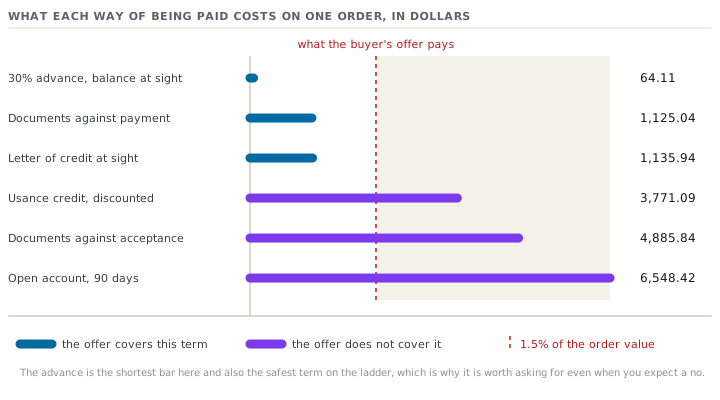
Read the first row again. A 30% advance is not only safer, it is cheaper than every other rung at USD 64.11 all in. Money in your account 45 days before shipment earns its keep against the facility at USD 18.80 a day while it sits there. That offsets almost the whole cost of waiting for the balance. An advance is the only term on the ladder that pays you to take it.
Now the two rungs in the middle, because they are the ones most often confused.
Documents against payment and documents against acceptance are both collections. Your bank sends the documents to the buyer's bank with instructions, and no bank promises you anything. Under D/P the collecting bank releases the bill of lading only against payment, so if the buyer refuses, you still own the goods. Under D/A the collecting bank releases the bill of lading against the buyer's signature on a bill of exchange. So the buyer walks off with 6,200 gilets and you are holding a promise.
The difference between those two letters is the whole of your security. The cost difference in the table is USD 3,760.80. People swap one for the other because the words sound alike.
Pricing the offer that was actually made
Meerhout have offered 1.5% to move from L/C at sight to open account at 90 days. Both rungs are in the table. The arithmetic is one subtraction.
- Open account, 90 days from bill of lading: USD 6,548.42
- L/C at sight: USD 1,135.94
- The change costs you: USD 5,412.48
- The offer pays you: 1.5% of 152,520 = USD 2,287.80
- You are short by USD 3,124.68, and that is before a single unit of risk has been priced.
Now turn it around. Turning it around is what makes you a merchandiser who says yes-and-here-is-the-number instead of one who says no.
5,412.48 divided by 152,520 is 3.55%. On a USD 24.60 gilet that is USD 25.47.
So the answer to the phone call is not we prefer letters of credit. It is:
Ninety days open account works for us at USD 25.47, not USD 24.97. The 3.55% is the cost of funding the receivable for the extra 83 days plus the credit insurance we would have to carry, and I can show you the build-up. If you would rather stay at USD 24.60, the sight credit does that.
You have given them a real choice between two priced options instead of a refusal. And you have shown them your arithmetic, which is the single most useful thing a merchandiser can do in a commercial conversation.
The mistake nobody made
Last season, PO MR-6910, same buyer, same lane. The payment line said 60 days. You priced 60 days. You were paid on day 98.
Nobody lied to you. Nobody changed the terms. Everyone did their job.
The purchase order brought in Meerhout's supplier manual, and clause 7 of that manual defines when the clock starts: the payment term commences on the date the goods are receipted into the Utrecht distribution centre. Not the bill of lading. Not the invoice. The goods-in scan at the far end of a chain you do not control.
Last season that chain was:
- 12 days Alexandria to Rotterdam
- 9 days waiting for a berth window, discharge and customs release
- 12 days for haulage and an intake appointment at a distribution centre that books its receiving slots
33 days before the clock the contract talks about even starts ticking.
You priced 60 days from the bill of lading plus 5 days for the transfer to land: 65 days at USD 62.68 is USD 4,074.20. You actually financed 98 days, which is USD 6,142.64. The difference is USD 2,068.44 on one order, or 12.4% of the margin. It was given away in a definition nobody read, because it sat in an attachment while the number on the front page was the number everybody discussed.
This is the general rule, and it is worth more than everything else in this lesson:
A payment term is a number and a trigger. The number gets negotiated. The trigger gets asserted, and it is usually worth more than the number.
Here are the triggers you will meet, cheapest first. Bill of lading date, invoice date, invoice receipt date. Then arrival at destination port, customs clearance, goods receipted at the warehouse. And the one that should end the conversation: the buyer's next payment run following approval. That is not a trigger at all. It is a description of somebody else's calendar.
Check yourselfA buyer offers to pay at sight instead of 60 days if you drop the price by 2%. Take it?Show the answer
Work it, do not feel it. Two per cent of USD 152,520 is USD 3,050.40. Sixty fewer days at USD 62.68 saves USD 3,760.80. So on cost of money alone you are USD 710.40 better off taking the discount. You have also turned a 60-day exposure into an immediate one, which is worth something you have not counted. It is a yes. Note that the same arithmetic said no to the ninety-day offer earlier in this lesson. The answer is not a preference for one term over another. It is whichever side of USD 62.68 a day the offer falls on.
Prompt · Price the payment terms I have been offered
When a buyer offers a price increase for longer terms and you need the break-even number before you answer.
Act as a treasury analyst inside a garment factory. Price payment terms in money, not in adjectives.

Order value and currency: [amount]
My cost of working capital: [annual rate, and whether it is a facility or an overdraft]
Current payment term offered or agreed: [term, and the exact event the clock starts from]
Alternative term being discussed: [term, and its trigger]
Bank charges I know: [advising, negotiation, collection, transfer, confirmation, discrepancy]
Credit insurance available: [rate, indemnified percentage, waiting period]
My shipment date and expected transit: [dates]

Do six things. One: calculate what one day of this receivable costs me. Two: build a table of at least six terms — advance, letter of credit at sight, documents against payment, documents against acceptance, discounted usance credit and open account — with days to cash, cost of money, bank charges, total cost, and what I am holding if the buyer never pays. Three: price the specific offer on the table and tell me whether it covers its own cost. Four: give me the break-even price uplift as a percentage and as a new unit price. Five: quantify the uninsured first loss I would carry on the alternative term. Six: read the trigger I gave you and tell me how many extra days it adds against a bill of lading date, and what those days cost. Be blunt about which of these is a decision above a merchandiser's level.
AI can make mistakes — check anything you act on.
What you should be able to do now
- State your own cost of a day. If you cannot say what one day of your largest receivable costs, you cannot price any payment term, and you will negotiate with adjectives.
- Put every term on both axes. How long do I wait, and what am I holding if they do not pay? A term that is cheap on one axis and bare on the other is not a cheap term.
- Answer an extended-terms request with a price, never with a refusal. Yes, at this number. Show the build-up.
- Find the trigger before you agree the number. Read the attachment. The clock is in the attachment.