Lessons · Lesson 3 of 3
The credit pays against documents, and only in one place
Read a letter of credit before it is opened for the three things most likely to defeat it, and price what a refusal really costs.
Lesson 3 of 3 · 38 min
Tuesday 18 August 2026
A bank that guarantees a customer's payment promises to pay against paperwork, and against nothing else. Nobody at the bank will look at the goods. A perfect shipment with flawed documents is not paid. A flawed shipment with perfect documents is. This lesson reads one such guarantee in the week it arrives, while every line in it can still be changed.
Pharos Bank in Alexandria advise the credit for MR-7326. Nine pages of SWIFT, the bank-to-bank message format. Most merchandisers read the amount, the latest shipment date and the document list, file it, and go back to the fabric.
Here is what it says, in the fields that decide whether you are paid:
- 32B Currency and amount: USD 152,520.00
- 41A Available with: Amstelveld Bank N.V., Amsterdam, by payment at sight
- 31D Date and place of expiry: 4 November 2026, at the counters of the issuing bank
- 44C Latest date of shipment: 14 October 2026
- 45A Goods: 6,200 PCS MEN'S QUILTED GILETS STYLE GV-317 AT USD 24.60 PER PC FOB ALEXANDRIA (INCOTERMS 2020)
- 43P Partial shipment: not allowed. 43T Transhipment: allowed
- 48 Period for presentation: within 21 days after the date of shipment, but within the validity of the credit
- 47A Additional conditions: a discrepancy fee of USD 100.00 for the beneficiary's account; all bank charges outside the Netherlands for the beneficiary's account
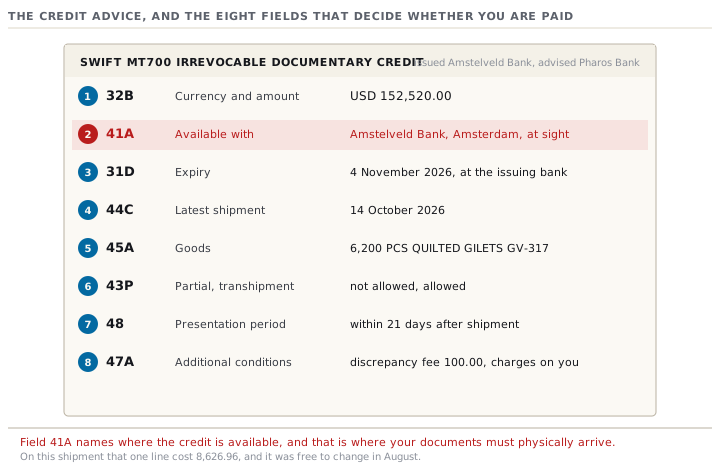
Every one of those lines can be negotiated before the credit is opened, and is expensive to change afterwards. One of them is going to cost this order USD 8,626.96.
What a credit actually is
A documentary credit is a bank's own promise to pay you, given at your buyer's request, on condition that you hand over specified pieces of paper. Three things follow from that, and they explain almost everything credits do:
- The credit is a separate transaction from your sale contract. Banks are not concerned with the contract and are not bound by it, even if the credit mentions it. Your buyer's helpful email is not something the bank may act on.
- Banks deal in documents, not in goods. Nobody at Amstelveld will open the container. If your paperwork complies and your gilets are the wrong colour, you are paid. If your gilets are perfect and your paperwork does not comply, you are not.
- Banks take no responsibility for whether the documents are genuine or accurate. They examine what appears on the face of them.
A credit is also irrevocable by default under UCP 600, the ICC rulebook that governs credits. It cannot be amended or cancelled without the agreement of the issuing bank, any confirming bank and you. That is a strong protection, and it cuts both ways. The credit you accepted in August is the credit you must comply with in October, whatever anyone has since said on the telephone.
The document set is a machine, and you own only half of it
| Document | Issued by | Can you correct it after shipment? | What kills it |
|---|---|---|---|
| Commercial invoice | You | Yes, immediately | A goods description that does not correspond with the credit |
| Packing list | You | Yes, immediately | Weights or carton counts that conflict with the invoice or the bill of lading |
| Bill of lading, full set 3/3 | The carrier | Only by asking the carrier for a fresh set, if they agree | A clause about damaged goods or packing; a wrong on-board date; wrong endorsement |
| Certificate of origin | A chamber of commerce | Reissue takes days and cannot be back-dated | A description conflicting with the invoice; a date after shipment |
| Inspection certificate | The buyer's nominated agent | No | Not being signed by the person the credit named |
| Beneficiary's certificate and courier receipt | You | Yes, immediately | Being undated, or dated after presentation |
| Insurance certificate, on a CIF or CIP sale | The underwriter | Rarely | A date later than the shipment date; the wrong currency; less than the required percentage of cover |
Three of the seven are made by somebody who does not work for you and does not lose money if you are refused. That is the real shape of the risk, and it is why the credit has to be read in August.
Three things to read a credit for
One: where and when the clock stops
This is the field almost nobody checks, and it is the one that ends this lesson badly.
41A says the credit is available with the issuing bank, in Amsterdam. Under UCP 600 the place of the bank a credit is available with is the place for presentation. So your documents are not presented when Pharos Bank in Alexandria stamps them. They are presented when they physically reach a counter in Amsterdam.
Two separate clocks then run, and they are easy to confuse:
- The presentation period. Documents must be presented within the number of days the credit states after the shipment date, which here is 21. If a credit says nothing, UCP 600 gives you 21 calendar days by default. Either way, never later than expiry.
- The expiry date. 4 November, at a counter three thousand kilometres away.
Ship on 14 October and both clocks stop on 4 November: fourteen plus twenty-one is the fourth. Two deadlines that agree with each other feel like confirmation. They are not. Neither of them tells you the only date that matters, which is the last day the courier can leave Alexandria.
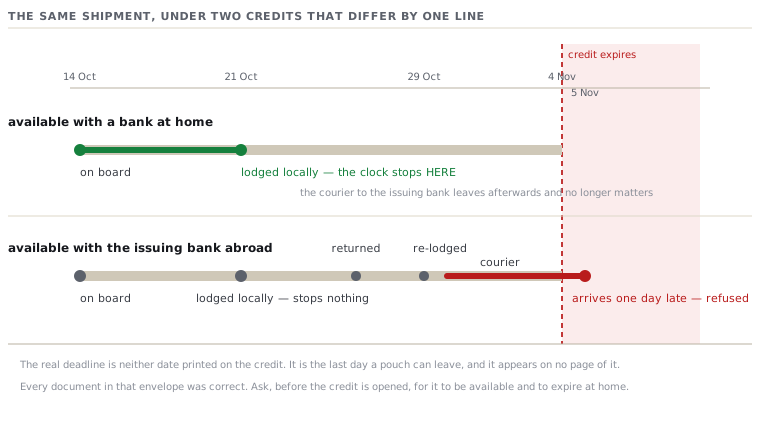
Once documents are lodged, each bank in the chain gets a maximum of five banking days after the day of presentation to examine them and decide. That is a ceiling on how fast you learn bad news, and it runs after the expiry, not before it.
Two: what the paper has to say
The commercial invoice is held to the strictest standard of any document. Its description of the goods must correspond with the description in the credit. Not paraphrase it. Not improve it. Field 45A says MEN'S QUILTED GILETS STYLE GV-317, so your invoice says men's quilted gilets style GV-317. Not padded vests, not bodywarmers, not the name your production system prints.
Every other document may use a general description, as long as it does not conflict with the credit. And across the whole presentation, data in one document need not be identical to data in another, but it must not conflict with it. A packing list showing 620 cartons and a bill of lading showing 618 is a conflict. A certificate of origin dated 16 October against a bill of lading dated 14 October is not a conflict. A certificate of origin dated 16 October on a credit requiring it to be dated no later than shipment is.
Read the transport clauses too. Your credit requires the bills of lading to be clean, meaning they carry no clause saying the goods or their packing are defective. They must also be on board, made out to order, blank endorsed, and marked freight collect, which is right for an FOB sale. If you were selling CFR the same field would have to say freight prepaid, and a bill of lading marked the other way is a discrepancy on a shipment that is otherwise perfect.
Three: which documents you do not control
Document 5 on this credit reads: inspection certificate issued by the applicant's nominated agent and countersigned by the applicant.
That is a soft clause: a condition your buyer can fail, by accident or on purpose, that stops the bank paying you. If their merchandiser is on leave, there is no countersignature, and no argument is available to you, because the bank is not concerned with your contract and cannot take your word for what was agreed.
You do not fix this in October. You fix it in August, by asking for one of three things before the credit is opened. Delete the countersignature requirement. Or name the agent, the exact wording and a deadline for signature. Or replace it with a certificate from a named third-party inspection company that you can instruct and pay yourself.
What actually happened
The vessel booked for 6 October rolled. The box went on board on Wednesday 14 October, the latest shipment date, exactly. Nobody had done anything wrong. A carrier rolled a container, which happens every week of the year.
- Tue 20 Oct The certificate of origin comes back from the chamber. The set is complete.
- Wed 21 Oct Presented to Pharos Bank, Alexandria. Seven days after shipment, with fourteen still in hand. Everyone relaxes.
- Mon 26 Oct Pharos return the set: the beneficiary's certificate is unsigned and undated.
- Mon 26 Oct The container is discharged at Rotterdam. Seven days of free time start.
- Thu 29 Oct The corrected set is re-lodged at Pharos.
- Fri 30 Oct Couriered to Amsterdam. The service is quoted at three working days.
- Wed 4 Nov The credit expires at the counters of Amstelveld Bank.
- Thu 5 Nov The documents arrive at those counters.
- Tue 10 Nov Refusal by SWIFT, within the five banking days allowed. One discrepancy: presented after expiry of the credit.
Every document in that envelope was correct. The goods were shipped inside the latest shipment date. The presentation was made to a bank seven days after shipment. And the credit is gone.
Note what the three quoted working days would have bought even if the courier had performed perfectly. Arrival on 4 November, the expiry day itself, with no margin at all. There was never a safe version of this shipment.
| Line | USD |
|---|---|
| Settlement discount conceded, 2.5% of the invoice | 3,813.00 |
| Quay rent and detention at Rotterdam charged back, 23 chargeable days at 145 | 3,335.00 |
| Discrepancy fee under the credit | 100.00 |
| 22 extra days of financing at 62.68 a day | 1,378.96 |
| Total | 8,626.96 |
That is 51.5% of the order's margin. Be honest about one line of it. Even on a clean presentation the documents would have reached Amsterdam around 10 November, so roughly 8 of those chargeable days, or USD 1,160, would have happened anyway. The figure properly attributable to the expiry is USD 7,466.96, or 44.6% of the margin. It is a better habit to attribute a loss narrowly and still be shocked by it than to attribute it generously and be argued out of it later.
The fix was one sentence, in August
At credit-opening you had two free moves, and you took neither.
- *Ask for field 41A to read available with any bank in Egypt by negotiation, and for the place of expiry to be in Egypt. Presentation then happens at a counter you can drive to, the courier leg to Amsterdam happens after the clock has stopped, and the risk of a pouch going missing in transit stops being yours. Cost, if asked before the credit is issued: nothing*.
- If the credit has already been issued, ask for an amendment. Amstelveld's amendment fee is USD 75 and Pharos charge USD 40 to advise it. That is USD 115, and three working days.
USD 115 against USD 8,626.96. The whole of the difference is one person reading field 41A in August and knowing what it meant.
Check yourselfYour credit expires on 30 November in your own country and is available with your local bank by negotiation. You ship on 20 November and present on 24 November. The credit says nothing about a presentation period. Are you in time?Show the answer
Yes, on both clocks, and it is worth seeing why separately. The expiry is 30 November at a counter in your own country, and you presented on 24 November, so you are in time. The credit is silent on the presentation period, so UCP 600 supplies 21 calendar days after the shipment date, which would run to 11 December. But a presentation may never be later than the expiry date, so your real limit was 30 November regardless. Both clocks are satisfied. Now change one fact: make the credit available with the issuing bank abroad. The 24 November stamp from your local bank becomes worthless, your documents have to be on a foreign counter by 30 November, and a four-day courier turns a comfortable presentation into a coin toss.
Prompt · Read this credit before I accept it
The day a letter of credit is advised, while every line in it is still free or cheap to change.
You are a documentary credit checker with twenty years at a trade finance desk. I am the beneficiary. Read this credit as if you were going to refuse it, and tell me what to ask for before I accept it.

[paste the credit: amount, availability, expiry date and place, latest shipment date, presentation period, goods description, documents required, additional conditions, charges]
My planned shipment date: [date]
Courier transit from my city to the issuing bank: [working days]
Who produces each required document: [list any that are not made by me]

Answer seven questions in order. One: where is this credit available, and therefore where and by when must my documents physically be? Give me the last safe date a courier can leave, as a date. Two: do the latest shipment date, the presentation period and the expiry work together for my planned shipment, or is one of them already impossible? Three: quote the goods description exactly as my commercial invoice must print it, and flag any wording in it my system will not produce. Four: list every required document that somebody other than me issues, and give me a fallback for each. Five: identify any condition I cannot satisfy by my own action alone, and draft the amendment wording that removes it. Six: list the charges that fall on me and total them. Seven: give me a ranked list of what to ask the applicant to change, most valuable first, with an estimate of what each one would cost me if it is left as written.
AI can make mistakes — check anything you act on.
What you should be able to do now
Take any credit that lands on your desk and answer these five before you file it:
- Where is this credit available, and where does it expire? If the answer to either is a city you cannot reach by hand, work out the last safe courier date and write it on the front of the file.
- Do my three dates work together? Latest shipment, presentation period, expiry. And does the shipment date I am actually planning leave room inside all three?
- Does field 45A match what my invoice will print, word for word?
- Which required document is made by somebody who does not work for me, and what is my fallback if they do not produce it?
- What do the charges clauses cost me? All charges outside the issuing country for the beneficiary's account is a real number, and it belongs on the cost sheet in lesson 1 of course 8.1, not as a surprise on the credit advice.
If any of those answers is unsatisfactory, the time to say so is the week the credit is advised. Every one of them is free to change before it is issued, cheap to amend for about a fortnight afterwards, and impossible to fix on the day the courier arrives one day late with a perfect set of documents.