Lessons · Lesson 1 of 3
Two boundaries in one three-letter word
Turn one FOB price into CFR, CIF, DAP and DDP, and know for each one where your cost stops and where your risk really moves.
Lesson 1 of 3 · 42 min
The order
The three-letter codes next to a price on an export quotation look like shorthand for one thing: who pays the freight. They settle two things, not one. The first is who pays for each stage of the journey. The second is the moment a loss stops being yours and becomes the buyer's. In several of the codes, those two points are not in the same place.
El Bostan Garments, Beni Suef. Tuesday 24 March 2026.
- Buyer Meerhout Retail B.V., Utrecht — Dutch value outerwear, fourth season with us
- PO MR-7326, season AW26
- Style GV-317, men's quilted gilet, recycled polyester shell, recycled polyester wadding, full zip, two zipped side pockets
- Quantity 6,200 pcs, four colours
- Price USD 24.60 FOB Alexandria. Order value USD 152,520
- Packing 10 pcs a carton, 620 cartons, one forty-foot high cube
- On board vessel October 2026, discharge Rotterdam, buyer's distribution centre at Utrecht
Your made cost is USD 21.90. So the margin is USD 2.70 a gilet, USD 16,740 on the order, 11.0% of FOB. Measure every decision in this course against USD 16,740. That is the whole of what this order can pay for a mistake.
On Thursday 9 April, Meerhout's sourcing manager sends four lines:
Thanks for the FOB. For the buying committee, can you also give us CFR Rotterdam, CIF Rotterdam and DDP Utrecht on the same style and quantity? We are comparing landed cost across three countries.
Three of those four numbers are arithmetic. The fourth one will lose you the order if you answer it the way it was asked.
What a three-letter word does, and what it does not
An Incoterms rule is a standard trade term published by the International Chamber of Commerce. It divides two things between a seller and a buyer: who pays for what, and at which moment the risk of loss or damage passes. It also divides the export and import formalities, the carriage, the insurance and the notices. Each rule lists ten duties for the seller and ten for the buyer, so every duty on your side has a matching line on theirs.
It does none of the following. Every one of them gets asked of a merchandiser at least once a season.
- It does not transfer title. Ownership passes when your sale contract or the law says it does. The Incoterms rules say nothing about it.
- It does not say when you get paid. That is the payment term. It is a separate negotiation with its own price, and lesson 2 is that price.
- It does not set the governing law, the court, or what happens if someone breaks the contract.
- It is not a contract of sale by itself. It is a shorthand that your contract refers to.
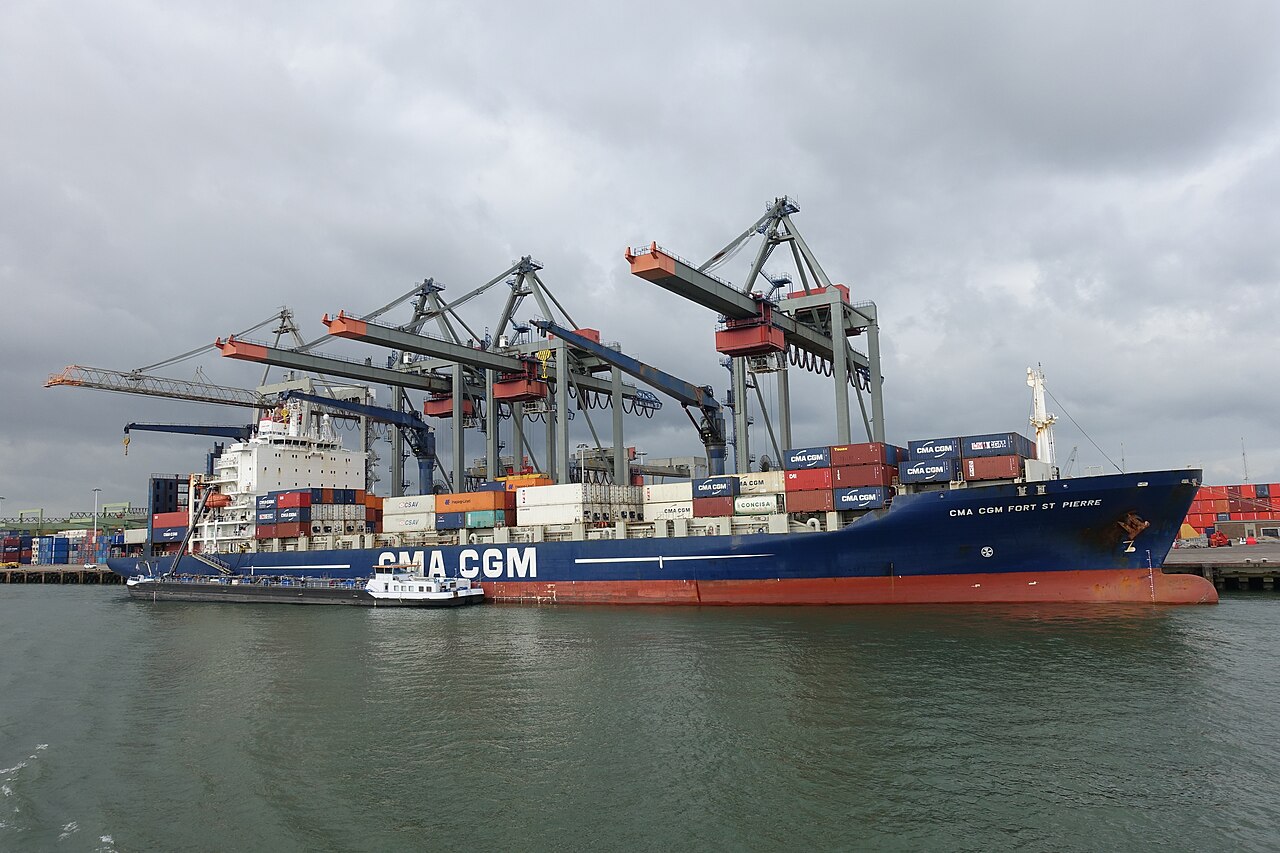
There are eleven rules. Seven work for any kind of transport, including a container handed to a carrier at an inland depot: EXW, FCA, CPT, CIP, DAP, DPU and DDP. Four are for sea and inland waterway only, where the goods are really lifted over the side into a vessel: FAS, FOB, CFR and CIF. Apparel is quoted almost entirely on those four sea rules, and mostly on FOB. That is odd, because nearly all of it travels in containers that are handed over at a terminal and never touch the seller's hands again.
The two boundaries are not the same boundary
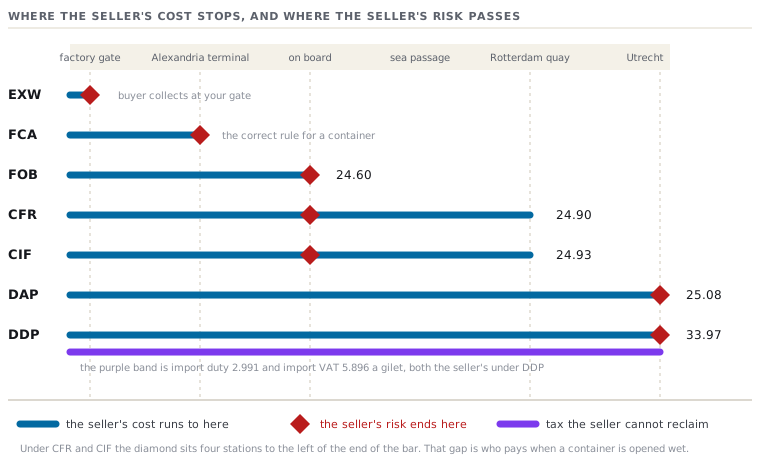
Here is the part that catches people. Every rule has a point where your costs stop and a point where your risk passes. In four of the eleven rules, those two points are in different places.
Under FOB they are the same. Cost and risk both leave you when the gilets are on board at Alexandria. Under CFR and CIF they are not. You pay the ocean freight, and under CIF you buy the insurance too, so your cost runs all the way to Rotterdam. But your risk still ends on board at Alexandria, exactly where it ended under FOB.
That is not a technicality. It decides who is out of pocket when a container is opened at the far end and the contents are ruined.
Building the four quotations
Start from the FOB you already have. Then add, in order, only what the next rule actually moves.
Ocean freight. Your forwarder quotes USD 1,860 all-in for the forty-foot high cube, Alexandria to Rotterdam, including the fuel and terminal surcharges. Across 6,200 gilets that is USD 0.300 a piece. Divide the box. Never estimate a per-piece freight.
CFR Rotterdam is therefore USD 24.90.
Marine insurance. Under CIF you must insure, and the duty has a set shape. Cover of at least 110% of the CIF value, in the currency of the contract, running from no later than the moment the goods are on board.
The extra ten per cent is not padding. A buyer who loses a cargo has lost more than the invoice. They have also lost the freight they paid, the duty, and the margin they would have made on the sale. Note too that the insured value is a percentage of CIF, and CIF contains the premium. So the sum runs in a circle and has to be solved, not added.
| Step | Order total, USD |
|---|---|
| CFR Rotterdam, 6,200 at 24.90 | 154,380.00 |
| CIF value, solved so that the premium is inside it | 154,532.99 |
| Insured value at 110% of CIF | 169,986.29 |
| Premium at 0.09% of insured value | 152.99 |
| CIF Rotterdam, per piece | 24.93 |
Now the trap inside the insurance line. CIF only obliges you to buy minimum cover, called Institute Cargo Clauses (C). That is not a lighter version of full cover. It is a short list of named disasters. Fire and explosion. The vessel sinking, running aground or turning over. A collision. Cargo thrown overboard to save the ship. Discharge at a port of refuge.
Water getting into a container is not on that list. It is on the (B) list, and it is covered by (A), which is all risks apart from its own exclusions.
The number that loses the order
Now the DDP question. It is a different animal from the other three, because it crosses a customs border.
Under DDP you deliver the goods, cleared for import, at the named place — Utrecht. You are responsible for everything: the freight, the handling at destination, the customs entry, the import duty, and any tax payable on importation. In the European Union that means the import VAT.
Build it and it comes out like this. The customs value is the price built up to the point where the goods enter the Union, which is the CIF Rotterdam figure. Duty is charged on that. The import VAT is charged on customs value plus duty plus the transport costs to the destination inside the country.
| Line | Order total, USD | Per gilet, USD |
|---|---|---|
| CIF Rotterdam | 154,532.99 | 24.93 |
| Terminal handling, customs entry, haulage to Utrecht | 992.00 | 0.160 |
| DAP Utrecht | 155,524.99 | 25.08 |
| Import duty at 12% of customs value | 18,543.96 | 2.991 |
| Import VAT at 21% of duty-paid landed value | 36,554.48 | 5.896 |
| DDP Utrecht | 210,623.42 | 33.97 |
The duty rate of 12% is taken here as a given. Proving that it is the right rate for this gilet, and asking whether a rule of origin can beat it, is course 8.5.
Look at the VAT line. It is USD 36,554.48. That is 24.0% of the whole FOB value of the order, and 2.2 times the entire margin on it.
Here is why answering the question as it was asked loses you the order. Meerhout are a VAT-registered Dutch company. If they import, the import VAT is input tax. They deduct it on their next return, and if they hold a deferment licence they never pay it at the border at all. It costs them nothing. It is not a cost, it is a cash movement that reverses.
If you import, it costs you the full USD 36,554.48. An Egyptian factory with no Dutch VAT registration has no return to deduct it on. You would be building thirty-six thousand dollars of dead cost into a price the buying committee will compare against a competitor who quoted DAP.
There is a second problem behind the first. A customs declaration in the Union has to be lodged by a declarant established in the Union. So an Egyptian seller quoting DDP needs an indirect representative who will accept joint liability for the debt. That is a paid service with a name on a form, not a favour your forwarder does for you.
When each rule is actually the right answer
- EXW — almost never right for export. It makes the buyer responsible for your export clearance, which they usually cannot do.
- FCA — the correct rule for a container handed over at a terminal or loaded at your own gate. The 2020 edition added something the trade had asked for. The parties may agree that the buyer tells the carrier to issue an on-board bill of lading to the seller. That is what makes FCA usable when a bank wants an on-board document.
- FOB, CFR, CIF — sea only, and strictly the wrong rules for containers. Used anyway, everywhere, because every buyer's system has an FOB field.
- CIP — like CIF but for any transport, and it obliges the wider (A) cover.
- DAP — the workhorse for delivered sales into a country where the buyer can import. Your cost runs to their door. Their duty and their tax stay theirs.
- DPU — the only rule where the seller unloads at destination. It was called DAT before the 2020 edition.
- DDP — the heaviest rule there is. Quote it only when you have priced the tax correctly and have a declarant.
Check yourselfA buyer asks you to move from FOB to CFR at the same price, saying the freight is small. What has actually changed for you, apart from the freight?Show the answer
Two things, and only one of them is the freight. First, you now hold a freight position. An ocean rate quoted in April for an October sailing is not a price, it is an opinion, and rates on this lane have moved by multiples inside one season. Quote CFR with a stated validity, or with freight at cost plus a fixed handling fee. Second, you now contract the carriage. You choose the carrier, you own the booking, and a rolled container becomes your problem to explain — while the risk of loss to the goods still left you at Alexandria. You have taken on the work without taking on the risk. That is the worst half of the trade if you do not price it.
Prompt · Convert my FOB into every other term
When a buyer asks for a delivered price and you have an hour to answer without giving away a margin you cannot see.
You are an export costing manager at a garment factory. I will give you an FOB price and the facts around one shipment, and I want a full conversion with every assumption named.

Goods: [garment, style, quantity, colours]
FOB price and named port: [price per piece, port, Incoterms edition]
Packing and container: [pieces per carton, cartons, container type, cubic metres]
Ocean freight quoted: [amount, all-in or excluding surcharges, validity]
Destination: [port, then final delivery place and country]
Destination charges you know: [terminal handling, customs entry, inland haulage]
Duty rate and basis: [rate, and what it is charged on]
Destination tax on import: [rate, and whether the buyer is registered for it]
Insurance rate offered: [rate, and on which clauses]

Produce five things. One: CFR, CIF, DAP and DDP per piece and per order, showing every added line separately and solving the insurance circularity rather than adding a flat premium. Two: for each rule, state in one line where my cost stops and where my risk passes, and flag every rule where those are different points. Three: tell me which lines in the DDP figure the buyer could recover and I could not, and quantify that across the order. Four: name any rule in my list that is technically wrong for how these goods actually move, and what the correct rule would be. Five: list the assumptions you had to make and what each one would do to the answer if it is wrong. Use my numbers only.
AI can make mistakes — check anything you act on.
What you should be able to do now
Take any live order and answer these from the paperwork, not from memory.
- Which edition of the Incoterms rules does my contract name? If it names none, the contract is unclear, and you should fix it on the next proforma.
- Where does my cost stop, and where does my risk pass? Say both out loud. If they are the same point, say so. If they are not, name each one.
- If I am insuring, on which clauses, and does the buyer know? Minimum cover is a decision, not a default.
- If I have been asked for a delivered price, who is the importer of record, and can they recover the import tax? If they can and you cannot, quoting the heavier rule gives money away in a form nobody on either side will notice until the season is costed.