Lessons · Lesson 2 of 3
Cartonisation: twenty millimetres that cost a container
Work a real container stow, and cost a carton decision that nobody thought was a costing decision.
Lesson 2 of 3 · 38 min
Step back six weeks
How big the cardboard boxes are looks like a packing question. It is really a freight question. A container is not filled the way a jug is filled. It is filled with whole boxes, in whole rows, in whole layers. A box that is slightly too tall loses a layer up the wall. The space above it is paid for and left empty.
Before the Tuesday at the weighbridge there was a Tuesday in August. On that day everybody in the building did their job correctly.
11 August. Wexholm's distribution centre sends Menara the receiving report for last season's parka. Of 8,400 pieces received, 63 were rejected at the DC with crushed shoulder seams. That is 0.75% of the shipment, invoice value USD 1,597.05, charged back. Nobody disputes the cause. On a seven-layer stow the cartons at the bottom carry the six above them, and a padded parka has nothing rigid inside it to carry a load.
Menara's packing engineer specifies the fix: a 20 mm double-wall corrugated top cap inside every carton. It spreads the weight of the layer above onto the carton walls instead of onto the garments. It costs USD 0.06 a carton, USD 84 across the whole of WX-7016. QA approves it. Merchandising approves it. It is a good, cheap, correct engineering answer to a real defect.
The carton goes from 380 mm high to 400 mm.
Nobody costs the height, because a carton height is not on the cost sheet. It is on the packing instruction, and that is a quality document. By the time somebody connects the two, WX-7016 needs three containers instead of two. That is USD 2,607 — thirty-one times what the fix cost, and 8.5% of the order's entire profit.
Why volume divided by volume is the wrong sum
The first instinct is to divide. A 40 ft high-cube container measures roughly 12.03 m long, 2.35 m wide and 2.69 m high inside, which is about 76.0 cbm on the door plate. A carton at 600 by 400 by 380 mm is 0.0912 cbm. Divide one by the other and you get 833 cartons.
You will never load 833. Cargo does not flow into a container. It stacks in whole units, and every dimension that does not divide evenly is space you have paid for and cannot use.
Do it properly, in three steps: the footprint across the floor, the number of cartons along the length, and the number of layers up the wall.
Across the width. The container is 2,350 mm wide. Lay the carton with its 400 mm side across the container: five fit, using 2,000 mm, and 350 mm of the floor is left as a lane you cannot fill. Turn the carton so the 600 mm side goes across instead and only three fit, using 1,800 mm and wasting 550 mm. Five it is.
Along the length. 12,030 mm divided by the 600 mm side gives twenty cartons, using 12,000 mm.
That is 100 cartons a layer, whichever way you cut it, and 100 is the number the whole order turns on.
Up the wall. The container is 2,690 mm high inside.
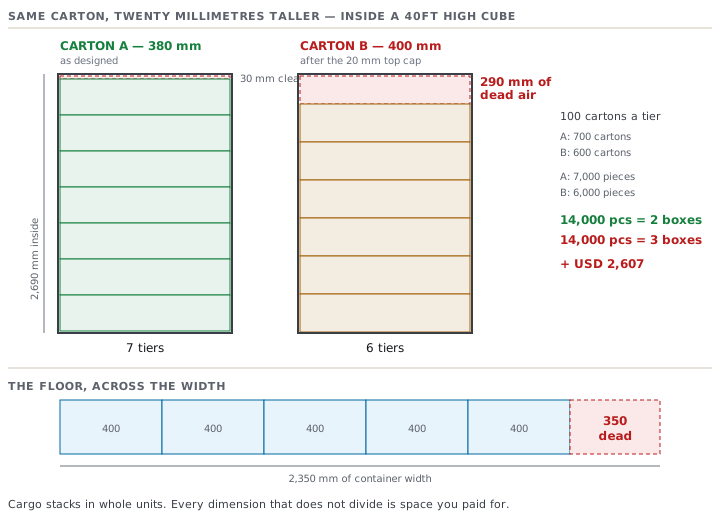
| Carton A, 380 mm | Carton B, 400 mm | |
|---|---|---|
| Cartons a tier | 100 | 100 |
| Tiers, in 2,690 mm | 7 | 6 |
| Height of the stack | 2,660 mm | 2,400 mm |
| Air above the top tier | 30 mm | 290 mm |
| Cartons a container | 700 | 600 |
| Pieces a container, at 10 a carton | 7,000 | 6,000 |
| Cargo volume loaded | 63.84 cbm | 57.60 cbm |
| Share of the container's cube used | 83.9% | 75.7% |
| Containers for 14,000 pieces | 2 | 3 |
Twenty millimetres of carton height is 8.2% of the container's cube. It is one whole layer, 100 cartons, 1,000 garments. On an order of 14,000 pieces it is the difference between filling two containers exactly and putting 2,000 pieces into a third container that travels two thirds empty.
Internal or external — ask which one you were quoted
There is a second way to lose a layer in the same dimension, and nobody has to change anything for it to happen.
A carton is quoted two ways. Internal dimensions are the space the goods sit in, which is what a packing engineer cares about. External dimensions are the space the container sees, and a stow can only be built on those. Double-wall corrugated board is around 7 mm thick, so once you allow for board on both sides and for the flaps, the outside of a carton runs roughly 14 mm larger than the inside on every axis.
Menara's 380 mm is an external figure, which is why the stow works. Now take the same carton quoted internally at 600 by 400 by 380. Its real outside is about 614 by 414 by 394. Redo the three counts. The 2,350 mm of width takes five cartons at 414 mm and no more. The 12,030 mm of length takes nineteen at 614 mm rather than twenty. And the 2,690 mm of height takes six layers at 394 mm rather than seven. Ninety-five cartons a layer, six layers, 570 cartons a container — and 14,000 pieces is three containers again, reached by a completely different route.
Ask the question in your first email to the carton supplier, and write the answer on the packing instruction: these dimensions are external.
The cost, per piece and in total
Here is the freight on this lane, per 40 ft high-cube from Port Said East to Gothenburg:
| Line | USD |
|---|---|
| Ocean freight including bunker adjustment | 1,980 |
| Origin terminal handling | 195 |
| Inland haulage, 10th of Ramadan to Port Said East | 310 |
| Container stuffing labour | 85 |
| VGM filing | 25 |
| Seal | 12 |
| Per container | 2,607 |
| Bill of lading and documentation | 65 |
| Export customs entry | 120 |
| Per shipment, whatever the container count | 185 |
Two containers cost USD 5,399, which is USD 0.386 a piece. Three containers cost USD 8,006, which is USD 0.572 a piece. So the carton height moved the logistics line on the cost sheet by USD 0.186 a garment, or USD 2,607 in total.
Set that beside the problem it was solving. The crushing cost USD 1,597.05 in chargebacks across a whole previous season. The fix cost USD 84 in board and USD 2,607 in freight.
The answer that was available all along
The defect was real, and the parkas did need protecting. What nobody asked was whether the protection had to be 20 mm tall.
A moulded-pulp corner pad does the same job a different way. It carries the load down the four corners of the carton, where the stacking strength already is. It costs USD 0.11 a carton — nearly twice the top cap — and it adds nothing to the carton height, because it sits in the corner space the folded garments leave anyway.
| Do nothing | Top cap | Corner pads | |
|---|---|---|---|
| Carton height | 380 mm | 400 mm | 380 mm |
| Containers | 2 | 3 | 2 |
| Protection cost | 0 | 84 | 154 |
| Extra freight | 0 | 2,607 | 0 |
| Expected crush claims | 1,597 | 0 | 0 |
| Total, USD | 1,597 | 2,691 | 154 |
The expensive option is the one that looked cheapest on the document it appeared on, because it was costed against the wrong number. A carton dimension is a freight decision wearing a quality document.
The stow you can improve for free, and why it saved nothing here
The five-across pattern leaves a 350 mm lane running down the length of the container. A mixed-orientation stow closes most of it. Work in a repeating block 1,200 mm long:
- Three cartons side by side with the 600 mm face across the container, using 1,800 mm of width and 400 mm of length. Three such rows fill the 1,200 mm block: nine cartons.
- In the 550 mm of width left over, cartons turned the other way — 400 mm across, 600 mm along — give two more in the same 1,200 mm.
Eleven cartons per 1,200 mm block, against the ten the simple pattern gives. Over ten blocks that is 110 cartons a layer instead of 100. A genuine 10% improvement that costs nothing but an instruction.
And on this order it is worth exactly nothing. With Carton B at six layers it gives 660 cartons, so 6,600 pieces a container. Two containers carry 13,200. The order is 14,000. You are 800 pieces short, and you still ship three containers.
This is the discipline the whole lesson turns on. A cube improvement is worth money only when it crosses a container boundary. Ten per cent more cartons a layer, a smarter polybag fold, a thinner board — all of it is decoration unless it changes the container count, or the LCL volume you are charged for. Work out where the boundary is first. Then look for the improvement that reaches it.
Cubing out against weighing out
Seven hundred cartons at 10.60 kg gross is 7,420 kg of cargo. A 40 ft container of this class is rated at a maximum gross of 30,480 kg. Take off a tare of about 3,900 kg and that leaves roughly 26,500 kg of payload.
Menara used 28.0% of the weight it paid to move, and 83.9% of the volume. This container cubes out: it runs out of space long before it runs out of lift. That is true of almost everything in outerwear, knitwear and made-ups.
The opposite case exists and behaves in the opposite way. A container of heavy denim, canvas workwear or wet-processed towelling weighs out. It reaches the payload limit with the box half full, and there the money is in weight per carton, not in layers.
Know which of the two your product is before you start optimising. The two answers pull against each other: packing more pieces into a carton helps a cube-out and hurts a weigh-out.
What the buyer's manual does to your carton
You do not choose the carton alone. Wexholm's supplier manual sets three constraints, and every one of them is a constraint on your stow:
- Maximum carton gross 15 kg, so a DC operator can lift it unaided. At 10.66 kg, Carton B is inside that, and so is any sensible alternative.
- Cartons must palletise on an 800 by 1,200 mm pallet with no overhang. A 600 by 400 mm footprint gives four cartons a pallet layer with nothing hanging over the edge, which is why that footprint is common in European retail.
- Maximum pallet height 1,800 mm including the pallet. With a 145 mm pallet that leaves 1,655 mm of cartons: four layers, at either 380 or 400 mm. Here the DC constraint does not bite, but check it every time. A carton that gains a layer in the container and loses one on the pallet has simply moved the loss to somebody who will charge you for it.
Check yourselfYou can make the carton 20 mm shorter or 20 mm narrower. Which is worth more?Show the answer
Work it, do not guess. Shorter attacks the layer count: at 2,690 mm of internal height, going from 400 to 380 mm buys a whole seventh layer, 100 cartons, 1,000 pieces. Narrower attacks the floor. Going from 400 to 380 mm across the width still gives five cartons across, because six would need 2,280 mm and there is 2,350 mm. So it would work, but it also changes how the 600 mm dimension fits along the length, and the pallet pattern at the DC. In this container the height is the sensitive dimension, because 2,690 mm divides badly. In another container, with another carton, it is the width. The rule is the same: find which dimension is closest to gaining a whole unit, and attack that one.
Prompt · Check my carton against the container
Before a packing instruction is approved, and again whenever anyone changes a carton dimension for any reason.
You are a stow planner. Do not divide volume by volume; count units.

Carton: [length] x [width] x [height] mm, [pieces] pieces, gross [weight] kg
Container: [type], internal [length] x [width] x [height] m, payload [kg]
Order: [quantity] pieces
Buyer's manual: maximum carton gross [kg], pallet [size] with no overhang, maximum pallet height [mm] including a [mm] pallet
Freight: [amount] per container, [amount] once per shipment

Work it in this order. One: cartons across the width in each orientation, and the dead lane each one leaves in millimetres. Two: cartons along the length. Three: layers up the height, and the dead air above the top layer. Four: cartons and pieces per container, cargo volume, share of the container's cube, and cargo weight as a share of payload. Then tell me whether this product cubes out or weighs out. Five: containers needed for the order, and the freight cost per piece. Six: the single dimension closest to gaining a whole extra row or layer, how many millimetres it needs, and what that change is worth in containers and in money. Seven: check my carton against every constraint in the buyer's manual, and say which one binds first.
AI can make mistakes — check anything you act on.
What to take to your next packing approval
- Never divide volume by volume. Count cartons across, cartons along, layers up.
- Find the dimension that is closest to buying a whole extra layer or row, and defend it.
- Cost every carton change in containers, not in board. The board line is cents; the container line is thousands.
- Establish whether the product cubes out or weighs out before you optimise anything.
- Read the buyer's manual constraints into the stow, not after it.