Lessons · Lesson 1 of 3
The cut-off is the deadline, the sailing is not
Read a booking backwards into a factory plan, and price what a missed sailing really costs.
Lesson 1 of 3 · 37 min
One order, one date, and a plan built on the wrong one
The date on a booking confirmation is the day the ship leaves. It is the wrong date to plan a factory around. Behind it sits a stack of earlier deadlines, and each one belongs to somebody else. The earliest of them, not the sailing, is the day your goods have to be finished. This lesson walks that stack backwards. The real deadline turns out to be more than a week earlier.
Menara Apparel, 10th of Ramadan City. Purchase order WX-7016 from Wexholm, a Swedish outdoor and workwear chain: 14,000 women's padded parkas, style CW-905, recycled polyester shell with a 120 gsm wadding, five sizes. Quoted CFR Gothenburg at USD 25.35 a piece. Order value USD 354,900. CFR is a selling term, and course 8.3 explains it. All you need here is that Menara books and pays the sea freight, and Wexholm takes the goods at Gothenburg.
The garments go into stores on Saturday 24 October. Wexholm's distribution centre needs them by Thursday 15 October, to sort them, put price tickets on them and send them out to 300 stores.
The forwarder, Cordis Freight, confirms a booking on the weekly service out of Port Said East: MV Ravenna Bay, voyage 034W, ETD Friday 25 September. The box changes ship at Rotterdam. ETA Gothenburg is Tuesday 13 October. ETD is the day the vessel leaves. ETA is the day it arrives.
The merchandiser puts one date into the time and action plan: 25 September. Ex-factory is set at 21 September, "four days of buffer". Everybody signs it.
The goods are ready. The container is inside the terminal on the Tuesday, fifty minutes before the gate closes. And it does not sail.
A booking is not a date, it is a ladder
The sailing date is the last thing that happens to your cargo. It is also the only date most people write down. Behind it sit earlier deadlines. Each one belongs to somebody else, and each one is final. These deadlines are called cut-offs.
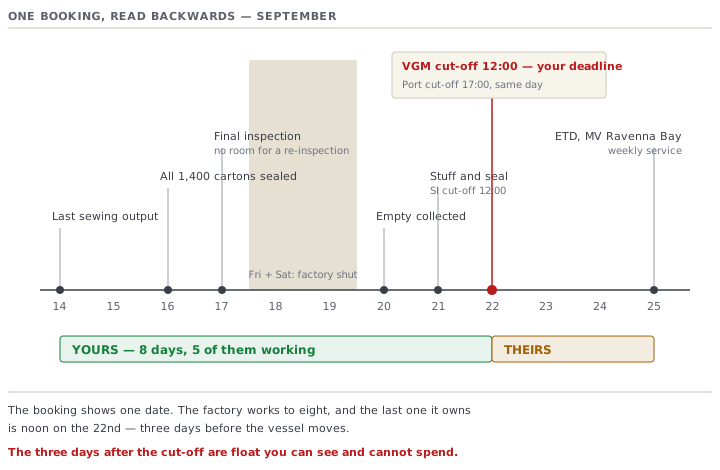
Booking cut-off. The day the carrier stops selling space on that voyage. Miss it and there is no booking at all.
Shipping instruction cut-off, also called the documentation cut-off. The day the carrier must have your bill of lading details: shipper, consignee, marks, description, carton count, gross and net weight, measurement. On this service it was Monday 21 September, 12:00 — four days before the sailing. Whatever you send is what the bill of lading will say. Once the manifest closes, changing it costs money at both ends.
VGM cut-off. VGM means verified gross mass: the weight of the packed container, checked and declared. Tuesday 22 September, 12:00. No VGM, no loading. This is not a carrier policy you can argue with. It comes from SOLAS, the international ship safety convention, and the terminal has no choice in it.
Port cut-off, also called the CY cut-off. The last moment the full container may be driven in through the terminal gate. Tuesday 22 September, 17:00.
Reefer, hazardous and out-of-gauge cut-offs run earlier still, usually a day ahead of the dry-cargo cut-off. Not this order, but worth knowing before you book one.
The number that matters is not 25 September. It is 22 September, 12:00 — the earliest deadline you own yourself. That is your ship date. Everything after it belongs to the carrier.
Reading the ladder backwards into the factory
Now walk it backwards through your own building. Menara works Sunday to Thursday. Friday and Saturday nothing moves.
| What has to happen | When | Who owns it |
|---|---|---|
| In store, 300 stores | Saturday 24 October | Wexholm |
| Wexholm DC receipt and allocation | Thursday 15 October | Wexholm |
| ETA Gothenburg, feeder from Rotterdam | Tuesday 13 October | carrier |
| Feeder departs Rotterdam | Saturday 10 October | carrier |
| Mother vessel arrives Rotterdam | Thursday 8 October | carrier |
| ETD Port Said East, MV Ravenna Bay 034W | Friday 25 September | carrier |
| Port cut-off, full container gated in | Tuesday 22 September, 17:00 | Menara |
| VGM cut-off | Tuesday 22 September, 12:00 | Menara |
| Shipping instruction cut-off | Monday 21 September, 12:00 | Cordis Freight |
| Container stuffed, sealed, trucks depart | Monday 21 September | Menara |
| Empty container collected from the depot | Sunday 20 September | haulier |
| Weekend — nothing moves at the factory | Friday 18, Saturday 19 September | nobody |
| Final inspection passed, goods released | Thursday 17 September | Wexholm QA |
| All 1,400 cartons packed, sealed and marked | Wednesday 16 September | Menara |
| Last sewing output to the packing floor | Monday 14 September | Menara |
Read the two ends of that table against each other. The booking says 25 September. The factory's real deadline is 16 September — nine days earlier. And the last garment has to come off the sewing line on 14 September, eleven days before the vessel moves.
A merchandiser who plans to the sailing date has not lost a day. They have lost eleven. They find out in the last week, when every remedy costs money.
The buffer that sat on the wrong side of the cut-off
Look again at what the plan called buffer. Ex-factory 21 September, sailing 25 September: four days.
Three of those four days sit after the port cut-off. They are the carrier's days. The container stands in a stack at Port Said East, waiting for a vessel. Not one hour of that is available to the factory. The float that really belonged to Menara runs from goods ready on 16 September to the VGM cut-off at 12:00 on 22 September. That looks like six days. It is three working days. Friday and Saturday are dead. And inside what is left, the container still has to be collected, stuffed and driven 210 km.
The Tuesday
The goods passed inspection on the Thursday. The empty container came on the Sunday. It was stuffed on the Monday and the trucks left at 14:00.
Menara had always filed the VGM by the second permitted method: add up the weight of the packed cargo from the packing list, then add the container's own empty weight from the plate on its door. The export clerk had just read a carrier bulletin saying those plates are sometimes wrong on repaired boxes. So he decided to do it properly, and drive to a certified public weighbridge to weigh the loaded container itself. More accurate. Entirely permitted. Nobody did anything wrong.
The weighbridge is 22 km off the route, and on Tuesday morning there was a queue of cement trucks. The ticket was issued at 13:40 and typed into the forwarder's portal at 14:20. The VGM cut-off was 12:00. The container went in through the gate at 16:10 — fifty minutes inside the port cut-off — and it was not on the loading list. At the moment the stowage plan closed, it had no verified gross mass.
The two numbers, when somebody finally compared them: calculated method, 11,320 kg. Weighbridge, 11,290 kg. A difference of 30 kg, or 0.27%.
The container did not sail. It was rolled to the next weekly sailing, Friday 2 October.
What a rolled booking actually costs
Nothing, in freight. The carrier moves the box on the next voyage at the same rate. That is exactly why rolling is underestimated.
The service is weekly. So the delay is seven days, not the three the merchandiser had in his head. And the change of ship at Rotterdam does not compress. Rotterdam Thursday 15 October, feeder Saturday 17 October, Gothenburg Tuesday 20 October. DC receipt Thursday 22 October. In store Saturday 31 October — one week after the launch.
Purchase order WX-7016 carries a late-delivery discount of 12% on the invoice value of any goods that miss the agreed DC date. On this order that is USD 42,588.
Now put that against what the order was ever going to earn. Menara's cost build for CW-905, per piece:
| Line | USD per piece |
|---|---|
| Materials | 15.90 |
| Direct labour | 4.30 |
| Factory overhead absorption | 2.35 |
| Testing and final inspection | 0.22 |
| Ex-factory cost | 22.77 |
| Ocean logistics to Gothenburg | 0.39 |
| Total cost | 23.16 |
| CFR Gothenburg | 25.35 |
| Profit | 2.19 |
Fourteen thousand pieces at USD 2.19 is USD 30,660 — the whole profit on the order. The late-delivery discount is USD 42,588. Two hours and twenty minutes at a weighbridge turned a USD 30,660 profit into a USD 11,928 loss, and the freight bill did not change by a single dollar.
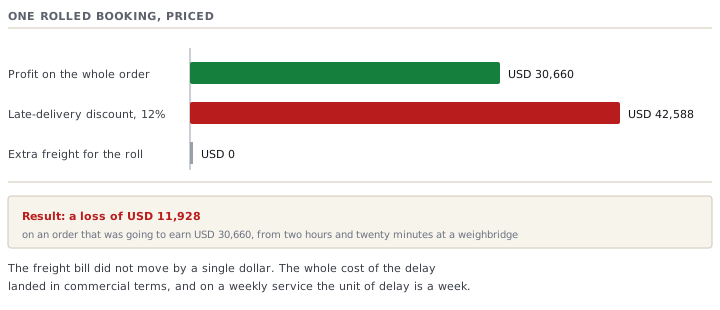
That is the sentence to keep: on a weekly service, an hour lost at a cut-off costs a week, and a week is priced in commercial terms, not in freight.
The second clock nobody looks at
There is another weekly clock on this booking, and it is not on the booking confirmation. Gothenburg is served by a feeder ship from Rotterdam, and the feeder leaves on Saturdays. If the mother vessel reaches Rotterdam two days late — ordinary weather, ordinary port congestion — the box misses the Saturday feeder and waits for the next one. The carrier's arrival date at Gothenburg has moved a week, and nothing in your factory caused it.
So before you promise a DC date, ask the forwarder two questions. Is this a direct service or does the box change ship? And how often does the connecting leg run? A transhipment with a weekly connection puts two weekly clocks one after the other. A three-day delay anywhere upstream can become fourteen days at the customer.
Which of these dates you can actually move
You cannot move a cut-off. You can move almost everything on your side of it. The time to do that is when the booking is confirmed, not in the last week.
- Book the final inspection earlier. Wexholm's QA needs five working days' notice and wants the goods 100% packed. Booked for Thursday 17 September, a failed inspection left no room for a re-inspection at all: the next free slot was Sunday 20 September and the container went in on the Tuesday. Book the inspection so that a failure still leaves one full re-inspection before the VGM cut-off.
- Collect the empty container two days earlier and stuff it over two shifts instead of one morning.
- Pack in tranches. Packing does not have to wait for the last size to come off the line. Seal and mark cartons as each size finishes, and build the packing list as you go.
- File the VGM the moment the container is sealed, from the packing list, rather than on the way to the port. If you do mean to weigh, put the weighbridge in the plan as a step with a time on it, not as an errand.
- Ask for the cut-offs in writing when you book, all of them, with times. A cut-off given as a date with no hour is not a cut-off you can plan against.
Check yourselfThe booking says ETD 25 September. Your goods are ready on 21 September. How much float do you have?Show the answer
None that you can spend. The deadline you own is the earliest cut-off, and on this booking that is the VGM at 12:00 on 22 September. Goods ready on 21 September leave you part of one working day to collect an empty, stuff it, seal it, weigh it, file the VGM and drive 210 km. And if Friday and Saturday fall inside that window, those days do not exist at all. The three days between the cut-off and the sailing belong to the carrier, not to you.
Prompt · Turn a booking into a factory deadline
The moment a booking is confirmed, and before the date goes into your time and action plan.
Act as an export shipping coordinator. I will give you a booking confirmation and a factory calendar, and I want a backward plan in working days.

Booking: vessel and voyage [name], ETD [date], POL [port], POD [port], direct or transhipment [which], transhipment port and feeder frequency [detail]
Cut-offs as quoted: booking [date and time], shipping instruction [date and time], VGM [date and time], port or CY [date and time]
Order: [quantity] pieces, [cartons] cartons, [containers] containers
Inland: factory at [place], [distance] to the port, haulage takes [hours]
Factory working week: [days], weekend [days], shifts [number]
Inspection: [inspector], notice required [days], goods must be [packed state], re-inspection lead time [days]

Do five things. One: name the earliest cut-off I own myself, and call it my ship date. Two: build a backward calendar in WORKING days from that date to the last sewing day. Show stuffing, empty pick-up, inspection, room for a re-inspection, last carton sealed and last sewing output, with my weekend blacked out. Three: tell me how many working days of real float I have, as distinct from the days between the cut-off and the sailing. Four: list every date on this plan that a public holiday, a Friday or a queue would destroy. Five: if the service is weekly, tell me what one missed cut-off does to my delivery date and to my in-store date. Use my figures only, and state any assumption as an assumption.
AI can make mistakes — check anything you act on.
What to take to your next booking
- Write down every cut-off with its hour, and mark the earliest one. That is your ship date.
- Count backwards through inspection, packing, sealing and stuffing in working days, with your own weekend in the calendar.
- Ask whether the service is direct or transhipped, and how often the connecting leg runs.
- Price the roll before it happens. On a weekly service, what does seven days cost you in discount, air freight or a missed launch? That number is what your float is worth, and it tells you how much it is sensible to spend to protect it.