Lessons · Lesson 3 of 3
Pricing the way out: part containers, air freight and the packing list
Price the choices you are left with once the plan has broken, and read a packing list as the costing document it is.
Lesson 3 of 3 · 35 min
The part container, and where consolidating stops being cheaper
Plans break. The useful skill is not avoiding that. It is pricing each way out before you choose one. This lesson prices three of them: a part load shared with other people's cargo, flying the goods, and flying only the urgent part. One rule runs under all three, and it is worth more than the arithmetic. What it is sensible to spend on speed is capped by what being late would cost.
Go back to 3 September for a moment, when Menara still believed it was shipping three containers. The third one would hold 200 cartons, 2,000 pieces, 19.20 cbm and 2,132 kg. One third full. So the obvious question went to Cordis Freight. Should the third container be a full container at all, or should those cartons go LCL, consolidated with other shippers' cargo?
The answer needs one piece of vocabulary. LCL means less than container load, and it is charged on the w/m, the weight-or-measurement unit. That is the greater of the cubic metres and the metric tonnes. Here it is 19.20 against 2.13, so you pay on 19.20 w/m. Everything about a parka says the same thing. It is a volume product, and volume is what you will be billed for at every stage.
| Third full container | LCL, on 19.20 w/m | |
|---|---|---|
| Ocean freight | 1,980 | 1,305.60 |
| Origin terminal handling / CFS receiving | 195 | 268.80 |
| Inland haulage | 310 | 240 |
| Stuffing labour | 85 | included |
| VGM filing and seal | 37 | not applicable |
| Documentation | included in the shipment | 55 |
| Total, USD | 2,607.00 | 1,869.40 |
LCL wins by USD 737.60 on this volume. But the useful output is not that answer. It is the crossover — the volume above which consolidating stops being cheaper. LCL costs USD 68 per w/m of freight plus USD 14 per w/m of handling at the consolidation warehouse. That is USD 82 a cubic metre. Add USD 55 of documentation, and the same USD 310 truck once you are hauling a full trailer's worth. Set all that equal to the full container's USD 2,607 and solve:
82 times the volume, plus 365, equals 2,607. The crossover is 27.34 cbm.
That is about 285 cartons, or 2,850 pieces, and it is roughly 36% of the container's rated 76.0 cbm. Most people guess the crossover sits near half a container. It sits nearer a third. Consolidate above it and you are paying full-container money for a service that is slower and handled more.
Air freight is priced on space, not on weight
The container was rolled on 22 September. Wexholm's launch is on 24 October, and the rolled vessel puts the goods in store on 31 October. So the question is now air freight. This is where most merchandisers get the number badly wrong, because they weigh the goods.
Air freight is charged on the chargeable weight, which is the greater of the actual gross weight and the volumetric weight. The volumetric weight is the shipment's volume turned into kilogrammes at the industry divisor of 6,000 cubic centimetres to the kilogramme.
One carton of CW-905 measures 60 by 40 by 38 centimetres, which is 91,200 cubic centimetres. Divide by 6,000 and the volumetric weight is 15.20 kg. The carton actually weighs 10.60 kg.
You will be charged on 15.20. Not because anybody is cheating you. A padded parka is mostly trapped air, and an aircraft runs out of hold space long before it runs out of lift. That is exactly the cube-out from the last lesson, priced openly instead of hidden.
Wexholm needs 3,000 pieces to open its 300 stores: one ratio carton of ten per store, sizes XS to XL at 1/2/4/2/1. That is 300 cartons.
| Line | Basis | USD |
|---|---|---|
| Actual gross weight | 300 cartons at 10.60 kg | 3,180 kg |
| Volumetric weight | 300 cartons at 15.20 kg | 4,560 kg |
| Chargeable weight | the greater of the two | 4,560 kg |
| Air freight | 4,560 kg at 4.20 | 19,152.00 |
| Origin terminal handling | 4,560 kg at 0.18 | 820.80 |
| Air waybill | per shipment | 45.00 |
| Export customs entry | per shipment | 120.00 |
| Trucking, factory to Cairo airport | per shipment | 240.00 |
| Total | 20,377.80 | |
| Per piece | 6.79 |
You are paying for 1,380 kg that does not exist — 43.4% more than the goods weigh. And the all-in rate of USD 4.20 is itself three numbers: a base rate of 3.10 at the 1,000 kg break, a fuel surcharge of 0.85 and a security surcharge of 0.25. Each of them moves on its own. A quote that gives you one number is a quote you cannot check.
Per piece, sea was USD 0.386 and air is USD 6.79. Air is 17.6 times the sea cost on this garment. On a dense product it would be perhaps six or eight times. The multiple is set by how much air you are shipping, which is why the volumetric sum belongs in the decision and not in the invoice check afterwards.
Four ways out, all of them priced
| Option | Cost, USD | What happens to the order |
|---|---|---|
| Accept the roll, all 14,000 on the 2 October sailing | 42,588 late discount | Profit gone, loss of 11,928 |
| Air the whole order | 94,331.40 | 26.6% of the order value; unpriceable |
| Air 3,000 for the launch, sea the balance | 20,377.80 | Profit falls to 10,282.20 |
| Offer an 8% markdown allowance instead of shipping early | 28,392 | Worse than airing, and sets a precedent |
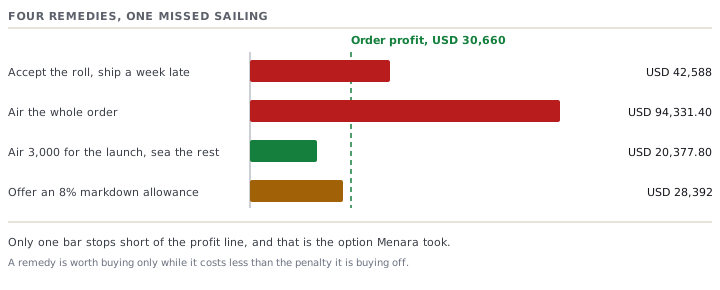
The answer is the third. Wexholm's category manager will waive the late claim if the launch quantity is in the DC by Thursday 15 October. Menara ends the order with USD 10,282.20 of profit, 2.9% of the CFR value, against the 8.6% it costed.
Two things in that table are worth more than the answer.
Airing part of an order does not save you sea freight. The remaining 11,000 pieces are 1,100 cartons, and a container takes 700. So the sea leg is still two containers, and the USD 20,377.80 is added on top of the full ocean bill, not instead of part of it. The only air split that saves anything is one that pushes the sea leg below a container boundary. Airing 7,000 pieces would leave exactly 700 cartons, one container, and USD 2,607 back. Same rule as the carton height, one lesson later.
Air freight is a payment to avoid a commercial penalty, so it is capped by that penalty. Nobody should spend USD 20,377.80 on freight to protect a claim of USD 5,000. Work out the penalty first — the discount clause, the cancelled launch, the markdown, the lost programme — and only then ask what the fastest option costs.
The packing list is a costing document
The 11,000 pieces arrived at Gothenburg on 20 October. Nine days later Wexholm's supplier accounts department sent a debit note for USD 1,252.
Wexholm's DC scans every carton at receipt and compares the label against the packing list. 41 cartons did not match. Wexholm's supplier manual charges USD 22 for each carton that does not match, plus USD 350 for the shipment once the mismatch rate goes above 2% of cartons. Forty-one of 1,400 cartons is 2.93%, so both charges applied.
The cause was, again, a correct action. On Wednesday 2 September Wexholm changed the size ratio from 1/2/4/2/1 to 1/3/3/2/1 across XS to XL. Still ten pieces, a different mix. Packing implemented it the same day, correctly. But the carton labels for the first two days of packing had already been printed against the old ratio, and they were used until the reprint arrived. The packing list, generated later from what was actually in the cartons, was right. The labels on 41 cartons were wrong. And the DC scans the label.
At a profit of USD 2.19 a piece, USD 1,252 is the profit on 572 garments.
Hold onto the shape of that. A carton has three descriptions of what is inside it — the label on the outside, the line on the packing list, and the actual contents — and three different steps produce them at three different times. A buyer's DC charges you every time any two of them disagree, and it charges per carton, so the fee is multiplied by your own carton count.
Three rules follow, and they cost nothing:
- Generate the packing list at the moment of packing, from what went into the carton. Never from the purchase order, and never from the original size breakdown. Both of those are what you intended, not what you did.
- Any change to quantity, ratio, size break or assortment kills every pre-printed label not yet used. Destroy them the day the change is accepted. A drawer of correct-looking labels is a chargeback waiting to be scanned.
- Read the buyer's mismatch threshold and the per-carton fee before you choose the carton size. A smaller carton means more cartons. More cartons means a lower threshold in absolute terms, and more units to be charged for.
Check yourselfYour buyer asks for a quotation to air 500 padded jackets. You weigh a carton at 11 kg. What do you send them?Show the answer
Nothing yet. Measure the carton before you weigh it. Length by width by height in centimetres, divided by 6,000, gives the volumetric weight. You are charged on whichever figure is larger, and on padded outerwear it will be the volumetric one by a wide margin. Then ask for the rate broken into base, fuel and security. Ask which weight break it applies at, because the rate falls as the shipment grows. And add the air waybill, origin handling, customs and trucking, which on a small shipment are a large share of the total.
Prompt · Price my way out of a missed vessel
When a booking has rolled or a delivery is going to be late, before you agree to anything with the buyer.
Act as a merchandising manager who prices remedies before choosing one. Never recommend an option without a number attached.

Order: [quantity] pieces, [style], selling term and price [term and amount], order value [amount]
My cost per piece: [breakdown] and profit per piece [amount]
Carton: [length] x [width] x [height] cm, [pieces] a carton, gross [kg]
Sea: [amount] per container, [pieces] per container, [amount] once per shipment
Air quote: [amount] per chargeable kg, weight break [kg], plus origin handling [rate], air waybill [amount], customs [amount], trucking [amount]
The penalty: late discount [percent or amount], cancellation risk [detail], the buyer's real deadline [date]

Do six things. One: work out the chargeable weight properly, as the greater of gross and volumetric at 6,000 cubic centimetres to the kilogramme, and tell me how much of what I am paying for is air. Two: cost three things — a full air shipment, a part air shipment covering only the quantity the buyer's deadline actually needs, and shipping late and paying the penalty. Three: tell me whether the part air shipment saves any ocean freight at all, by checking whether the remaining cartons drop below a container boundary. Four: rank the options by total cost, and show each one as a share of the order's profit. Five: name the smallest air tranche that protects the buyer's deadline. Six: tell me the point at which no option is worth taking, and the right move is to renegotiate the delivery.
AI can make mistakes — check anything you act on.
What to take away
- Consolidation stops being cheaper far earlier than people expect. Find the crossover in cubic metres and use it, and remember that the buyer's landed crossover is lower still.
- Air freight is priced on the greater of weight and space. Measure the carton before you weigh it.
- Price the penalty before you price the remedy. Fast is worth exactly what slow would have cost, and not a dollar more.
- A part-air shipment saves ocean freight only when it drops the sea leg below a container.
- The label, the packing list and the carton's actual contents are three separate things. Every disagreement between them is a per-carton fee.