Lessons · Lesson 2 of 3
Origin is made in the factory, not on the invoice
Work out where a garment originates from what was done to it, and price the sourcing decision that quietly moved a whole order off its preference.
Lesson 2 of 3 · 38 min
Two shipments at nothing, and then a third
Where a garment comes from sounds like a question about an address. In the law that decides border taxes, it is not. It is a question about what was physically done to the goods, and where. For clothing, the answer usually turns on where the cloth was made, not where it was cut and sewn. This lesson works through the rule, and what it costs to get it wrong.
Shipments 1 and 2 of BRK-4402 left Alexandria in June and early July: 9,600 pieces of the 24,000. Brandvik's broker filed the entries under the Kaldera agreement, claimed the lower rate, and paid 0%. The duty line on the buying sheet read zero. That is why nobody had ever pushed the classification question from lesson 1 to a conclusion. At a preferential rate of 0%, the difference between 10.5% and 14.0% is nothing at all.
Shipments 3 and 4, in August and September, were 14,400 pieces. Same style. Same factory. Same machines. Same operators. Same cartons. Labelled Made in Egypt. And they were not entitled to the lower rate.
Nothing was concealed and nobody lied. What happened is the subject of this lesson.
Origin is decided by processing
Almost everybody starts with the instinct that goods come from wherever the seller is. It is a reasonable instinct and it is wrong. In customs law, origin is a property of what was done to the goods and where. Not the address on the invoice. Not the flag on the vessel. Not the currency of the contract. Not the nationality of the company.
There are only two ways a good can originate anywhere.
Wholly obtained. Everything in it came from that territory: crops harvested there, minerals extracted there, fish taken by its vessels, animals born and raised there, and goods made only from those things. Apparel is almost never wholly obtained. It could be — cotton grown, ginned, spun, knitted, dyed, cut and sewn inside one country would be. But the moment a single imported input goes into it, this route closes and the other one opens.
Substantially transformed. The good was made from non-originating materials, but enough was done to it in the territory that it counts as that territory's product. "Enough" is the entire argument. Every agreement defines it for itself, product by product, in a list of product-specific rules. Three ways of writing that definition are in common use, and you will meet all three:
- a change in tariff classification — the finished good must fall in a different heading, or a different chapter, from every non-originating material that went into it;
- a value criterion — non-originating materials must stay below a stated share of the price, or local content must reach a stated share;
- a specified process — the rule names the operations that must happen in the territory, in the words of the industry rather than of the tariff.
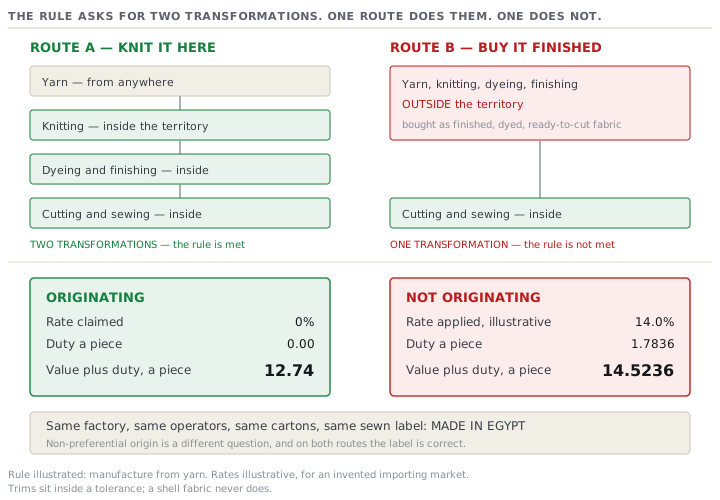
Apparel is usually governed by the third kind. The specified process usually turns on where the fabric was made and where the garment was assembled. A rule written as manufacture from yarn requires both fabric formation and making-up in the territory: two transformations, which is why the trade calls it double transformation. A stricter rule written as manufacture from fibre pushes the requirement one stage further back and brings the spinning in too. Which one applies to your goods is a question with a written answer in the agreement's annex, and that is the single most valuable page in the document.
The rule that applied, and the decision that broke it
The Kaldera agreement is invented, as lesson 1 said, and so is its rulebook. Give it the most common shape for knitted apparel: for goods of Chapter 61, manufacture from yarn. The fabric must be formed in the territory; yarn may come from anywhere.
Tanmia met that comfortably, and without thinking about it, because Tanmia is a vertical knitter. It buys cotton yarn. It knits its own fleece on its own circular machines. It dyes and finishes the fabric in its own dyehouse. It cuts it and sews it. Fabric formation and assembly both happen in Egypt. The garment originates in Egypt for the agreement's purposes, the lower rate is available, and the duty is 0%.
On 11 July the knitting programme fell over. Another customer's order had been moved into the same weeks, the dyehouse was the bottleneck, and Tanmia's own fleece for shipments 3 and 4 was going to be eleven days late against a fixed vessel.
The sourcing manager did what a good sourcing manager does. He found the identical construction: same 320 gsm, same brushed back, same shade, approved against the same lab dip. It came as finished, dyed, ready-to-cut fabric from Selvan Mills, a large knitter outside the agreement's territory, delivered to Borg El Arab in six days.
It was also cheaper. Tanmia's own knitted-and-dyed fleece costs USD 7.40 a kilo by the time it reaches the cutting room. Selvan's landed price was USD 6.95. At a gross consumption of 0.86 kilos a piece, that is USD 0.387 a piece and USD 5,572.80 across the 14,400 pieces.
Look at what he actually did. He protected the ship date. He held the approved specification. He bought from a qualified mill with a shade-approved lab dip. He took cost out of a confirmed order. On every axis the factory measures a sourcing decision by, this was a good one. Show the file to the managing director and he would have signed it in ten seconds.
And it moved the whole of shipments 3 and 4 off the preference, because the fabric was no longer formed in Egypt. Cutting and sewing alone is one transformation, and the rule asks for two.
Why nothing rescued it
Three mechanisms commonly save an order in this position. It is worth knowing all three, because on another order one of them would have worked.
Tolerance. Most agreements allow a small proportion of non-originating material to be ignored. For textiles it is expressed as a share of the weight of the goods, or of the fabric, or as a share of the price. Give the Kaldera agreement an illustrative tolerance of 10% by weight. HD-260 weighs 0.64 kilos finished. The shell fleece is 0.61 kilos of that, or 95.3% of the weight. The drawcord, eyelets, labels and thread together are 0.03 kilos, or 4.7%. The trims were always going to be inside the tolerance and the shell fabric was never going to be. Tolerance is written to forgive a zip and a label, not a body fabric.
Cumulation. Agreements frequently let materials from a named partner country count as originating. That can be bilateral, between the two parties, or diagonal, across a group of countries that share the same rules. If Selvan Mills had sat inside the Kaldera cumulation zone, its fabric would have counted as originating material and the garment would have qualified with nothing else changed. The mill's technical file, its price and its lead time would have been identical. Only the postcode would have differed, and the postcode was worth USD 25,683.84.
A different rule. Had the agreement's rule for Chapter 61 been written as a change of tariff heading rather than as a specified process, buying finished fabric might have satisfied it, because fabric and garment sit in different chapters. Rules of origin are not a natural law. They are drafting, negotiated line by line, and two agreements covering the same garment can reach opposite conclusions about it.
None of the three was available here. The order was simply not originating from 11 July onward.
What it cost, and what the alternative cost
There were three ways to get fabric into the cutting room in time. Here they are at the only comparison that matters, which is not the fabric price.
| In-house knit and dye | Egyptian subcontract knit and dye | Selvan finished fabric | |
|---|---|---|---|
| Available for the vessel | No — eleven days late | Yes | Yes |
| Fabric cost a kilo | 7.40 | 7.75 | 6.95 |
| Fabric cost a piece at 0.86 kilos | 6.364 | 6.665 | 5.977 |
| Fabric formed in the territory | Yes | Yes | No |
| Originating under the agreement | Yes | Yes | No |
| Duty rate applied | 0% | 0% | 14.0% |
| Duty a piece on a customs value of USD 12.74 | 0.00 | 0.00 | 1.7836 |
| Duty on 14,400 pieces | 0.00 | 0.00 | 25,683.84 |
The subcontract route means sending Tanmia's own yarn to another Egyptian knitter and dyehouse with spare capacity. It was available, and it was the expensive one. It costs USD 0.688 a piece more than Selvan's fabric, which is USD 9,907.20 across the 14,400 pieces. That is a genuinely painful number to put in front of a managing director in July, and it is less than two-fifths of the duty it would have avoided.
Now put the two sides of the decision next to each other:
- The factory saved USD 5,572.80.
- The buyer was charged USD 25,683.84.
The duty is 4.6 times the saving, and the two numbers landed in different companies. Every dollar of the benefit went into Tanmia's margin on a confirmed price that did not move. Every dollar of the cost went onto Brandvik's landed sheet.
This is not somebody cheating. It is a decision taken with a complete view of one company's cost sheet and no view at all of the other's. That is what happens by default whenever the FOB is treated as the boundary of the conversation.
Prompt · Test a fabric substitution against the rule of origin before you buy it
The morning your mill is late and an identical fabric is available, finished, from somewhere else.
Act as a trade compliance adviser who reads rules of origin for a living and will not guess. I am about to substitute a fabric on a confirmed order, and I need to know what it does to my buyer's preferential claim.

Facts: exporting country [COUNTRY], importing market [MARKET], agreement claimed [NAME IT, OR SAY YOU DO NOT KNOW], garment [DESCRIBE IT] in tariff chapter [61 OR 62 OR OTHER], quantity affected [QTY], customs value per piece [AMOUNT] — or FOB [AMOUNT] plus freight and insurance [AMOUNT] plus buyer-supplied materials [AMOUNT]. Original fabric: knitted or woven at [MILL] in [COUNTRY], dyed and finished at [MILL] in [COUNTRY], from yarn bought in [COUNTRY]. Proposed substitute: [SAME FIELDS]. Garment weight [KG], shell fabric weight [KG], all other materials [KG].

Do the following. First, tell me what to look for in the agreement to find the product-specific rule for my chapter, and what the common wordings mean in factory terms — manufacture from yarn, manufacture from fibre, a change of tariff heading, a value criterion. Second, apply each of those wordings in turn to my substitution, and tell me which ones it survives and which it fails. Third, work the tolerance provision. Tell me whether it is normally expressed on weight or on value, calculate my non-originating share both ways from the weights above, and say whether any plausible tolerance rescues this. Fourth, tell me what cumulation is, ask me which countries the agreement cumulates with, and tell me whether that would change the answer. Fifth, separate preferential origin from non-preferential origin explicitly, and tell me what my Made in label should say under each. Sixth, give me the exact question to send my buyer's compliance contact, in one paragraph, written so that a yes or no answer is actually useful. Do not tell me the rule of a specific real agreement unless I have named it and you are certain of the wording.
AI can make mistakes — check anything you act on.
Reading a product-specific rule without a lawyer
You will not always have a compliance department. When you have to read the annex yourself, four questions get you most of the way.
- Which line covers my goods? The annex is ordered by tariff heading or chapter. Find the row for the chapter your garment is in: Chapter 61 for knitted apparel, Chapter 62 for woven. If the row is written for a heading, you need your heading — which is the classification work from lesson 1. Origin and classification are not independent tasks.
- What stage does it start from? Manufacture from yarn and manufacture from fibre are very different requirements. Read the exact words, not the summary somebody sent you.
- What does it forgive? Find the tolerance provision. Is it expressed on weight or on value? Does it apply to the whole garment or only to the fabric?
- What may I count as mine? Find the cumulation provision and the list of countries it reaches. This is the clause that most often turns a failing order into a passing one, and it is the clause merchandisers least often know exists.
Check yourselfYour mill is late. An identical fabric is available as finished goods from a mill in a country outside your buyer's trade agreement, at a lower price and a shorter lead time. What is the first question you ask, and who do you ask it of?Show the answer
Ask whether the agreement's product-specific rule for your garment requires the fabric to be formed in your territory. Ask your buyer's compliance or customs contact, in writing, before you place the fabric order. If the rule is a specified process of the manufacture-from-yarn kind, buying finished fabric abroad ends the claim for every piece cut from it. Ask about cumulation in the same message: if the mill sits inside the cumulation zone, the problem disappears entirely.
Check yourselfA colleague says the switch cannot matter because the garments are still made in Egypt and the labels are correct. What is wrong with the reasoning?Show the answer
Nothing is wrong with the label. Non-preferential origin, which governs the Made in marking, is very often conferred by cutting and sewing a complete garment. Preferential origin is a separate test under a specific agreement, and here it required the fabric to be formed in the territory as well. The garments are honestly Made in Egypt and honestly not entitled to the preferential rate. Both statements are true at once.
What you should be able to do now
Open the trade agreement your largest customer imports under. Find the product-specific rule for your chapter. Say out loud what your factory must do to the goods for them to qualify. Then look at your last three fabric substitutions and say, for each one, whether it would have survived.
The rule is only half of it. Lesson 3 is the other half. What has to exist on paper before anybody may claim the preference. What happens when the paper says one thing and the production records say another. And who ends up paying for the fourteen months in between.