Lessons · Lesson 1 of 3
What the duty is actually charged on
Build the customs value of one order from the FOB up, and see why the tariff code and the value base are two separate decisions that both move the money.
Lesson 1 of 3 · 38 min
The line that is not on your cost sheet
When a garment crosses a border, the importing country charges a tax on it. The sum always has the same shape: a percentage applied to a value. Both halves are decisions, not facts. Each one can be got wrong on its own. The value is not simply what the factory invoiced. The percentage comes from a code, and the code is decided by what the garment physically is.
10 February, Borg El Arab. Tanmia Knitwear has just confirmed purchase order BRK-4402 with Brandvik, a clothing retailer in Kaldera: 24,000 men's hooded sweatshirts, style HD-260, 320 gsm brushed-back cotton fleece, one colour, four sizes. FOB Alexandria USD 11.85. Order value USD 284,400. Four shipments between June and September.
The cost sheet behind that price is complete and correct. Fabric, trims, cut-make-trim, finishing, packing, overhead, margin, and the export charges up to the ship's rail. It ends at USD 11.85 because that is where the factory's responsibility ends.
Brandvik's buying sheet does not end there. It ends at a landed cost — the price of the goods once they have arrived and been cleared. Between the two numbers sits a line the factory never sees, cannot quote and does not control on paper: the import duty. On this order it is somewhere between nothing and forty-two thousand dollars. Which it turns out to be is decided almost entirely by things the factory does. What it makes the garment from. Where it makes the fabric. What it writes on a piece of paper in July. This course is about that line.
Duty is a rate multiplied by a value, and both are decisions
Every duty charged as a percentage works the same way:
duty = rate x customs value
That looks like two facts. It is two decisions, and each one can be got wrong on its own.
The rate comes from a tariff code. That is a decision about what the garment is. The value comes from a valuation rule. That is a decision about what the sale is worth for customs purposes. It is related to your invoice, but it is not the same thing.
Merchandisers who think about duty at all usually think only about the rate. In practice the value moves more often, moves quietly, and is the half your own paperwork creates.
Take the value first, because it is the half a factory can see.
The customs value is not the invoice
The agreed international method is transaction value: the price actually paid or payable for the goods when they are sold for export, plus a set list of additions and minus a set list of exclusions. It is set out in the WTO Customs Valuation Agreement, whose formal name is the Agreement on Implementation of Article VII of the GATT 1994. Almost every trading country applies it.
Two things about it matter to a merchandiser.
First: some markets add freight and insurance, and some do not. A country that values goods on a CIF basis charges duty on the price of the goods plus the cost of getting them to the port of import. A country on an FOB-type basis charges duty on the goods alone. Same garment, same rate, different bill.
Kaldera values on a CIF basis. Ocean freight and marine insurance on BRK-4402 come to USD 0.62 a piece, or USD 14,880 for the order. So the starting value is USD 12.47 a piece, not USD 11.85.
Set the rate at an illustrative 14.0% for a moment. On the CIF order value of USD 299,280 that is USD 41,899.20 of duty. On the FOB order value of USD 284,400 it would have been USD 39,816.00. The gap is USD 2,083.20. Nobody made a mistake to create it. It is a property of the destination.
It also means something practical that catches people out every peak season. In a CIF market, a freight increase is a duty increase. Four hundred extra dollars of freight per container on this order is USD 0.40 a piece. At 14.0% it drags another USD 0.056 a piece behind it, which is USD 1,344 of duty. The freight quote and the duty line are not independent.
Second: things nobody invoiced can still be dutiable. The valuation rules require some items to be added to the price paid. The reasoning is simple: the invoice price is artificially low if the buyer supplied part of the product free. Two of these appear on almost every apparel order.
- Assists — materials, components, tools or design work that the buyer gives the factory free, or below cost, to use in making the goods. Brandvik supplies its own woven main labels, care labels and hangtag sets at no charge. Tanmia pays nothing for them, so nothing appears on the commercial invoice. But they are physically in the garment, and they cost Brandvik USD 0.18 a piece.
- Royalties and licence fees the buyer must pay as a condition of the sale. The chest artwork on
HD-260is licensed, and Brandvik pays USD 0.09 a piece for it.
Add both, and the dutiable value per piece is not USD 12.47 but USD 12.74.
| Line | Per piece | On 24,000 pieces | Why it is there |
|---|---|---|---|
| FOB Alexandria, invoiced by the factory | 11.85 | 284,400 | The price actually paid |
| Ocean freight and marine insurance | 0.62 | 14,880 | Kaldera values on a CIF basis |
| Free-issue label and hangtag set | 0.18 | 4,320 | An assist: supplied free, used in the goods |
| Licensed artwork royalty | 0.09 | 2,160 | Payable as a condition of sale |
| Customs value | 12.74 | 305,760 | The base the rate is applied to |
| Buying agent commission at 3% of FOB | 0.3555 | 8,532 | A buying commission — NOT added |
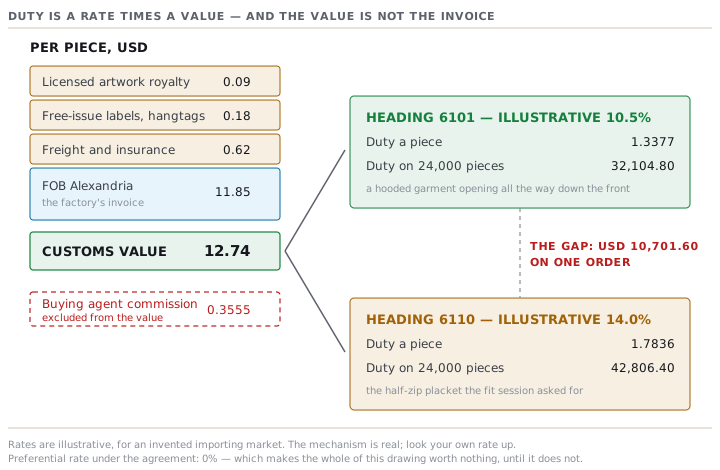
That last line is worth more than it looks. A commission paid to a selling agent is part of the value. A commission paid to the importer's own buying agent is specifically excluded. The same word does two opposite jobs.
Brandvik's agent in Alexandria is a buying agent, so the USD 8,532 stays out. A broker who adds it anyway, because the number is sitting on the file, pays 14.0% on it. That is USD 1,194.48 of duty on this order that nobody owed.
Notice the size of the whole valuation question. The additions moved the value by USD 0.27 a piece. At 14.0% that is USD 0.0378 a piece, or USD 907.20 on the order. It is not a career-ending number. It is exactly the sort of thing an audit finds two years after clearance, with interest attached: cheap to get right once, expensive to correct afterwards.
The rate comes from a code, and the code comes from the garment
Now the other half. The rate is not attached to "a hooded sweatshirt". It is attached to a position in a tariff schedule, and getting there is a formal exercise called classification.
The framework is the Harmonized System, run by the World Customs Organization under the International Convention on the Harmonized Commodity Description and Coding System. Almost every trading country uses it. That is why an eight-digit code from one country looks so much like an eight-digit code from another.
The resemblance is only partly real, and the real part is worth knowing: the Harmonized System is harmonised to six digits and no further. Everything after the sixth digit is a national subdivision, written by the importing country for its own purposes, including its own duty rates. So a ten-digit code is that country's opinion, not an international fact about your garment. Two countries can split the same six digits very differently.
For apparel, the structure above the six digits is easy to hold in your head. Textiles and clothing sit in Section XI. Inside it, Chapter 61 is garments that are knitted or crocheted, and Chapter 62 is garments that are not. So the single most important thing about a garment, for classification, is how the fabric was made — before anybody looks at what the garment is for.
HD-260 is knitted fleece, so it is in Chapter 61. Below that, two headings are in play:
- 6110, which covers jerseys, pullovers, cardigans, waistcoats and similar articles, knitted or crocheted;
- 6101, which covers men's or boys' overcoats, anoraks, wind-cheaters, wind-jackets and similar articles, knitted or crocheted.
A hooded fleece garment can look like a candidate for either. Which one it is turns on how it is built. Does it open all the way down the front? How does it fasten? Is it made and finished as an outer garment? That is a reading of the physical garment against the heading texts and the legal notes. It is not a judgement about the design intent on the mood board.
Brandvik's broker worked from the January tech pack and expected 6101. The sample he had seen had a full-length separating zip. The illustrative Kaldera rate on that heading is 10.5%.
On 6 March the buyer's design team changed the front. The full separating zip became a half-zip placket, because the full zip broke the chest artwork in the fit session and nobody liked the result. It was a good decision, made for a good reason, by people who had never heard of a tariff heading. The garment that resulted is a pullover, and it goes to 6110, at an illustrative 14.0%.
| Heading 6101, illustrative | Heading 6110, illustrative | |
|---|---|---|
| Rate | 10.5% | 14.0% |
| Duty per piece on a customs value of USD 12.74 | 1.3377 | 1.7836 |
| Duty on 24,000 pieces | 32,104.80 | 42,806.40 |
USD 10,701.60, decided by a fit comment in March.
That is the lesson underneath the arithmetic, and it is worth saying plainly: a specification change is a duty change. Not always, not by much, and often not at all. But the only way to know is to ask, and the only moment it is cheap to ask is while the change is still on paper.
Where the answer is genuinely contested, the honest response is not to pick the heading you prefer. Most customs administrations issue advance rulings: a binding written decision on classification, and often on origin, before the goods arrive. The duty to offer them sits in the WTO Trade Facilitation Agreement, whose Article 3 requires members to rule in advance on tariff classification and on origin.
Applying in March would have cost Brandvik some paperwork and no money. It would have turned a USD 10,701.60 uncertainty into a fact before the first shipment. The question was left open instead, because — for a reason lesson 2 will destroy — it did not appear to matter.
Classification turns on features, not on intentions
If you need one example to convince a design team that the tariff cares about construction details, use this one.
The chapter notes to Chapters 61 and 62 of the Harmonized System decide whether a garment is men's or women's by which way the front overlaps. Left over right for men's and boys'. Right over left for women's and girls'. And a garment that cannot be identified as either is classified with women's and girls'.
There is no fibre in that rule. No fit. No marketing. A button placement decides which line of the tariff the goods enter, and where the two lines carry different rates, it decides the duty.
Once you accept that, the practical questions follow, and not one of them is exotic. Every answer is on a tech pack you already have. Does it open all the way down the front, and does it fasten? Is there a hood, and is it lined? What is the fibre content by weight? Is it made up as an outerwear garment, with a wind-resistant face or a lining? And which way does the front overlap?
Who actually pays, and why it is not the same question
Duty is owed by the importer of record, which here is Brandvik. Tanmia sells FOB Alexandria. It does not clear the goods, does not file the entry, and has no liability to Kaldera customs at all.
That is the legal answer, and it is why so many factories genuinely believe duty is not their problem.
The commercial answer is different. Brandvik buys at a landed cost per piece, against a retail price it has already set. Every dollar of duty is a dollar of the same margin the FOB comes out of. A factory that hands its buyer a duty problem has made itself more expensive without changing its price. And because the buyer sees only one number, it usually never finds out why the next order went elsewhere.
Prompt · Build the landed number your buyer is actually managing against
Before you quote, or the first time a buyer tells you a competitor was cheaper and you cannot see how.
Act as an import compliance manager for a clothing retailer, working for me rather than for my supplier. I want the landed cost of one order built properly from an FOB price, so I can see the duty line my cost sheet stops short of.

Order facts: garment [DESCRIBE IT — KNITTED OR WOVEN, GENDER, WHETHER IT OPENS DOWN THE FRONT AND HOW IT FASTENS, HOOD, LINING], fibre content by weight [PERCENTAGES], quantity [QTY], FOB [PRICE] at [PORT], destination market [MARKET], term of sale [TERM]. Freight and insurance to the port of import [AMOUNT] a piece, or [AMOUNT] a container at [PIECES] a container. Things my buyer gives me free of charge: [LIST THEM WITH VALUES — LABELS, HANGTAGS, TRANSFERS, TRIMS, TOOLING, ARTWORK]. Royalties or licence fees payable as a condition of sale: [AMOUNT]. Buying agent commission: [AMOUNT OR PERCENT].

Do the following. First, tell me whether the destination values imports on a CIF basis or on a value that excludes freight, and say how you know rather than just asserting it. Second, build the customs value per piece line by line from my FOB. Show each addition and each exclusion, and name the rule that puts it there. Third, name the two most likely tariff headings for this garment, and the construction features that decide between them. Do not pick one and move on; show me the argument. Fourth, for each heading, give the duty per piece and on the whole order at the rate you believe applies. Say plainly that the rate must be confirmed against the destination's own published tariff. Fifth, tell me which single change to the garment specification would move it between the two headings. Sixth, tell me what an advance ruling would cost me in time, and what it would settle. Do not give me a range where a number is possible, and list every assumption you made at the end.
AI can make mistakes — check anything you act on.
There is one important exception to the legal answer, and it belongs to the term of sale rather than to this course. If the goods are sold delivered duty paid, the seller clears them for import and pays the duty itself. Everything else leaves import clearance with the buyer. Course 8.3 owns the terms. All you need here is the reflex: before you argue about who bears a duty, read which party the contract makes the importer.
Check yourselfYour buyer's broker asks you to confirm the value of everything the buyer free-issues you for this style. Why is he asking, and what happens if you tell him nothing?Show the answer
He is building the customs value, and free-issued materials are an assist that must be added to the price on your invoice. If you say nothing, the entry is filed on an understated value. That is not a saving. It is an underpayment that surfaces in an audit after clearance, with interest, and the importer has no defence — the goods really did contain your buyer's labels. The number is easy to produce on the day and expensive to piece together two years later.
Check yourselfA fit session moves your hooded garment from a full separating zip to a half-zip placket. Nothing else changes. What is the customs question, and who do you ask?Show the answer
The question is whether the garment is still in the same tariff heading. Opening all the way down the front is one of the features that separates a pullover-type article from an outerwear-type one. You ask the importer's customs broker or compliance desk, in writing, while the change is still a sample comment. If the answer is genuinely contested, an advance ruling from the importing administration settles it before the goods ship rather than after.
What you should be able to do now
Build the customs value of any confirmed order from your own FOB. Add freight and insurance if the destination values on a CIF basis. Add everything the buyer gives you free. Add any royalty payable as a condition of sale. Leave the buying commission alone. Then find the rate that value is multiplied by, and ask what feature of the garment put it there.
You will have a number. Lesson 2 is why that number was zero for the first two shipments of this order — and why it stopped being zero in July without anybody deciding that it should.