Lessons · Lesson 3 of 3
Proving it, and paying for it when you cannot
Assemble the evidence file behind an origin claim, price a verification that goes wrong fourteen months later, and see which side of the invoice ends up holding it.
Lesson 3 of 3 · 34 min
A letter in November of the following year
Claiming a lower rate of tax at a border is easy on the day. Somebody signs a statement, the goods are released, and nobody asks for evidence. The evidence is asked for later, often more than a year later. By then the season is over and the people who decided have moved on. This lesson assembles the file that has to answer that request.
4 November. Brandvik's import compliance manager forwards a letter from Kaldera customs to Tanmia's export documentation office. It concerns four entries filed the previous year against BRK-4402, and it asks a single question: on what basis was preferential origin claimed?
The letter arrives fourteen months after the last of those entries cleared. The goods have been sold. The season is over. The people who made the decisions have moved desks. And the answer to the question is sitting in a fabric purchase file that nobody connected to an origin declaration, because the two documents were produced by two departments that do not talk to each other.
A certificate is a conclusion, not evidence
The single most useful sentence in this lesson: the proof of origin is a statement of a conclusion, and the evidence is the file underneath it.
Depending on the agreement, that statement takes one of a few forms. A certificate on a prescribed form, endorsed by a chamber of commerce or a government authority. A declaration the exporter prints on the commercial invoice. A statement made by an exporter who is registered for the purpose. The form varies. What never varies is that the person who signs it is asserting a fact about production, and is expected to be able to demonstrate it later.
Nor does the customs administration receive the evidence at the time. It receives the assertion, releases the goods at the preferential rate, and reserves the right to come back.
That is not a loophole. It is the design. Clearing a container is measured in hours, and verifying a supply chain is measured in weeks, so the system trades speed at the border for the ability to audit afterwards. The consequence for you is that the moment of maximum scrutiny is not the moment of shipment. It is one to five years later, in an office, with an auditor holding your invoices.
What must be in the file for an apparel claim under a fabric-formation rule is not mysterious:
- the fabric mill's invoice and delivery notes, showing what was bought, from whom, and where the mill is;
- a supplier declaration from that mill, stating where the fabric was knitted or woven and dyed — a statement of origin about the material, on which your statement about the garment rests;
- your own production records — knitting or weaving output, dyeing batch records, cutting tickets, sewing output — tying a fabric lot to a PO, a shipment and a date;
- the yarn purchases behind the fabric, if the rule reaches back that far;
- the export documents — invoice, packing list, bill of lading — matching the entry that was filed;
- the proof of origin itself, and a record of who authorised its issue.
Any one of those can be reconstructed with effort. What cannot be reconstructed is a fact that never happened. If the fabric was knitted outside the territory, no document will fix it. The correct thing to do with a claim you cannot support is to stop making it.
What a failed verification costs
Kaldera's administration reviews what Tanmia can produce. It finds that the fabric for shipments 3 and 4 was knitted and dyed outside the territory, and denies the preference on those entries. The claim on shipments 1 and 2 is supported and stands.
The duty is then recovered from the person who owed it, which is the importer.
| Line | Amount |
|---|---|
| Pieces affected — shipments 3 and 4 | 14,400 |
| Customs value a piece | 12.74 |
| Duty a piece at 14.0% | 1.7836 |
| Duty recovered | 25,683.84 |
| Interest, illustrative 6% a year, simple, over fourteen months | 1,797.87 |
| Total demand on the importer | 27,481.71 |
Penalties are a separate question. They vary by market, and the honest answer is that they turn on whether the administration reads this as an error or as something worse. A file that shows a documentation process with no origin check in it is evidence of carelessness — which is usually the better of the two findings available.
Set the demand against the factory's saving from lesson 2, USD 5,572.80, and the whole episode costs the two companies together about five times what one of them gained.
The asymmetry that decides how you behave
While assembling the file, Brandvik's compliance manager finds something else. Shipment 1, 4,800 pieces, cleared in June at the full 14.0%. The origin declaration was still in a courier envelope on the day of entry, and the broker filed without it rather than let the container sit. Nobody noticed, because a duty line on a landed sheet does not look wrong the way a missing carton does.
That duty — 4,800 pieces at USD 1.7836 — is USD 8,561.28, and those goods genuinely qualified.
Many markets allow an importer to claim a preference after the fact, within a stated window, supported by a valid proof of origin covering the goods. Brandvik files the claim and expects to recover the money. Note what had to be true for that to work: the goods really did originate, the mill and production records really do exist, and the window has not closed.
Now hold the two halves of this lesson next to each other. Together they are the single most important behavioural fact in the whole subject.
- A wrong claim finds you. It arrives as a letter, on the administration's schedule, with interest running from the date of entry.
- A missed claim does not. Nobody writes to tell you that you overpaid. You recover it only if you go and look, and only inside a window that expires quietly.
The same discipline serves both. The money is not in the certificate. It is in the file that lets you prove or disprove a claim on demand.
| Line | Amount |
|---|---|
| Duty and interest demanded on shipments 3 and 4 | 27,481.71 |
| Duty recovered on the unclaimed shipment 1 | 8,561.28 |
| Net cost of fourteen months of not asking | 18,920.43 |
Who pays, and what the contract says about it
Brandvik is the importer of record. It owes the money to Kaldera customs, it owes it now, and no argument with its supplier suspends that. Whether it can then recover from Tanmia is an entirely separate question, governed by the vendor agreement, and the answer is whatever that agreement says.
A well-drafted apparel vendor agreement contains an origin clause. The supplier warrants that goods described as originating meet the applicable rule. It undertakes to keep supporting records for a stated period and to co-operate with any verification. And it indemnifies the buyer for duty, interest and penalties arising from an incorrect declaration. Where that clause exists it is usually decisive. Where it does not, the buyer is arguing from general principles against a supplier it needs next season.
Four options were actually on the table here, and they are the four that are always on the table.
- Brandvik absorbs it. USD 27,481.71, which is USD 1.15 a piece across the order. That is most of a season's margin improvement on the style, taken in one line.
- Brandvik claims under the origin warranty. Tanmia carries the duty of USD 25,683.84. Brandvik carries the interest of USD 1,797.87, which the clause does not cover. Eight weeks, and a difficult conversation before the next price negotiation.
- They split it. USD 13,740.86 and USD 13,740.85. Nobody is happy and both keep working.
- They offset it against future business. USD 0.31 a piece across the next 90,000 pieces recovers USD 27,900, which is USD 418.29 more than the demand. It costs Tanmia real margin, it costs Brandvik nothing in cash today, and it keeps a supplier that has otherwise performed.
There was a fifth option that people reach for, and it was not available: cure it retrospectively. A retrospective proof of origin can be issued under many agreements, but only where the goods actually qualified and the evidence for that existed at the time. Here the facts failed, not the paperwork. You can reissue a document. You cannot reissue a knitting run.
Prompt · Assemble the origin file before somebody asks for it
When you sign origin declarations as a routine and could not, today, prove one of them.
Act as a customs auditor preparing to verify a preferential origin claim, and be as unhelpful to me as a real one would be. I want to find the holes in my own file before you do.

Facts: exporting country [COUNTRY], importing market [MARKET], agreement [NAME], product-specific rule as written [PASTE IT, OR SAY IT IS UNKNOWN], purchase order [NUMBER], style [CODE], quantity [QTY] in [NUMBER] shipments, dates [DATES], proof of origin type and issue dates [DESCRIBE]. Materials: every fabric in the garment with the mill, the country it was formed in, the invoice number, and whether I hold a supplier declaration [LIST THEM]. Production records I can produce: [LIST — KNITTING OR WEAVING OUTPUT, DYEING BATCHES, CUTTING TICKETS, SEWING OUTPUT, PACKING LISTS]. Anything that changed mid-order: [DESCRIBE, WITH DATES].

Do the following. First, list the documents you would ask for, in the order you would ask for them, and say what each one is meant to prove. Second, go through my list and tell me which of your requests I cannot currently satisfy. Rank those gaps by how likely each is to defeat the claim on its own. Third, tell me specifically what a mid-order change of fabric mill does to a claim, and what would have to be true for the shipments before the change to stand while the ones after it fall. Fourth, if the claim fails on part of the quantity, calculate the duty recoverable on that part at [RATE] on a customs value of [AMOUNT] a piece. Add interest at [RATE] a year over [MONTHS] months, and show the total demand. Fifth, tell me who the demand goes to, and what a supplier origin warranty in a vendor agreement typically does and does not cover. Sixth, tell me whether a retrospective proof of origin can cure this, and be precise about when it can and cannot. Seventh, write me the five-part origin file I should have had, as a template I can fill in. Do not reassure me.
AI can make mistakes — check anything you act on.
The one-page origin file
Everything in this course reduces, on the factory side, to a single document per purchase order that a stranger could pick up in three years and follow. It has five parts.
- The claim. Which agreement, which product-specific rule, in the rule's own words.
- The materials. For every material the rule reaches — under a fabric-formation rule that means the shell fabric, the rib, the lining and any other fabric — the mill, the country the fabric was formed in, the invoice number, and a supplier declaration.
- The production. Which fabric lot went into which cut, and which cut into which shipment, with dates.
- The statement. A copy of the proof of origin issued, and the name of the person who authorised it against parts 1 to 3.
- The exceptions. Anything that changed mid-order, with the date it changed and what was done about it. The whole failure in this course would have been a two-line entry here on 11 July.
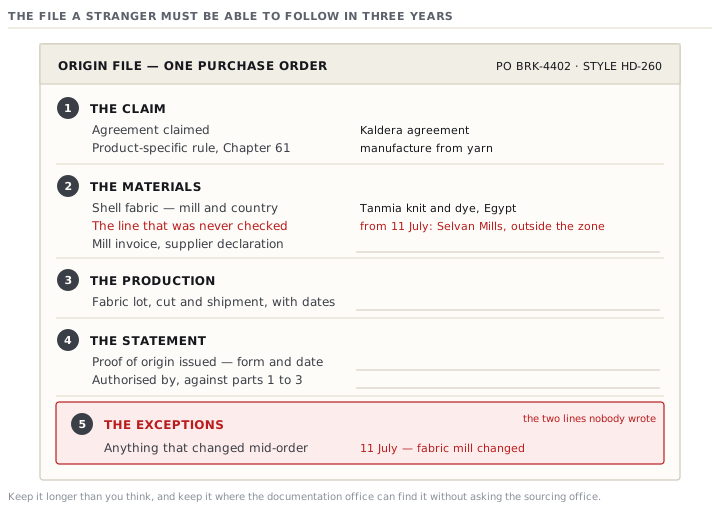
Retention periods vary by agreement and are usually several years. Keep it longer than you think, and keep it where the documentation office can find it without asking the sourcing office.
Why a factory should care about a number it never pays
Here is the closing arithmetic, and it is the argument to take to your own management.
Brandvik is choosing between two suppliers for next season. Tanmia quotes FOB USD 11.85 and can demonstrate originating status. A second factory quotes FOB USD 11.55 and buys all its fabric as finished goods from outside the zone.
| Tanmia | The cheaper factory | |
|---|---|---|
| FOB a piece | 11.85 | 11.55 |
| Freight, insurance and additions | 0.89 | 0.89 |
| Customs value a piece | 12.74 | 12.44 |
| Duty rate | 0% | 14.0% |
| Duty a piece | 0.00 | 1.7416 |
| Landed a piece | 12.74 | 14.1816 |
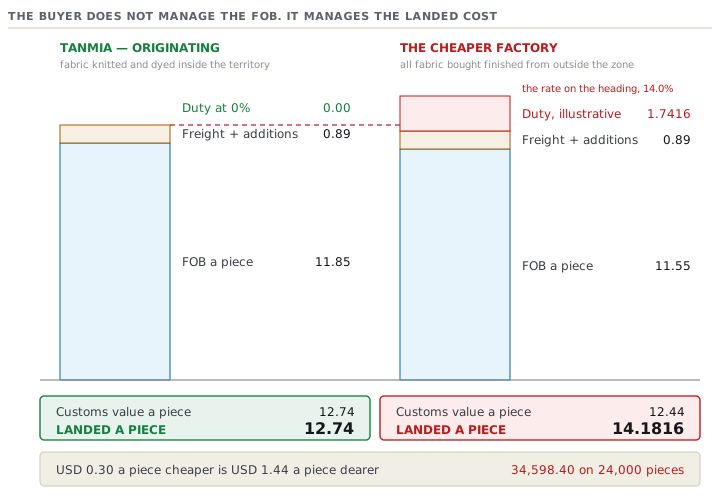
The factory that is USD 0.30 a piece cheaper is USD 1.44 a piece more expensive — USD 34,598.40 on 24,000 pieces. And unless somebody at that factory understands why, it will never learn what happened. It will simply be told the price was not competitive.
That is the position most factories are in today. The one that can hand a buyer a completed origin file with its quotation is selling something its competitors are not, and it is selling it into the only number its customer actually manages.
Check yourselfYour buyer asks you to sign an origin declaration for a shipment. What do you check before you sign, and what do you keep afterwards?Show the answer
Check the product-specific rule for your chapter in the agreement being claimed. Then check that the materials the rule reaches actually meet it. Under a fabric-formation rule, that means where every fabric in the garment was knitted or woven, evidenced by the mill's invoice and a supplier declaration — not by the sourcing team's recollection. Afterwards keep that evidence with the production records tying the fabric lot to the shipment, for the retention period the agreement sets. If you cannot answer the fabric question today, you cannot sign today.
Check yourselfA verification arrives on an order where the goods did qualify, but your fabric mill has since closed and will not answer a letter. Where do you stand?Show the answer
Better than you fear and worse than you would like. Your own records are evidence: the mill's original invoices and delivery notes, the supplier declaration you took at the time, your dyeing and cutting records. They are why you take the declaration at the time rather than when it is asked for. What you cannot do is obtain a new statement from a company that no longer exists. This is the practical reason retention is a supplier-qualification question and not a filing question.
What you should be able to do now
Take one live order to a market you claim a preference into, and build its origin file: the rule, the fabric mills, the supplier declarations, the production trail, and the name of the person who signs. If any of the five parts is missing, you have found the shape of your next verification letter — and you have found it while it is still free to fix.