Lessons · Lesson 3 of 3
Minimums, consolidation, and the shortage in week three
Price the four ways out of a shortage, then go back and see the two procurement decisions that would have prevented it.
Lesson 3 of 3 · 46 min
The morning it becomes real
Running short of cloth invites the obvious remedy, which is to buy more cloth. On a tight calendar that is usually the one answer that cannot work. A fresh batch of a dyed colour arrives after the sewing floor has moved on. This lesson prices the four ways out against the date rather than the price. Then it goes back to the day the shortage was really created.
Back to 21 April. The cutting master cannot cut 112 Rust hooded sweatshirts and 89 Ecru ones. Sewing finishes on 30 April, final inspection is on 4 May, and the goods leave the factory on 7 May.
The first instinct is to ask the mill for more fabric. Do the arithmetic on that instinct before you act on it, because the cheapest option is very often not on the table at all.
| Way out | In the store by | Cost | Residue | Needs |
|---|---|---|---|---|
| Re-dye at the mill, minimum lot 300 kg, air freight | 7 May | USD 3,990 | 229.1 kg | Nothing — and it still misses the sewing floor |
| Buy 300 kg from a local stockist, near match | 25 April | USD 2,760 | 229.1 kg | The buyer accepting an off-shade in writing |
| Re-marker the remaining fabric | 22 April | USD 96 | None | Two hours of the CAD room and a slower lay |
| Short-ship and take the deduction | — | USD 12.40 a piece plus 15% | None | The buyer accepting a short colour |
The re-dye fails on the date, not on the price. The mill's minimum dye lot on this quality is 300 kg. The chain from release to your gate is 16 days even with the queue bought back, so the fabric lands on 7 May — the day the container leaves. Fabric that arrives after the sewing floor has moved on is not a solution at any price. It is 229.1 kg of Rust fleece you have paid USD 3,990 for and will carry into next season.
The stockist works on the date and fails on the shade. Near match means grade 4 on the grey scale against the standard. That needs Rennick's written acceptance, and you are asking for it in the same email in which you tell them the colour is short. That is the worst moment to ask anyone for anything.
The re-marker is the option nobody costs, and it is the best one. The 88 kg of fixed loss per colour from lesson 1 is an average, not a law. Roll tails and the residue under the last lay are physically there in the cutting room. What makes them waste is that nobody has laid a marker short enough to use them. Re-marking the remnants as a short lay in the two smallest sizes recovers 41 kg on Rust and 34 kg on Ecru — 65 pieces and 54 pieces — for two hours of CAD time and a slower lay. It costs USD 96.
The same error, fatal on one colour and invisible on the other
After the re-marker, Ecru is 35 pieces short and Rust is 47.
The contract allows a delivery tolerance of plus or minus 2% per colour. On Ecru that is 52 pieces, so 35 short ships inside tolerance with no deduction, no email and no conversation. On Rust it is 28 pieces, so 47 short is a breach. The deduction is the FOB value plus a short-delivery charge of 15%, which is 47 x USD 12.40 x 1.15 = USD 670.22.
Total cost of the shortage: USD 766.22, against USD 973.10 of fabric that the flat allowance did not buy. The saving cost more than it saved. And that is with the cheap recovery available and a buyer who did not make an issue of it.
The number worth carrying out of this is not the USD 766.22. It is that a percentage tolerance becomes a piece count once you get to the colour line. The identical arithmetic error was absorbed silently on a 2,600-piece colour and became a chargeable breach on a 1,400-piece one. Everything in material planning gets more dangerous as the colour gets smaller, and the smallest colour is the one nobody checks.
Ordering to the minimum, not to the requirement
Now go back to February and look at what was actually raised, because the shortage was the second-most expensive thing Rust did to this order.
Suppliers do not sell what you need. They sell what their process can make in one go. The mill dyes in lots and will not run less than 250 kg of rib. The nominated zip supplier moulds and assembles in runs and will not book less than 3,000 pieces of a colour.
| Line | Rust requirement | Supplier minimum | Bought | Stranded | Value |
|---|---|---|---|---|---|
| Rib, dyed to match | 91.14 kg | 250 kg | 250 kg | 158.86 kg | USD 1,413.85 |
| Zip, custom colour | 1,428 | 3,000 | 3,000 | 1,572 | USD 974.64 |
Stranded value on the Rust colourway: USD 2,388.49. Across 1,400 pieces that is USD 1.71 a piece, on a garment selling at FOB USD 12.40.
The expected margin on this style is USD 1.12 a piece. Rust was budgeted to make 1,400 x 1.12 = USD 1,568. Instead it loses USD 820.49 — on an order whose whole expected profit is USD 20,160. A colour that is 7.8% of the pieces has removed about 12% of the profit, and it did so the moment the purchase orders were raised, months before anybody could see it.
There were three ways out of that, and all three had to be taken in February:
- Raise the colour to the minimum. Ask the buyer to take 3,000 Rust instead of 1,400. The trim is bought either way, so you may as well ship it as garments.
- Share a trim across colourways. A Charcoal zip and Charcoal rib on a Rust body is a design decision, and on a hooded sweatshirt a contrast rib is usually a feature rather than a compromise. It removes both minimums at once.
- Price the residue into the colour. If the range needs Rust and the trims cannot be shared, the Rust line carries USD 1.71 a piece of stranded trim, and the cost sheet should say so, so that somebody decides knowingly.
Residue is an asset or a write-off, and you choose when you raise the order
Every minimum leaves a remainder, and merchandisers habitually call it stock. Whether it is stock or scrap is decided by three tests, and you can apply all three before you place the order:
- Is it colour-neutral? Greige fabric — cloth that has been knitted or woven but not yet dyed — keeps almost all its value, and so do black thread, plain polybags and unprinted cartons. Anything dyed to a buyer's standard is worth what one buyer will pay for it, and that buyer has already bought.
- Is there a named next order? Not "we always repeat this" — a style number and a season. The 158.86 kg of Rust rib is an asset the moment Rennick confirms a Rust repeat, and a write-off the moment they do not.
- Will it still be acceptable when that order comes? Dyed goods drift, elastic relaxes, and adhesive tapes age. A trim held for two seasons is often re-tested and re-approved before it can be used, and that costs more than it is worth.
Anything that fails all three should be written off in the month it is created, not carried at cost for three years and discovered during a stock count. Carrying a dead trim at full value is not caution. It is an unbooked loss that grows a storage cost every month.
Consolidating across orders
The most useful thing in this course is also the simplest, and almost nobody does it: look at your other live orders before you place a purchase order.
On 26 February, Khalda has three confirmed orders that all use quality F280:
| Order | Style | Pieces | Colours | Requirement |
|---|---|---|---|---|
| PO 5514 | RN-6140 hooded sweatshirt, Rennick | 18,000 | Four | 11,717.2 kg |
| PO 5518 | RN-6165 crew sweatshirt, Rennick | 7,500 | Charcoal and Navy | 4,409.3 kg |
| PO 6127 | VT-2080 kids' hoodie, Vanterra | 9,000 | Ecru | 3,443.7 kg |
| Total | 34,500 | 19,570.2 kg |
Serapeum prices F280 in bands: under 5,000 kg at USD 7.85, from 5,000 to 14,999 kg at USD 7.40, and 15,000 kg and above at USD 7.05.
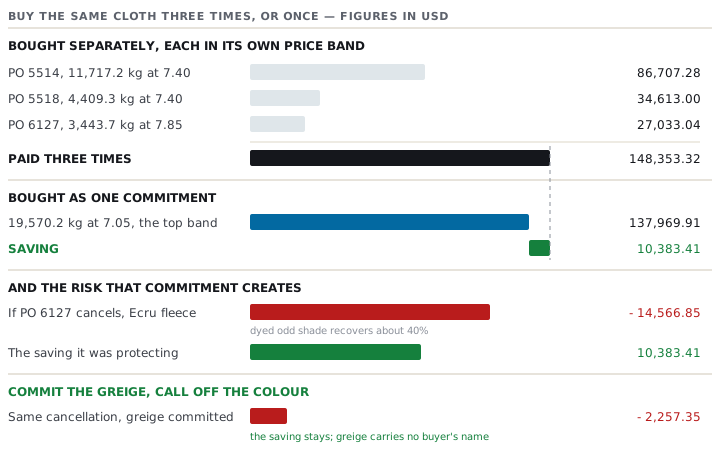
Bought separately, each order sits in its own band: USD 86,707.28 plus USD 34,613.00 plus USD 27,033.04 is USD 148,353.32. Bought as one commitment, 19,570.2 kg at USD 7.05 is USD 137,969.91. The difference is USD 10,383.41, which is more than half the expected profit on PO 5514, and it required nobody to work harder or faster.
Then stop and price the risk you have just taken. This is where the obvious answer becomes the wrong one. Consolidating means committing to all three quantities on the earliest date. Vanterra's PO 6127 is confirmed, but Vanterra has cancelled late before. If it goes, you are holding 3,443.7 kg of Ecru-dyed fleece in a shade nobody else specified, and dyed odd-shade knit fleece recovers about 40% of its cost on the local market. That is a USD 14,566.85 loss to protect a USD 10,383.41 saving.
The professional answer is not to abandon the consolidation. It is to consolidate the part that carries no colour risk:
Commit the greige, call off the colour. Serapeum will give the 15,000 kg band price against a committed tonnage of undyed F280, with colour and quantity released in call-offs at 21 days' notice. Greige has no buyer's name on it. Your next three orders in this quality will take it, and the mill's other customers will take it if you cannot. Exposure on a cancelled PO 6127 falls from USD 14,566.85 to about USD 2,257.35, and the USD 10,383.41 stays.
The same shape works on dye lots. Consolidating the greige still lets you dye Charcoal for PO 5514 and PO 5518 in one lot, which is a real gain. One lot means one shade band across two styles a buyer will see side by side in a store.
What you actually raise
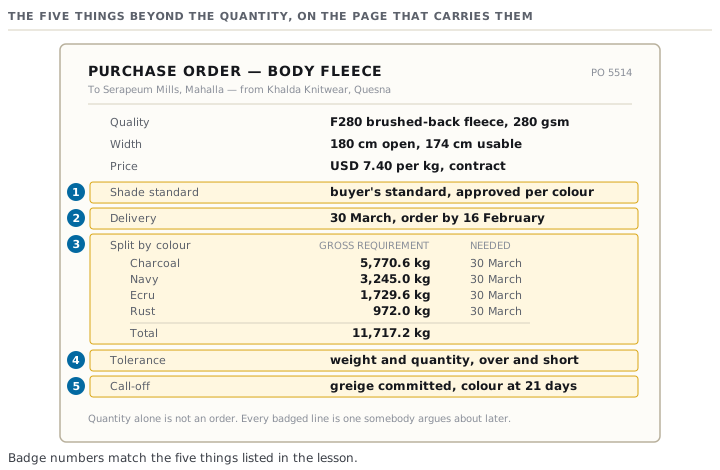
A purchase order that survives contact with a factory carries five things beyond the quantity:
- The quality and shade standard it was approved against.
- The delivery date taken from the offset table, not the one the supplier suggested.
- The split by colour, each with its own date.
- The tolerance rule — what happens if the weight or quantity delivered falls outside it.
- The call-off terms, if the commitment is bigger than the first release.
Here is that purchase order as it really goes out, with those five things marked on it.
Everything in this course reduces to one habit. Before you send a purchase order, ask what happens if you are wrong by 10% on that line. If the answer is "we buy it twice", change the order before you send it, not the explanation afterwards.
Check yourselfA trim supplier quotes a minimum of 5,000 pieces and you need 1,900 for one colourway. What is the first question you ask, and who do you ask?Show the answer
Not the supplier. Ask the buyer whether the colourway can go to 5,000 pieces, or whether that colourway can share the trim of a bigger one. The minimum is a fact about the supplier's process and will not move much. The range is a decision the buyer has not yet finalised and can move a great deal. Only when both answers are no is it a costing question, and then the 3,100 stranded pieces belong on that colourway's cost line where somebody has to look at them, not spread invisibly across the order.
Prompt · Price a minimum I cannot avoid
When a supplier's minimum is bigger than a colourway needs, and you want the leftover valued and placed on somebody's cost line before the order is raised.
You are a costing auditor. A supplier minimum is bigger than my requirement. I need to know what that costs and who should carry it.

Material and supplier: [description]
My requirement for this colourway: [quantity and unit]
Supplier minimum: [quantity]
Price: [per unit]
Colourway: [name], [pieces] pieces of an order of [total pieces]
Selling price and expected margin per piece: [FOB and margin]
Other live orders or colourways that could use this material: [list, or none]

Do four things. One: work out the stranded quantity and its value, express it per piece of this colourway, and tell me what it does to that colourway's margin. Two: test whether the leftover is an asset or a write-off, on three grounds — is it colour-neutral, is there a named next order for it, and will it still be acceptable when that order comes. Three: give me the alternatives in the order I should try them, including raising the colourway to the minimum and sharing a trim across colourways, with the cost of each. Four: write the two sentences I should send the buyer, stating the problem and the choice, without asking them to solve it for me.
AI can make mistakes — check anything you act on.