Lessons · Lesson 1 of 3
What you need, and what the store actually has
Turn a confirmed order into a requirement for each colour, then subtract a stock figure you have no reason to trust.
Lesson 1 of 3 · 48 min
Two complaints, one line on a spreadsheet
A wastage allowance is written as one percentage. It is really two different things sharing one number. Part of what a cutting room loses grows with the size of the order. The rest is spent once for each colour, however small that colour is. Use one flat percentage and the fixed part over-buys the biggest colour and starves the smallest.
Khalda Knitwear, Quesna. It is Monday 21 April. Two people are standing in the merchandising office and they want different things.
The storekeeper wants a bin number for a roll of Charcoal fleece that has nowhere to go. It is the tail of the main body cloth for style RN-6140. The order is nearly cut and there is fabric left over. He wants to know whether to book it as carry-over stock or write it off.
The cutting master wants 112 hooded sweatshirts in Rust that he cannot cut, because the Rust fabric has run out.
They think they have two problems. They have one. Both were created on 26 February, on a single line of the requirement sheet raised for purchase order PO 5514: wastage allowance, 5%.
This lesson is that sheet, built the way it should have been built.
Three questions, in this order
Material requirement planning sounds like a system you buy. It is one question, asked properly, in three parts:
- What do I need? Consumption times quantity, plus what the process destroys. This is the gross requirement.
- What do I already have? On hand, on order, and honestly free of any other claim.
- When do I need it? That is lesson 2, and it is where most orders are lost.
A system answers all three in a second. It answers them from numbers a merchandiser gave it. If the consumption is wrong, or the allowance is a habit rather than a policy, or the stock figure is a book entry nobody has checked at the bin, the system will be confidently wrong at machine speed. That is worse than being slowly wrong, because nobody argues with a system.
The order
PO 5514, style RN-6140, a men's full-zip hooded sweatshirt for Rennick Outfitters. 18,000 pieces at FOB USD 12.40, an order value of USD 223,200, on board at Alexandria on 14 May.
Four colours. The split matters more than anything else in this lesson:
- Charcoal 9,000
- Navy 5,000
- Ecru 2,600
- Rust 1,400
The body cloth is quality F280, a brushed-back fleece at 280 gsm, 60% cotton and 40% polyester. It is 180 cm wide open, with 174 cm usable once you take off the selvedge (the finished edge of the roll, which you cannot cut garments from). The mill is Serapeum Mills in Mahalla. The contract price for this order's volume is USD 7.40 per kg.
The marker is the cutting plan: the pattern pieces arranged on the cloth. The sample room's marker lays 12 pieces in a size ratio of S2 : M4 : L4 : XL2 and measures 15.10 m.
- Marker area: 15.10 m x 1.74 m = 26.27 sq m
- Per piece: 26.27 / 12 = 2.19 sq m
- Net weight at 280 gsm: 0.613 kg per piece
That is the fabric inside the marker. It is not the fabric you must buy.
Wastage is a policy, and it has two halves
The gap between the marker and the purchase order is the allowance. The most common mistake in this trade is to treat that allowance as one percentage. It is two different things wearing one number.
The variable half grows with quantity. Losses between plies, splices where a roll is joined in the middle of a lay, fabric faults you cut around, panels rejected at the cut-piece check. Cut twice as many garments and you lose twice as much. At Khalda, measured across last season on this quality, that is 3.0%.
The fixed half does not grow at all. It is spent once for each colour. It is the same whether the colour is 9,000 pieces or 1,400:
- the bulk approval and test lay, about 30 m per colour, cut before anyone may lay production
- the stranded tail of the last dye lot, about 90 m — you lay within one lot to hold the shade, and what is left when that lot runs out cannot be joined to the next colour
- the residue under the final lay, about 55 m, where the last lay is short of plies and what remains is shorter than one ply
That is 175 m per colour. At 1.80 m full width and 280 gsm the cloth weighs 0.504 kg per linear metre. So the fixed loss is 88 kg per colour.
Now build the requirement colour by colour. It is the only way it works:
| Colour | Pieces | At 0.613 kg plus 3.0% | Fixed loss | Gross requirement |
|---|---|---|---|---|
| Charcoal | 9,000 | 5,682.6 kg | 88 kg | 5,770.6 kg |
| Navy | 5,000 | 3,157.0 kg | 88 kg | 3,245.0 kg |
| Ecru | 2,600 | 1,641.6 kg | 88 kg | 1,729.6 kg |
| Rust | 1,400 | 884.0 kg | 88 kg | 972.0 kg |
| Total | 18,000 | 11,717.2 kg |
What the flat allowance did
The February sheet did not do that. It took the factory's standard allowance — a flat 5% on the order — and applied it to the whole quantity. Then it split the result across the colours in proportion to their pieces. Every factory did it that way for years. It is signed off in the quality manual. On a one-colour order of 18,000 pieces it is very nearly right.
Total at 5%: 18,000 x 0.613 x 1.05 = 11,585.7 kg. That is 131.5 kg less than the requirement above — USD 973.10 of fabric, on an order worth USD 223,200. Nobody would notice.
The damage is not in the total. It is in the split:
| Colour | Bought | Consumed | Difference | Pieces |
|---|---|---|---|---|
| Charcoal | 5,792.9 kg | 5,770.6 kg | 22.3 kg over | — |
| Navy | 3,218.3 kg | 3,245.0 kg | 26.7 kg short | 42 |
| Ecru | 1,673.5 kg | 1,729.6 kg | 56.1 kg short | 89 |
| Rust | 901.1 kg | 972.0 kg | 70.9 kg short | 112 |
A flat percentage gives every colour the same allowance per piece. But the fixed 88 kg is spent once for each colour, large or small. As a percentage that is 1.5% of the Charcoal requirement and 9.1% of the Rust one. So the flat method over-buys the big colour and under-buys the small ones, in the same order, from the same rule.
And the surplus cannot rescue the shortage, because it is dyed. There is one roll of Charcoal in the store and 112 Rust hoodies that will not exist. That is the whole of the 21 April conversation, and it was decided in February.
The requirement is nine lines, not one
Fabric is the money, so fabric gets the attention. Then the order stops for a drawcord. The requirement sheet covers every line on the bill of materials. Each line has its own unit, its own consumption and its own allowance, because the allowance belongs to the process, not to the sheet.
| Line | Unit | Per piece | Allowance | Requirement |
|---|---|---|---|---|
| Body fleece F280 | kg | 0.613 | 3.0% plus 88 kg a colour | 11,717.2 |
| Rib, 1x1, dyed to match | kg | 0.062 | 5.0% | 1,171.8 |
| Zip, moulded, open end | pc | 1 | 2.0% | 18,360 |
| Drawcord, flat | m | 1.42 | 3.0% | 26,326.8 |
| Aglets | pc | 2 | 3.0% | 37,080 |
| Woven main label | pc | 1 | 2.0% | 18,360 |
| Care and content label | pc | 1 | 2.0% | 18,360 |
| Sewing thread | m | 186 | 8.0% | 3,615,840 |
| Polybag | pc | 1 | 2.0% | 18,360 |
Two of those lines are worth a second look. Thread is quoted in metres and bought in cones: 3,615,840 m at 5,000 m a cone is 724 cones. A purchase order that says "thread as required" is not a purchase order. Aglets — the metal tips on the ends of a drawcord — are two per piece and come from a different supplier from the cord itself. That is exactly the kind of line that is missing from a bill of materials until the finishing floor stops.
Now subtract what you have
The gross requirement is the easy half. The net requirement is gross minus what is already yours. That is the line that costs money, because it is the only line built on somebody else's record-keeping.
Navy is where this order found out. The store system showed 640 kg of F280 in Navy, left from last season. The February sheet subtracted all of it and ordered the difference.
Here is what 640 kg turned out to mean:
- 44 kg had gone to the sample room in December and was never booked out. The system still held it. Physical stock: 596 kg.
- 210 kg was informally promised to a repeat order the sales office had accepted but had not yet raised as a purchase order. Nothing in the system said so. Free stock: 386 kg.
- 148 kg was dye lot
L-2244. Rennick re-issued the Navy standard in January, and that lot now reads grade 4 on the grey scale against the new one. It is perfectly good fabric and it cannot go in this garment.
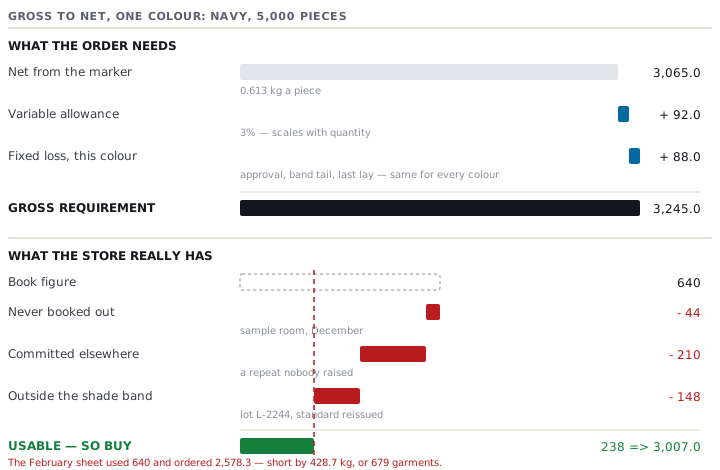
Usable free stock in Navy: 238 kg. The true net requirement is 3,245.0 minus 238, which is 3,007.0 kg. The February sheet ordered 2,578.3 kg. The gap is 428.7 kg — 679 Navy hooded sweatshirts the plan believed were sitting in a bin.
What a merchandiser owes the planner
A requirement run is only as honest as five things, and all five are yours:
- Consumption per piece from an approved marker, with the width it was laid at written next to it. A consumption without a width is a rumour.
- The colour split, not the order total. Every calculation in this lesson changed at the colour line.
- An allowance with its two halves separated, and the order profile it was measured on.
- A complete bill of materials, including the lines that cost nothing and stop everything.
- A stock figure somebody has physically counted, with anything committed, unbooked or out of shade already taken off.
Give a planner those five and the arithmetic is easy. Give a planner four of them and the system will still produce a number, printed to one decimal place. It will be wrong in a way that only shows up in week three of sewing.
Check yourselfYour order is 12,000 pieces in six colours, ranging from 4,000 down to 500. The factory allowance is a flat 4%. Without doing the arithmetic, which colours are at risk and why?Show the answer
The small ones, and the risk grows as the colour gets smaller. A flat percentage assumes every kilogram of loss grows with quantity. But a fixed loss for each colour — approval yardage, the stranded tail of a dye lot, the residue under the last lay — is spent once, however many pieces follow it. Spread over 4,000 pieces it disappears inside 4%. Spread over 500 it can be double that. Six colours also means the fixed loss is paid six times instead of once, so the order total is understated as well. Rebuild the requirement colour by colour before you place anything.
Prompt · Attack my requirement calculation
Before a fabric or trim purchase order goes out, when the requirement sheet looks tidy and you want it broken rather than approved.
You are a fabric store manager and a cutting master, arguing together against a merchandiser. I will give you a requirement calculation. Break it, do not confirm it.

Style and garment: [description]
Order quantity and the split by colour: [each colour and its pieces]
Marker: [length] m at [usable width] m for [pieces] pieces, size ratio [ratio]
Fabric: [quality, gsm, full width], bought by [kg or m] at [price]
Allowance used: [percentage, and anything else applied]
Stock the sheet netted off: [quantity, colour, where the figure came from]

Do five things. First, rebuild the gross requirement colour by colour instead of for the order total, and split my allowance into the part that grows with quantity and the part that is spent once per colour. Second, tell me which colour is under-bought, and by how many kilograms and how many garments. Third, list every reason the stock figure I netted off could be smaller than the system says, and what each one would cost me here. Fourth, name any line of the bill of materials I have not mentioned that this garment must have. Fifth, give me one number: the total quantity at risk if you are right and I am wrong. Use my figures only, and say when something is an assumption.
AI can make mistakes — check anything you act on.