Lessons · Lesson 2 of 3
The order-by date that has already passed
Work backwards from a vessel to an order-by date for every line on the bill of materials, and find the line that is already late.
Lesson 2 of 3 · 46 min
The only date the buyer wrote down
A supplier's lead time is not a number they can give you. It is a chain of steps, and most of them were never in their quotation. The wait while your customer approves a colour. The queue in front of a dyeing machine. The honest total is routinely twice the figure in the email.
Go back to 26 February. PO 5514 has been confirmed for six days. The requirement sheet from lesson 1 exists, and the merchandiser is about to raise the fabric order. The only date in the buyer's purchase order is the one at the bottom: on board at Alexandria, 14 May.
Every other date in this order is one you have to work out, and you work backwards. A need-by date minus a lead time is an order-by date. That single subtraction is the whole discipline. When a factory runs it honestly for the first time, it usually finds that several order-by dates are in the past.
Backwards from the vessel
Start at the fixed point and walk back, one step at a time, with a reason for each step:
| Milestone | Date | Why this gap |
|---|---|---|
| On board | 14 May | The buyer's contract date |
| Gate-in at Alexandria | 10 May | Terminal cut-off ahead of sailing |
| Ex-factory | 7 May | Trucking and export documents |
| Final inspection passed | 4 May | Buyer's inspector, whole order packed |
| Packing complete | 2 May | Two days from last sewn piece |
| Sewing complete | 30 April | |
| Sewing start | 13 April | 18,000 pieces on two lines at 620 a line a day is 15 working days |
| Cutting start | 7 April | Cutting stays five working days ahead of sewing |
| Fabric in the store | 30 March | Three days roll inspection, two days relaxation, two days buffer |
Nothing in that table is optional. Two lines in it are routinely forgotten, because they happen inside your own factory. Roll inspection is lead time. Relaxation is lead time too: a brushed-back fleece cut straight off the roll keeps shrinking after it is cut, and the panels come back out of tolerance at the measurement check. Cutting fleece two days early is not a two-day saving. It is a re-cut.
A lead time is a chain, not a number
Ask Serapeum Mills for a lead time and the answer is 20 days. That is an honest answer to a question about their factory. It is not the answer to your question, which is how long it takes for approved fabric to be lying in your store.
| Step | Days | Whose |
|---|---|---|
| Lab dip submitted to bulk shade approved | 9 | Buyer's |
| Mill acknowledgement and yarn call-off | 3 | Mill's |
| Dye-house queue | 8 | Mill's |
| Knitting | 6 | Mill's |
| Dyeing and finishing | 9 | Mill's |
| Mill quality check and roll packing | 3 | Mill's |
| Transit, Mahalla to Quesna | 2 | Mill's |
| Goods-in check at your gate | 2 | Yours |
| Total | 42 |
The mill quoted the four rows it can control once a lab dip is approved. Those four rows total 20 days. The other 22 are the approval loop, the queue in front of a dye machine in the middle of the season, and your own gate. None of them is the mill's fault, and every one of them is on your calendar.
The queue is the row people argue about. It is also the row you should measure instead of arguing about. A dye house running near capacity has work waiting in front of every machine. How long your lot waits depends on how much work is in the queue and how fast the house clears it. It does not depend on how urgent your order is. Ask the mill what their queue is today, in days, and write down the answer with the date you asked. In February it is 8 days at Serapeum. In August, before the autumn shipments, it will not be.
So: fabric in the store 30 March, minus 42 days, gives an order-by date of 16 February. Today is 26 February. The fabric order is ten days late and nobody has said anything, because the fabric has not been ordered yet, and a thing that has not happened does not appear on a report.
Now do it for every line
One lead time is not a plan. Every line on the bill of materials has its own need-by date and its own chain. The line that decides the order is the one with the longest chain. That is almost never the line with the biggest number on the cost sheet.
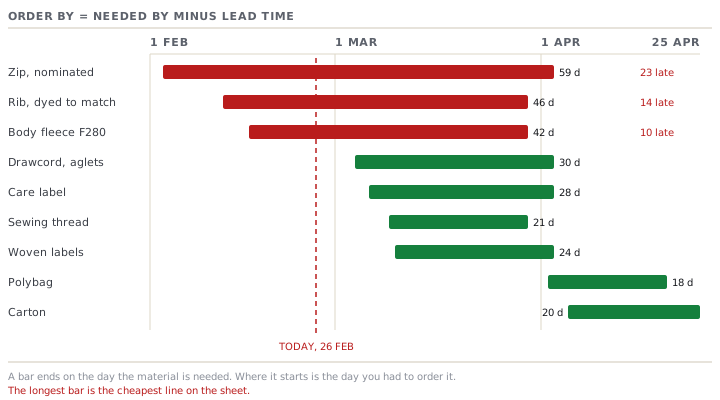
| Line | Needed | Lead time | Order by | Status on 26 February |
|---|---|---|---|---|
| Zip, nominated supplier, custom colour | 3 April | 59 days | 3 February | 23 days late |
| Rib, dyed to match | 30 March | 46 days | 12 February | 14 days late |
| Body fleece F280 | 30 March | 42 days | 16 February | 10 days late |
| Drawcord and aglets | 3 April | 30 days | 4 March | Six days left |
| Care and content label | 3 April | 28 days | 6 March | Eight days left |
| Sewing thread | 30 March | 21 days | 9 March | Eleven days left |
| Woven main and size labels | 3 April | 24 days | 10 March | Twelve days left |
| Polybag | 20 April | 18 days | 2 April | Comfortable |
| Carton | 25 April | 20 days | 5 April | Comfortable |
The zip costs USD 0.62. The fabric costs USD 7.40 per kg and is more than half the cost sheet. Everybody in the building has been watching the fabric. The zip is the line that is going to lose the order:
- Colour matching of the tape and approval, 14 days
- Supplier acknowledgement and production slot, 7 days
- Tape dyeing, moulding, assembly, 21 days
- Sea transit from Taiwan, 12 days
- Clearance and inland delivery, 5 days
Fifty-nine days. And it is a nominated supplier, so you cannot substitute one and you have no leverage over the slot. The critical line is the one with the longest chain, and cheap trims have the longest chains — because a cheap trim is made far away, in bulk, in a colour somebody has to approve first.
Two kinds of buffer, and only one of them works here
Every planner is told to hold a buffer. There are two to choose between. Safety stock is extra quantity: hold more than you need, so a shortage cannot stop the line. Safety time is earliness: order sooner than the arithmetic demands, so a late delivery still lands before you need it.
For a factory buying to order, safety stock is mostly an illusion, and lesson 1 explained why. Fabric dyed to one buyer's standard, rib matched to that fabric, a zip in a nominated colour, a label carrying a brand's artwork — none of that is stock. It is that order's property wearing a bin number. Holding more of it protects nothing. It only enlarges what you write off if the order changes. Safety stock works on the colour-neutral lines: sewing thread in black and white, plain polybags, unprinted cartons, standard-colour zips. Those are exactly the cheap lines, which is why nobody bothers.
Safety time is the buffer that fits this problem, and the rule for placing it is the opposite of what most people do. Do not spread a few days evenly across every line on the sheet. On the short chains that buffer is free, and on the long ones it is nowhere near enough. Put the safety time on the longest chain and on the steps you do not control — the approval loop and the queue. Take it off the lines where you can simply tell a supplier to hurry. The zip should carry two weeks and the polybag should carry none.
Then ask about the queue again. A lead time is a measurement with a date on it, not a constant. The figure a mill gives you in a quiet month is not the figure that governs your order in a busy one. Write the date beside every lead time on your sheet, and treat any number older than a season the way you would treat a stock figure nobody has counted.
Ten days late on the fabric, and what it costs
The fabric can be recovered. Price the recovery before you decide it cannot.
Buy the queue back. Serapeum will hold a dye slot for a priority fee of USD 0.22 per kg. On 11,717.2 kg that is USD 2,577.78, and it removes the 8-day wait in front of the machine. Eight of the ten days come back for the price of a used car tyre per colour.
Recover the last two days at the back end. Two Sunday shifts on both sewing lines: 92 operators, eight hours, at a fully loaded USD 1.35 an hour, with an overtime factor of 1.5. That is USD 1,490.40 a day, so two days is USD 2,980.80.
Total recovery: USD 5,558.58, or 2.5% of the order value.
Now price the alternative properly. This is the comparison that gets the decision made. Miss the 14 May sailing and the next one is a week later, which lands after the buyer's in-store date. The buyer's remedy is air freight. 18,000 pieces at a packed weight of 0.72 kg is 12,960 kg chargeable, and at USD 4.10 per kg that is USD 53,136. That is nearly ten times the recovery, and on most contracts it is charged to you.
Do not take the two days out of the roll inspection and the relaxation instead. Those are the cheapest two days in the whole calendar, and they are the ones everybody reaches for first, because they are inside your own building and nobody has to be asked. Cutting unrelaxed fleece turns a ten-day problem into a measurement failure at final inspection on 4 May, with nothing left to recover with.
The recovery for the worst line is not money
The zip is 23 days past its order-by date, and no fee fixes that. The 21 days of production and the 12 days of sea transit are physical. Air freighting the finished zips costs USD 3,528.79 and still leaves you waiting 21 days for them to be made.
What fixes it is a change to the specification, and you have exactly one week left to ask for it. The nominated supplier stocks the same moulded zip in standard black and standard navy. Take a stock colour and both the 14-day tape matching and the 21-day production disappear: acknowledgement 7 days, sea 12, clearance 5. That is a lead time of 24 days and an order-by date of 10 March. Twelve days of slack instead of 23 days of debt.
The buyer has to accept a contrast zip on the Ecru and Rust colourways. Rennick may say no. But the conversation is available on 26 February, it costs an email, and it is not available on 20 March. That is what running the offset table buys you: it turns a problem that will be discovered into a decision that can be taken.
The rib is the same shape with a different answer. It is 14 days late because it cannot be shade-matched until the fleece standard is approved. Except for Charcoal and Navy: Rennick did not change those standards this season, and the mill already holds them. Release those two colours today and let Ecru and Rust follow the fleece approval. Splitting a release by colour is a recovery tool, and it costs nothing.
Check yourselfA supplier tells you their lead time is 30 days and your goods are needed on 1 June. Is your order-by date 2 May?Show the answer
Only if you have asked what the 30 days contains and what sits outside it. It almost certainly means 30 days of their production, starting from a confirmed and approved order. So it excludes your approval loop, their order queue, transit, customs if it crosses a border, and your own goods-in inspection. Ask for the chain step by step rather than the total, and add the two steps that happen inside your own factory. A 30-day quotation routinely becomes 50 days door to door, and the 20 days you did not ask about are the 20 days you will be late by.
Prompt · Find the line that is already late
The day an order is confirmed, before any purchase order is raised, to turn a ship date into an order-by date for every material.
Act as a production planner building a backward schedule. I will give you a ship date and a bill of materials. I want an order-by date for every line, and a list of the ones that have already passed.

Ship date and mode: [date, sea or air, port]
Order: [quantity] pieces, [colours] colours
Sewing capacity: [lines] lines at [pieces] a line a day, [days] a week
Materials, with the supplier's quoted lead time: [line, supplier, country, quoted lead time]
Today's date: [date]
Anything needing buyer approval before production: [list]

Work backwards from the vessel to the day each material must be in my store. Show every step, and why the gap exists. Then, for each material, open the supplier's quoted lead time into the full chain: approval loop, supplier acknowledgement, queue, production, transit, customs, and my own goods-in inspection. Give me a table of need-by date, real lead time and order-by date, sorted by urgency. Mark every line whose order-by date has already passed, and say how many days late it is. Finish by naming the single line that decides this order, and tell me whether it is the most expensive one.
AI can make mistakes — check anything you act on.