Lessons · Lesson 1 of 3
Four quotes for the same yarn
Read the spinning route behind a yarn price, and say what ring, rotor, air-jet and compact spinning each do to strength, fuzz, evenness and the feel of the garment.
Lesson 1 of 3 · 33 min
The situation
A heap of loose fibre can become thread in several ways. The machine that does it leaves its mark on everything the customer touches. Strength, fuzz, dye depth, whether the shirt pills: all of it follows from the route. This lesson puts the routes side by side and prices the gap between them. The usual spec names a fibre and a thickness. It says nothing at all about the route.
It is 14 March, 08:20, at the yarn desk of Rashid Knitwear in Mahalla al-Kubra. Four quotations are open on the screen. Every one of them answers the same line on the same fabric spec: 100 percent cotton, Ne 30/1. The fabric is the single jersey of style TS-440, a men's T-shirt for the Swedish retailer Nordvik. PO NV-3318, 24,000 pieces, FOB USD 3.20, order value USD 76,800. The knitting programme needs 6,200 kg of yarn.
| Spinner | Yarn offered | Price per kg | Yarn cost on this order |
|---|---|---|---|
| Nile Rotor Spinners | Ne 30/1 carded, open-end | USD 2.80 | USD 17,360 |
| Delta Spinning, line 3 | Ne 30/1 carded, ring spun | USD 3.05 | USD 18,910 |
| Delta Spinning, line 7 | Ne 30/1 combed, ring spun | USD 3.55 | USD 22,010 |
| Anatolia Yarn | Ne 30/1 combed, compact | USD 3.85 | USD 23,870 |
Same fibre. Same count. Four prices. The gap between the cheapest and the dearest is USD 1.05 a kilo — USD 6,510 on this order. That is 8.5 percent of what the whole programme sells for.
Nothing in the phrase "100 percent cotton, Ne 30/1" tells you which of those four yarns you are buying. That is the point of this lesson. The spec line, as written, is not a specification at all. It names a fibre and a thickness. It says nothing about how the fibre was turned into thread. And that one decision sets the strength, the pilling, the dye depth, the feel — and about a dollar a kilo.
The road from bale to yarn
Every one of those four yarns starts the same way. A bale of cotton lint arrives pressed to about 220 kg. It has to become one continuous, even, twisted strand. Six steps do it:
- Blowroom. The bales are opened and mixed. The blend is drawn from forty or fifty bales at once, so no single bale's character reaches the yarn. The tufts are beaten against grid bars to shake out seed, leaf and dust.
- Carding. The first stage that handles fibres one by one. Surfaces covered in fine wire teeth pull the tufts apart, remove short fibres and neps (small knots of tangled fibre), and deliver a soft rope called a sliver, at about 4.5 ktex. You can break a sliver with two fingers, because it has no twist at all.
- Drawing. Six or eight slivers go in and one comes out. Blending them evens out the thick and thin places. Stretching them straightens the fibres and pulls out the hooks the card left behind. Two passes is normal, three for a finer count.
- Combing, if the yarn is to be combed. This step is optional. The whole of the next section is about it.
- Roving. The sliver is drawn down to about 0.7 g per metre and given a tiny amount of twist, just enough to survive the trip to the next machine.
- Ring frame, or the machine that replaces it. It stretches the strand, twists it, and winds it up.
Steps one to five are much the same on every route. The route is decided at step six — and, separately, at step four.
What combing actually removes
A comber grips a sheet of drawn sliver and combs the free end with a rotating bar of needles. Anything the grip does not hold is pulled out. What is not held is: fibres shorter than the setting, neps, and the last of the trash and seed-coat pieces.
Set the comber to remove fibres under 12.7 mm and it takes out 14 to 18 percent of what you feed it. That removed part is called the noil. It is not thrown away — it is sold on, for coarse open-end yarn and for wadding. But it is not in your yarn any more, and you paid for it.
Here is the arithmetic that explains most of the price gap on the desk.
To ship 6,200 kg of yarn you have to buy lint. A combed cotton yarn turns about 76 percent of the lint fed at the bale opener into yarn. A carded yarn turns about 90 percent, because it never meets a comber.
- Combed:
6,200 / 0.76= about 8,160 kg of lint. - Carded:
6,200 / 0.90= about 6,890 kg of lint.
The difference is 1,270 kg of cotton. At a lint price of USD 2.10 a kilo, that is USD 2,667. The carded-to-combed gap on the quotations is USD 0.50 a kilo, which is USD 3,100 on 6,200 kg. So about USD 2,667 of that gap is fibre you buy and do not ship. The remaining USD 433 pays for the comber itself: the machine, its power, its floor space, and the fact that it slows the line.
That is a useful thing to say out loud in a negotiation. A spinner asking a full dollar over carded for a combed yarn is not quoting you the arithmetic.
What does the money buy? Not softness, whatever the sales sheet says. It buys fewer short fibre ends sticking out of the yarn. That is a different thing, and it matters more:
| Property | Carded ring | Combed ring | Why |
|---|---|---|---|
| Single-yarn strength | 100 | 112 | Longer fibres, better aligned, grip each other over a longer overlap |
| Hairiness index | 6.4 | 4.1 | The short fibres that stick out have been taken out |
| Neps per gram | 180 | 45 | The comber removes them mechanically |
| Evenness, CV percent | 12.5 | 10.8 | A more uniform fibre population drafts more evenly |
| Pilling after 20 washes | Grade 2 to 3 | Grade 3 to 4 | Pills form from protruding ends; there are fewer of them |
The four routes at step six
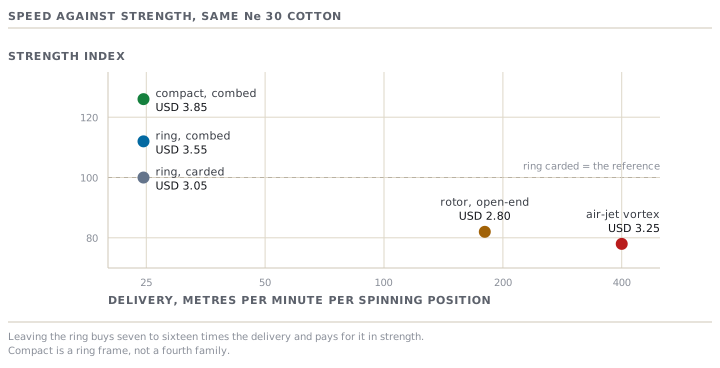
| Route | Delivery per position | Strength vs ring | Hairiness | Evenness, CV percent | Price at Ne 30 |
|---|---|---|---|---|---|
| Ring, carded | 24.6 m/min | 100 | High | 12.5 | USD 3.05 |
| Ring, combed | 24.6 m/min | 112 | Medium | 10.8 | USD 3.55 |
| Compact, combed | 24.6 m/min | 126 | Low | 10.2 | USD 3.85 |
| Rotor, open-end | 180 m/min | 82 | Low | 9.8 | USD 2.80 |
| Air-jet vortex | 400 m/min | 78 | Very low | 10.5 | USD 3.25 |
Read the delivery column first, because it explains the price column. A ring spindle at Ne 30 delivers 24.6 metres a minute. That number is not a machine setting. It comes from the twist. Delivery is spindle speed divided by turns per inch: 18,000 rpm at 18.6 turns per inch gives 968 inches a minute, which is 24.6 m/min. A rotor runs seven times faster. A vortex spindle runs sixteen times faster. Both skip the roving frame entirely. Speed is the whole commercial argument for leaving the ring.
Ring is the oldest route and the reference. Fibres are stretched out, twisted at a small triangle under the front roller, and wound onto a bobbin by a traveller circling a ring. It makes the strongest yarn at a given count, the best feel in the hand, and the widest range of counts — Ne 4 to Ne 120 and beyond. It is also the slowest. And every kilo has to be rewound afterwards, to cut out faults and join the bobbins together.
Rotor, still called open-end, feeds a sliver straight in. An opening roller pulls it back into single fibres. The fibres are thrown down a duct into the groove of a rotor turning at 100,000 to 130,000 rpm, and a twisted yarn peels off continuously. No roving, no rewinding — the yarn comes off ready on a package. The economics are excellent below about Ne 20. They get harder above Ne 30, because the rotor groove has too few fibres in the cross-section to hold together. The yarn is more even than ring yarn but 15 to 20 percent weaker, because some fibres wrap around the outside of the strand like a belt instead of lying in the body of it. It is bulkier, it dyes deeper on the same recipe, and it feels drier and harsher. Denim weft, terry towels, fleece, workwear and socks are its home.
Air-jet and vortex use compressed air instead of mechanical twist. A bundle of fibres passes through a nozzle. The leading ends are held while the trailing ends are blown open and wrapped around the core. It is the fastest of all. It gives the lowest hairiness of any route, and it pills far less than ring yarn. But it is weaker in pure cotton, and it feels lean and papery. It is at its best on polyester and polyester-rich blends.
Compact is not a fourth family. It is a ring frame with a suction zone that gathers the ribbon of fibres together just before the twist triangle. With the triangle gone, almost every fibre ends up bound into the yarn. The result is 10 to 15 percent stronger, 30 to 50 percent less hairy. And — the point most merchandisers miss — it holds together at a lower twist. That is how you buy a strong yarn and a soft fabric at the same time.
Prompt · Audit the yarn line on a fabric spec
Before a fabric spec leaves your desk, when the yarn line says something like "100 percent cotton, Ne 30/1" and you want to know what it has failed to say.
Act as a senior yarn technologist in a knitting and garment factory. Here is the yarn line from a fabric specification exactly as written: [PASTE THE LINE]. The fabric it belongs to is [KNIT OR WOVEN, CONSTRUCTION], target weight [GSM] g/m2, finished width [CM] cm, and the garment is [GARMENT] for [BUYER] at FOB USD [PRICE]. Order quantity [QTY] pcs, estimated yarn requirement [KG] kg. Do the following. First, list every property this line leaves undecided that the spinner will therefore decide for me: carded or combed, spinning route, twist multiplier, twist direction, whether the cones are steam-set, ply and resultant count, contamination and evenness class. Second, for each undecided property, tell me which way a spinner optimising for their own yield and machine efficiency will decide it, and what that costs me in the finished garment. Third, write the corrected yarn line as a single sentence I can paste into the spec. Fourth, estimate the price per kilo of the corrected specification against the price of the line as written, and the difference in dollars across [KG] kg and per garment. Do not invent a property the fabric does not need: if a choice genuinely does not matter for this garment, say so and say why.
AI can make mistakes — check anything you act on.
Check yourselfA spinner offers you Ne 40/1 open-end at USD 2.65 a kilo, well under any ring quote you hold, for a fine-gauge single jersey. What do you ask before you take it?Show the answer
Ask whether they are really spinning Ne 40 on a rotor, and ask to test it. Rotor spinning gets harder as the count gets finer, because the yarn cross-section in the rotor groove runs out of fibres to hold on to. Ne 30 is already at the difficult end. Ne 40 is beyond where most rotor lines run reliably. Expect a yarn 15 to 20 percent weaker than the ring equivalent. On a fine gauge machine that weakness shows up as end-breaks in knitting, and as a fabric that is bulkier and dyes deeper than the shade you approved. The price is real. So is the reason for it.
Check yourselfYour customer approved a compact combed sample. Purchasing want to save USD 0.30 a kilo by moving to combed ring. Where will that show first?Show the answer
In hairiness and in pilling — and only after the garment has been worn. The dyeing will match. The strength will pass. The fabric weight and the day-one feel will be close enough that nobody objects at the fit session. Then the tee comes back from the consumer's third wash with a fuzzed surface at the underarm and the collar. On 6,200 kg that saving is USD 1,860, against an order that sells for USD 76,800 — a quarter of a percent of revenue, bought with the one property the customer actually noticed.